

Last updated: 16 October 2026 · By Naijatipsland Editorial Team · Editorial policy
“Is forex trading legal in Nigeria?” is one of the most searched money questions in the country, and the honest answer has two parts. Trading currencies online as an individual is not banned. But running a forex platform or brokerage aimed at Nigerians without registering with the Securities and Exchange Commission (SEC) is an offence under the Investments and Securities Act 2025, and in September 2026 the SEC published draft rules that would tighten the market a lot. This guide explains what is legal, what has changed, what the draft rules would mean for you, how forex scams work, and how to check a broker before you deposit money. It is general information, not financial, legal or tax advice.
The short answer
- Individuals: No Nigerian law we found bans an individual from trading currencies online. A March 2026 Daily Trust guide says the same, and adds that online retail forex has little local supervision, so most Nigerians use offshore brokers at their own risk.
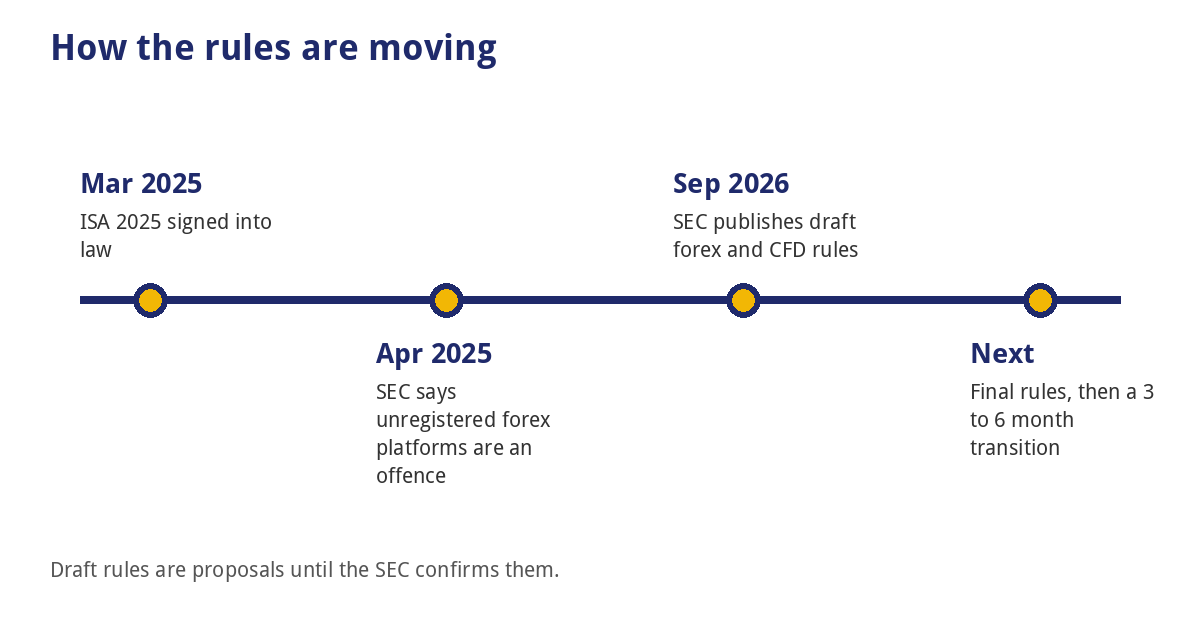
- Platforms and brokers: In April 2025 the SEC said that it is an offence for any entity not registered by the commission to operate online forex trading platforms or related services under the Investments and Securities Act (ISA) 2025.
- New draft rules (September 2026): The SEC proposed a licensing regime for online forex and contracts for difference (CFDs). These are proposals and are not yet in force.
- Safety: Legal does not mean safe. Leverage magnifies losses, many beginners lose money, and fake “account managers” and signal groups are common.
What the law and the SEC actually say
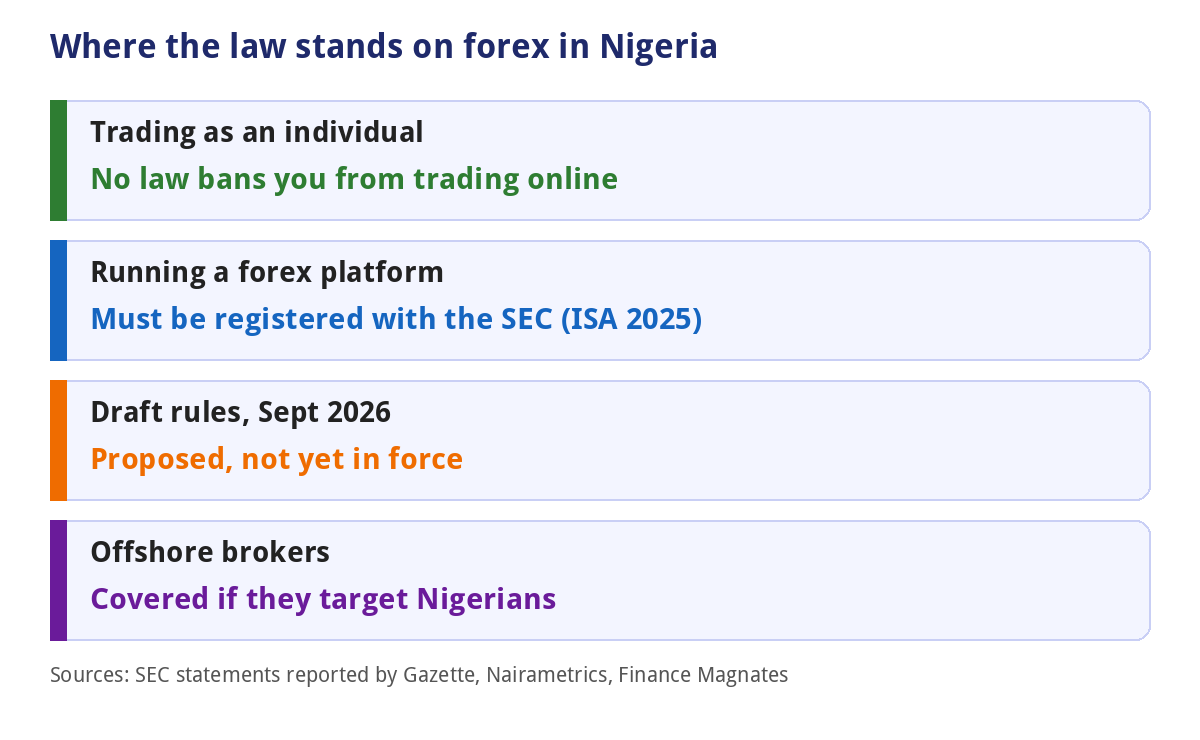
The ISA 2025 was signed by President Tinubu in March 2025 and replaced the 2007 Act. Days later the SEC issued a statement, reported by Peoples Gazette and NAN on 13 April 2025, saying that digital asset exchanges and online forex trading platforms must be registered with the commission, and that operating without registration is an offence. The statement refers to entities and businesses. It does not say that an individual who trades through a broker is committing an offence, and reports of it did not state penalties.
The Central Bank of Nigeria (CBN) separately regulates the foreign exchange market in Nigeria, including banks and authorised dealers. Forex trading in this article means speculating on currency price moves through an online broker, which is different from buying dollars for school fees or travel. For that, see our guide to the official and black market dollar rate.
The September 2026 draft rules
On 1 September 2026 the SEC released draft rules for online forex trading and CFDs, reported by Nairametrics and Finance Magnates. Nairametrics says the rules are not yet in force. According to those reports, the proposals include:
- Licence categories: online forex broker or broker dealer, introducing broker, and technology or platform provider.
- Capital: N3 billion paid-up capital for market-making (B-book) brokers, N2 billion for STP, ECN and A-book brokers, and N5 billion for platform providers. Introducing brokers would need N150 million (companies) or N30 million (individuals).
- Offshore brokers: Brokers outside Nigeria would be covered if they list Nigeria as a supported country, let Nigerians open accounts, market locally through affiliates or influencers, or have local representatives or support. Finance Magnates reports that those without the right licence would be treated as illegal operators.
- Leverage for retail clients: up to 1:400 on major pairs, 1:300 on minor and exotic pairs and index and commodity CFDs, and 1:2 on crypto.
- Binary options: prohibited for retail clients.
- Client protection: client money in segregated accounts at CBN-licensed banks, negative-balance protection, mandatory close-out when equity falls to 50% of required margin, monthly disclosure of the percentage of retail accounts that lose money, and an investor protection fund.
- Promotions: bonuses, trading contests and referral incentives would be banned, and adverts and influencer promotions would need SEC approval.
- Naira pairs: brokers could not offer naira currency pairs without prior SEC approval.
- Transition: existing operators would get three months after the rules take effect to apply and six months to comply.
Reports do not say whether individual traders would need a licence; the rules focus on operators. Because these are drafts, details may change, so check the SEC’s website before relying on any figure above.
Why “legal” does not mean “safe”
- Leverage cuts both ways. At 1:100, a 1% move against you wipes out your whole stake.
- Most beginners lose money. Overtrading, too much leverage and expecting quick results are the usual reasons.
- There may be no local protection. If an offshore broker refuses to pay you, Nigerian regulators may not be able to help, which is part of why the SEC wants offshore brokers that target Nigerians to be licensed.
- The broker can be the risk. Some brokers run a dealing desk (B-book), taking the other side of your trade.
- Transfers and fees. Funding usually means a dollar card or crypto. See our guides to a dollar virtual card and to buying Bitcoin and USDT, and watch charges.
How forex and trading scams work in Nigeria
- The “account manager”. Someone takes your deposit, promises weekly returns and then loses or keeps the money.
- The signal group. A Telegram or WhatsApp group shows early wins, then pressures members to deposit into a specific (often fake) platform.
- The guaranteed-return platform. This is the classic Ponzi scheme. The SEC’s case against CBEX, a crypto platform that claimed AI-powered trading and, according to the SEC, guaranteed 100% returns in 30 days, alleges it operated unregistered and collapsed. Investigations and victims’ accounts suggest as much as N1.3 trillion may have been lost, an estimate and not a confirmed figure. CBEX was a crypto platform, not a forex one, but the pattern is identical.
- The fake broker. A site that looks real, shows fake profits, then blocks withdrawals or asks for a “tax” or “release fee”.
- The influencer lifestyle. Posts of cars and cash, with a link to a broker that pays the influencer. The draft rules would restrict this kind of promotion.
The SEC’s warning in April 2025 on Ponzi risks named guaranteed or unusually high returns with little or no risk, and unregistered platforms offering crypto, forex or blockchain-based investments, as red flags. Its advice was to do due diligence, check registration status on the SEC website, and report suspected schemes. Our guides to internet scams and online safety cover the wider picture.
How to check a broker before you deposit
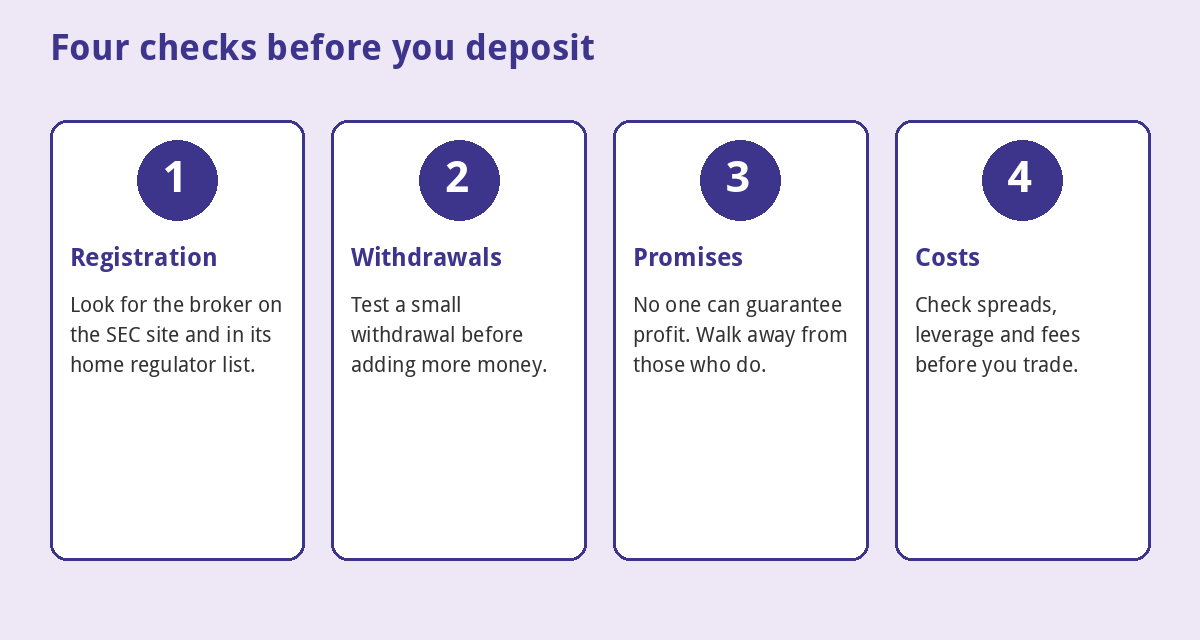
- Search the SEC website for the company’s name. If it is not registered, treat it as high risk, whatever its adverts say.
- Find its home regulator on its own site and confirm the licence number on the regulator’s register, not through a link the broker gives you.
- Read the terms on fees, spreads, leverage, bonuses and withdrawal conditions. Bonuses often lock your money.
- Test a withdrawal with a small amount before adding more.
- Refuse anyone who manages your money or promises returns.
- Use a demo account first and trade only money you can afford to lose.
- Do not rely on awards and rankings. Many broker “reviews” are paid promotions, including some in major publications.
Tax on forex profits
Under the Nigeria Tax Act 2025, profits from any trade, business or profession are taxable, and the first N800,000 of annual income is taxed at 0%, with progressive rates above that. How forex profits from an offshore broker are treated depends on your circumstances, for example whether it is a business or an occasional activity. Get advice from a tax professional, make sure you have a tax identification number, and see our guide to personal income tax bands.
Common mistakes
- Treating forex as a quick way to get rich.
- Using high leverage on a small account.
- Trusting a signal group or “manager”.
- Depositing with a broker you have not checked.
- Chasing losses by adding more money.
- Borrowing money or using rent or school fees to trade.
- Ignoring the tax position.
Frequently asked questions
Is forex trading legal in Nigeria?
For individuals, no law we found bans it, but operating a forex platform without SEC registration is an offence under ISA 2025, and the SEC’s draft rules, not yet in force, would add a full licensing regime.
Is forex trading a scam?
Forex itself is a real market, but it is risky, and the space is full of scams such as fake managers, guaranteed-return platforms and fake brokers.
Does the SEC regulate forex in Nigeria?
The SEC says forex trading platforms must be registered with it under ISA 2025 and has proposed detailed rules. The CBN regulates the wider foreign exchange market.
Can I trade forex with a foreign broker?
Many Nigerians do. Under the draft rules, foreign brokers that target Nigerians would be expected to be licensed, so check the position when the rules are finalised.
Are binary options allowed?
The draft rules would prohibit them for retail clients. Treat them with extra caution.
How do I report a forex scam?
Report suspected schemes to the SEC, and to the police or the EFCC. If you paid by card or transfer, tell your bank at once. Our guide to cybercrime laws explains the legal side.
How much money do I need to start?
Brokers set their own minimums. Start small with money you can afford to lose, and use a demo account first.
Bottom line
Individual forex trading is not banned in Nigeria, but the rules for platforms are tightening and the risks are high. Treat any promise of guaranteed profit as a scam, check that a broker is registered, test withdrawals with small amounts and never hand your money to someone else to trade. Watch the SEC’s website for the final forex rules.
Sources
- Peoples Gazette (NAN): ISA 2025 bans unregistered digital asset exchanges and online forex platforms (13 Apr 2025)
- Nairametrics: SEC proposes N3 billion minimum capital for forex brokers (2 Sep 2026)
- Finance Magnates: Nigeria axes binary options in new FX and CFD rules (3 Sep 2026)
- Daily Trust: Forex trading in Nigeria 2026, is it legal, profitable and safe? (12 Mar 2026) (contains broker promotion)
- Arise: SEC issues warning on growing Ponzi investment risks (25 Apr 2025)
- Techeconomy: CBEX, SEC orders freeze of accounts over Ponzi scheme probe (11 Dec 2025)
- Mondaq: Understanding personal income tax under the Nigeria Tax Act 2025
Related: Ponzi schemes in Nigeria: warning signs before you invest
Join the discussion
Have you tried this, or do you have a question we did not answer? 4 readers have already shared their views. Naijatipsland members help each other with real, first-hand experience.





The leverage point deserves repeating. At 1:100, a 1% move against you can wipe out your whole stake. If you trade, what leverage do you use, and what did losses teach you?
The SEC’s draft rules would ban bonuses and trading contests and require approval for influencer adverts. Would you trust a broker more if it were licensed in Nigeria, or does it make no difference to you?
No Nigerian law we found bans individuals from trading currencies online, but the SEC says it is an offence for unregistered entities to operate online forex platforms. Legal doesn’t mean safe, so how do you check a broker before you trust it?
The SEC proposed a licensing regime for online forex and CFDs in September 2026. These are proposals and not yet in force. Would licensing make you trust local brokers more than offshore ones?