Last updated: 16 October 2026 · By Naijatipsland Editorial Team · Editorial policy
A remote job that pays in dollars can change a Nigerian household’s budget, which is exactly why so many people chase one and why so many scammers pretend to offer one. The real market exists: Nigerians work remotely as customer support agents, virtual assistants, writers, designers, analysts and developers for companies abroad. It is also competitive, it asks for strong written English and reliable internet, and since January 2026 the money you earn is part of a new tax picture. This guide explains where remote jobs are posted, which skills tend to sell, what pay ranges are being quoted, how Nigerians actually receive dollars, what the tax rules mean, and how to avoid the scams.
The lists of platforms, the payment options and the pay ranges come from Nigerian and international guides dated 2025 and 2026. Several are independent sites with no cited data, and some contradict each other, so we flag where a number is an estimate rather than a measured figure. Fees, platform availability and tax rules change, so check each service’s current terms before you rely on them. This is general information, not financial, tax or legal advice.
The short answer
- There are three ways in: remote job boards for full-time or contract roles, freelance marketplaces such as Upwork and Fiverr, and vetted talent networks such as Toptal and Turing. LinkedIn and employers’ own career pages sit across all three.
- Entry-level roles such as customer support and virtual assistance are the most accessible. One 2026 guide quotes roughly US$5 to US$15 an hour, while a second puts customer support at US$400 to US$1,500 a month. Neither cites survey data.
- Getting paid: Payoneer is the common route for Upwork and Fiverr. Dollar-account apps such as Grey, Raenest and Cleva give USD, GBP or EUR account details, and Nigerian banks offer domiciliary accounts. Wise’s dollar transfers to Nigeria were reported as suspended in 2022.
- Tax: From January 2026, reports say Nigerian-resident remote workers and freelancers are taxed on income wherever it arises, and a foreign client will not withhold tax for you, so you must register and file yourself.
- Never pay to get a remote job, never receive and forward money for an employer, and never buy equipment from a vendor an employer names. Those are the standard scam moves.
Where remote jobs are posted

Remote job boards
Boards list full-time and contract roles from companies that hire remotely. A June 2025 Zikoko list named We Work Remotely, Remote OK, Remotive, JustRemote and Jobspresso, plus Wellfound for startups. Most let you browse without signing up. Always check each listing for a location restriction, because many remote jobs are open only to people in certain countries or time zones. Remotive lets you filter by time zone, which helps you avoid night shifts.
Freelance marketplaces
Upwork, Fiverr, Contra, Outsourcely and PeoplePerHour connect you directly with clients. One June 2026 guide says Upwork charges tiered fees of 20%, 10% and then 5% depending on how much you bill a client, and Fiverr takes a flat 20% commission, while Contra charges no commission. Treat these figures as a snapshot and confirm them on the platforms. Marketplaces are the easiest place to start because you can take small jobs first and build reviews, but you compete with freelancers all over the world.
Vetted talent networks
Toptal, Turing and Arc screen developers, designers and other specialists. Toptal’s acceptance rate is stated at about 3%, with an English test, skills assessment and live screening, and sometimes a paid test project. They suit people with proven experience. If you are new, build a track record on a marketplace first.
LinkedIn and company career pages
Set LinkedIn to Open to Work with remote selected, use keywords such as remote and worldwide, and follow companies that hire globally. When you see a job you like, find it on the employer’s own careers page too. That also protects you from fakes: see how to spot fake job ads in Nigeria.
Skills that sell
Remote work is mostly written. The skill every guide stresses first is clear written English for Slack, email and documentation. After that, the demand sits with role-specific tools and skills:
- Customer support: Zendesk, Intercom or Freshdesk, plus patience and speed.
- Admin and virtual assistance: Google Workspace or Microsoft 365, scheduling and inbox management.
- Data: Excel or Google Sheets, SQL, and Python for analyst roles.
- Design: Figma, Canva and a portfolio. Dribbble Jobs lets companies recruit from your work.
- Software: JavaScript, Python, React, Node.js, with GitHub as your proof.
- Marketing and content: SEO, Google and Meta ads, email marketing and writing samples. Free Google and Meta training and certificates exist, as one guide notes.
If you are choosing a skill, look at demand in the boards above, not just at income claims. Our guide to the digital skills checklist for Nigerian professionals and skills in demand in 2026 can help you pick.
What remote jobs pay: treat the numbers as estimates
Pay depends on the role, the client and whether you are an employee or a contractor. The ranges below are from two 2026 guides that cite no survey data, so use them only as a rough guide:
- Customer support: about US$400 to US$1,500 a month in one guide, or US$5 to US$15 an hour in another for entry-level support or virtual assistance.
- Virtual assistant: about US$400 to US$1,200 a month.
- Data analyst: about US$500 to US$2,000 a month, with mid-level analysts and developers up to US$2,000 to US$6,000.
- Content writer: from under US$20 an article for generalist work to several hundred dollars for specialist content.
- UI/UX designer and software developer: from the low thousands to much more for experienced engineers.
A figure like US$3,000 a month is possible for strong developers and specialists. It is not what a beginner should expect in the first months. Ask any client for the rate in writing, and ask whether it is an hourly, monthly or per-project rate.
A realistic way to start
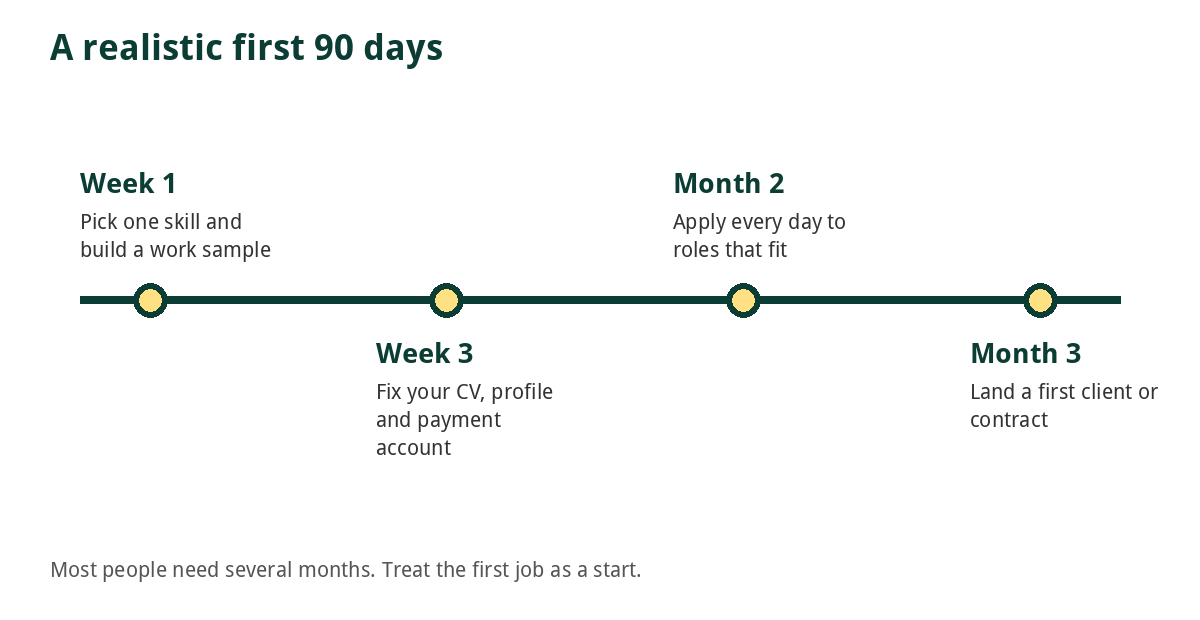
- Pick one skill and one role. Customer support, virtual assistance, writing, design, data or development. Learning five things badly is worse than one thing well.
- Build proof. A writing sample, a Figma file, a GitHub project, a short case study. Clients hire evidence.
- Fix your profile and CV. Keep it to one or two pages with measurable results. See how to write a CV for Nigerian jobs.
- Set up your payment account before your first interview. You will be asked how you want to be paid.
- Apply consistently. One guide suggests 5 to 10 applications a day. Quality matters more than volume, so tailor each application.
- Prepare for the interview. Use specific stories and practise on video. Our interview tips and common interview questions apply to remote roles too.
- Take a first small job. It gives you a review, a reference and a rate to build on.
Be honest about the competition. Rejection is normal, and nobody can honestly promise you an offer within a set number of weeks.
Practical issues: time zones, internet and contracts
- Time zones. US roles can mean evenings or nights in Nigeria. One guide says US Eastern Time is five to six hours behind Nigeria, and some support roles use night or rotating shifts. Check the required hours before you accept.
- Power and data. A backup for electricity and a second internet line are not luxuries if a client expects you on a call. Our USSD codes guide and Airtel data plans guide can help you plan data.
- Employee or contractor. Many remote roles for Nigerians are contractor roles, not salaried employment. Some employers use an employer-of-record service such as Deel or Remote to run payroll. Ask who pays you, in what currency, how often, who covers the transfer fees, what the notice period is and what happens if you are not paid. Get it in writing.
- One client risk. Relying on one client for all income is fragile. Aim for a second source as soon as you can.
How to get paid in dollars
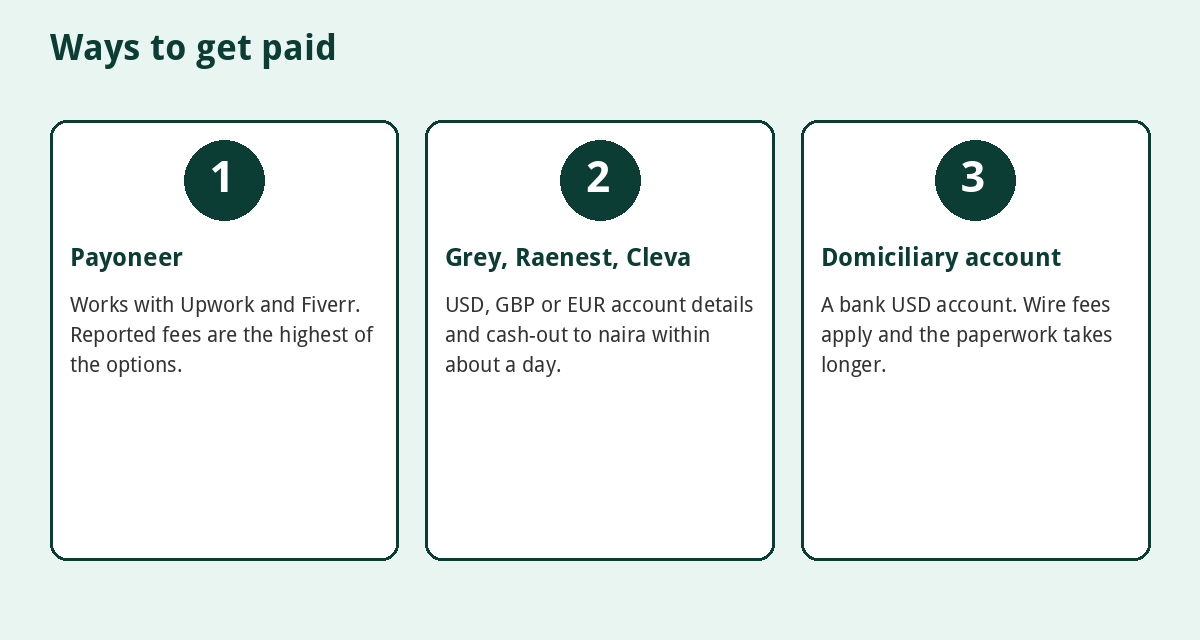
A May 2026 comparison and other guides describe the main options. Fees change, so check the live rates before moving large sums.
- Payoneer. Available in Nigeria and built into Upwork and Fiverr. The comparison reports a 1% receiving fee, a conversion markup of up to 4.5%, a withdrawal fee of up to 3% and an annual fee for low-volume accounts, which makes it the most expensive of the options for large amounts. Its strength is marketplace payouts.
- Grey. Gives USD, GBP and EUR account details in your name and a virtual dollar card. The same comparison reports about 0.8% on incoming ACH payments (capped at US$10) and 1% on conversion (capped at US$6), with naira cash-out in up to a day. It does not pay directly from Upwork or Fiverr, so marketplace money usually goes through Payoneer first.
- Raenest (formerly Geegpay) and Cleva. Offer similar USD, GBP and EUR account details, with fee structures that include free monthly deposits or promotions. Check the current terms in the app.
- Domiciliary account. A Nigerian bank USD account is useful for wires from employers. It needs paperwork, and bank wire fees are higher. See how to open a domiciliary account in Nigeria.
- Wise. One guide reports that dollar transfers to Nigeria were suspended in November 2022, with only GBP-to-naira payouts working. If your client pays in pounds, it may help. If they pay in dollars, it will not.
- PayPal. Described as restricted in Nigeria. Do not build your income on it without checking the current rules.
Whatever you use, keep records of every payment: invoices, contracts and screenshots. You will need them for tax and for proving where your money came from. Compare transfer costs using our guide to bank transfer charges in Nigeria, and see how to get a dollar virtual card if you need to pay for tools.
Tax on remote income
Reports from late 2025 say that from January 2026 Nigerian-resident remote workers and freelancers pay income tax like other earners, and that residents are taxed on income wherever it arises. Foreign clients cannot withhold Nigerian tax for you, so you have to register with the tax authority, self-assess and file a return yourself. One 2026 guide says the first N800,000 of annual income is tax-free, that rent relief is 20% of rent up to N500,000, that pension, housing fund and health insurance contributions are deductible, that business expenses such as data, software and equipment can be deducted if you can prove they relate to your work, and that foreign income should be converted to naira at the official CBN rate on the date you receive it. It also lists penalties for late registration, late filing and false declarations.
Guides differ on which tax office you register with and on exact deadlines, so confirm with the tax authority or a qualified tax professional. For the bands and how they work for employees, read personal income tax in Nigeria 2026 and how to get a Tax Identification Number. Keep your income records tidy from day one.
Scams to avoid
- Pay-to-apply. A fee for a training kit, a software licence, a background check or a slot is a stop sign. See how to spot fake job ads.
- The fake cheque. An employer sends a cheque or transfer for more than the agreed amount and asks you to send the difference to a vendor. The original payment later bounces, and you lose your own money.
- Receive and forward money. Being asked to move money through your account for a company can make you part of a crime.
- The equipment vendor. A job that requires you to buy a laptop from a specific seller, with a promise of reimbursement.
- Chat-only hiring. A job offered over WhatsApp or Telegram with no video interview, no contract and no company email.
- Too good to be true. A high salary for no experience, or instant hiring.
- Requests for sensitive details early. Do not send your BVN, bank login or ID scans before a verified offer. See digital identity in Nigeria and how to avoid internet scams.
Check the company, ask for a video call and read the contract. If something feels rushed, it probably is.
Frequently asked questions
Can I get a remote job with no experience?
Entry-level support, virtual assistance, data entry and content roles exist, but you will still need clear writing, a working computer and proof of ability. Expect competition and low early pay.
Do I need a degree?
Many remote employers care more about a portfolio, tests and references than a degree, but some roles and visa-sponsored jobs do ask for one.
Which payment method is the cheapest?
It depends on how the client pays and how much. For marketplace jobs, Payoneer is usually the practical route even though it is costlier. For direct clients, dollar-account apps are often cheaper. Compare live fees.
Do I have to pay tax on dollars earned abroad?
Reports say Nigerian residents are taxed on worldwide income from 2026. Register, keep records and consult a tax professional.
Is it safe to share my bank details?
Share them only after you have verified the employer, signed a contract and chosen a payment route you control. Never give your card PIN or online banking login to anyone.
How long does it take to land the first job?
It varies widely. Treat any promise of a fixed timeline as marketing.
Bottom line
Remote dollar income is real but it is built, not found: choose one skill, show proof, apply every day, set up a payment account early, read every contract, record every payment and plan for tax. Start with the boards and networks above, ignore anyone who asks you to pay or to move money for them, and treat the first job as the start of a track record, not the finish line.
Sources
- Zikoko: 15 remote job platforms Nigerians use to earn in dollars (June 2025)
- WithinNigeria: Best remote work websites for Nigerians (June 2026)
- Turnet Finance (independent site): How to get a remote job that pays in dollars (June 2026)
- Turnet Finance (independent site): How to receive dollar payments in Nigeria (May 2026)
- TechCabal: The taxman is coming for Nigeria’s remote workers (September 2025)
- Cleva (company blog): Nigeria tax reform 2026 for freelancers and remote workers