
Last updated: 14 October 2026. Tournament schedules and results change, and some details of the domestic league were not available in the sources we reviewed. Results shown are confirmed to mid-September 2026. Check the NFF and CAF for the latest. We replaced an earlier version that had outdated information.
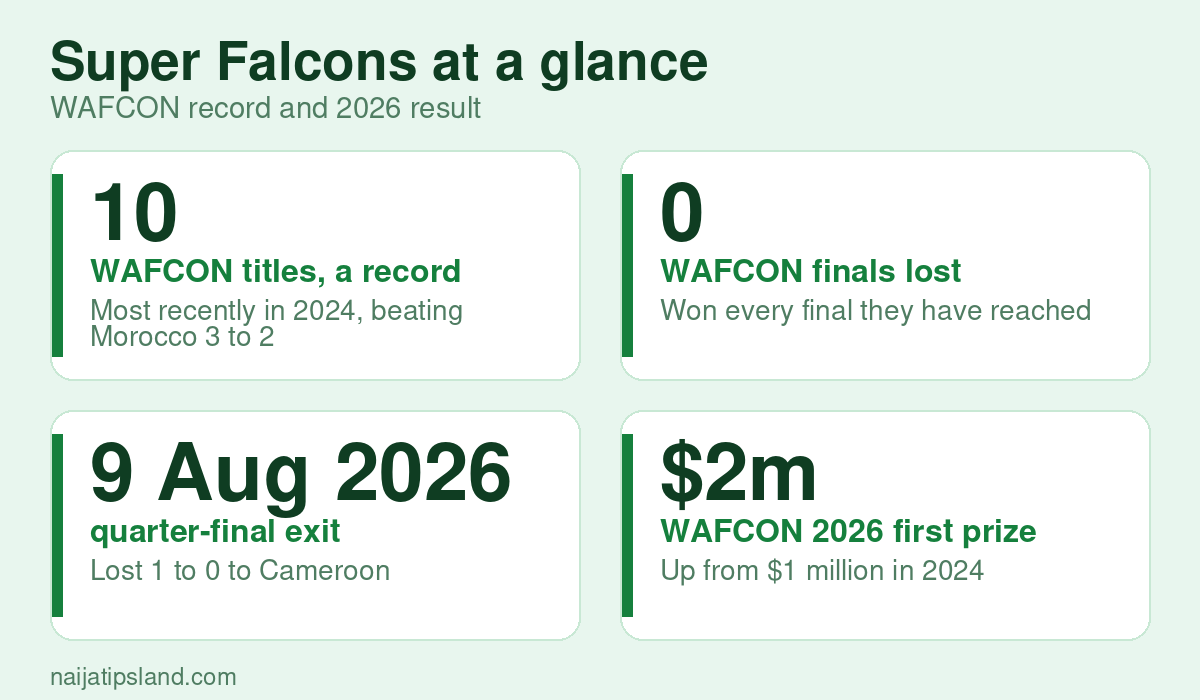
Nigeria’s Super Falcons are the most successful team in the history of the Women’s Africa Cup of Nations (WAFCON). They have won a record ten titles, in 1998, 2000, 2002, 2004, 2006, 2010, 2014, 2016, 2018 and 2024, and have never lost a WAFCON final. Only Equatorial Guinea (twice) and South Africa (once) have ever broken their grip on the trophy.
The 2024 triumph
Nigeria won its tenth title in Morocco, beating the hosts 3 to 2 in a thrilling final in Rabat after crushing Zambia 5 to 0 in the quarter-final. CAF paid the Super Falcons $1 million, the biggest prize in WAFCON history at that time, and the Nigerian government added national honours, houses and $100,000 for the players and officials. By comparison, the winners of the men’s 2025 Africa Cup of Nations were to receive $10 million, which fuels the debate about pay and investment in women’s football.
The 2026 tournament
The 2026 WAFCON, again hosted by Morocco, expanded to a record 16 teams and offered a first prize of $2 million. The semi-finalists qualified automatically for the 2027 FIFA Women’s World Cup in Brazil, while quarter-final losers had another chance through intercontinental play-offs. Nigeria, drawn in a group with Malawi, Zambia and Egypt, began on 28 July, but on 9 August the defending champions lost 1 to 0 to Cameroon in the quarter-final, courtesy of a free-kick, ending hopes of automatic qualification. Cameroon qualified directly for the World Cup, and Nigeria must go through the play-offs to reach Brazil.
People behind the team
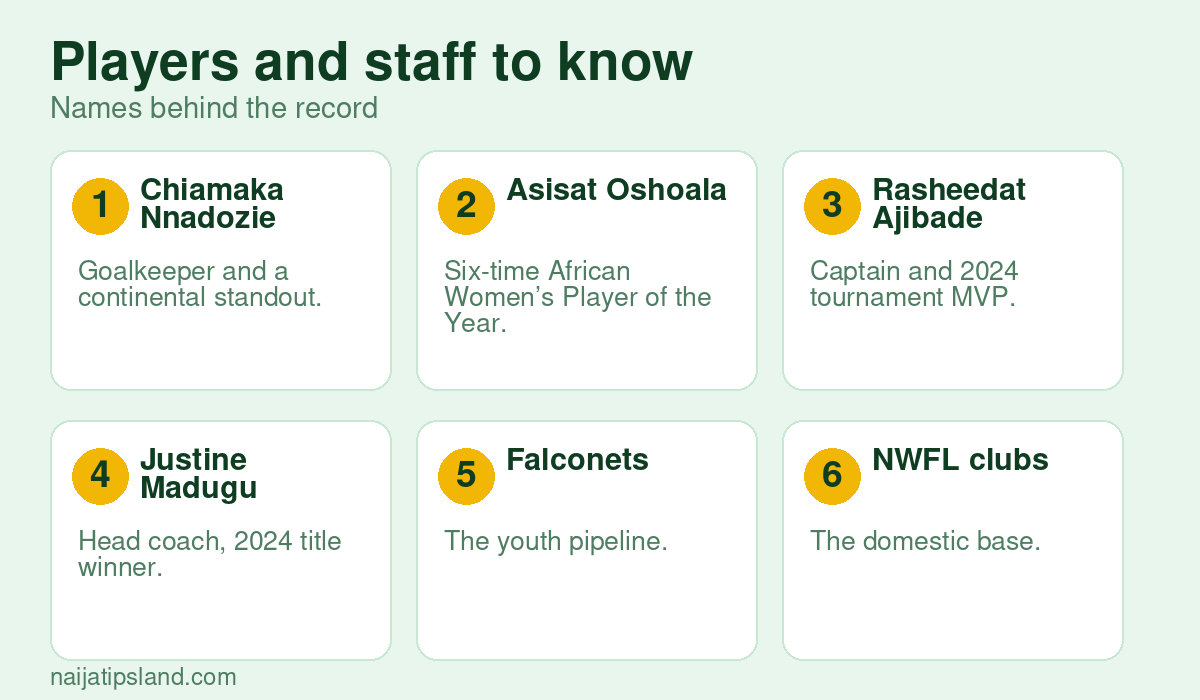
- Chiamaka Nnadozie, widely regarded as one of the continent’s finest goalkeepers.
- Asisat Oshoala, a six-time African Women’s Player of the Year.
- Rasheedat Ajibade, the captain and most valuable player of the 2024 tournament.
- Justine Madugu, the head coach who guided Nigeria to the 2024 title after a long career in the national team set-up.
The youth and the future
The Falconets, Nigeria’s youth team, are an important pipeline. At the 2026 Under-20 Women’s World Cup in Poland, the Falconets lost 2 to 0 to Spain, drew 0 to 0 with China, beat New Caledonia 10 to 1 and then beat England 3 to 0 in the round of 16 on 17 September. They went out in the quarter-final against Colombia after a stoppage-time goal. Strong youth teams, academies and a competitive domestic league are what sustain the senior side over time.
The domestic game
The Nigeria Women Football League runs the top-flight clubs that supply the national team. Like many women’s leagues, it faces challenges: limited sponsorship and broadcast, uneven facilities, and travel and pay problems. Fans who follow the league and attend matches help the sport grow. See our guide to watching the Super Eagles for how to find broadcasts and fixtures.
Why it matters
- Representation and opportunity: girls who see women succeed in sport are more likely to play and to stay in school.
- Economic value: sponsorship, coaching and media jobs depend on a healthy game. See our guides on entertainment and culture and earning money online.
- National pride: the Super Falcons have often outperformed the men’s team in results.
How to support women’s football
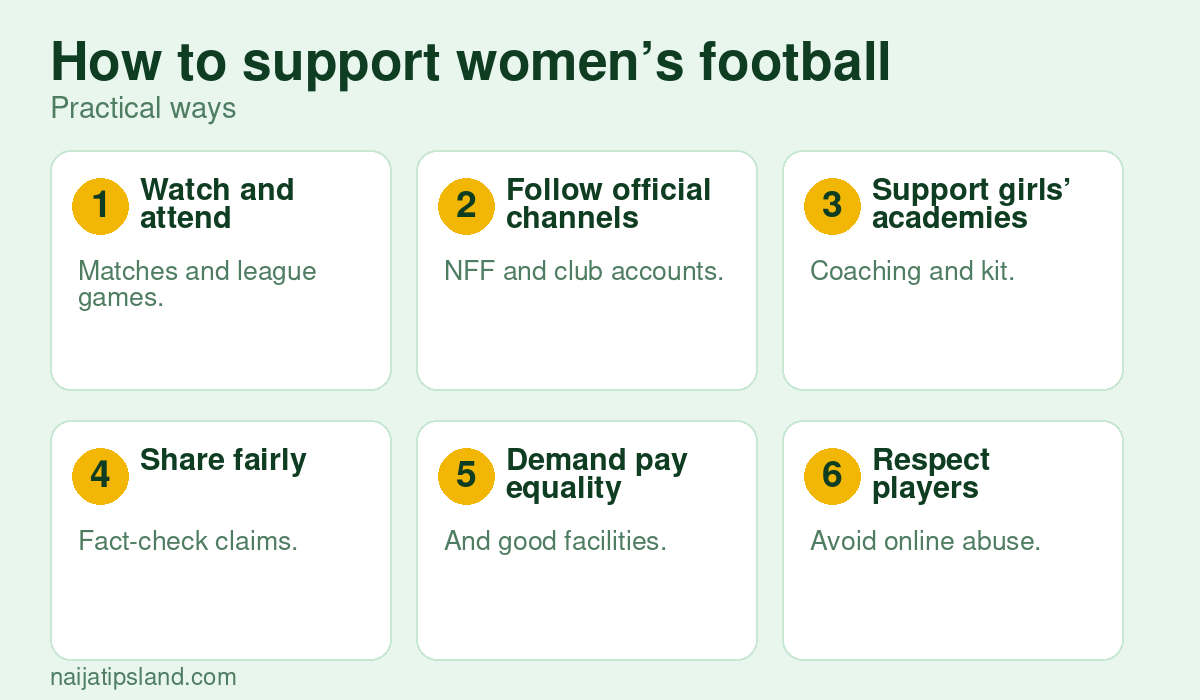
- Watch and attend matches, and follow official NFF and club accounts.
- Support girls’ academies, school teams and coaching programmes.
- Check claims about transfers and results before sharing. See verifying news.
- Call for fair pay, safe facilities and good governance.
- Respect players online, and avoid abuse. See our guide on cyberbullying.
The Domestic Game and Youth Pipeline
The league, school competitions and academies feed the national teams. The Falconets’ run to the 2026 Under-20 World Cup quarter-finals shows the depth of talent, but results depend on funding, coaching and match experience. Better facilities, regular fixtures and clear career paths for players, coaches and referees are the long-term answer.
How to Support Girls in Football
- Encourage girls to play, and help with kit and transport.
- Attend local matches and share results fairly.
- Challenge stereotypes and online abuse. See cyberbullying.
What Comes Next
The Super Falcons now face the play-off route to the 2027 Women’s World Cup, and the men’s team is working through AFCON qualifiers. See how to watch the Super Eagles.
Frequently Asked Questions
How many WAFCON titles have the Super Falcons won?
Ten, a record, most recently in 2024.
Did Nigeria win WAFCON 2026?
No. Nigeria lost 1 to 0 to Cameroon in the quarter-final on 9 August 2026.
Can Nigeria still qualify for the 2027 Women’s World Cup?
Yes, through the intercontinental play-offs, according to reports after the quarter-final loss.
Sources
- Sahara Reporters: Defending champions Super Falcons crash out of WAFCON
- allAfrica: WAFCON 2026, Super Falcons to open title defence against Zambia, Egypt and Malawi
- BellaNaija: 10 WAFCON titles, every Super Falcons triumph
- SuperSport (AFP): WAFCON favourites Nigeria eye World Cup slot and record prize money
- VON: Super Falcons set to defend WAFCON crown
- Leadership: Super Falcons eye historic 11th crown as 2026 WAFCON kicks off
Join the discussion
Have you tried this, or do you have a question we did not answer? Be the first to share your experience. Leave a comment below. Every comment is read by the editor before it appears.