

Last updated 16 November 2026. Recipes change from family to family and from city to city, so this article describes what cooks in each country most often do.
Ask a Nigerian and a Ghanaian who makes the better jollof and you will start an argument that has been running on radio, television and social media for years. Before you pick a side, it helps to know what the actual differences are. Some are real and easy to taste. Others are habits that vary so much between households that the national labels stop meaning much.
Here is what the food writers, cooks and reference sources agree on, where they disagree, and how to cook each version well at home.
Where jollof comes from
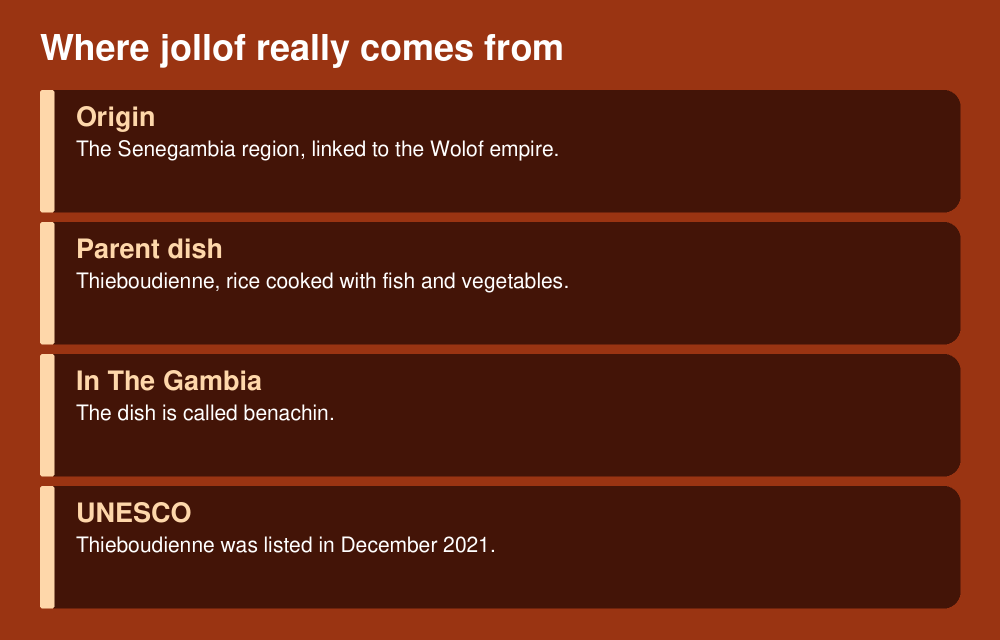
Neither Nigeria nor Ghana invented the dish. According to Britannica, jollof rice most likely started in the Senegambia region, in what is now Senegal and The Gambia, and was probably first cooked in the 14th century in the Wolof empire. It descends from thieboudienne, a Senegalese dish of rice cooked with fish and vegetables. The word jollof is a variant spelling of Jolof, the name of a major Wolof state. In The Gambia, the same style of dish is called benachin.
Thieboudienne was added to UNESCO’s list of intangible cultural heritage in December 2021, after a request from Senegal’s Ministry of Culture. Senegal and The Gambia have mostly stayed out of the Nigeria and Ghana debate, which says something about how seriously the two bigger rivals take it.
The rice
This is the clearest split. Nigerian jollof is normally made with long-grain parboiled rice. Parboiled grains are firm and hold their shape through a long cook, which is why a Nigerian party pot can sit on the fire for a while without turning to paste. Some Nigerian cooks wash the rice twice to remove loose starch before it goes in.
Ghanaian jollof is usually made with a more fragrant rice, either Thai jasmine or basmati. One cooking site describes Ghanaian cooks avoiding parboiled rice altogether, saying it turns soggy. Jasmine rice brings its own scent to the pot, and it also cooks quickly, so a Ghanaian pot needs more watching. One recipe author warns that jasmine goes from cooked to mushy fast, which is why many cooks seal the pot with foil and keep the heat low.
For reference, Britannica lists the wider pattern across West Africa: broken jasmine in Senegal, parboiled rice in Nigeria and long-grain jasmine in Ghana.
The tomato and pepper base
Both versions start the same way. Tomatoes, peppers and onions are blended, then fried in oil until the raw taste cooks off and the oil rises to the top. After that, the two styles drift apart.
Nigerian cooks tend to build the sauce around red bell peppers and scotch bonnet, with tomato paste and sliced fresh tomatoes added for body. Pulse Nigeria sums up the difference by saying Nigerians favour pepper, while Ghanaians favour the tomato flavour. The same article says Ghanaian cooks sometimes add a little sugar or honey to balance the tang of the tomato.
In one side-by-side recipe, the Ghanaian pot gets fresh ginger and garlic blended into the pepper mix, and fewer peppers overall. That matches what most Ghanaian cooks describe: the base is a bit sweeter and more aromatic, and the heat comes from the scotch bonnet and from condiments served on the side.
Spices and seasoning
Nigerian jollof is usually seasoned with curry powder, dried thyme, bay leaves and stock cubes. Bay leaf gets special mention from Demand Africa, which credits it for much of the smoky richness. Many Nigerian cooks also add white pepper.
Ghanaian jollof is often described as the more heavily spiced of the two. Pulse Nigeria lists ginger, garlic, nutmeg, rosemary and anise. The recipe I compared uses nutmeg where the Nigerian version uses thyme, along with curry powder and bay leaf in both. Shito, the dark Ghanaian condiment made from hot pepper, ginger, shrimp and onion, is often stirred in or served alongside.
On heat, the sources disagree. Pulse says Nigerians favour pepper. Demand Africa calls the Ghanaian version the spicier one. Both can be true, depending on the cook and whether you count the shito. I would not trust anyone who claims one country always cooks hotter.
Party jollof and the smoky bottom
If there is one thing that Nigerian jollof has become famous for, it is party jollof. At weddings, birthdays and funerals, the rice is cooked in a huge pot over firewood. The bottom layer is allowed to catch and char slightly, and that scorched edge gives the whole pot its smoky flavour. Britannica notes that celebration rices across the region are cooked over live flames, with a crusty bottom layer, so the idea is not unique to Nigeria. But Nigerian party jollof is the version most people overseas know.
Ghanaian jollof is generally described as less smoky, even at parties. Demand Africa says there is no firewood party version in Ghana. Cooks at home who want some of that character in a regular kitchen can use a heavy stainless steel pot and let a thin layer of rice stick and darken at the end, as one recipe author suggests. Do it carefully, because there is a fine line between smoky and burnt.
What goes on the plate
Nigerian jollof is typically served with fried chicken or beef, fried plantain, Nigerian salad, coleslaw and moimoi. Ghanaian jollof is usually served with shito, fried plantain, grilled or fried fish or chicken, and sometimes a simple salad of cabbage and carrots. Plantain is the one thing both tables agree on.
Side by side
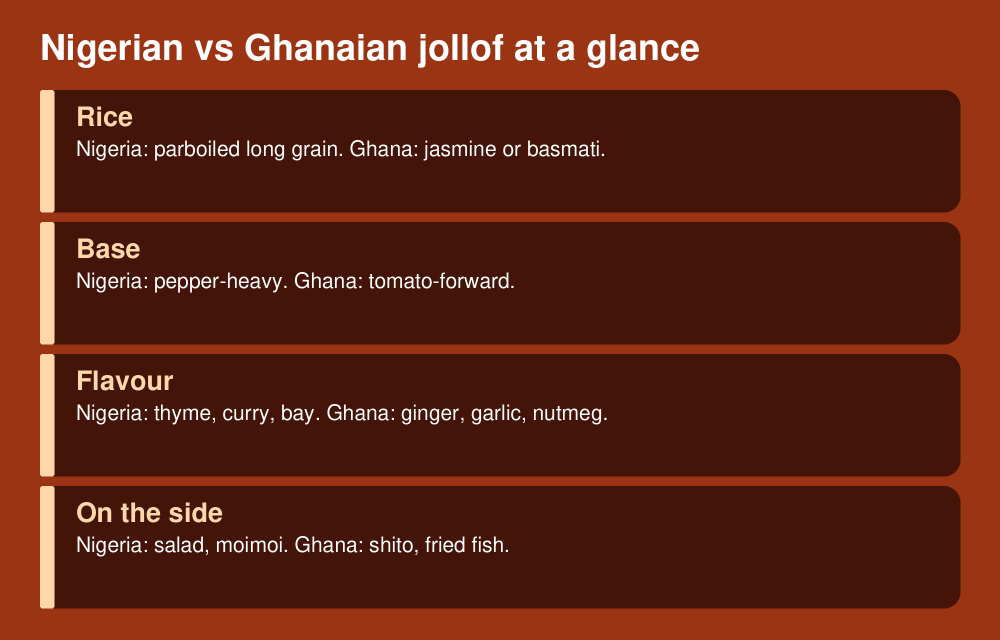
| Feature | Nigerian jollof | Ghanaian jollof |
|---|---|---|
| Usual rice | Long-grain parboiled | Jasmine or basmati |
| Base | Pepper and tomato, pepper leading | Tomato leading, with ginger and garlic |
| Typical seasoning | Curry, thyme, bay leaf | Curry, nutmeg, bay leaf, sometimes rosemary or anise |
| Smoky party style | Yes, cooked over firewood | Rare |
| Condiment | Rarely needed | Shito is common |
| Common sides | Salad, coleslaw, moimoi, plantain | Shito, plantain, fish or chicken |
How to tell them apart on the plate
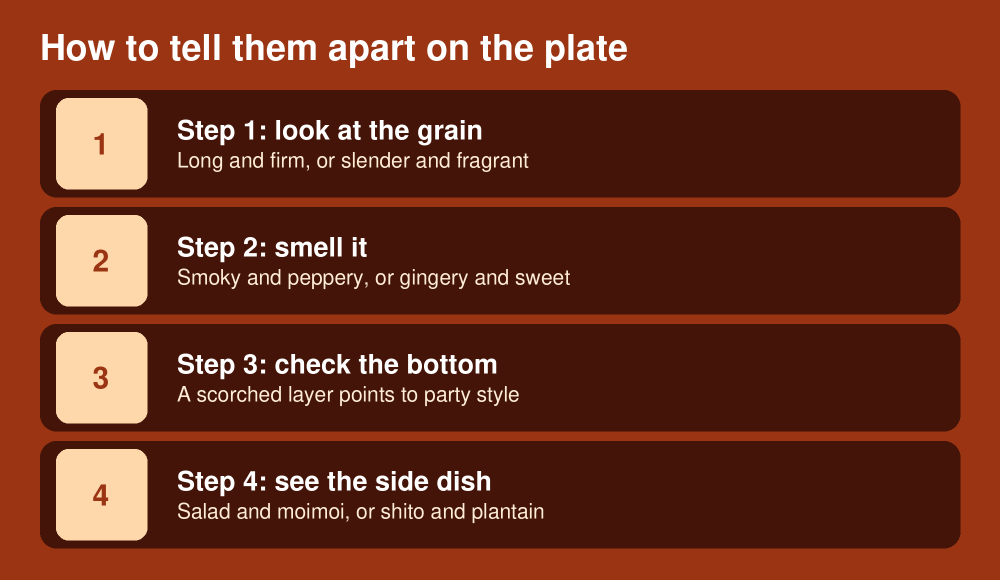
If you are served a plate with no label, the grain is the first clue. Parboiled rice looks long, separate and slightly golden. Jasmine looks slender and tends to clump a little more. The smell comes next: a smoky, peppery smell points to a Nigerian party pot, while a gingery, slightly sweet smell points to Ghana. The sides will usually settle it.
None of this is a strict test. Plenty of Nigerian cooks use basmati, plenty of Ghanaian cooks use long-grain rice, and plenty of diaspora cooks in the UK use whatever rice the shop has. The labels describe a tendency.
Cooking each one at home
For a Nigerian-style pot, wash parboiled rice until the water runs mostly clear, fry the blended pepper base until the oil separates, add stock and seasoning, then add the rice with enough liquid to just cover it. Cover tightly, cook on low heat and resist the urge to stir. If the rice is still firm when the liquid is gone, add a splash of hot water, seal the pot with foil and steam it for a few more minutes. Our step-by-step party jollof recipe walks through the full method.
For a Ghanaian-style pot, fry the tomato paste first, add the blended base with ginger and garlic, and cook it down well. Use jasmine rice with slightly less liquid, cover with foil under the lid and check early. Serve with shito and fried plantain.
If you live abroad and cannot find the exact rice, our guide to Nigerian foods you can cook abroad with local ingredients lists sensible substitutes. For more dishes to cook for guests, see Nigerian recipes foreigners will love.
The jollof wars
The rivalry is mostly good humour, though it has produced some memorable moments. In 2014, British chef Jamie Oliver published his own jollof recipe, and Nigerians and Ghanaians briefly united online to criticise it. The hashtag #JollofGate followed, with the line that Africans’ plates would not be colonised. The two countries did not stay on the same side for long.
Britannica notes that Nigeria and Ghana have had the most intense part of the debate, with Cameroon, Liberia and Sierra Leone also joining in. Food writer Renny Vonne has said that in 2024 no one’s jollof is better than another, because people prefer the version they grew up with. That is probably the most honest answer available.
So which one is better?
It depends on what you want. If you want a smoky, peppery pot for a big event, the Nigerian party style is hard to beat. If you want fragrant, gently spiced rice with a sweet tomato base, the Ghanaian style will suit you. Both are cooked by people who care about the pot, and the best jollof is usually the one cooked by someone who has made it a hundred times.
Related guide (updated 16 November 2026)
How to make ofada stew and ayamase is a step-by-step recipe for the green pepper stew, with notes on cooking ofada rice and buying the ingredients in the UK.
Frequently asked questions
What is the main difference between Nigerian and Ghanaian jollof?
The rice and the flavour. Nigerian jollof is usually made with long-grain parboiled rice and a pepper-led base, often with a smoky finish. Ghanaian jollof usually uses jasmine or basmati rice and a tomato-led base with ginger, garlic and nutmeg.
Who invented jollof rice?
Neither country. Britannica traces it to the Senegambia region and the Wolof empire, as a descendant of thieboudienne. Gambians call their version benachin.
Is Ghanaian jollof spicier than Nigerian jollof?
Sources disagree. Pulse Nigeria says Nigerians favour pepper, while Demand Africa calls the Ghanaian version spicier. Heat depends on the cook and on whether shito is added.
Why does Nigerian party jollof taste smoky?
It is cooked in a large pot over firewood, and the bottom layer is allowed to char slightly. That scorched layer gives the smoky flavour.
Which rice is best for jollof?
Long-grain parboiled rice is the usual choice for Nigerian jollof because it stays firm. Jasmine or basmati is common for Ghanaian jollof, but it cooks faster, so watch the pot.
Can I make smoky jollof without firewood?
Not exactly, but you can come close. Use a heavy pot and let a thin layer of rice stick and darken at the end of cooking, then stir it through. Stop before it tastes burnt.
Is there a World Jollof Day?
Yes, jollof lovers mark World Jollof Day each August, usually with friendly arguments online about whose pot is best.
Sources
- Britannica: Jollof rice
- Pulse Nigeria: 5 ways Ghanaian jollof is different from Nigerian jollof
- Demand Africa: Know the differences between Nigerian and Ghanaian jollof rice
- Eat Well Abi: Jollof rice two ways, Nigerian and Ghanaian
- theGrio: It’s World Jollof Day. Who gets to claim West Africa’s best-known dish?
- Quartz Africa: Senegal’s thieboudienne listed as UNESCO cultural heritage









Editor’s note: cooks in both countries will tell you their way is the right one, so treat this as a guide to common habits and not a rulebook. If your family cooks it differently, tell us in the comments. – Ade