


TL;DR:
- Nigeria uses a hybrid voter registration system combining online pre-registration with in-person biometric capture.
- Eligible Nigerians must register at designated centers, bringing valid ID documents and booking appointments online.
- After registration, voters verify their details and collect their Permanent Voter Cards to participate in elections.
Many Nigerians miss their chance to vote not because they don’t care, but because the registration process feels confusing and overwhelming. Long queues, unclear requirements, and missed deadlines push people away from exercising one of their most important civic rights. Whether you’re a first-time voter or someone looking to update your details before the next election, this guide breaks everything down clearly. You’ll learn exactly how Nigeria’s voter registration system works, what documents you need, how to complete the process from start to finish, and how to collect your Permanent Voter Card (PVC). Start early and stay informed.
Table of Contents
- Understanding the voter registration system in Nigeria
- Eligibility and requirements for voter registration
- How to register: Step-by-step voter enrollment procedure
- After registration: Verification, corrections, and getting your PVC
- Why the hybrid voter registration model is Nigeria’s best option
- Take your civic engagement further
- Frequently asked questions
Key Takeaways
| Point | Details |
|---|---|
| Hybrid process required | You must complete both online and in-person steps to register as a voter in Nigeria. |
| Eligibility is strict | Only Nigerian citizens aged 18+ with valid credentials can register, and double registration is not allowed. |
| PVC collection is essential | After your registration is verified, collect your Permanent Voter Card at a designated center to participate in elections. |
| Register early to avoid issues | Start the process before peak periods to sidestep long queues and meet deadlines. |
Understanding the voter registration system in Nigeria
Now that you know what this guide covers, let’s start by clarifying how Nigeria’s voter registration system works and why it matters.
The Independent National Electoral Commission (INEC) is the body responsible for managing voter registration in Nigeria. INEC runs what is called the Continuous Voter Registration (CVR) program, which means registration is not limited to a single period before elections. Instead, it happens in structured phases throughout the year, giving more Nigerians the opportunity to get registered at a convenient time.
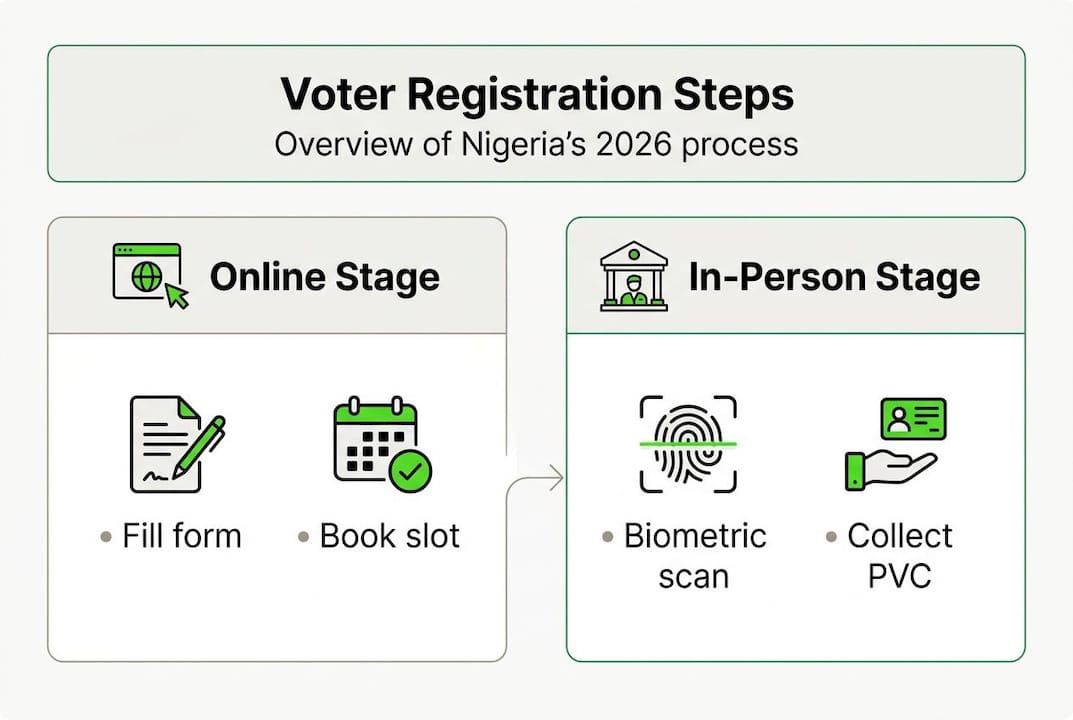
The CVR process is managed by INEC and involves online pre-registration followed by physical biometric capture. Biometric capture means your fingerprints and photograph are taken to confirm your identity and prevent duplicate registrations. This two-stage approach is what makes the system a hybrid model.
Here is a quick breakdown of how the current CVR phase is structured:
- Phase dates: The 2025 to 2026 CVR runs from August 18, 2025 to August 30, 2026
- Stage 1: Online pre-registration through the INEC portal
- Stage 2: Physical visit to an INEC registration center for biometric capture
- Outcome: A Temporary Voter Card (TVC) is issued after biometric capture, followed later by the PVC
| CVR stage | What happens | Where it happens |
|---|---|---|
| Online pre-registration | Fill form, upload documents, book appointment | INEC portal (online) |
| Biometric capture | Fingerprints and photo taken | INEC registration center |
| TVC issuance | Temporary card issued | Registration center |
| PVC collection | Permanent card collected | Designated INEC office |
“A credible voter register is the foundation of a credible election. Every eligible Nigerian who registers is strengthening democracy from the ground up.”
Understanding the influence of reforms on turnout helps you see why INEC’s hybrid model was designed this way. You can also follow INEC updates to stay current on registration windows and center locations near you.
Eligibility and requirements for voter registration
With the structure in mind, it’s vital to know if you’re eligible and what you need before you begin the process.
Not everyone can register, and knowing the rules upfront saves you time and frustration. Eligibility requires that you are a Nigerian citizen aged 18 or older on the day of registration, resident in Nigeria, not previously registered, and free from any legal incapacity that would disqualify you.
If you are already registered, you are not left out. First-time voters follow new registration; existing registrants can update their details, transfer their registration to a new location, or replace a lost or damaged card.
Here is a summary of the different registration types and what each requires:
| Registration type | Who it’s for | Key documents needed |
|---|---|---|
| New registration | First-time voters, 18+ | Proof of identity, age, and nationality |
| Update | Existing voters with changed info | Original TVC or PVC, proof of change |
| Transfer | Voters who moved to a new area | PVC, proof of new residence |
| PVC replacement | Lost or damaged card holders | Valid ID, affidavit of loss |
Accepted identity documents may include:
- National Identity Card or National Identification Number (NIN) slip
- International passport
- Birth certificate or age declaration
- Driver’s license
- Any other government-issued document accepted by INEC
For voting eligibility updates and any changes to accepted document formats, always check INEC’s official website before visiting a center.
Pro Tip: INEC occasionally updates the list of accepted identification formats. Confirm the current requirements on the INEC website before your appointment to avoid being turned away at the center.
How to register: Step-by-step voter enrollment procedure
Once you meet the eligibility criteria and have your documents ready, follow these steps to register efficiently.
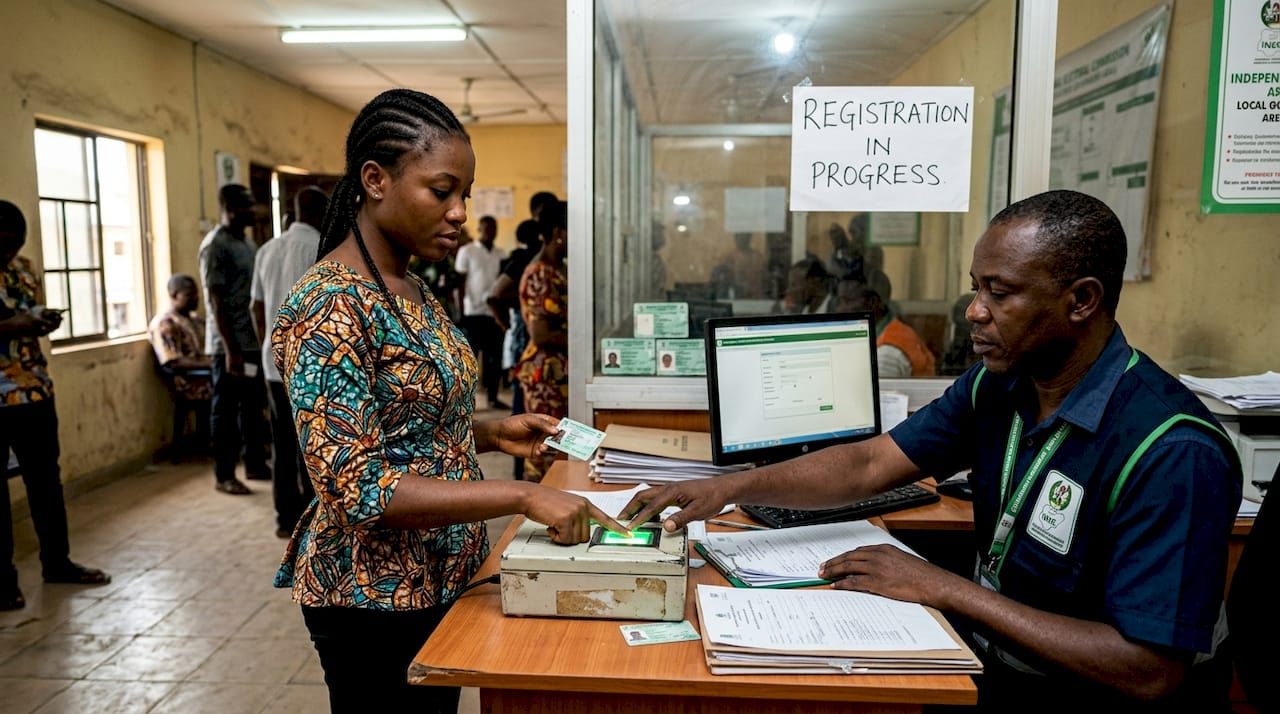
The registration process has two clear phases. Completing both is essential. Skipping the physical step means your registration is incomplete, and you will not receive a PVC.
Step 1: Online pre-registration
- Visit the official INEC self-service portal at irev.inecnigeria.org or the INEC main website
- Create an account using your valid email address and phone number
- Fill in your personal details accurately, including your full name, date of birth, state of origin, and residential address
- Upload a clear passport photograph if required
- Select your preferred registration center and book an appointment date
- Save or print your confirmation slip, which you will present at the center
Step 2: Physical visit for biometric capture
- Arrive at your chosen INEC registration center on your appointment date
- Bring your confirmation slip, original identity documents, and any supporting materials
- Join the queue and wait to be attended to by an INEC officer
- Have your fingerprints scanned and photograph taken
- Collect your Temporary Voter Card (TVC) after biometric capture is complete
The registration process blends online pre-registration with in-person biometric capture to protect the integrity of the voter register. This is why both steps are mandatory.
| Step | Online | Physical center |
|---|---|---|
| Fill personal details | Yes | No |
| Book appointment | Yes | No |
| Biometric capture | No | Yes |
| Receive TVC | No | Yes |
Pro Tip: Book your appointment for early morning on a weekday. Centers tend to be less crowded, and INEC officers are fresher and faster at the start of the day. Avoid Mondays and days immediately after public holidays.
Citizens have also raised calls for stronger safeguards in the registration process, which shows how important it is for you to engage and hold the system accountable.
After registration: Verification, corrections, and getting your PVC
Having completed the registration steps, the final stage is verification and collecting your all-important voter card.
After biometric capture, INEC does not immediately issue your PVC. There is a verification period where the voter register is made available for public inspection. This is your opportunity to confirm your details are correct and raise any concerns.
After registration, INEC displays the register for claims and objections, and PVC collection takes place at designated centers with your TVC.
Here is what the post-registration process looks like:
- Display of register: INEC publicly displays the voter register at local government offices and registration centers for a set number of days
- Check your details: Visit your registration center or check online through digital verification efforts to confirm your name, photo, and details are correct
- File a claim or objection: If your information is wrong or missing, submit a formal claim at the INEC office with supporting documents
- PVC collection: Once the verification window closes and your record is confirmed, collect your PVC at the designated center using your TVC as proof
- Lost TVC: If you lose your TVC before collecting your PVC, report to your registration center with a valid ID and follow INEC’s retrieval procedure
Common reasons details may be wrong include data entry errors during online pre-registration or biometric capture issues. Always double-check your confirmation slip at the center before leaving.
“Your voter card is more than a piece of plastic. It is your formal declaration that you are a participant in Nigeria’s democratic process. Keeping your registration accurate and current is a civic responsibility.”
Key things to bring when collecting your PVC:
- Your Temporary Voter Card (TVC)
- A valid form of identification
- Your appointment confirmation if applicable
Why the hybrid voter registration model is Nigeria’s best option
The debate around whether Nigeria should move to a fully digital voter registration system is understandable, but it misses some important ground realities.
A fully online registration system would exclude millions of Nigerians who live in areas with poor internet connectivity or who lack smartphones and digital literacy. On the other hand, a purely physical system creates long queues, geographic barriers, and higher costs for both INEC and registrants. The hybrid process improves access while ensuring that the physical biometric visit preserves the integrity of the register.
What INEC gets right is the principle: use technology to reduce paperwork and queues at the front end, then use physical verification to prevent fraud at the back end. The challenge is execution. Connectivity issues, understaffed centers, and long waits have frustrated many registrants during previous CVR phases. These are real problems that need addressing.
Progress is happening, though. You can track Nigerian democracy progress to understand how reforms are gradually improving the system. The hybrid model is not perfect, but it is the most realistic path forward for a country as large and diverse as Nigeria.
Pro Tip: If you know neighbors or family members who lack internet access, help them complete the online pre-registration step. Civic participation grows when communities support each other through the process.
Take your civic engagement further
Getting your PVC is a major step, but it is only the beginning of your civic journey. Staying informed about candidates, policies, and electoral developments is just as important as being registered.

Naijatipsland.com is your go-to community for everything happening in Nigerian politics, elections, and public affairs. Explore how internet communities in Nigeria are shaping civic conversations, or learn the basics of starting online discussions around issues that matter to you. If you’re new to online forums, our guide to online discussions for Nigerians will help you get started. Your voice matters beyond the ballot box.
Frequently asked questions
What is the duration of the voter registration exercise in Nigeria?
The CVR runs in phases from August 18, 2025 to August 30, 2026, giving eligible Nigerians over a year to complete registration across multiple windows.
Can I register online only, without visiting a center?
No. Online pre-registration is just the first step. A physical biometric capture at an INEC center is required to complete your registration and receive your TVC.
What documents are accepted for voter registration in Nigeria?
You may need to present proof of identity, age, and nationality, such as a national ID card, international passport, driver’s license, or birth certificate.
How do I check if my registration has been successful?
INEC displays the register publicly for claims and objections after each registration phase, and you can also verify your status at your registration center or through INEC’s online portal.
If I lose my Temporary Voter Card (TVC), can I still get my PVC?
Yes. Report the loss to your INEC registration center and follow their retrieval procedures with a valid form of identification to still collect your PVC.