

Last updated: 3 November 2026 · By Naijatipsland Editorial Team · Editorial policy
Checked 3 November 2026. If you can teach a skill that helps people earn, pass an exam, save money or do their job better, you can package it as an online course. Nigerians are buying courses on everything from Excel and data analysis to baking, fashion design, forex risk management and relocation paperwork. You do not need a studio or a big budget, but you do need a clear topic, honest promises and a payment setup that works for both naira and dollar buyers. This guide covers how to choose and validate a course topic, record on a budget, which platforms to use and what they really charge, how to get paid through Paystack, Flutterwave and global platforms, pricing in naira and dollars, marketing, refunds, piracy and the legal and tax basics.
Courses are one type of digital product. If you are still deciding what to sell, start with our guide to the best digital products to sell online in Nigeria.
1. Choose a topic people will pay for
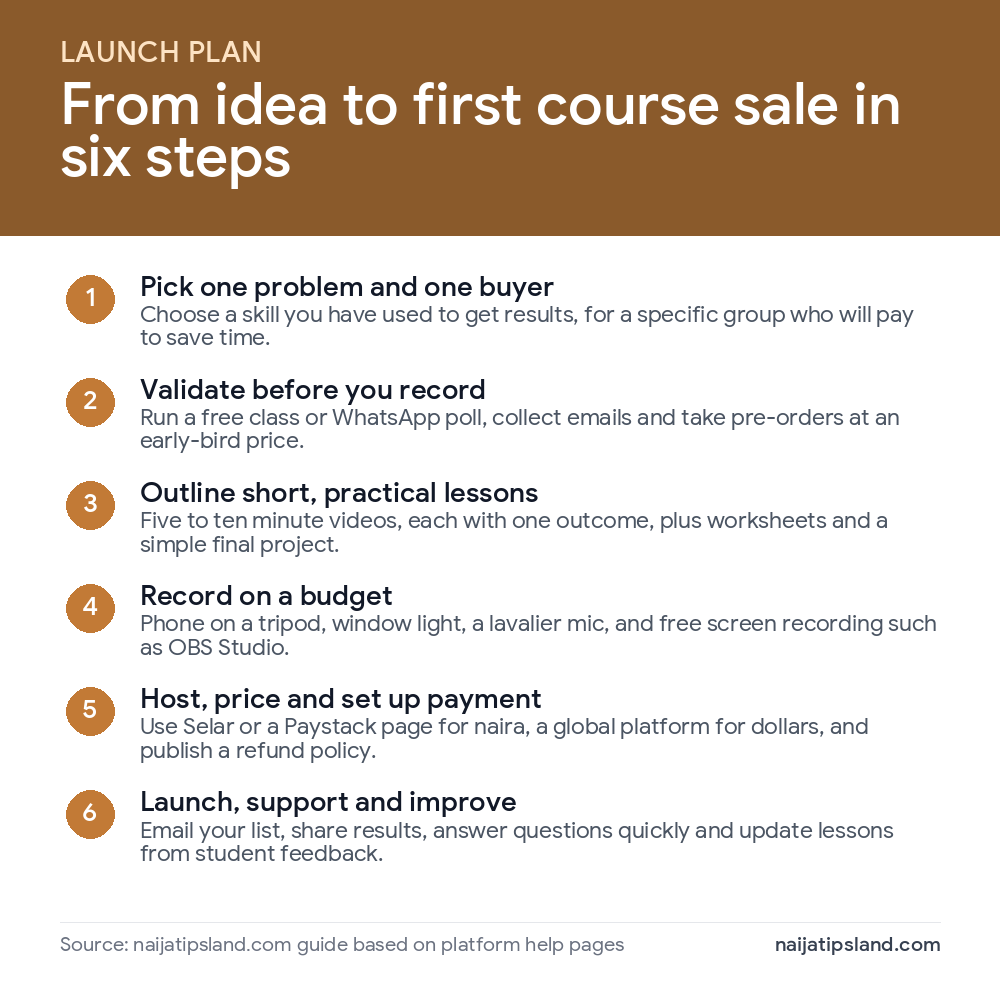
The best course topics sit where three things meet: a skill you have actually used to get results, a group of people with a painful or expensive problem, and a clear outcome you can describe in one sentence. “Learn Excel” is vague. “Build the five Excel reports Nigerian SME accountants are asked for every month” is a course.
- Skills with income attached: data analysis, UI design, copywriting, video editing, social media management, bookkeeping.
- Exam and certification prep: professional exams, language tests, school admissions.
- Practical crafts and businesses: baking, catering, tailoring, hair, make-up, photography.
- Processes people find confusing: visa and study applications, setting up a business, using specific software.
Avoid topics where you would need to promise income or investment returns. Courses on forex, crypto and “making millions” attract regulators’ attention and angry buyers if results do not come.
2. Validate demand before you record
The most expensive mistake is spending two months filming a course nobody buys. Test first:
- Host a free live class on WhatsApp, Telegram, Zoom or Google Meet and see how many people register and stay.
- Ask your audience which of three course ideas they would pay for, and at what price.
- Check what similar courses sell for on Selar, Udemy and other platforms, and read their reviews to spot gaps.
- Pre-sell: offer an early-bird price for a course that starts on a fixed date. If ten to twenty people pay, build it. If nobody pays, refund them and rethink.
3. Record on a budget
Students forgive simple video but not bad audio. A basic setup:
- Camera: a recent smartphone on a tripod, filming in landscape at 1080p.
- Microphone: a lavalier (clip-on) mic is the cheapest big upgrade. Record in a soft-furnished room and switch off fans if you can.
- Lighting: face a window in daylight, or use a ring light or soft-box. Avoid a bright window behind you.
- Screen recording: OBS Studio is free on Windows, Mac and Linux. Many phones and laptops also have built-in screen recorders.
- Editing: CapCut or Descript are enough; see our guide to AI tools for Nigerian content creators for prices.
- Power and data: charge everything before recording, keep a power bank or inverter, and upload on Wi-Fi or a night bundle.
Keep lessons short: five to ten minutes, one outcome each, with a worksheet, template or task. Students finish short lessons; they abandon long ones.
4. Course platforms and their real fees
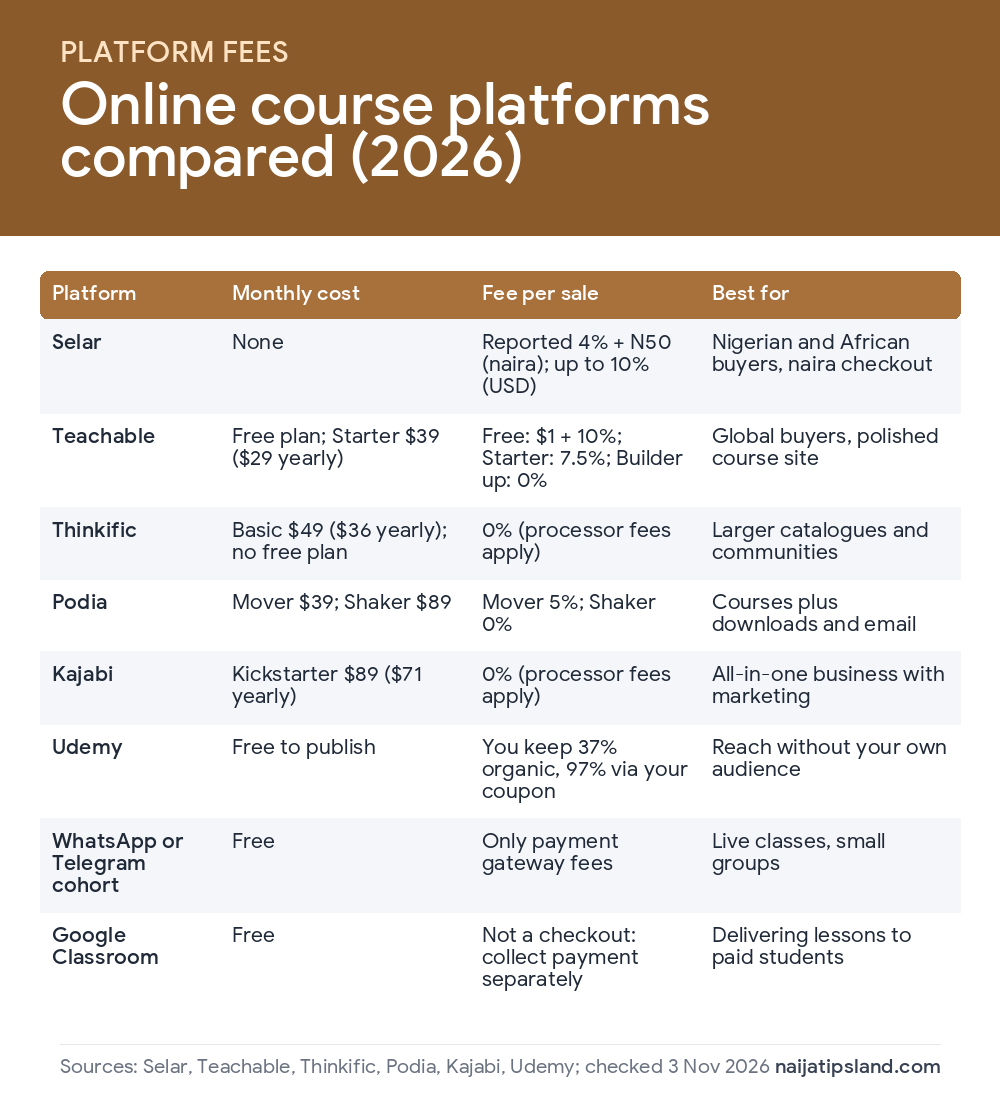
Your choice depends on who is buying. Nigerian buyers want to pay in naira by card, bank transfer or USSD. Buyers abroad expect a polished checkout in dollars or pounds.
| Platform | Monthly cost | Fee per sale | Good for |
|---|---|---|---|
| Selar | None | Reported 4% + ₦50 on naira sales; up to 10% on USD sales | Nigerian and African buyers, naira payments |
| Teachable | Free plan; Starter $39 ($29 a month yearly); Builder $89 ($69 yearly) | Free: $1 + 10%; Starter: 7.5%; Builder and above: 0% | Global buyers |
| Thinkific | Basic $49 ($36 yearly); no free plan | 0% platform fee; payment processor fees apply | Larger course catalogues |
| Podia | Mover $39; Shaker $89 (30-day trial, no free plan) | Mover 5%; Shaker 0% | Courses plus downloads and email |
| Kajabi | Kickstarter $89 ($71 yearly) | 0% platform fee; processor fees apply | All-in-one marketing and courses |
| Udemy | Free to publish | You keep 37% of organic marketplace sales, 97% of sales through your coupon or referral link | Reach without your own audience |
| WhatsApp or Telegram cohort | Free | Only your payment gateway’s fee | Live classes and small groups |
| Google Classroom | Free with a Google account | No checkout; collect payment separately | Delivering lessons to students who have paid |
Teachable, Thinkific, Podia and Kajabi prices are from 2026 pricing comparisons, and Udemy’s shares are from its instructor support page. Before you choose a global platform, check how it pays creators in Nigeria. Several rely on Stripe or PayPal, which have limited support for Nigeria-based sellers, so confirm the payout method and minimum before you build. Our guide to receiving international payments as a Nigerian explains Payoneer, Wise and domiciliary accounts.
The cohort model
Many successful Nigerian tutors start without a course platform: students pay through a Paystack or Flutterwave link, get added to a private WhatsApp or Telegram group, and attend live classes over four to eight weeks, with recordings shared after each session. It is cheap, personal and easy to sell. The downsides are that it does not scale, recordings are easy to forward, and you must manage group members manually. Google Classroom is a free way to organise lessons, assignments and files for paid students.
5. Getting paid: Paystack and Flutterwave
If you sell directly, a payment gateway lets students pay by card, bank transfer or USSD. Paystack’s support page lists these charges for Nigerian businesses:
- Local payments: 1.5% + ₦100, with the ₦100 waived on transactions under ₦2,500 and fees capped at ₦2,000 per transaction.
- International cards: 3.9% + ₦100 (American Express 4.5%).
Flutterwave was reported at 1.4% for local cards (capped at ₦2,000) and 3.8% for international payments in a 2024 review; check its current pricing page before you sign up. Both let you create payment pages and links without building a website, though a simple site on your own domain looks more professional; see our guide to cheap .ng domain registration.
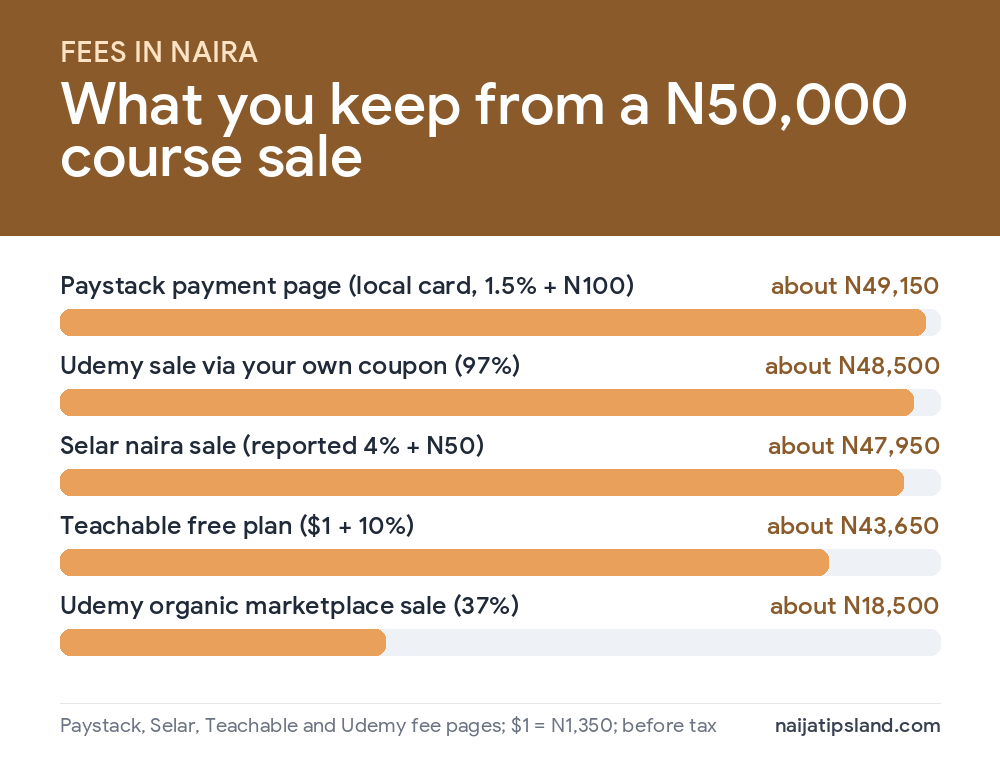
The chart shows why your own audience matters: on Udemy you keep 97% when the student uses your coupon, but only 37% when Udemy finds the student for you.
6. Pricing in naira and dollars
There is no single right price, but these principles help:
- Price the outcome, not the hours of video. A short course that helps someone land a job is worth more than a long general one.
- Check the market. Look at what comparable courses charge on Selar and in your niche, then position above or below for a reason.
- Use tiers: a self-paced version, a version with group support or live sessions, and a premium one-to-one option.
- Separate naira and dollar prices. Do not simply convert your naira price; buyers abroad often pay more, and conversion fees eat into small dollar sales.
- Early-bird discounts with a real deadline work better than permanent “90% off” banners.
7. Marketing your course
- Teach for free first: short tips on TikTok, Instagram, LinkedIn or a YouTube channel build trust. See how to start a YouTube channel in Nigeria.
- Build an email or WhatsApp broadcast list from free classes and downloadable checklists. Your list is the audience no algorithm can take away.
- Collect real testimonials with permission, and share student results honestly. Never invent reviews.
- Affiliates: Selar and several global platforms let others promote your course for a commission. Our guide to affiliate marketing in Nigeria with no money explains how affiliates work from the other side.
- Partnerships: offer a free session to a church group, alumni association, professional body or student union in exchange for a mention.
8. Refunds, piracy and protecting your course
Publish a clear refund policy before launch. Udemy, for example, offers students a 30-day refund window, which buyers now expect elsewhere too. A fair policy, such as a full refund within seven days if less than a quarter of the course has been watched, reduces disputes and chargebacks.
Piracy is common: courses get recorded and resold on Telegram. You cannot stop it completely, but you can reduce it:
- Host videos on a platform with logins rather than sending download links.
- Release lessons weekly (drip content) and keep the most valuable parts live or in community support.
- Add a subtle watermark with your name and website.
- Report pirated copies to the platform hosting them; most have copyright takedown forms.
- Keep updating the course, so the official version is always better than a stolen copy.
9. Legal and tax basics
- Register: a business name with the Corporate Affairs Commission (CAC) lets you open a business bank account and use a business name on Paystack or Flutterwave.
- Tax: under the Nigeria Tax Act, in force from 1 January 2026, individuals earning up to ₦800,000 a year are exempt from personal income tax, and small companies with turnover below ₦100 million and assets below ₦250 million are exempt from company income tax, as reported by The Guardian. Keep records of sales and expenses either way.
- Content rights: only use music, images and materials you have the right to use, and do not copy another tutor’s slides or videos.
- Honest claims: do not promise jobs, visas or income you cannot guarantee.
This is general information, not legal or tax advice; speak to an accountant as sales grow.
Mistakes to avoid
- Recording the whole course before anyone has paid.
- Making lessons too long and too theoretical.
- Choosing a global platform without checking it can pay you in Nigeria.
- Ignoring students after they pay; support is what earns referrals.
- Buying “done-for-you” course packs and reselling them as your own.
For the bigger picture on why learners choose online study, read our article on the advantages of e-learning, and for courses you can take yourself, see affordable tech courses for beginners in Nigeria.
Frequently asked questions
What is the best platform to sell online courses in Nigeria?
For Nigerian buyers paying in naira, Selar or a Paystack or Flutterwave payment page with a WhatsApp or Telegram group is simplest. For global buyers, Teachable, Thinkific, Podia or Kajabi, provided you can receive their payouts.
How much does it cost to start an online course?
You can start with a phone, a tripod, a cheap lavalier mic, free editing and screen-recording software, and a free platform or payment link. The main cost is your time.
Can Nigerians sell courses on Udemy?
Yes. Udemy is free to publish on. You keep 97% when a student buys through your coupon or referral link and 37% on organic marketplace sales.
How much should I charge for my course?
Base it on the outcome and on comparable courses in your niche. Offer tiers and set separate naira and dollar prices rather than converting one into the other.
How do I stop people sharing my course?
Use a login-protected platform, drip lessons weekly, watermark videos and keep live support or community access for paying students only.
Do I need to pay tax on course income?
Income is taxable, but under the 2026 rules individuals earning up to ₦800,000 a year are exempt from personal income tax. Keep records and ask an accountant once sales grow.
Disclaimer: platform prices and fees in this guide come from official help pages, 2026 pricing comparisons and news reports, checked on 3 November 2026. Fees change often and some figures are reported rather than confirmed by the platform. Nothing here is financial, legal or tax advice; confirm current terms before you choose a platform.







Editor’s note: pre-sell before you record. Run one free live class, offer an early-bird price with a fixed start date, and only build the full course once enough people have paid.