
How Nigerians Can Get Canada Permanent Residence in 2026: Express Entry, CRS Scores and Costs

Last updated: 15 November 2026 · By Naijatipsland Editorial Team · Editorial policy
Canada is one of the few countries where a skilled Nigerian can apply for permanent residence on merit, without a job offer. The main route is Express Entry, a points-based pool in which the government invites the highest-ranked candidates to apply. It rewards young, highly educated, English or French-fluent applicants and punishes weak language scores. This guide explains how it works, what scores recent draws needed, how much money you must show and what mistakes cost Nigerians the most. Checked 28 October 2026 and updated 15 November 2026. Draw scores and funds figures change often, so confirm everything on the official Canada.ca pages before acting.
How Express Entry works
You create an online profile, declare your age, education, language results, work experience and other details, and receive a Comprehensive Ranking System (CRS) score out of 1,270 (the maximum since 3 November 2026, up from 1,200). Immigration, Refugees and Citizenship Canada (IRCC) then holds regular draws and sends an Invitation to Apply (ITA) to candidates above that draw’s cut-off. If you are invited, you have a limited window to submit a complete application with documents. Your profile is not an application; it is only entry into the pool.
The three programmes inside Express Entry
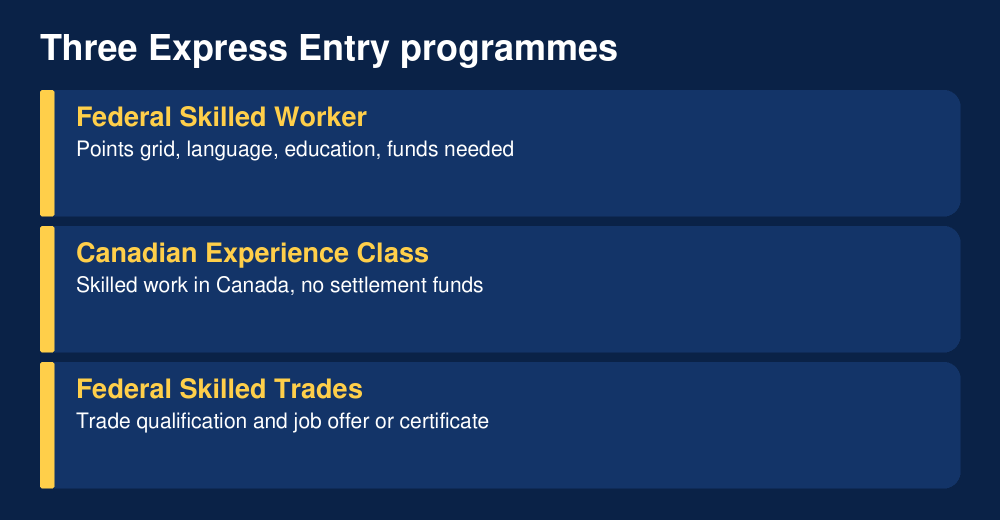
- Federal Skilled Worker (FSW): for skilled workers with foreign experience. You must also score enough on a separate eligibility grid (the pass mark has long been 67 out of 100), meet a minimum language level, hold a qualifying education credential and, unless exempt, show settlement funds.
- Canadian Experience Class (CEC): for people who already worked skilled jobs in Canada. It has no settlement funds requirement, which is why many Nigerians come first on a study permit and post-graduation work permit. See our Canada study permit guide and the cost of studying in Canada.
- Federal Skilled Trades (FST): for qualified tradespeople with a Canadian job offer or certificate of qualification.
How your CRS score is calculated after 3 November 2026
Updated 15 November 2026 from IRCC’s Comprehensive Ranking System (CRS) criteria page and its page on the 2026 changes. The numbers below are the official maximums; check the live IRCC page before you rely on them.
On 3 November 2026 IRCC added a new Labour Market Integration factor to the CRS. It replaced the old points for Canadian work experience and for job offers, and it lifted the maximum score from 1,200 to 1,270. The score is still built in four parts: core human capital factors, spouse or partner factors, skill transferability factors and additional points. If your spouse or partner is not coming with you, or is already a Canadian citizen or permanent resident, you are scored as a single applicant.
| Factor | Maximum without a spouse or partner | Maximum with a spouse or partner |
|---|---|---|
| Age | 110 | 100 |
| Level of education | 150 | 140 |
| Official languages (first and second) | 160 | 150 |
| Labour Market Integration factor (new) | 150 | 140 |
| Spouse or partner factors | Does not apply | 40 |
| Skill transferability factors | 100 | 100 |
| Additional points | 600 | 600 |
| Maximum total | 1,270 | 1,270 |
The new Labour Market Integration factor
IRCC works out two options and gives you whichever is higher. You cannot add them together.
- Option A, Canadian work experience: points for length of qualifying Canadian work (without a spouse: 40 for one year, 53 for two, 64 for three, 72 for four and 80 for five or more; with a spouse: 35, 46, 56, 63 and 70), plus extra points for at least 12 months in a high-wage occupation (70, 40 or 20).
- Option B, a qualifying job offer: 100, 70 or 50 points for a genuine offer in a high-wage occupation.
- Cap: 150 points without a spouse or partner, 140 with one.
A high-wage occupation is a National Occupational Classification (NOC) code whose median wage across Canada is at least 1.3 times the average median wage of the Canadian workforce. The three bands are at least twice the median (top points), at least 1.5 times and at least 1.3 times. It depends on the occupation, not on your own salary, and an offer in an occupation that is not on IRCC’s list earns no points.
The most important change for people applying from Nigeria is that a job offer no longer needs a Labour Market Impact Assessment (LMIA) to count, and having an LMIA gives no extra points. An officer still checks that the offer is genuine: that the employer is active, needs the position and can meet the terms, and that you are qualified. That makes the old “LMIA job for a fee” pitch even less believable. Nobody can sell you a valid offer, and a fake one can lead to refusal and a five-year ban for misrepresentation.
Other ways to add points
- Provincial nomination: 600 points. Even so, 2026 nominee rounds cut off between 697 and 805, so it is a big advantage, not a guarantee.
- French: up to 50 additional points for NCLC 7 or higher in all four abilities, on top of language points in the core section.
- Canadian post-secondary credential: up to 30 points.
- Brother or sister in Canada: 15 points, if they are 18 or older and a citizen or permanent resident.
- Second official language: up to 24 points without a spouse (CLB 5 or 6 earns 1, CLB 7 or 8 earns 3, CLB 9 or more earns 6, per ability).
Draws are paused, so do not chase old cut-offs
IRCC paused invitation rounds on 3 November while it recalculates every profile in the pool. It said this could take up to two weeks and has published no restart date. As of 13 November 2026, the last round was number 453 on 28 October, a Transport round that invited 150 candidates at 477. The earlier tables on this page show cut-offs set under the old scoring, so treat them as history, not a forecast. Commentators expect Canadian Experience Class cut-offs to rise because that group gains the most from the high-wage points, but nobody outside IRCC knows. Your score in your account may change while the recalculation runs, and you do not need to resubmit your profile.
Another point worth knowing: IRCC has not held a general, all-program round since April 2024. Every 2026 round targeted Canadian Experience Class candidates, provincial nominees, French speakers or a listed occupation, so there is no single “Express Entry cut-off” to aim for. Ask which group you belong to, then compare yourself with that group’s recent results.
A quick checklist for Nigerian applicants
- Take IELTS General Training, CELPIP or PTE Core (or TEF Canada or TCF Canada for French) and aim for the highest level you can reach; results must be under two years old when you submit and when you apply.
- Get your Nigerian degree assessed (an Educational Credential Assessment is required for the Federal Skilled Worker programme and valid for five years).
- Work out which group you could join: Canadian work experience, a listed occupation, French, or a provincial stream.
- Check whether your NOC code is on IRCC’s high-wage list before you count on any job-offer points.
- Update your profile as soon as anything changes, such as a new job, a new test result, a marriage or a child.
What scores recent draws needed
Cut-offs depend on the type of draw. IRCC now runs targeted rounds by category, so a general score tells you little. Recent results published by immigration trackers for October 2026 include:
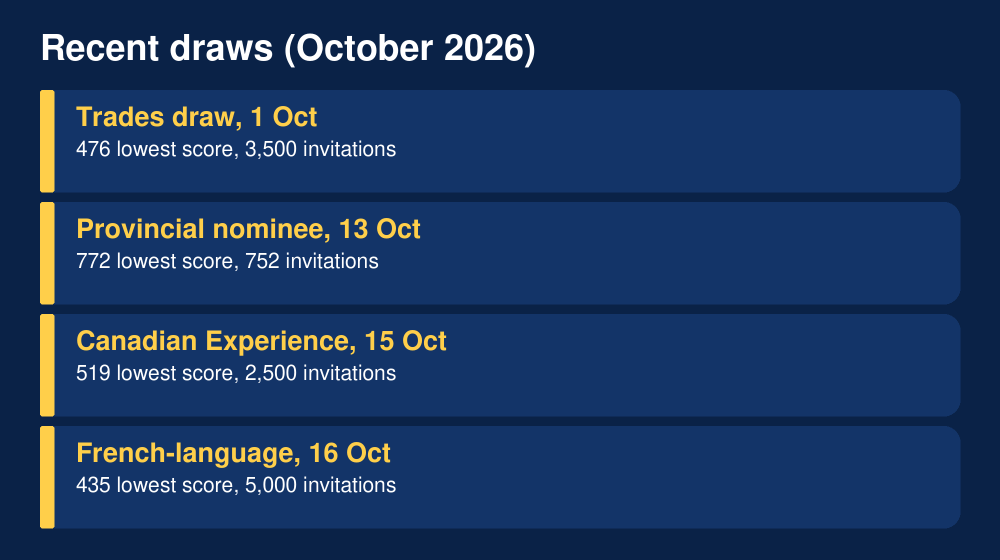
Notice the French-language draw: candidates who are strong in French have been invited with scores far below the Canadian Experience Class cut-off. For Nigerians, learning French to a good level can be one of the biggest score boosts available, and extra points are awarded for bilingual ability. A provincial nomination adds 600 points, which is why nominee draws show very high scores, as the provincial points are included. Draw sizes and scores can change from one round to the next; check the current round on the official Rounds of invitations page.
Update, 29 October 2026: IRCC’s rounds page lists a Transport Occupations round on 28 October 2026, and trackers report a French-language round on 27 October 2026 with a lowest score of 407, below the 435 of the 16 October French round shown in the image above. Cut-offs move from round to round, so always check the official Rounds of invitations page for the latest.
Language tests
You must take an approved test, such as IELTS General Training or CELPIP for English, and TEF Canada or TCF Canada for French. Test results must be recent when you apply. Language is the largest single driver of CRS points, so a retake that lifts you from Canadian Language Benchmark 8 to 9 or 10 can be worth more than any other effort.
Education assessment
If your degree is from Nigeria, you need an Educational Credential Assessment (ECA) from an approved body to show its Canadian equivalent. Do this early because it can take time and your degree level affects both the FSW eligibility grid and the CRS score.
How much money you need
If you apply under the Federal Skilled Worker or Skilled Trades programmes without a valid Canadian job offer, you must show settlement funds. The IRCC table, last updated on 7 July 2025 when we checked, lists C$15,263 for one person, C$19,001 for two, C$23,360 for three and C$28,362 for four, rising with family size. Funds must be in accessible accounts, and property equity is not accepted. Canadian Experience Class applicants do not need to show settlement funds. IRCC revises this table periodically, so use the figure on the live page.
On top of that come government fees for the permanent residence application and right of permanent residence, language tests, the credential assessment, police certificates and a medical exam. Immigration advice services estimate the total for a single applicant at a few thousand Canadian dollars before travel, so budget conservatively. Pay government fees only through the official IRCC portal.
Step by step
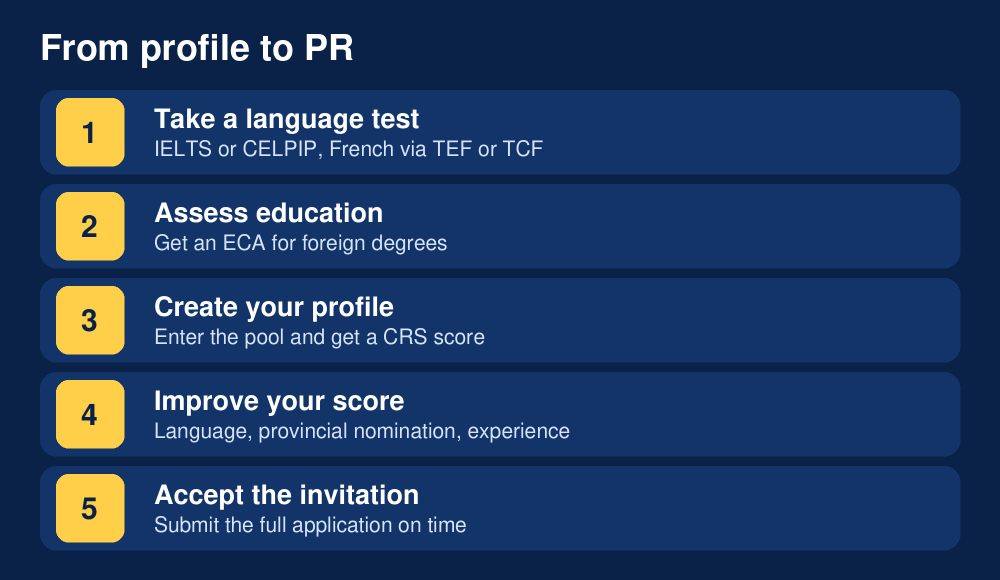
- Take your language test and aim as high as you can.
- Get your education assessed if your degree is from outside Canada.
- Create your Express Entry profile and note your CRS score.
- Look for ways to raise it: better language results, French, a Canadian job offer if eligible, a provincial nomination, Canadian study or work experience.
- Respond fast to an ITA. Documents (police certificates, medicals, proof of work) can take weeks, so collect them in advance.
Provincial nominee programmes
Many provinces run their own streams, some linked to Express Entry. A nomination adds 600 CRS points, which usually guarantees an invitation, but provinces have their own occupation lists and fees, and not every stream accepts applicants from outside Canada. Check each province’s immigration website.
Mistakes that cost Nigerians
- Paying an agent for a “guaranteed” invitation. Nobody can guarantee an ITA; see our warnings on job and recruitment scams and internet scams.
- Letting a language test or ECA expire during the wait.
- Exaggerating work experience. Misrepresentation can bring a five-year ban.
- Ignoring the fact that Canada’s immigration levels plan limits places, as covered in our guide to the best countries to move to for work.
If Canada looks too competitive, compare other paths in our guides to the easiest work visas for Nigerians and types of visas.
Frequently asked questions
Do I need a job offer?
No, not for Express Entry, though a valid offer can add points and removes the funds requirement.
Is a CRS score of 450 enough?
It depends on the draw type. Recent general and CEC cut-offs were far higher, while category draws such as French have been lower. Always check current rounds.
How long does processing take?
IRCC publishes processing times for Express Entry; the standard service target has been about six months from a complete application, but check the live tool.
Can my spouse help my score?
Yes. A spouse’s language and education can add points, or they can be the principal applicant if their profile is stronger.
What is the maximum CRS score now?
1,270 since 3 November 2026, up from 1,200, because of the new Labour Market Integration factor worth up to 150 points (140 with a spouse or partner).
Do I still need an LMIA for a job offer to count?
No. Since 3 November 2026 an Express Entry job offer needs no LMIA or LMIA exemption, and having one adds no points. The offer must still be genuine, full-time (30 hours a week or more) and last at least a year after you become a permanent resident.
When will Express Entry draws restart?
IRCC has not said. It paused rounds on 3 November to recalculate scores and described the work as taking up to two weeks. Watch IRCC’s rounds of invitations page for the next round.
Bottom line
Express Entry is open to Nigerians, but it is competitive. Start with the language test, get your credential assessed, calculate your CRS honestly and decide whether study in Canada, French or a provincial nomination is the cheapest way to raise your score. Use official portals only and never pay for a promise.
Sources
- IRCC: Comprehensive Ranking System (CRS) criteria
- IRCC: 2026 changes to points for Canadian work experience and job offers
- Moving2Canada: How long will Express Entry draws be paused? (November 2026)
- Bright Tomorrows Immigration Services: Express Entry, programmes, CRS points and draws (2026)
- IRCC: Express Entry rounds of invitations
- IRCC: Express Entry proof of funds
- CanadaVisa: Express Entry draw results (tracker)
- Moving2Canada: Express Entry draw tracker
Related guide (updated 31 October 2026)
Prefer to start with a job offer? Read how Nigerians can get a job in Canada from abroad, including LMIA and scam warnings.
Related guide (updated 31 October 2026)
Bringing your family? Compare Canada with other options in our guide to the best countries for Nigerian families to relocate.
Join the discussion
Have you tried this, or do you have a question we did not answer? Be the first to share your experience. Leave a comment below. Every comment is read by the editor before it appears.







Express Entry rewards young, highly educated, English-fluent applicants. What is your biggest hurdle: the language test, age points or the cost?
Improving your language score is often the cheapest way to move up the ranking. Have you taken an English test yet, and which one?