
Best Countries for Nigerian Families to Relocate to in 2026: Visas, Costs and Schools


Last updated: 31 October 2026 · By Naijatipsland Editorial Team · Editorial policy
Checked 31 October 2026. Moving abroad alone is hard. Moving with a spouse and children means school places, childcare, housing that fits four people, and visas that let the whole family stay together. This guide compares the countries Nigerian families most often consider, UK, Canada, Ireland and Germany, using official government information, and explains what each one asks for before your partner and children can join you. Salary thresholds and fees change often, so treat every figure as a snapshot and confirm it on the official site before you commit.
What Makes a Country Family-Friendly for Migrants?
A country can have a good visa route and still be a poor fit for a family. Before you compare countries, check six things:
- Can your spouse and children come with you from day one? Some routes allow it, some delay it, and some do not allow dependants at all for certain jobs.
- Can your spouse work? A second income often decides whether a move is affordable.
- What does the whole family pay in government fees and health charges? These are per person.
- Can the children go to state school? Most destinations allow it, but check local rules and waiting lists.
- How much does housing cost for a family-sized home?
- What is the long-term route? Settlement and citizenship rules are being reviewed in several countries, so check the latest position.
The Four Destinations Compared

The figures below come from official or government-linked pages checked on 31 October 2026. They are guides, not promises, and your job, qualifications and family make-up change the result.
| Country | Main route | Spouse and children | Key money figure |
|---|---|---|---|
| Canada | Express Entry (permanent residence) or an employer-sponsored permit | Spouse and dependent children can be included in the application | Proof of funds: C$15,263 for one person, C$28,362 for a family of four (figures updated July 2025) |
| Ireland | Critical Skills Employment Permit | Immediate family from arrival; spouse can work | Minimum salary €40,904 for listed jobs, €68,911 otherwise (from 1 March 2026) |
| Germany | EU Blue Card | Spouse can join without a German test and can work | Minimum salary €50,700, or €45,934 for shortage jobs (2026) |
| United Kingdom | Skilled Worker visa | Partner and children can apply; care roles are restricted | Health surcharge about £1,035 per adult per year |
Canada: Strong for Skilled Families Who Qualify
Canada’s Express Entry lets a skilled worker apply for permanent residence with a spouse and dependent children, without needing a job offer. The catch is the points system and the proof of funds. At the time of checking, the government showed C$15,263 for one person, C$19,001 for two, C$23,360 for three and C$28,362 for four, with more for each extra person. You must count your family members even if they are not travelling with you. Read our full guide to Canada permanent residence, and if you would rather start with a job offer, see how to get a job in Canada from Nigeria.
Good for families: permanent residence from arrival, access to public schools, and a clear route to citizenship over time. Watch out for: high rents in big cities, cold winters, and fierce competition in Express Entry draws.
Ireland: English-Speaking, With Family Rights From the Start
Ireland attracts Nigerian professionals because it is English-speaking and the Critical Skills Employment Permit allows immediate family to come from arrival. The spouse or partner gets permission to work. From 1 March 2026 the minimum salary is €40,904 for jobs on the Critical Skills list and €68,911 for other eligible roles, and the permit is tied to a relevant degree for the lower threshold. For the General Employment Permit the family route is slower: reports say the holder can apply after 12 months, subject to an income threshold of €30,000 gross for a spouse or partner. Irish housing is very expensive and tight, so check rents before you accept an offer.
Germany: Good Blue Card Terms, But Language Matters Later
The EU Blue Card requires a recognised degree and a job offer meeting the salary threshold. In 2026 that is €50,700 gross a year, or €45,934.20 for shortage occupations such as IT, engineering and healthcare. Spouses of Blue Card holders can join without proving German before arrival and can work. Children go to state school, which is free but taught in German, so plan language support for them. Germany can suit families who are happy to learn a new language and who work in a field with strong demand.
United Kingdom: Many Nigerians Have Ties, But Rules Are Tighter
The UK is familiar to many Nigerian families, but the Skilled Worker route has become more expensive and restrictive. Partners and children of a Skilled Worker pay the same visa fee for the same length of time, plus the Immigration Health Surcharge, which is usually £1,035 per adult per year (children pay a lower rate). The Home Office guidance on dependants also explains special limits for some care and lower-skilled roles, so check your occupation code before you assume your family can join. For costs once you land, read our cost of living in the UK for Nigerians, and for partners see our UK spouse visa guide. If you are comparing study routes for a child later, see cheap UK universities for Nigerian students.
How Much Should a Family Budget Before Moving?
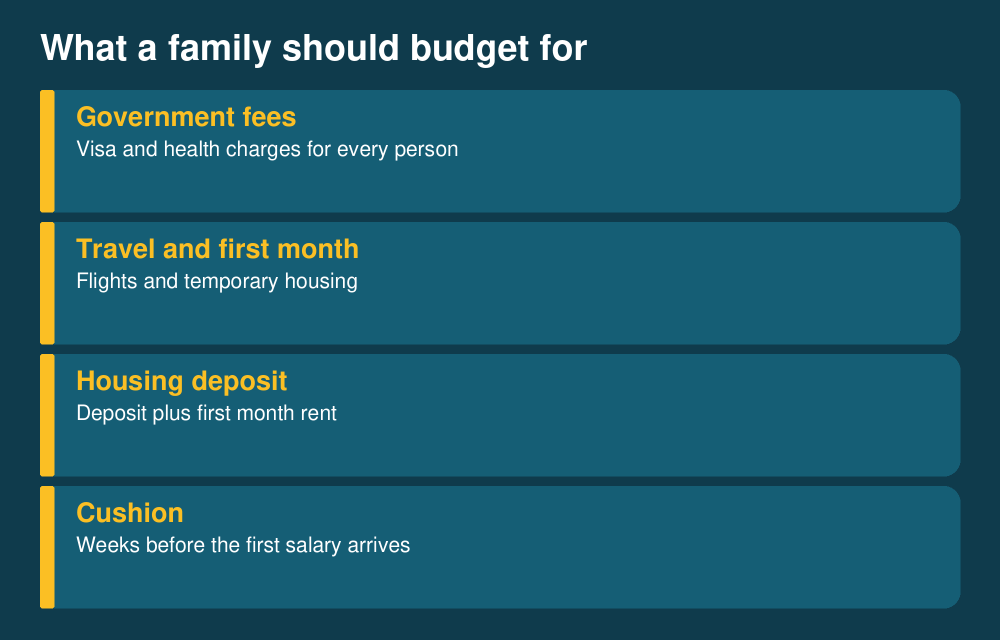
Government fees are only part of the bill. A realistic budget includes visa and health fees for every person, flights, temporary accommodation for the first month, a deposit and first month’s rent, school uniforms and supplies, winter clothing, and a cushion for the weeks before the first salary arrives. Many families underestimate the cost of a deposit in expensive cities. Moving money safely matters too: see our guide to money transfer apps for Nigerians in the UK for how to compare real exchange rates, and use authorised providers only.
A Practical Checklist for Families
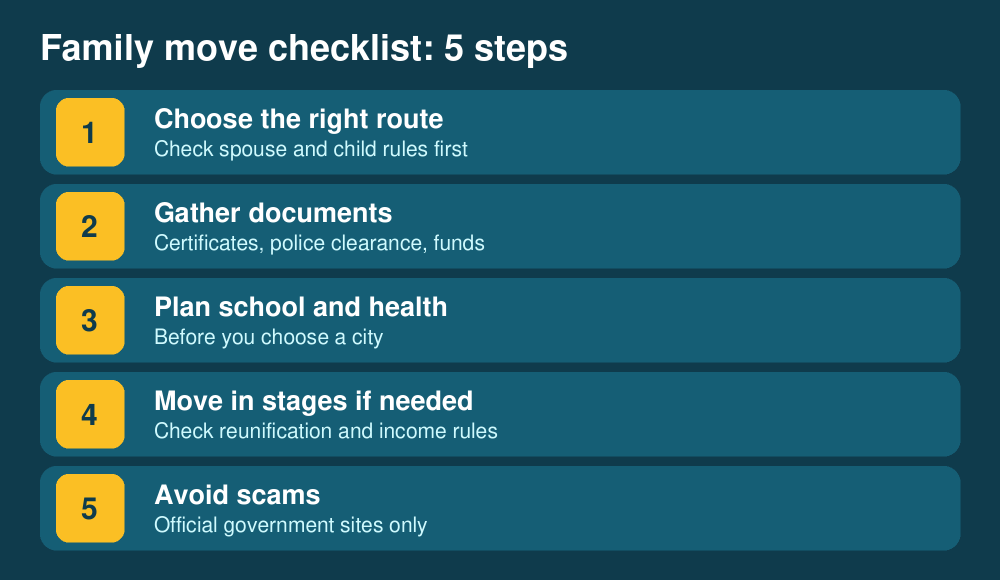
1. Choose a route that fits your job and your family
Start from the visa rules, not from the country you like most. A route that does not allow your spouse to work or your children to come may not be worth it.
2. Gather documents early
Passports, marriage certificate, children’s birth certificates, degree certificates, police clearance and proof of funds can take weeks. Check whether translations or notarisation are required. Keep digital and paper copies.
3. Plan schooling and health cover
Ask about school places before you choose a city. Check how health insurance or public healthcare works for your family from day one.
4. Move in stages if you must
Some families send the main earner first, then bring the rest when the work permit and housing are secure. Make sure the route allows later reunification and note the income rules.
5. Avoid scams
Do not pay anyone for a guaranteed visa or a job. Fake agents target families who are desperate to leave. Use official government sites, and see our guide on the easiest work visas for Nigerians for routes that are real.
Schools, Healthcare and Settling In
For most families, the children come first. In Canada, Ireland, Germany and the UK, children of residents can usually attend state schools, but the details differ: some areas have waiting lists, some schools prioritise by catchment area, and in Germany lessons are in German. Contact local education authorities before you sign a lease, because the address you choose can decide which school your child can attend. Bring school reports, birth certificates and immunisation records, and ask whether any entrance assessments are required.
Healthcare also differs. The UK charges the Immigration Health Surcharge up front, which gives access to the NHS on similar terms to residents. Canada has provincial health insurance that can have a waiting period in some provinces, so ask your employer about private cover for the first weeks. Ireland and Germany have their own systems that combine public and private cover, and Germany generally requires health insurance for residents. Whichever country you choose, find out how to register with a family doctor and how to book dental and eye checks, since these are often not fully covered.
Finally, think about the emotional side of the move. Children can feel isolated when they change schools and accents, and a spouse who gives up a career may feel the loss. Plan how you will keep in touch with relatives in Nigeria, find a church, mosque or community group, and give everyone time to adjust in the first six months. Families who set a budget, a school plan and a support network before they leave tend to settle faster than those who rely on luck.
Common Mistakes Nigerian Families Make
- Choosing a country by reputation instead of visa rules.
- Leaving out family members when calculating proof of funds.
- Underestimating housing and winter heating costs.
- Assuming children will settle easily without language or school support.
- Selling property or taking loans before the visa is approved.
Frequently Asked Questions
Which country is easiest for a Nigerian family to move to?
None is easy. The best choice depends on your profession, savings and family size. Canada suits skilled applicants who score well, Ireland and Germany suit professionals with a qualifying job offer, and the UK works for those with sponsorship and the money for the fees.
Can my spouse work?
In Ireland’s Critical Skills route and for Germany’s Blue Card, yes. In other routes it depends on the permit, so check before you apply.
Do children need separate visas?
Usually yes, or they are included as dependants on the family application. Each child normally needs their own fee and health charge.
How much money do we need for Canada?
The government lists proof of funds by family size, and for a family of four it was C$28,362 at the time of checking. Always check the current table.
Is it safe to use an agent?
You can apply without an agent. If you use a representative, make sure they are authorised and never pay for a guaranteed outcome.
This guide is general information, not legal, financial or immigration advice. Always confirm current rules on the official government pages for each country.








Ireland and Germany let a spouse work from the start on their main skilled routes, which can decide whether a family move is affordable at all. If you have moved with children, what did you wish you had planned first: schools, housing or money?