
Sending Money to Nigeria at Christmas 2026: Best Times, Rates and Scams to Avoid

Last updated: 10 November 2026 · By Naijatipsland Editorial Team · Editorial policy
Every December, millions of pounds, dollars and euros move from the diaspora to families in Nigeria for food, travel, school fees and gifts. It is also the season when exchange rates attract attention, transfer apps run promotions and scammers get busy. This guide explains how to send money to Nigeria at Christmas 2026 without losing more than you need to, which checks to do before you press send, and how to spot the scams that peak at this time of year. It is written from a UK perspective, and the principles apply from the US, Canada and Europe too.
Quick answer: start early, compare the exchange rate and the fee together (not the fee alone), use a regulated provider, send a small test amount first, and never pay anyone a fee to release money that is supposedly waiting for you. Rates change every minute, so always check the live quote in the app before you confirm.
What the pound is worth in naira right now
On 10 November 2026, Wise’s live currency page showed a mid-market rate of about 1 GBP = 1,836 to 1,846 NGN, with the page stating no exact timestamp. Over the previous 30 days Wise showed a range from roughly 1,776 to 1,836, and over 90 days a high of about 1,900. The mid-market rate is the midpoint between buy and sell prices, which is the fairest benchmark. Your provider will usually offer a rate slightly below it or add a fee, so compare what the recipient actually receives. These figures are a snapshot, not a forecast, and nobody can reliably predict where the rate will be in December.
How to compare providers properly
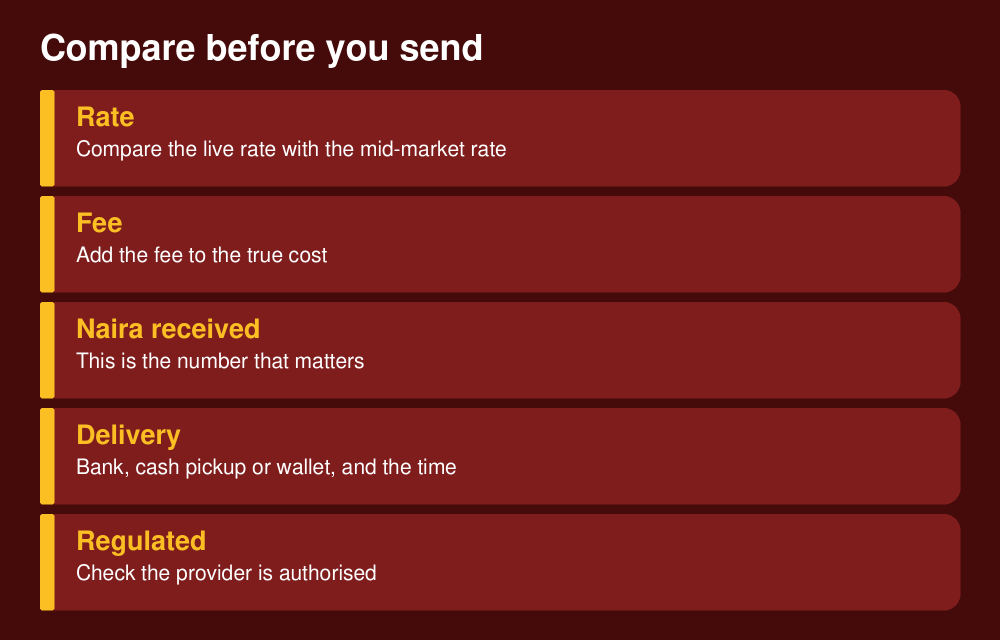
A provider that advertises zero fees can still give you a weaker rate, and a provider with a visible fee can give a better one. The only fair test is the amount that lands in Nigeria. For example, Wise’s own comparison page showed that sending 1,000 GBP by bank transfer with a fee of 6.07 GBP produced about 1,835,232 NGN for the recipient. Use the same method with every provider you consider:
- Enter the same amount, say 500 or 1,000 GBP, in each app or website.
- Note the fee and the exchange rate shown.
- Write down the total naira the recipient gets.
- Check the delivery method (bank deposit, cash pickup, mobile wallet) and the stated delivery time.
- Pick the highest naira amount from a regulated provider you trust.
A Wise comparison published in December 2025 found that the naira received for 1,000 GBP varied by a few percent between popular providers, and that promotional rates for new customers often applied only to the first transfer or to a capped amount. That article is a year old, so use it only to understand how offers work, not for current prices. Our regularly updated guide to the cheapest money transfer apps for Nigerians in the UK and the official versus street dollar to naira rate give more context.
What changed in 2026: naira-only payouts
The Central Bank of Nigeria directed international money transfer operators to pay diaspora remittances in naira from 1 May 2026, ending dollar payouts to recipients through those channels. IMTOs such as Western Union, MoneyGram and WorldRemit were required to open naira settlement accounts with authorised dealer banks, and a CBN circular dated 24 March 2026 required this to improve transparency. In practical terms, if you send pounds, your relative collects naira. If they need dollars, they would have to buy them separately after receiving the naira. Check the latest CBN and provider notices before you send, because detailed rules can change. Official data shows remittances through IMTOs hit a record 947 million dollars in July 2026, and 3.8 billion dollars across January to July 2026, up about 50 percent on the same period of 2025, which shows how many families rely on these channels.
Best times to send money
There is no guaranteed best day. Rates move with the market, and December demand can be high. Sensible habits include:
- Send earlier than Christmas week to avoid delays, bank holidays and busy support lines. UK banks close on 25 and 26 December.
- Use a rate alert in your app so you are notified when the rate reaches a level you are happy with.
- Split large amounts: send part now and part later so you are not exposed to one day’s rate.
- Do not wait for a perfect rate if your family needs the money for a fixed date.
Bank transfer, cash pickup or mobile wallet?
Bank deposits are usually the easiest to track and often the cheapest. Cash pickup helps relatives without accounts but can mean travel, queues and agent limits, and you should only use agents named by your provider. Check the recipient’s name exactly matches their bank account name to avoid failed transfers. For household budgeting back home, see our guides to Christmas travel costs in Nigeria 2026 and Christmas food prices in Nigeria 2026, and for bank charges at the Nigerian end read bank transfer charges in Nigeria.
Scams to avoid at Christmas
Scams rise in December because people are in a hurry. Warning signs include:
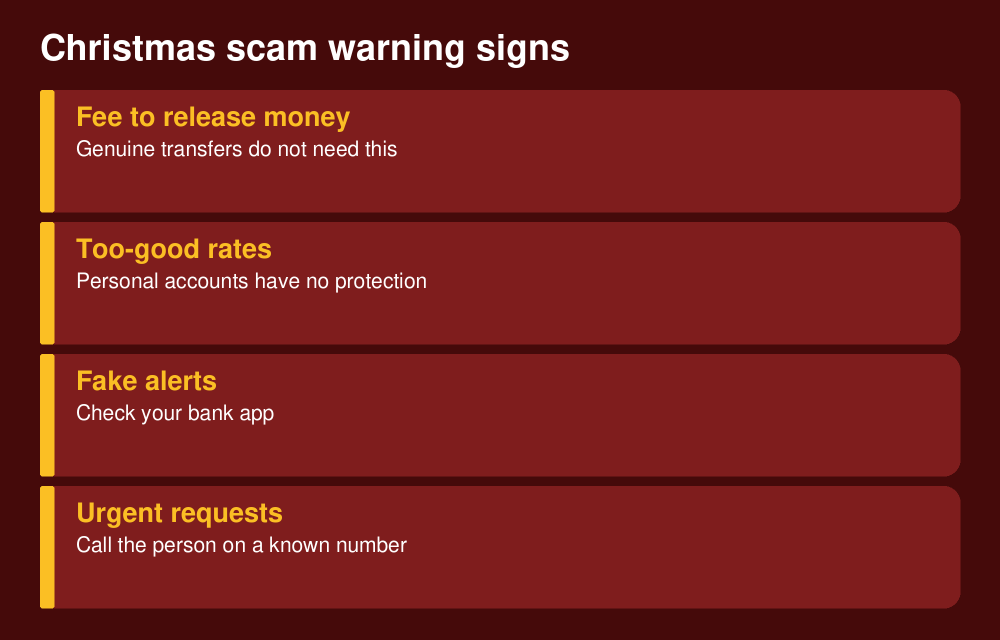
- Requests to pay a fee to release money. Genuine transfers do not require the recipient to pay a stranger first.
- Offers of unusually good rates from individuals on social media or messaging apps, asking you to send to a personal account.
- Fake credit alerts and phishing texts claiming a transfer arrived. See how to check that a transfer is real.
- Pressure and urgency, such as a message saying your family member is in trouble and you must send immediately to a new account. Call them on a number you already know.
- Unregulated apps. In the UK, check that a firm appears on the Financial Conduct Authority register before using it.
- Changed account details sent by message or email. Verify by phone.
If you think you have been scammed, contact your bank and the transfer provider immediately and report to Action Fraud (in England, Wales and Northern Ireland) or Police Scotland. This article does not accuse any named company of wrongdoing; always rely on regulators’ published warnings.
Checklist before you send
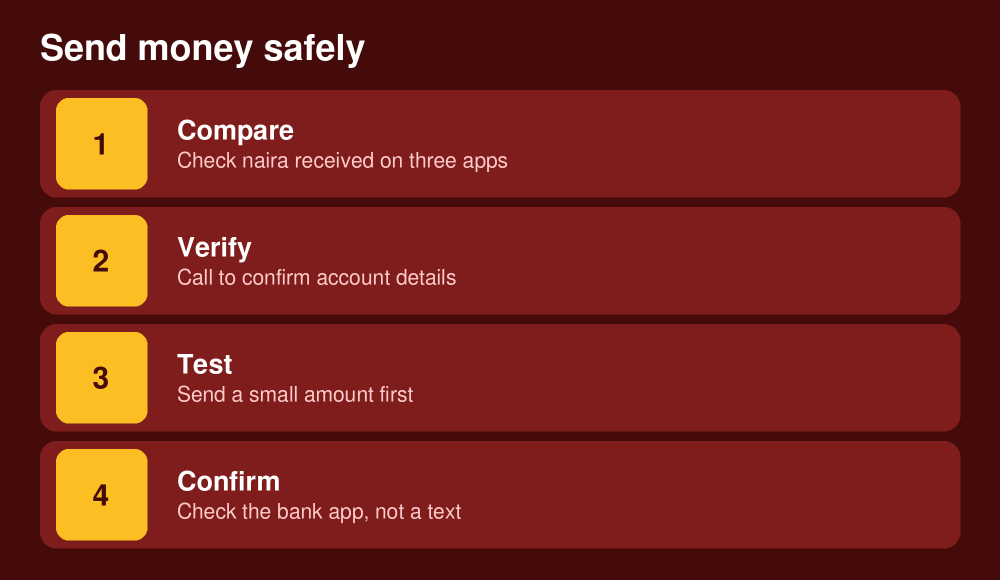
- Compare the total naira received across at least three regulated providers.
- Confirm the recipient’s account name and number with them by voice call.
- Send a small test amount first if it is a new recipient.
- Keep receipts and reference numbers.
- Tell the recipient to confirm the money in their bank app, not from a text message.
- Check any transfer limits and ID verification, and complete them early.
If you are planning a longer-term route for receiving dollars as a freelancer, see how to receive international payments as a Nigerian freelancer.
FAQ
What is the cheapest way to send money to Nigeria from the UK?
It depends on the day. Compare the naira received after fees and rates across regulated providers and choose the highest amount.
Will the rate be better at Christmas?
Nobody can promise that. Rates move daily, so use alerts and avoid waiting until the last week.
Can my family still receive dollars?
Since 1 May 2026, CBN rules require IMTO payouts in naira. Ask your provider about current options.
Is it safe to send to a personal account for a better rate?
It is risky. Unregulated transfers have no protection if something goes wrong. Use regulated providers.
How fast does money arrive?
Some bank transfers arrive in seconds according to provider pages, but delays can happen, so allow extra time before Christmas.
Sources
- Wise: GBP to NGN rate (viewed 10 November 2026)
- Wise: GBP to NGN comparison (viewed 10 November 2026)
- Wise: Cheapest way to send money to Nigeria (December 2025)
- Prime Business Africa: CBN naira-only payout from May 2026
- Nairametrics: Remittances hit record 947 million dollars in July
Rates and fees change constantly. This is general information, not financial advice.
Join the discussion
Have you tried this, or do you have a question we did not answer? 1 reader has already shared their view. Naijatipsland members help each other with real, first-hand experience.






Sending money home this Christmas? Compare the naira received, not just the fee, and tell us in the comments which method works for you. – Ade Adeniyi