
How Nigerians in the Diaspora Can Build a House in Nigeria (2026): Costs, Supervision and Property Scams to Avoid

Last updated: 7 November 2026 · By Naijatipsland Editorial Team · Editorial policy
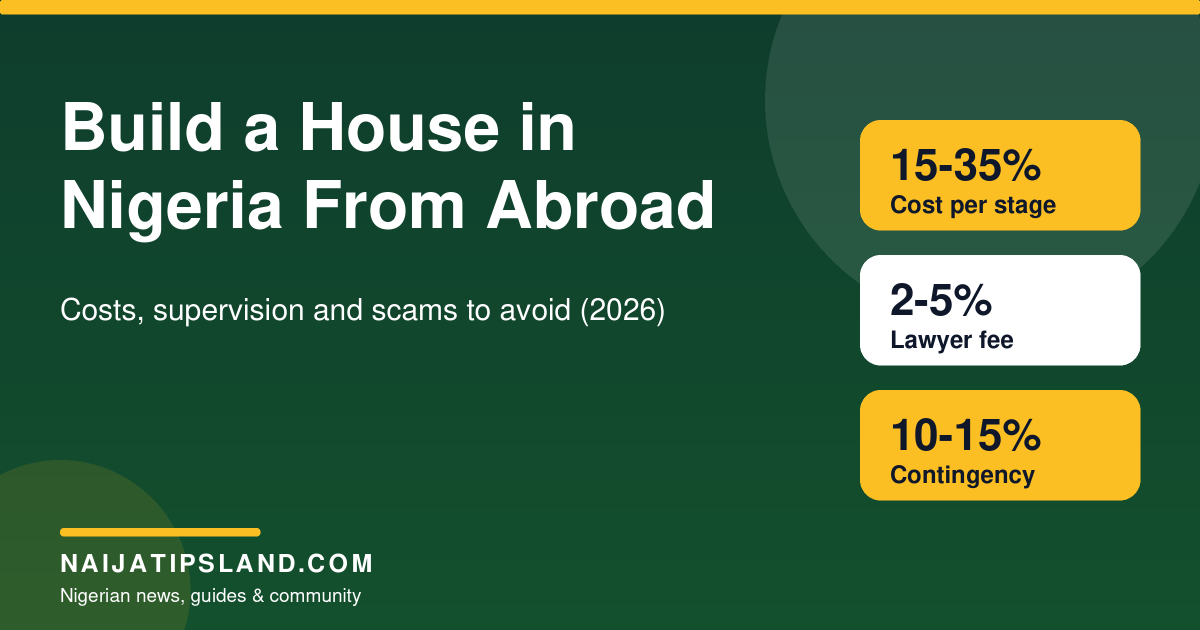
Building a home in Nigeria while you live in the UK, the US, Canada or the Gulf is one of the most common dreams in the diaspora, and also one of the most common ways to lose money. The building itself is not the hard part. The hard parts are buying land with a title that holds up, paying for work you cannot see, and keeping a contractor honest from thousands of miles away. This guide walks through the whole project in the order you will meet it: land and verification first, then the budget, then supervision, then the scams that target Nigerians abroad.
About the figures in this guide: cost ranges come from published 2026 articles by Rosettee Construction (29 July 2026) and Massodih Plans, and verification fees from Lands of Nigeria (September 2026 exchange rate of about ₦1,410 to the dollar). Building costs move with cement, diesel and the exchange rate, so treat every number as a planning estimate and get a written bill of quantities before you commit money. This is general information, not legal or financial advice.
Quick answer: how do you build a house in Nigeria from abroad safely?
Buy land only after your own independent lawyer and surveyor have checked it, get full architectural and engineering drawings and a bill of quantities before you pay a builder, release money in stages against inspected work, and hire a supervising consultant who is separate from the contractor. Never send money to a personal account for land, never pay 100% upfront, and never let the seller or agent choose your verifiers. Our guide to investing in Nigerian real estate from abroad covers the buying side in more detail.
Step 1: Buy the land properly before you think about the house
Nigerians abroad can own property in Nigeria. The difficulty is verifying and perfecting title, not eligibility. One diaspora safety guide notes that under Section 22 of the Land Use Act 1978, transferring land held under a Statutory Right of Occupancy needs the Governor’s consent, and without it the transfer is void. A Deed of Assignment on its own does not complete a purchase from an existing Certificate of Occupancy holder.
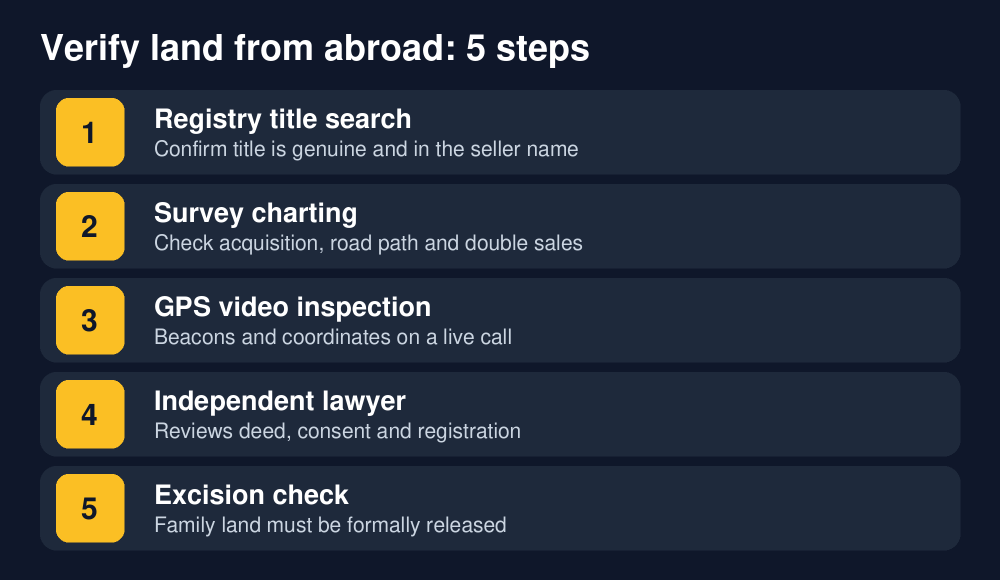
Lands of Nigeria sets out a remote verification sequence that works well for people who cannot fly home first:
- Registry title search, about ₦15,000 to ₦20,000, to confirm the title is genuine and in the seller’s name.
- Survey charting, about ₦30,000 to ₦100,000, to check the plot is not under government acquisition, not in a road path and not already sold.
- GPS video site inspection, about ₦300,000 to ₦600,000, where the inspector records survey beacons on a live call and sends you the coordinates.
- An independent conveyancing lawyer, typically 2% to 5% of the price, to review documents and see the transfer through to perfection.
- An excision or gazette check for family land, to confirm the government has formally released it.
The same source puts total verification spend at roughly ₦50,000 to ₦600,000 for searches, charting and inspection, plus the lawyer’s fee. That is small next to the cost of losing a plot. For Lagos specifically, see our step-by-step guide to verifying land ownership in Lagos State and the checklist in how to buy land in Nigeria without getting scammed.
One rule matters more than the rest: hire and pay every verifier yourself, and make sure none of them is connected to the seller or agent. If the seller recommends the surveyor, the lawyer and the person who will film the site, the checks become a performance.
Step 2: Understand what a house costs in 2026
Rosettee Construction’s July 2026 guide gives early-planning rates per square metre of floor area: about ₦150,000 to ₦250,000 for basic residential work, ₦300,000 to ₦500,000 for a medium standard, and ₦600,000 or more for high-end finishes. It quotes cement at ₦8,500 to ₦12,500 per 50 kg bag. Multiply your planned floor area by the rate that matches your finish, then add the items people forget.
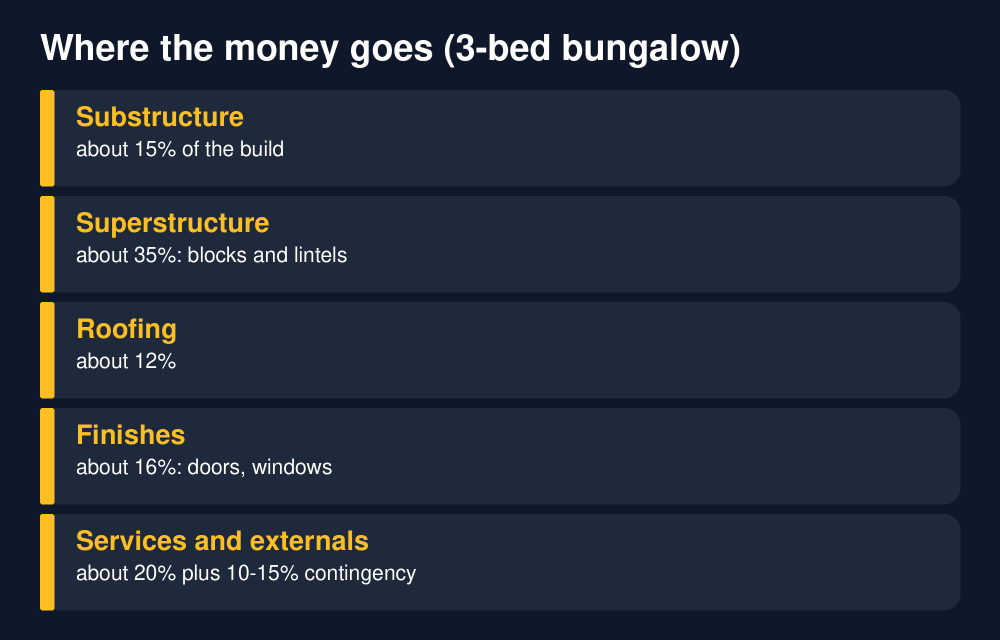
For a worked example, Massodih Plans estimates a three-bedroom bungalow on a 50ft by 100ft plot at about ₦25 million to ₦45 million to complete, with a duplex on the same plot starting from about ₦45 million. Its stage breakdown is useful for staging payments:
| Stage | Estimated cost | Approx. share |
|---|---|---|
| Substructure (foundation to DPC) | ₦4.5m to ₦6m | about 15% |
| Superstructure (blockwork, lintels) | ₦10m to ₦14m | about 35% |
| Roofing | ₦3.5m to ₦5m | about 12% |
| Doors, windows, finishes | ₦4m to ₦6.5m | about 16% |
| Electrical and plumbing | ₦3m to ₦4.5m | about 11% |
| Painting and external works | ₦2.5m to ₦4m | about 9% |
| Contingency | ₦2m to ₦3m | – |
Costs often left out of first budgets, according to Rosettee, include professional fees (architect, structural engineer, quantity surveyor), soil investigation and survey, planning approvals, services such as water, drainage, solar and security, and external works such as fencing, gates, boreholes and septic systems. Weak soil may need piling or a raft foundation. Massodih Plans advises a contingency of at least 10% to 15%, because cement and other materials rose sharply between 2019 and 2026. For current material prices, see our guide to the cheapest building materials in Nigeria, and if you are still choosing where to build, the cheapest states to live in Nigeria shows how costs differ by state.
Step 3: Get drawings, a bill of quantities and a written specification first
Rosettee’s advice is blunt: complete the architectural and engineering designs and obtain a detailed bill of quantities before you commit funds, and write down finishing specifications instead of promising "good materials". Late design changes cause demolition and waste. Choose durable, locally available materials, because imports cause delays, and keep the building form simple to reduce labour and waste. Confirm approval requirements with the relevant state or local planning authority before the first block is laid.
Step 4: Supervise from abroad without trusting WhatsApp photos
Massodih Plans warns never to rely on WhatsApp photos alone, since photos can be staged or old. It recommends an independent supervising consultant, separate from the contractor, who inspects the foundation, the DPC level, the lintel level and the roofing. It cites a case where a client paid ₦8 million for a foundation and later found no visible trench inspection. A practical system looks like this:
- Pay in stages tied to the milestones above, and release each payment only after your supervisor confirms the stage in person with dated photos or video.
- Keep a single paper trail: contract, bill of quantities, payment receipts and site reports in one shared folder you control.
- Buy major materials in planned batches from one trusted supplier, and have receipts issued to the project.
- Plan the generator, borehole and drainage early so the borehole is not placed too close to a soak-away and the site does not flood.
- Visit at least at the foundation and roofing stages if you can, or send a trusted relative who is not paid by the contractor.
Property scams that target Nigerians abroad
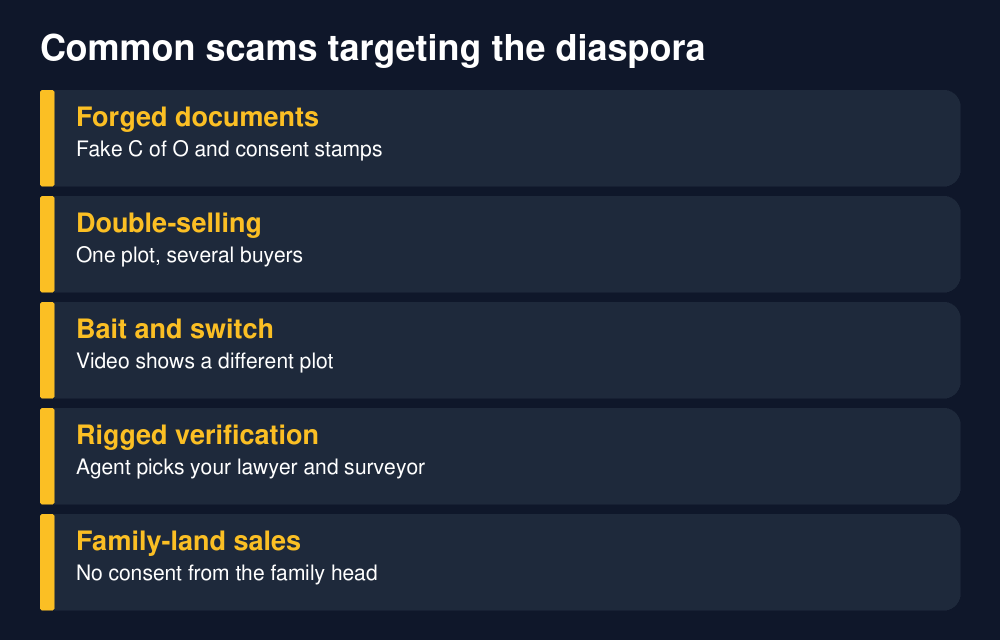
Diaspora buyers are targeted because they are far away and eager. The scam types named in the sources we read are:
- Forged documents: fake Certificates of Occupancy, Governor’s consent or survey plans with registry numbers that do not exist.
- Double-selling: the same plot sold to several buyers.
- Impersonating absent owners: a safety guide says this specifically targets the diaspora.
- Bait and switch: the inspector films a genuine plot, but you are sold a different one.
- Compromised verification: the surveyor, lawyer and inspector are all the agent’s associates.
- Video-only buying: relying on a convincing video without a registry search.
- Misused Power of Attorney: a POA is not proof of ownership.
- Omo onile demands and family-land sales: escalating fees, or land sold without the agreement of the recognised family head or all adult members.
- Un-excised or acquired land: plots inside a government acquisition that can later be demolished.
One diaspora guide reports that Lagos land fraud cases rose roughly 23% between 2023 and 2025, with the Lekki, Ajah and Ibeju-Lekki corridor accounting for a large share. That figure is that site’s claim and we have not independently verified it, but the pattern matches what buyers report. Safer habits: prefer registered estates from reputable developers where title is already verified, confirm company sellers through CAC records and a corporate bank account, and pay only into corporate or lawyer-held accounts. For wider protection, read our Diaspora Money Guide and how Nigerians in the diaspora can invest in Nigeria safely.
A simple checklist before you send any money
- Independent lawyer and surveyor hired and paid by you.
- Registry search done and the seller’s name matches the title.
- Survey plan verified and plot coordinates match the video you were shown.
- Litigation, acquisition and family-claim checks completed.
- Deed of Assignment signed, Governor’s consent obtained and the deed registered.
- Payment to a corporate or lawyer-held account, never cash, never 100% upfront.
- Drawings, bill of quantities, written specification and staged payment plan agreed.
- Independent supervisor appointed, separate from the contractor.
- Contingency of 10% to 15% set aside.
- Current Central Bank of Nigeria rules on bringing funds in confirmed with your bank (they change).
Frequently asked questions
Can a Nigerian living abroad own land and build a house in Nigeria?
Yes. Nigerian citizens abroad can own property. The challenge is verifying the title and perfecting it with the Governor’s consent and registration.
How much does it cost to build a house in Nigeria in 2026?
Published planning rates range from about ₦150,000 to ₦250,000 per square metre for basic work to ₦600,000 or more for high-end finishes. One estimate puts a three-bedroom bungalow at about ₦25 million to ₦45 million. Get a bill of quantities for your own plan.
How do I check land documents from abroad?
Hire an independent lawyer and surveyor, run a registry title search, have the plot charted, and commission a GPS video inspection with coordinates you can verify. Make sure no verifier is connected to the seller.
Is a Power of Attorney enough to buy or build?
No. A Power of Attorney does not prove ownership and can create its own risks if given to the wrong person.
Should I use a contractor or manage workers directly?
Most people abroad use a contractor under a written contract, plus a separate supervising consultant who inspects each stage before payment.
How often should I release payments?
Tie payments to completed stages such as foundation, DPC, lintel and roofing, and pay only after independent confirmation. Avoid large advance payments.
What is the biggest mistake diaspora builders make?
Paying for land or work based on videos and photos supplied by the seller or contractor, without independent verification.
Should I buy in an estate instead of raw land?
Registered estates from reputable developers can reduce title risk because documents are already verified, but you should still run your own searches.
Sources and notes: Rosettee Construction, cost of building a house in Nigeria (29 July 2026); Massodih Plans, cost of building a house in Nigeria for Nigerians abroad; Lands of Nigeria, remote land verification in Nigeria 2026; Janus Hermes, buying property in Nigeria as a diaspora buyer 2026. Figures are as published by those sources and change often. This article is general information, not legal, tax or financial advice.
Join the discussion
Have you tried this, or do you have a question we did not answer? 2 readers have already shared their views. Naijatipsland members help each other with real, first-hand experience.





Ade Adeniyi here. If you are building from abroad, the single habit that saves most people money is hiring your own supervisor and paying by stage only after they confirm the work in person. Tell us in the comments which stage worries you most and I will point you to the right checks.
Ade Adeniyi here. If you are building from abroad, the single habit that saves most people money is hiring your own supervisor and paying by stage only after they confirm the work in person. Tell us in the comments which stage worries you most and I will point you to the right checks.