
Cheapest Building Materials in Nigeria and Their Prices (2026): Cement, Blocks, Iron Rods and Roofing


Last updated: 4 November 2026 · By Naijatipsland Editorial Team · Editorial policy
Building costs in Nigeria have swung wildly over the past few years. Cement, iron rods and roofing sheets all jumped sharply after 2023, and although some prices have eased in 2026, most materials still cost far more than they did three years ago. If you are planning to build, the smartest saving is not a single “cheapest” product but knowing which materials are genuinely cheap per unit of work, which are worth paying more for, and where you can cut cost without cutting safety. This guide lists the cheapest building materials in Nigeria and their approximate prices in 2026, with honest notes on how much those prices vary by city, brand and season.
How to read the prices: every figure below comes from dated price pages and news reports published between August and October 2026. They are indicative market ranges, not quotes. Prices differ between Lagos, Abuja, Enugu, Kano and smaller towns, between brands, and between a supplier’s list price and what you pay delivered. Always get at least three written quotes for the same specification, unit and delivery location before you buy. For the full budget picture, see our guide to the cost of building a house in Nigeria.
Cheapest building materials in Nigeria at a glance
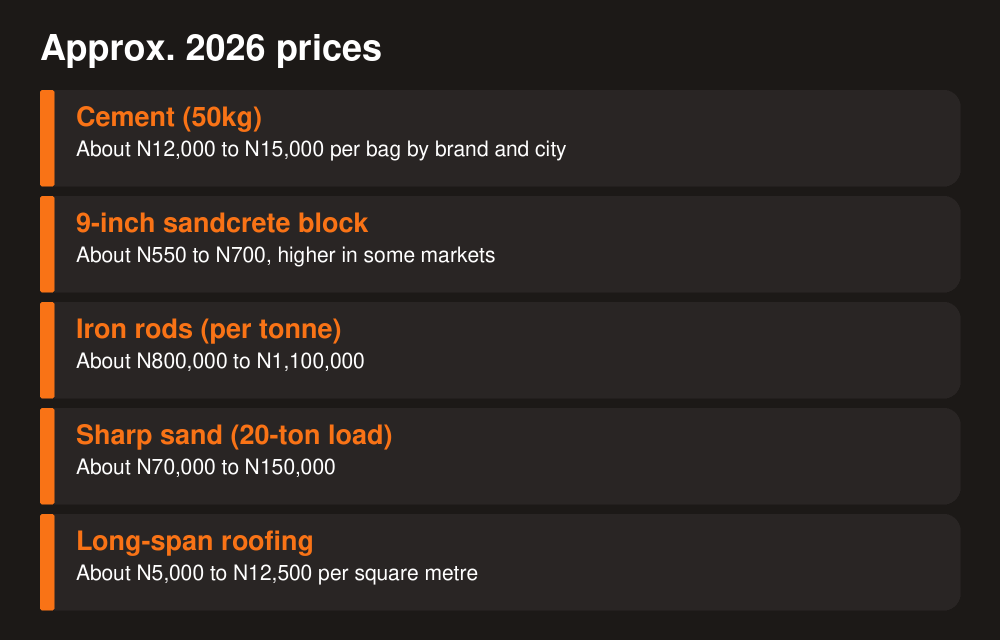
The table above summarises the main structural materials. Below we go through each one, what drives its price, and where to save.
Cement: roughly N12,000 to N15,000 per 50kg bag
Cement is the single most watched price in Nigerian construction. In mid-October 2026, one news report listed Dangote 3X at about N13,100, BUA at about N12,800 and HBM Elephant at about N12,600 per 50kg bag in Abuja, while noting some dealer quotes reaching N15,000 elsewhere. Another price index, last updated on 18 October 2026, showed base prices around N12,000 to N12,500 per bag for most brands in Enugu, with Lafarge at about N14,000. Delivery is usually extra.
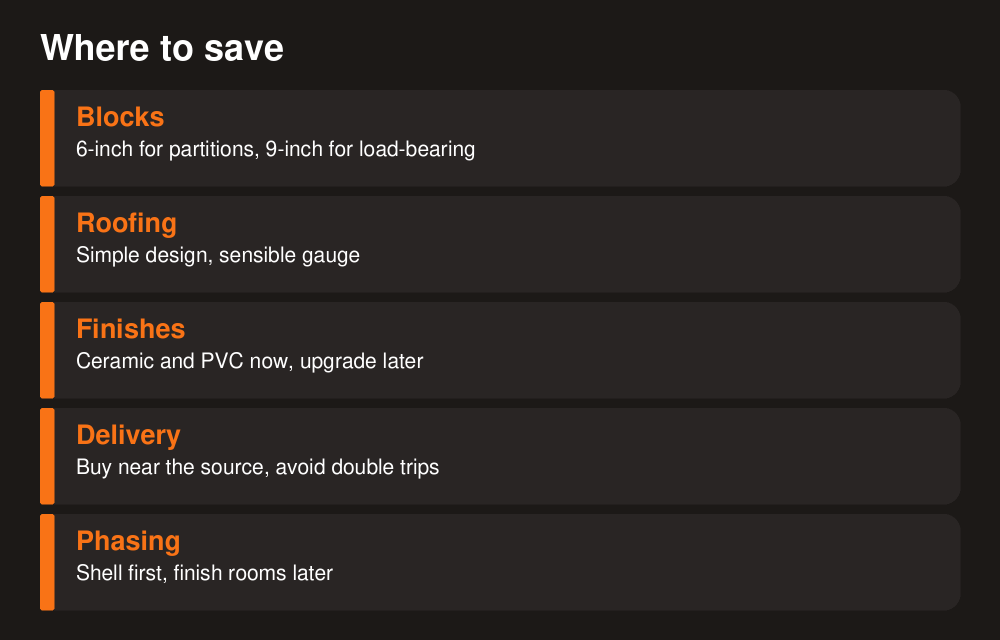
Where to save: compare brands (the cheaper brands are often structurally fine for blockwork and plastering), buy in bulk when you can store it dry, and buy close to the source because transport is a large part of the final price. Never buy cement you cannot verify as sealed, in-date and stored off the ground.
Sandcrete blocks: about N550 to N700 each, and more in some markets
Price pages in 2026 put a 9-inch hollow sandcrete block at roughly N550 to N700 and a 6-inch block at roughly N450 to N550, with some markets and Lagos suppliers quoting above N1,000 for 9-inch. Stone-dust or vibrated blocks cost more, around N700 for 6-inch and N900 for 9-inch in one Enugu price list, but they are usually stronger and need less plastering.
Where to save: use 6-inch blocks for internal partition walls and keep 9-inch for load-bearing and external walls. Better still, check whether a reputable local block factory beats market-stall prices, and reject poorly cured, crumbling blocks, which cost you far more in the end. Blocks cast on site from your own cement and sand can be cheaper if done properly, but only with good mixing and proper curing.
Sharp sand and granite: price depends on trips and distance
Sand and granite are sold by the tipper load, so quoted prices vary hugely by city and tonnage. One 2026 price guide put sharp sand at about N70,000 to N150,000 per 20-ton tipper, with Lagos quotes around N95,000 to N130,000, and granite loads from about N280,000 to N660,000 depending on size and location. Another price list gave Enugu base prices of about N7,250 per ton for sharp sand and N10,000 per ton for three-quarter-inch granite. Always confirm the tonnage and whether the load is measured by weight or truck volume.
Where to save: buy directly from the quarry or sand pit if you can, schedule delivery when the site is ready, and avoid paying twice for the same trip. Use the right mix: over-ordering granite is a classic waste.
Iron rods: eased in 2026, but still expensive
Iron rods (reinforcement) are one of the biggest cost lines. A price tracker last checked on 12 October 2026 put bulk prices at about N800,000 to N1,100,000 per tonne, with local rods nearer N800,000 to N900,000 and TMT rods nearer N900,000 to N1,000,000. The same source reported prices down about 17 percent from 2025 but still more than double the 2023 level.
Per 12-metre rod, that tracker listed approximate ranges of N3,800 to N5,200 for 8mm, N5,900 to N8,100 for 10mm, N8,500 to N11,700 for 12mm, N15,200 to N20,900 for 16mm, and N23,700 to N32,600 for 20mm. Other price pages show slightly different ranges because of length, brand and city.
Where to save: do not under-specify. Reinforcement is the last place to cut corners. Instead, ask your engineer to detail the structure efficiently, buy by tonne from a reputable dealer rather than piece by piece, and insist on correct diameters and proper steel (ask for mill certificates where available). Cheap, thin or rusty bars are a safety risk.
Roofing sheets: price varies enormously by type and gauge
Long-span aluminium roofing is usually priced per sheet or per square metre. One 2026 guide gave approximate ranges of N5,000 to N7,500 per square metre for 0.45mm, N7,000 to N9,500 for 0.55mm and N9,500 to N12,500 or more for 0.7mm and above, with stone-coated tiles from about N5,000 to N15,000 per square metre. An Enugu price list showed aluminium long-span at about N11,000 per sheet for 0.45mm up to about N26,000 for 0.70mm, and stone-coated steel tile at about N22,000 per square metre. Asbestos sheets are cheaper at roughly N4,500 per sheet in that list, but they are discouraged on health grounds and are not recommended for homes.
Where to save: choose a sensible gauge (0.45mm to 0.55mm is common for simple roofs), keep the roof design simple with fewer cuts and valleys, and avoid ultra-cheap thin sheets that dent and leak. Also compare the cost of timber or steel trusses against your roofing choice, because a cheaper roofing sheet can be cancelled out by an expensive structure beneath it.
Timber, ceilings, tiles and paint
Finishing materials are where costs can climb quickly. In one October 2026 price list, hardwood timber (4.8m) was about N4,500 per length and softwood about N3,000, PVC ceiling board about N4,000 per square metre, POP ceiling about N11,000 per square metre, ceramic floor tiles about N3,500 per square metre and porcelain about N7,000, and emulsion paint about N2,200 per litre. Another guide quoted 60×60 ceramic tiles at N4,500 to N10,000 or more per carton. Treat these as rough pointers; finishing prices are the most brand- and city-dependent.
Where to save: spend on structure and waterproofing, and economise on finishes you can upgrade later. Choose ceramic over porcelain tiles in low-traffic areas, PVC rather than POP ceilings, and standard emulsion rather than premium imported paint.
Cheaper alternatives to explore
Several lower-cost approaches are used across Nigeria, with trade-offs:
- Interlocking or stabilised earth blocks: these can reduce mortar and cement use, but quality depends on proper manufacture and a competent builder.
- Local sourcing: laterite, sand and granite are cheaper close to the source, so building in or near quarrying areas lowers material cost.
- Standard dimensions: design around standard block, sheet and tile sizes to cut waste.
- Phased building: build the shell and roof first and finish rooms as money allows, rather than buying everything in one inflation-exposed hit.
None of these should replace an engineer’s advice. Structural elements such as foundations, columns and beams should be designed and supervised by a qualified professional.
How to buy building materials without overpaying
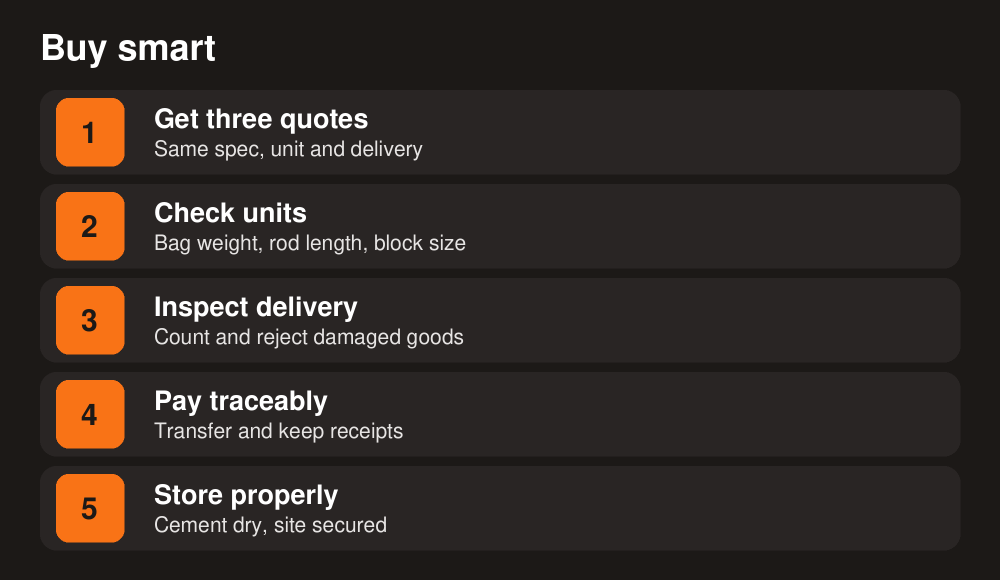
- Get three written quotes for identical specification, unit and delivery.
- Buy in stages to match your build schedule, but lock in prices for big items like iron rods when a trusted supplier offers a firm quote.
- Check the weights and sizes: a 50kg bag, 12m rod and 9-inch block mean different things at different suppliers.
- Inspect on delivery: count blocks and sheets, check rod diameters and reject damaged goods before the truck leaves.
- Keep every receipt and pay by traceable transfer, not cash.
- Protect materials: store cement dry and raised, cover sand and granite, and secure the site against theft.
If you are building from abroad, use a trusted site supervisor and do not send money to a relative or contractor without milestone-based payments. See our guide to investing in Nigerian real estate from abroad. Before you buy the plot itself, read how to verify land ownership in Lagos State.
Frequently asked questions
What is the cheapest building material in Nigeria?
Per unit, sand, granite and sandcrete blocks are among the cheapest materials, but “cheapest” depends on what you are building. For most houses, cement, iron rods and roofing make up the bulk of the material budget, so those are where careful buying saves the most.
How much is a bag of cement in Nigeria in 2026?
Recent reports show roughly N12,000 to N15,000 per 50kg bag depending on brand, city and dealer. Delivery is often extra, so compare delivered prices.
Are iron rod prices falling in 2026?
One price tracker reports bulk iron rod prices down about 17 percent from 2025, but still more than double the 2023 level. Prices can change quickly, so check current quotes.
Is it cheaper to make my own blocks?
It can be, if you have the right mould, good sand, correct cement ratio and time to cure the blocks properly. Poorly made blocks save little and can weaken your walls.
Do prices differ between Lagos and other states?
Yes. Transport, demand and local supply all matter, and prices in one city can be noticeably different from another. Always use local quotes.
How can I reduce the cost of building a house?
Keep the design simple, use standard sizes, buy in stages from trusted suppliers, prioritise structure over finishes, and use a qualified engineer and supervisor to avoid expensive mistakes.
Disclaimer: prices are indicative and drawn from dated third-party price pages and news reports (August to October 2026). They are not quotes. Confirm with suppliers before budgeting.
Join the discussion
Have you tried this, or do you have a question we did not answer? 1 reader has already shared their view. Naijatipsland members help each other with real, first-hand experience.









Thanks for reading. Material prices move fast, so treat every figure here as a guide and get three written quotes before buying. If you have a recent price from your town for cement, blocks or rods, share it below and it will help other readers. – Ade Adeniyi