
Cheapest States to Live in Nigeria in 2026: Inflation Data, Rents and Trade-Offs


Last updated: 5 November 2026 · By Naijatipsland Editorial Team · Editorial policy
If you are choosing where to live, move, retire or work remotely in Nigeria, the cost of living can differ dramatically from one state to another. Lagos and Abuja dominate the headlines because of their jobs and prices, but many other states offer cheaper rent, cheaper food and a slower pace. This guide explains the cheapest states to live in Nigeria in 2026, using the latest official inflation data from the National Bureau of Statistics (NBS), reported rent ranges, and an honest look at the trade-offs, including security, jobs and infrastructure. It is written from a UK-based perspective for Nigerians at home and in the diaspora who are weighing a move or planning a return.
A crucial caveat first: most “cheapest states” lists you will see, including the monthly Nairametrics rankings, are based on inflation rates (how fast prices are rising), not on price levels (how expensive things already are). A state can have very low inflation in a given month and still be costly to live in, or the reverse. We therefore combine the official data with reported rent and living-cost estimates and flag where evidence is thin. For a city-level view of Lagos, see our guide to the cheapest areas to live in Lagos.
The official picture: states with the lowest inflation in September 2026
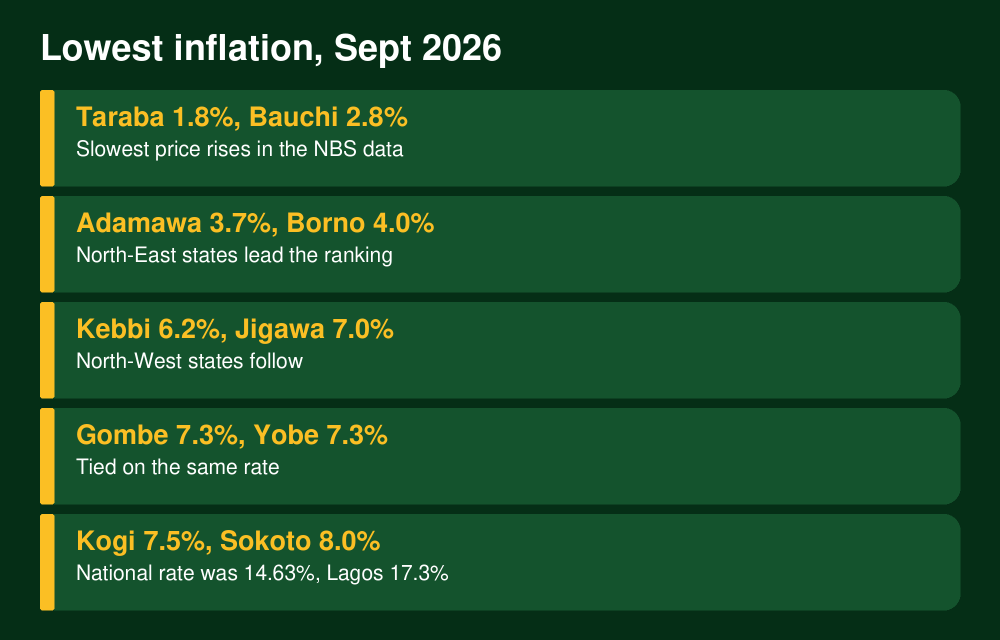
NBS figures for September 2026, released on 15 October 2026, showed national headline inflation falling to 14.63 percent from 15.39 percent in August, with food inflation at 19.59 percent. Nairametrics ranked states by headline inflation for the month. The ten states with the slowest price rises were:
- Taraba: 1.8%
- Bauchi: 2.8%
- Adamawa: 3.7%
- Borno: 4.0%
- Kebbi: 6.2%
- Jigawa: 7.0%
- Gombe: 7.3%
- Yobe: 7.3%
- Kogi: 7.5%
- Sokoto: 8.0%
Six of the ten are in the North-East, three in the North-West and one (Kogi) in the North-Central region; no southern state made the list. By comparison, Lagos ranked 30th at 17.3 percent. The previous month’s ranking looked quite different (in August, Sokoto, Kebbi, Jigawa, Borno and Kogi led), which shows how volatile monthly state figures are. A single month is a snapshot, not a verdict, and a low rate can reflect statistical quirks, falling food prices after a harvest, or lower market activity rather than genuine cheapness.
Reported rents and living costs in popular affordable states
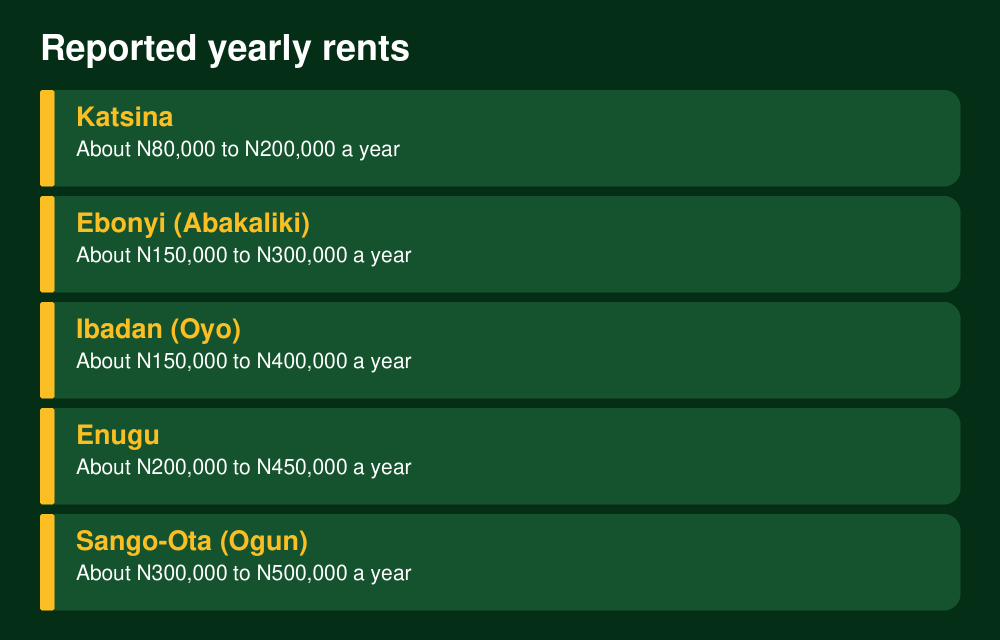
For day-to-day costs, a Nigerian finance blog published a 2026 guide with estimated rents and monthly expenses for a single person in several states. These are estimates from one source and should be treated as rough guides, but they help show relative differences:
- Ebonyi (Abakaliki): self-contain rent roughly N150,000 to N300,000 a year; food about N18,000 to N25,000 and transport N8,000 to N15,000 a month. Trade-off: a limited formal job market, mostly government, agriculture and small trade.
- Katsina: rent roughly N80,000 to N200,000 a year; food about N15,000 to N22,000 and transport N6,000 to N12,000 a month. Trade-off: security concerns in parts of the North-West and limited formal jobs.
- Enugu: rent roughly N200,000 to N450,000 a year; food about N20,000 to N30,000 and transport N10,000 to N18,000. Trade-off: a smaller job market than Lagos, though broader than Abakaliki, and periodic insecurity in the South-East.
- Ibadan (Oyo): rent roughly N150,000 to N400,000 a year; food about N22,000 to N30,000 and transport N10,000 to N20,000. Trade-off: commuting to Lagos on the expressway is exhausting, so it suits remote workers or Ibadan-based jobs.
- Ogun (Abeokuta, Sango-Ota): Sango-Ota rents roughly N300,000 to N500,000 a year. Trade-off: long commutes into Lagos.
- Kaduna: two-bedroom rents roughly N500,000 to N900,000 a year, with security concerns in some rural and peri-urban areas.
Those figures are low enough to explain why many remote workers and retirees look beyond Lagos, but they are estimates for a single person with modest spending. Your own costs will depend heavily on neighbourhood, electricity, school fees, generator fuel and internet.
How the cheapest states compare, and what you give up
Cheaper living almost always comes with trade-offs, and the right choice depends on your priorities.
Jobs and income
Lagos and Abuja concentrate private-sector jobs, banks, start-ups and international firms. In cheaper states, the biggest employers are often government, education, agriculture and small trade. Remote work changes this, but you need reliable power and internet.
Security
Several of the lowest-inflation states, including Borno, Yobe and Adamawa, are in the North-East, where insecurity has been a long-running concern. Parts of the North-West and South-East also face periodic security challenges. Before relocating, check the latest official and local security advisories for the specific town and neighbourhood, not just the state, and speak to people already living there.
Infrastructure and services
Power, roads, hospitals, schools and internet can be weaker outside the big cities. Cheaper rent may be offset by generator or solar costs, travel to access healthcare, or school fees for boarding.
Food prices
Food prices can be lower in agricultural states close to where food is grown, but they move seasonally and with transport costs. Food inflation in individual states swung widely between July and August 2026, so there is no guarantee that a low-inflation state is cheap for food.
Who should consider which state?
- Remote workers and freelancers: Enugu, Ibadan and parts of Ogun offer lower rents with better connectivity than many rural areas. Test internet and power in the exact neighbourhood.
- Families: prioritise schools, healthcare and security. A state that looks cheap on paper may cost more if you must pay for private schools or private power.
- Retirees and returnees: consider where you have family, access to good hospitals and flights. Our guide to investing in Nigerian real estate from abroad covers safe ways to buy or build back home.
- Students and early-career workers: university towns often offer lower rents, but check commuting and job prospects.
A practical way to test a state before you move
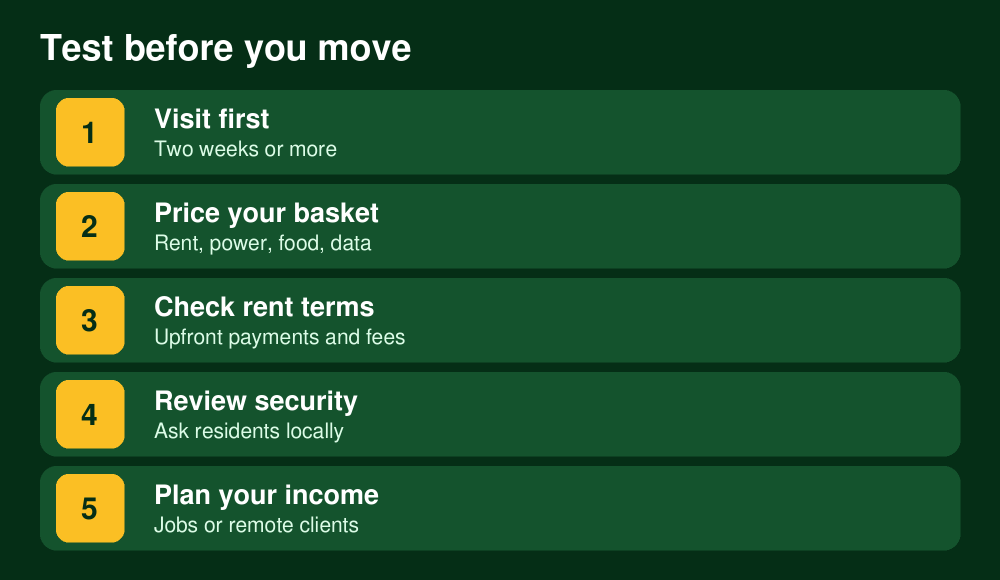
- Visit first. Spend at least two weeks, ideally across different parts of the month, living as you would normally.
- Price your actual basket. Rent, electricity or solar, water, food, transport, data, school fees and healthcare.
- Check the rent terms. Many landlords ask for one to two years upfront, plus agent and legal fees. See our guide on mistakes first-time landlords make in Nigeria to understand how the other side thinks.
- Verify property before buying. If you plan to buy land or a house, run proper searches; our guide to verifying land ownership in Lagos State explains principles that apply broadly, though each state has its own land registry.
- Plan for income. Confirm job or client prospects before you give up your current income.
- Review security locally. Talk to residents, and monitor trusted news sources.
Bottom line
There is no single cheapest state in Nigeria. On the latest official inflation data, states such as Taraba, Bauchi, Adamawa, Borno and Kebbi are seeing the slowest price rises, while rent and cost estimates point to states like Ebonyi, Katsina, Enugu and Oyo as relatively affordable for day-to-day living. The right choice balances cost against jobs, security and services. Use the data here as a starting point, then verify on the ground.
Related guide (updated 5 November 2026): How to Save Money on a Low Salary in Nigeria (2026) — a step-by-step savings plan with current 2026 prices, savings rates and treasury bill yields.
Related guide (updated 5 November 2026): Profitable Agricultural Businesses in Nigeria for Beginners (2026) — startup costs, current prices and risks for poultry, fish, crops and processing.
Frequently asked questions
Which is the cheapest state to live in Nigeria in 2026?
It depends on how you measure it. By lowest headline inflation in September 2026, Taraba ranked first at 1.8 percent. By reported rents and living costs, states such as Ebonyi, Katsina, Enugu and Oyo are often cited as affordable. No single ranking captures everything.
Are inflation rankings the same as cost of living?
No. Inflation measures how quickly prices are rising, not how high prices already are. A state with low inflation can still be expensive, and one with high inflation can still be cheap.
Is Lagos the most expensive state?
Lagos is widely regarded as one of the most expensive places to live, mainly because of rent and property prices. In September 2026, its inflation rate was 17.3 percent, ranking it 30th, above the national rate of 14.63 percent.
Is it safe to live in the cheapest states?
Safety varies by state and by neighbourhood. Several low-inflation states have had serious security challenges, so check current advisories and speak to residents before moving.
Can I work remotely from a cheaper state?
Yes, many people do, but you need reliable electricity and internet. Test both in the exact area before committing to a long lease.
How often do these rankings change?
Monthly. The NBS publishes new state-level inflation data each month, and rankings can shift sharply from one month to the next.
Sources and notes: inflation data are from NBS figures as reported by Nairametrics and Voice of Nigeria (September 2026). Rent and living-cost ranges are estimates from a single 2026 finance blog and are indicative only.









Thanks for reading. Remember that inflation rankings show how fast prices are rising, not how cheap a state already is, so visit and price your own basket before moving. Which state are you considering? Tell me below. – Ade Adeniyi
Follow-up: if you are weighing a move, rent a place short-term first and track what you really spend over a month. That beats any ranking. Let me know which state you are eyeing. – Ade Adeniyi