
How to Import Goods From China to Nigeria (2026): Step-by-Step Guide, Costs and Scams

Last updated: 8 November 2026 · By Naijatipsland Editorial Team · Editorial policy
Importing from China can turn a small capital into a real business, but it can also eat that capital through hidden charges, bad suppliers and goods stuck at the port. This guide explains how to import goods from China to Nigeria in 2026, from checking whether your product is allowed, through Form M, SONCAP and the PAAR, to paying duty and avoiding the scams that catch first-time importers. Checked 8 November 2026. Duty rates, levies, freight prices and portal rules change often, so treat every figure below as a guide and confirm it with the Nigeria Customs Service, your bank and a licensed clearing agent before you pay anyone.
The short answer
- Check first: make sure the product is not on the import prohibition list and find its HS code, because the code decides your duty rate and which permits you need.
- Paperwork: a Form M opened through your bank is mandatory for commercial imports; regulated goods also need a SONCAP certificate; then a PAAR and a Single Goods Declaration are needed to clear at the port.
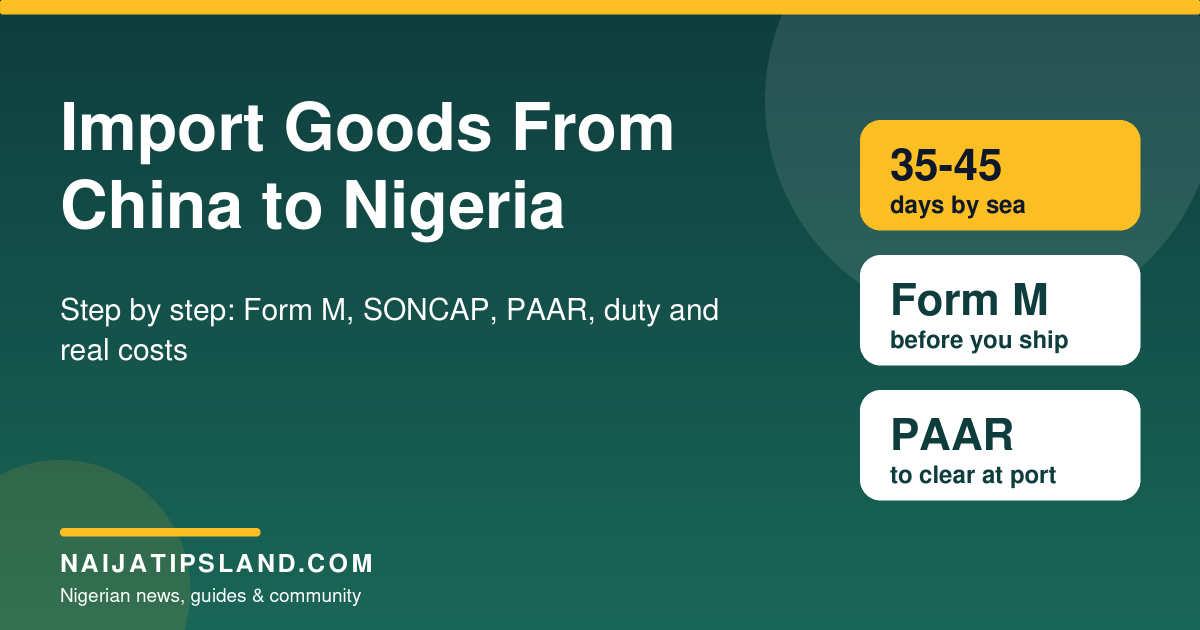
- Time: sea freight from southern Chinese ports to Lagos is typically 35 to 45 days, air freight 5 to 10 days, plus production, inspection and clearing.
- Real cost: landed cost on finished consumer goods commonly runs 40% to 80% above the supplier’s quoted price once freight, insurance, duty, VAT and port charges are added (third-party estimates, not an official figure).
- Biggest risks: paying a supplier that is not who it claims to be, shipping before the paperwork is ready, and wrong HS codes.
Step 1: Check that your product can be imported
Nigeria restricts some goods outright. The Nigeria Customs Service announced its 2026 fiscal policy measures and tariff amendments on 29 July 2026, covering a revised Import Adjustment Tax list, a revised National List, a revised Import Prohibition List and a Green Tax Surcharge on higher-capacity motor vehicles. The full orders are published on the Customs website, so always read the current text rather than relying on social media posts.
A law firm’s summary of the 2026 measures says a revised prohibition list restricts imports from outside the ECOWAS region across 17 categories from 1 April 2026, with a 90-day transition for transactions backed by valid Form M documents and irrevocable commitments made earlier. The categories it lists include poultry and livestock products, some meat cuts, refined vegetable oils, sugar, cocoa products, processed tomato products, medicaments, NPK fertiliser, bagged cement, selected steel products, cartons, soaps and detergents, sweetened beverages and ballpoint pens. If your product is anywhere near these, check the official list before you pay a deposit.
Also decide whether your product needs a regulator. Food, drinks, cosmetics and drugs need NAFDAC clearance (see our guide to NAFDAC registration for small food and cosmetic businesses), and many manufactured products need SONCAP conformity certification from the Standards Organisation of Nigeria.
Step 2: Find the HS code and estimate your landed cost
Every product has a Harmonised System (HS) code. The code decides the duty rate, so a wrong code can mean underpaying (penalties or seizure) or overpaying. Nigeria Customs has an online tariff search tool, and your clearing agent should confirm the code before you ship.
Third-party guides give these typical ranges, which you should treat as estimates: customs duty of about 5% to 35% of the CIF value depending on the HS code, VAT of 7.5% on the CIF value, clearing agent fees of roughly 1% to 1.5% of goods value, and marine insurance of about 0.3% to 0.5% of cargo value on one freight forwarder’s schedule. Other levies apply to some categories. One guide’s worked example for a US$30,000 container of goods at about 20% duty reached an estimated landed cost near US$49,300, which is roughly 64% above the FOB price.
A note on the 4% FOB charge. Customs announced a 4% charge on the free-on-board value of imports in 2025, then suspended it after objections, and later reports described declarations being cancelled and re-captured. Reports have been confusing, and the 29 July 2026 Customs statement does not mention it, so ask your agent whether any FOB-based charge applies to your consignment today and get the answer in writing.
Step 3: Register your business and get a TIN
You can buy a few items for personal use without a company, but regular commercial imports are far smoother with a registered business, a Tax Identification Number and a corporate bank account. See our guides to registering a business name with CAC and registering a limited company.
Step 4: Find and verify a supplier
Most first-time importers find suppliers on platforms such as Alibaba, 1688 or through agents in Guangzhou and Yiwu. Whatever the source, verify before you pay:
- Check the company against the Chinese business registry (SAMR) and ask for its business licence.
- Make sure the bank account name on the invoice is the same as the registered company name. One forwarder guide calls an account-name mismatch the most common fraud on the corridor.
- Order a sample first and test it. Quality, packaging and labelling matter for SONCAP and NAFDAC.
- Ask for a pro-forma invoice with the HS code, Incoterms (for example FOB Guangzhou), unit prices and delivery time.
- On first orders avoid paying 100% upfront. A common structure is 30% deposit and 70% against the bill of lading and inspection report.
- If you use a platform, use its escrow or trade assurance service and keep all communication on the platform.
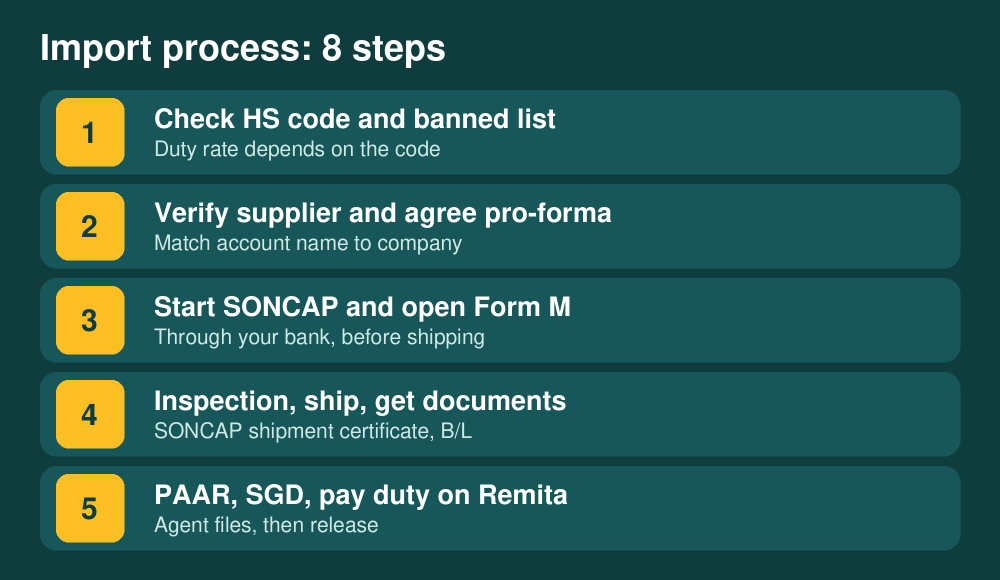
Step 5: SONCAP, Form M and the pre-shipment paperwork
The usual order of events, according to current importer guides, is:
- Start the SONCAP Product Certificate for regulated goods before you open the Form M.
- Open the Form M through a CBN-licensed bank on the Nigerian Single Window. It captures the pro-forma invoice, a Nigerian marine insurance certificate and the SONCAP certificate where needed. Do not let the supplier ship before the Form M is approved.
- Pre-shipment inspection: the supplier contacts an accredited inspection firm, and a SONCAP Shipment Certificate is issued for each consignment. One guide says SONCAP processes moved to the National Single Window portal in March 2026, so confirm the current portal with your agent.
- Ship and receive the bill of lading, commercial invoice, packing list and certificate of origin.
Missing or mismatched certificates are a leading cause of demurrage (port storage charges) and refusal of clearance.
Step 6: Choose how to ship
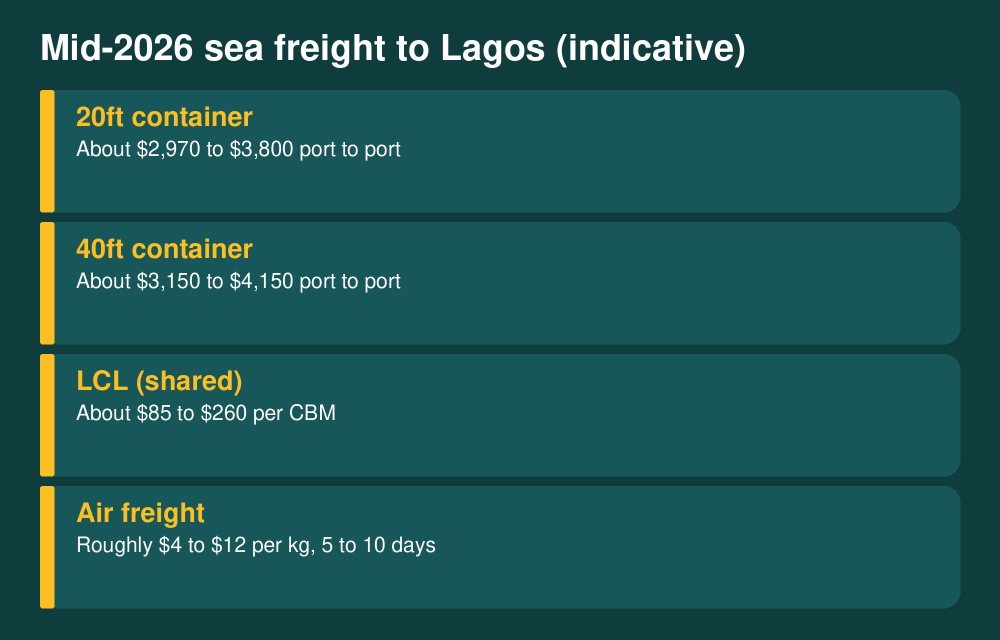
The right mode depends on volume, value and urgency. Third-party forwarders’ mid-2026 price listings, which move with fuel, season and carrier surcharges, show these indicative ranges to Lagos:
- 20ft container (FCL): about US$2,970 to US$3,800 port to port from major Chinese ports.
- 40ft container: about US$3,150 to US$4,150 port to port.
- Part-load (LCL): roughly US$85 to US$260 per cubic metre depending on volume, with 5 to 15 CBM at the cheaper end.
- Air freight: roughly US$4 to US$12 per kg for 5 to 10 days; suited to high-value or urgent goods.
- Sea transit: about 35 to 45 days, longer from northern ports such as Qingdao and Tianjin; door to door 42 to 50 days is typical.
Extra charges include origin and destination terminal handling, documentation, peak-season surcharges (August to October) and carrier surcharges. Shipments to Port Harcourt cost much more than to Lagos on one listing. Book four to six weeks ahead for busy periods, and ask any forwarder for a written all-in quote that states what is and is not included.
Step 7: Clearing at the port
- PAAR (Pre-Arrival Assessment Report): your agent applies for it through Customs’ system while the goods are in transit. Goods cannot be cleared without an approved PAAR.
- Single Goods Declaration (SGD): filed by your licensed agent at the port. Customs classifies, values and may inspect the goods.
- Pay duties and charges through the official payment platform (Remita) and keep the receipts.
- Release and delivery: terminal charges, shipping line charges and any demurrage must be settled before the goods leave. Free storage periods are usually 7 to 14 days, after which daily charges can be heavy.
Use a licensed customs broker, ask for their licence details, and get a written breakdown of every fee. Be wary of anyone who offers to “skip” the process for cash, because that exposes your goods to seizure and you to prosecution.
Warning signs of import scams
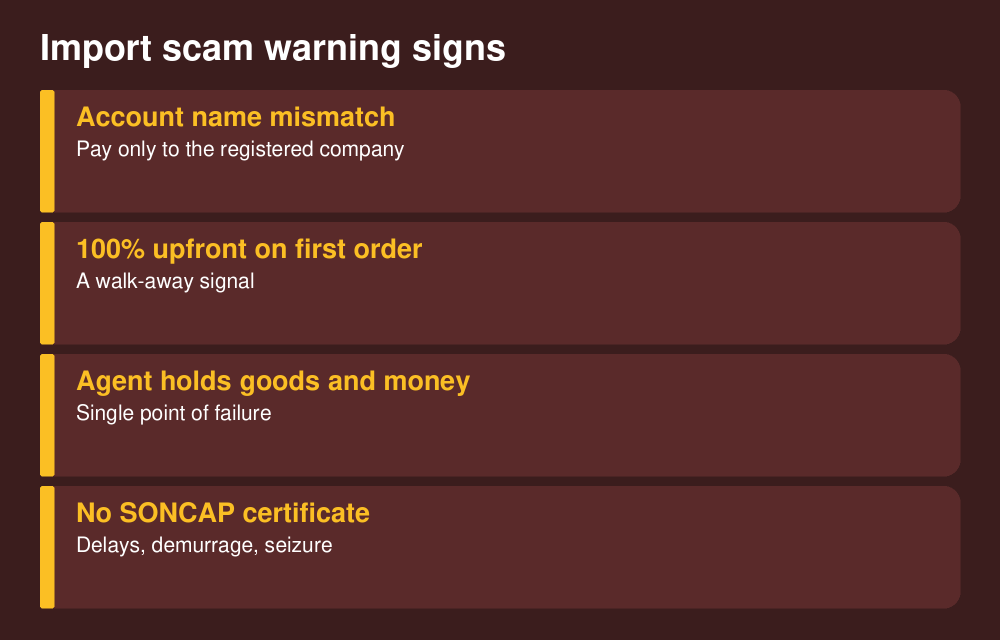
Most losses come from a short list of patterns. None of this is about any particular company; it is about behaviour you can check.
- The bank account is in a personal name, or a different name from the company on the invoice.
- A new supplier demands full payment upfront or pushes you to pay through an informal channel “for faster processing”.
- The price is far below every other quote for the same product.
- An agent controls the goods, the documents and the money all at once, so you have no independent check.
- You are told Form M or SONCAP “does not matter” for your product.
- Someone you met on social media sells a “guaranteed” import business or investment scheme.
Safer options include paying a verified company account, using platform escrow, paying a deposit then the balance against documents, inspecting before final payment, and starting with a small order. Read our guide to common WhatsApp scams in Nigeria and, if you lose money, how to report cybercrime in Nigeria.
A simple example of the maths
Suppose a supplier quotes US$10,000 for goods. On one guide’s illustrative ranges, freight might add US$1,500 to US$4,000, duty and VAT US$750 to US$3,500, and agent and port fees US$200 to US$600. That puts the landed cost somewhere around US$12,450 to US$18,100 before inland delivery and before you have sold anything. Always build your own spreadsheet using your real HS code and a written freight quote, then price your goods so you still make a margin if the naira moves.
Tips for first-time importers
- Start with one product you understand and a small, low-risk shipment.
- Keep copies of every document: pro-forma, Form M, SONCAP, bill of lading, receipts.
- Include insurance in your quote.
- Pay attention to labelling and packaging requirements for your product category.
- Keep your business separate from personal accounts so your records are clean.
- If your goods are food, drinks or cosmetics, plan the NAFDAC process early.
If you are still choosing a business idea, see our guides to profitable businesses to start from home and the Start a Business in Nigeria hub.
FAQ
Do I need a Form M to import from China to Nigeria?
Form M is mandatory for commercial imports. Some personal effects and small consignments fall outside it, so ask Customs or a licensed agent if your shipment is small.
How long does it take to import goods from China to Nigeria?
Allow production time plus roughly 35 to 45 days by sea or 5 to 10 days by air, then 5 to 15 days for assessment and clearing in many guides’ estimates.
How much duty will I pay?
It depends on the HS code. Guides quote 5% to 35% duty plus 7.5% VAT and other levies, but the only reliable figure comes from the Customs tariff for your exact code.
What is a PAAR?
A Pre-Arrival Assessment Report. Your agent applies for it through Customs while your goods are at sea, and goods cannot be cleared without it.
Is SONCAP compulsory?
For many regulated products it is. Ask the Standards Organisation of Nigeria or your agent whether your product category needs a certificate.
How can I avoid being scammed by a Chinese supplier?
Verify the company, match the bank account name to the registered name, order samples, avoid 100% upfront payment on first orders, and use escrow or documentary payment where possible.
Can I import without a registered company?
Small personal purchases may not need one, but regular commercial imports are easier and safer with a registered business, TIN and corporate account.
Which port should I use?
Most goods arrive through Lagos ports such as Apapa, Tin Can and Lekki Deep Sea Port. Ask your agent which has better turnaround for your cargo.
Is the 4% FOB charge being collected?
Reports about this charge have changed more than once. Ask your agent for the current position in writing before you finalise your costing.
Bottom line
Importing from China works when you do things in the right order: check the product is allowed, find the HS code, verify the supplier, open the Form M, get the certificates, ship, then clear with a licensed agent. Cost your goods honestly, start small and never pay a stranger without verification.
This guide is general information, not legal, customs or financial advice. Rules and prices change, so confirm with the Nigeria Customs Service, the Standards Organisation of Nigeria, your bank and a licensed clearing agent.
Sources
- Nigeria Customs Service: 2026 fiscal policy measures and tariff amendments (29 July 2026)
- SCP Law: Nigeria 2026 fiscal policy measures and import restrictions
- TheCable: Customs cancels import declarations under suspended FOB levy
- Within Nigeria: Importing goods from China to Nigeria (11 June 2026)
- DTFU Logistics: China to Nigeria container costs (mid-2026)
- Keybs: Importing from China to Nigeria 2026
Freight and cost figures come from third-party forwarders and guides, are indicative and change often.
Join the discussion
Have you tried this, or do you have a question we did not answer? 1 reader has already shared their view. Naijatipsland members help each other with real, first-hand experience.





Ade Adeniyi here. If you have imported from China to Nigeria, what surprised you most: the freight cost, the clearing charges or the paperwork? Share your experience below (no supplier names or payment details, please) so other first-time importers can learn from it. Remember to check current Customs rules before you ship.