Last updated: 30 October 2026 · By Naijatipsland Editorial Team · Editorial policy
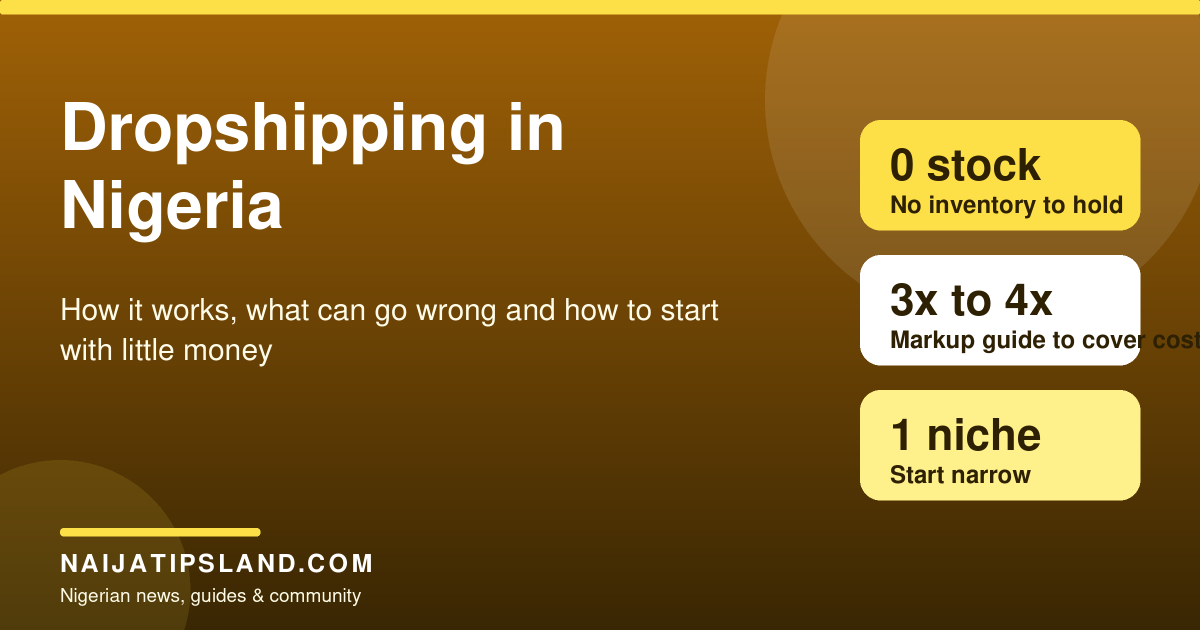
Dropshipping lets you sell products online without holding stock. You list items in your own store, a supplier ships them directly to your customer, and you keep the difference between your selling price and the supplier’s price. It sounds simple, and low startup cost is why so many Nigerians ask about it. But the business is harder than the YouTube videos suggest: margins are thin, delivery and payments need planning, and a lot of “courses” are the real money-makers. This guide explains how it works, what to watch for in Nigeria, and how to start carefully. Checked 30 October 2026. This is general information, not financial advice, and no income is guaranteed.
How dropshipping works
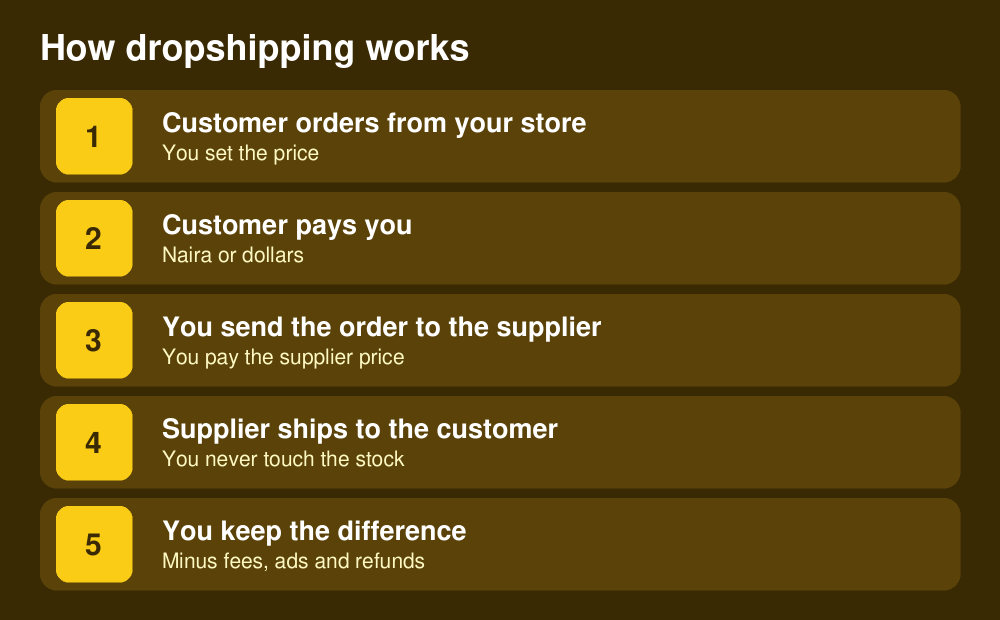
The flow is: a customer orders from your store and pays you, you place the same order with your supplier at the supplier’s price, and the supplier packs and ships it to your customer. Because the supplier usually wants payment before shipping, and customer card payments can take a few business days to reach your bank, you often need some working cash to bridge the gap. Shopify’s Nigeria guide notes that some supply partners offer margins of roughly 20% to 50%, but fierce competition can reduce what you actually keep.
Is dropshipping worth it in Nigeria?
It can be a low-cost way to test whether people will buy a product, but it is rarely “passive”. You still handle marketing, customer messages, refunds and supplier problems. Challenges that Nigerian sellers commonly face include slow overseas shipping, customs and delivery uncertainty, exchange-rate swings, trust (buyers worry about scams), and the cost of paid advertising. If you enjoy testing products, writing good descriptions, replying quickly and tracking numbers carefully, it may suit you. If you want guaranteed income, it will not.
Choose your model
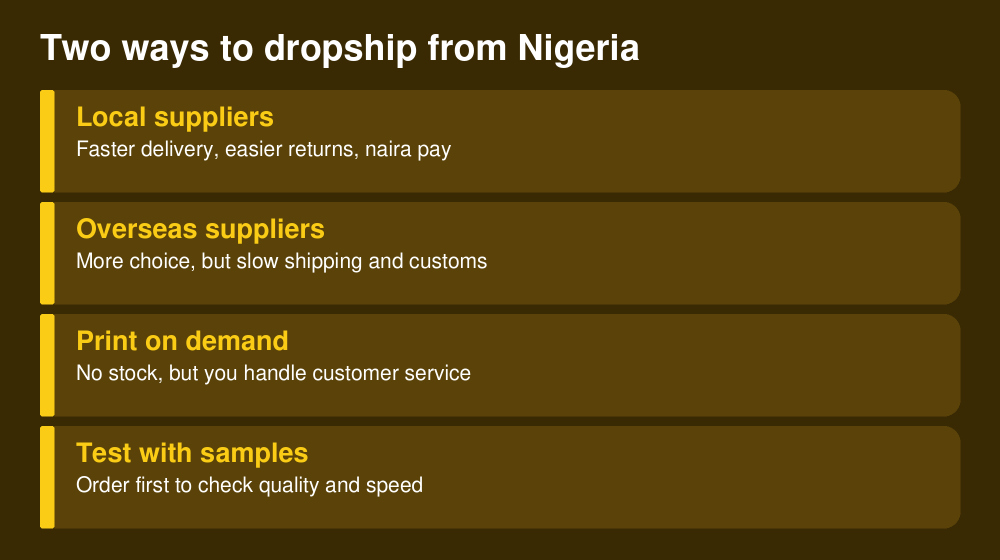
- Local suppliers or wholesalers: you sell items that a Nigerian supplier can dispatch or deliver within your city or country. Delivery is faster, returns are easier, and customers can pay in naira. The trade-off is a smaller catalogue and lower margins. Always confirm stock and delivery time with the supplier before listing.
- Overseas suppliers: platforms such as AliExpress and CJdropshipping give you huge catalogues, and curated services such as Spocket and Syncee list vetted regional suppliers, according to Stripe’s dropshipping guide. Shipping can be slow and customs and delivery to Nigeria need extra care, so order samples and check delivery times to your target cities first.
- Print on demand: services like Printful and Printify produce custom designs only after an order is placed, which removes inventory risk. You still handle design, marketing and customer care, and shipping to Nigeria may be slow or costly.
Step-by-step: how to start
- Pick a narrow niche. A focused category (for example, phone accessories for students or kitchen gadgets) is easier to market than “everything”. Check that people search for it year-round using free tools such as Google Trends, instead of chasing short fads.
- Find reliable suppliers. Read reviews, check shipping speed, return policy and hidden fees, and talk to the supplier. Order samples of anything you plan to sell.
- Work out your numbers. Stripe’s guide suggests aiming for roughly a 3x to 4x markup over supplier cost to cover ads, payment fees and customer acquisition. Include delivery cost, refunds and the exchange rate.
- Choose where to sell. You can start with WhatsApp, Instagram or Facebook Marketplace to test demand, or build a store on Shopify or WooCommerce. Our guide to starting a Shopify store in Nigeria with little money covers that route in detail.
- Set up payments. Shopify merchants targeting Nigerian customers commonly add Paystack or Flutterwave to accept cards, bank transfers and mobile payments. Check each provider’s current fees, settlement currency and business requirements before launching. To pay overseas suppliers you may need a dollar virtual card or other foreign-payment method.
- Write honest listings. Show real delivery times, clear photos and a refund policy. Over-promising is the fastest way to get chargebacks and bad reviews.
- Market with a small budget. Test organic content on TikTok and Instagram, ask micro-influencers to try samples, and only then spend on ads.
- Track every order. Send tracking numbers, reply to messages quickly and keep a spreadsheet of supplier prices, costs and refunds.
Costs to expect
Stripe’s guide puts typical startup costs at roughly $10 to $20 for a domain, a platform subscription from a few dollars (promotional) to about $39 a month, $30 to $100 for product samples and $100 to $300 for initial ads. These are US-based estimates, so convert and adjust for naira prices and your own market. You can reduce costs by testing demand on social media first, using free app tiers and starting with fewer products.
Risks and how to reduce them
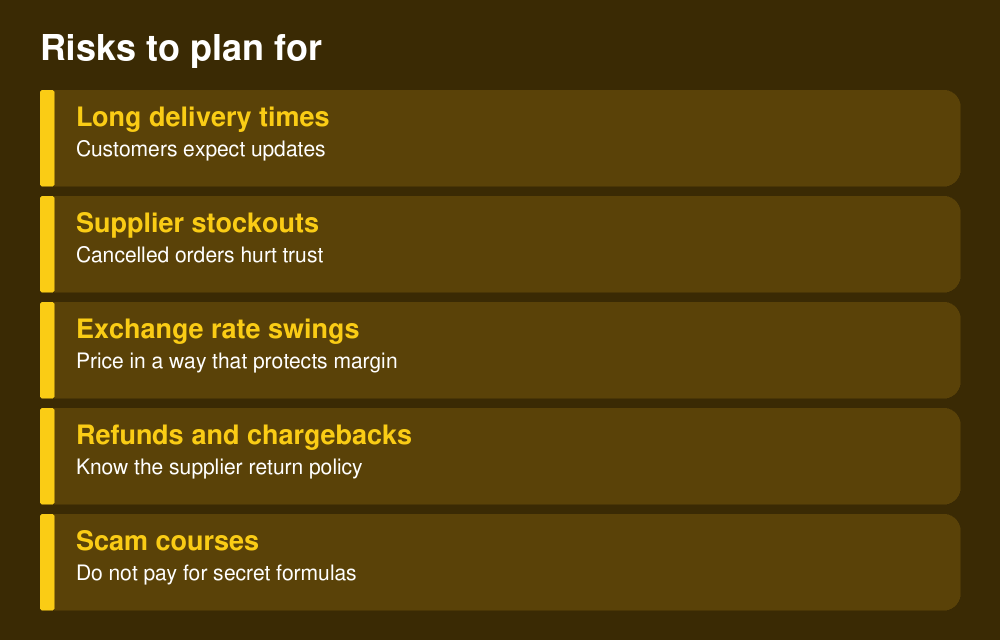
- Slow delivery: tell customers the real time frame and send updates. Consider suppliers with local warehouses.
- Stockouts and quality problems: test samples, avoid fragile or complex items, and have a back-up supplier.
- Exchange-rate swings: review your prices regularly so a weaker naira does not erase your margin.
- Refunds and disputes: understand the supplier’s return rules before you list a product, and keep records of every order.
- Payment gaps: because you often pay suppliers before your customer’s payment lands, start with small orders you can afford.
- Legal and tax: consider business registration and tax obligations as you grow, and speak to a qualified adviser.
Scams and bad advice to avoid
Be cautious of anyone selling a “secret” product list, a paid “winning products” group or a course that promises quick millions. Fake supplier websites also exist, so never wire large sums to a stranger. Read our guides on internet scams in Nigeria and Ponzi schemes before paying for any programme, and check how it compares with other options in our list of online business ideas and side hustles.
Frequently asked questions
Can I start dropshipping in Nigeria with no money?
You can test demand with almost nothing by posting products on social media, but you will still need some money for samples, supplier payments and ads.
Do I need to register a business?
Not to test an idea, but registration and tax compliance become important as you grow. Ask a qualified adviser.
Which payment gateway should I use?
Nigerian merchants commonly use Paystack or Flutterwave for local checkout. Compare fees and eligibility on their sites.
Is dropshipping legal in Nigeria?
Selling products online is legal, but you must follow consumer-protection, tax and import rules, and you should not sell prohibited or counterfeit goods.
Bottom line
Dropshipping lowers the cost of testing a product, but it does not remove the hard work of marketing, customer service and cash management. Start with one niche, order samples, price with a safe margin, be honest about delivery times and avoid anyone who sells a “get-rich” shortcut.