
How to Ship From the USA to Nigeria (2026): Costs, Freight Forwarders and Customs

Last updated: 2 November 2026 · By Naijatipsland Editorial Team · Editorial policy
Checked 2 November 2026. Sending a box of clothes to family, moving your household back home, or bringing in stock for a small business all start with the same question: what is the cheapest safe way to get goods from the USA to Nigeria? The answer depends on weight, urgency and what is inside, and the freight price is only part of the bill once Nigerian customs, clearing and delivery are added.
This guide is about shipping your own parcels and goods. If you mainly want to buy from online stores, see our separate guide on how to buy from Shein, Amazon and Temu in Nigeria. Here we compare air, sea and express options, give 2026 price ranges, explain duty and VAT basics, list prohibited items and show how to avoid the most common shipping scams.
Your main options
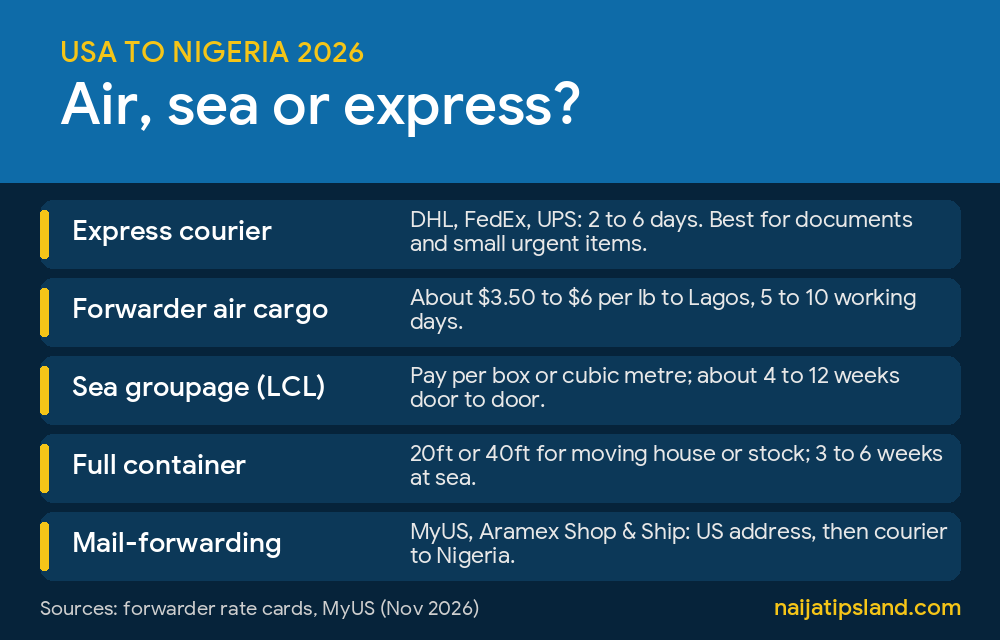
- Express courier (DHL, FedEx, UPS, Aramex): fastest and simplest, with door-to-door tracking and customs handled by the carrier. Expensive per kilo, so best for documents, phones, small gifts and urgent items.
- US-to-Nigeria freight forwarder (air cargo): you drop off or ship your box to the forwarder’s US warehouse; they consolidate cargo and fly it to Lagos, clear it and deliver or hold it for pickup. Much cheaper per kilo than express for 10kg and above.
- Sea freight, shared container (LCL or groupage): you pay for the space your boxes take. Slowest, but the cheapest for heavy, non-urgent items.
- Full container (FCL): a 20ft or 40ft container for moving house, cars or business stock.
- Mail-forwarding services: companies such as MyUS and Aramex Shop & Ship give you a US address, then forward your packages to Nigeria by courier.
How much it costs in 2026
The figures below come from published rate cards and price pages checked in 2026. Rates change often with fuel prices and airline space, so always get a written quote for your exact shipment.
| Method | Example 2026 price | Typical time | Source |
|---|---|---|---|
| Express via MyUS, 5 lb parcel | About $41 (budget) to $104 (FedEx Priority) | 2 to 14 days, by service | MyUS Nigeria page, 1 Nov 2026 |
| Express via MyUS, 10 lb parcel | About $81 (budget) to $138 (FedEx Priority) | 2 to 14 days | MyUS Nigeria page, 1 Nov 2026 |
| Forwarder air cargo to Lagos | About $3.50 to $5.80 per lb ($7.70 to $12.70 per kg) | 3 to 10 working days | Valuehandlers, SGK Global, FCEL rate cards |
| Forwarder air cargo, other states | About $7.85 per lb | 7 to 10 working days | FCEL Texas rate card, 2026 |
| Sea groupage (LCL) | About $70 to $150 per cubic metre, or fixed prices per box size | 4 to 12 weeks | Valuehandlers; FCEL box pricing |
| Full container, ocean freight | Listed from about $1,200 (20ft) and $2,400 (40ft), freight only | 3 to 6 weeks at sea | Valuehandlers price page |
Container prices quoted by forwarders usually cover ocean freight only. Port charges, terminal handling, clearing agent fees, storage and haulage from Apapa or Tin Can to your house can add a large amount, so ask for a door-to-door quote.
Actual weight vs volumetric weight
Air carriers charge on whichever is higher: the real weight or the volumetric weight (length × width × height in cm, divided by 5,000 or 6,000 depending on the company). A big, light box of duvets can cost more than a small, heavy box of books. Pack tightly, remove shoe boxes and use vacuum bags for clothes.
Couriers and forwarders you can check
These companies publish their USA-to-Nigeria services on their own websites. This is not an endorsement or ranking. Check each company’s current rates, terms and reviews before shipping.
- DHL Express: one of the most widely used express couriers into Nigeria, with offices across Lagos and other cities. Its Nigeria site also publishes an import duty guide.
- FedEx and UPS: express and economy international services from the US to Nigeria, usually 1 to 6 business days. Book directly or through resellers.
- Aramex: express delivery plus the Shop & Ship mail-forwarding service with a US address.
- MyUS: US mail-forwarding with package consolidation and a choice of Aramex, DHL, FedEx, UPS or budget economy to Nigeria.
- Valuehandlers: Lagos-based forwarder offering US air cargo, sea groupage and full containers into Lagos airports and ports.
- FCEL (Foon Chaser Express): publishes a 2026 Texas-to-Nigeria rate card for air and sea cargo with a Lagos customs team.
- SGK Global: publishes door-to-door US-to-Nigeria air and sea rates.
Many smaller forwarders run from Houston, Atlanta, Maryland, New Jersey and New York, often advertised on WhatsApp and Instagram. Some are reliable; some disappear with customers’ goods. Use the checks in the scam section below.
Nigerian customs: duty, VAT and levies
Anything arriving in Nigeria can be assessed by the Nigeria Customs Service (NCS). Express couriers usually clear parcels for you and bill duties on delivery; forwarders either include clearing in their price or charge it separately. The main charges, as explained in DHL Nigeria’s June 2026 import guide, are:
- Import duty: a percentage of the CIF value (cost of goods + insurance + freight), set by the item’s HS code under the ECOWAS Common External Tariff. Common rates range from 5% to 35%.
- Surcharge: 7% of the import duty.
- CISS: 1% of the FOB value; ETLS: 0.5% of the CIF value.
- VAT: 7.5% on the CIF value plus duty and levies.
Customs uses the official exchange rate on the day of assessment, so the naira cost can change between shipping and arrival (watch the dollar to naira rate this week). Note also that the 4% FOB charge introduced by the NCS in 2025 has been suspended and reintroduced at different points after objections from importers, so ask your agent which levies apply when your goods land.

Personal effects and gifts: used household goods for a genuine relocation can qualify for concessions, but you will normally need your passport, proof of return or residence and a full packing list. Gifts are still assessed on value, so declare honestly and keep receipts. Under-declaring can lead to seizure and penalties.
Prohibited and restricted items
Nigeria has an absolute prohibition list and a separate import prohibition list. According to the US Commerce Department’s summary of Nigerian rules, items you should not send include:
- Second-hand (used) clothing, which is absolutely prohibited. Many people still send used clothes in personal boxes, but they can be seized.
- Counterfeit or pirated goods, and counterfeit currency.
- Weapons, air pistols, ammunition and items that discharge noxious substances.
- Pork, beef, poultry and bird’s eggs; refined vegetable oil; spaghetti and noodles; fruit juice and bottled water in retail packs; tomato paste in retail packs.
- Most pharmaceuticals (with a short list of exceptions), soaps and detergents in retail packs, and mosquito coils.
- Used fridges, freezers and compressors; used tyres; carpets; and many footwear, bag and suitcase categories.
- Cars more than 15 years old from the year of manufacture.
Carriers add their own restrictions, especially on lithium batteries, perfumes, aerosols, liquids, power banks and Starlink kits, which often attract surcharges or must go by sea. Check with your forwarder before packing.
Clearing and delivery
- Express parcels are cleared by the courier. You may be asked to pay duties before delivery through the courier’s official website or app.
- Forwarder air cargo usually lands at Lagos airport cargo terminals (such as NAHCO or SAHCOL) and is cleared by the forwarder’s agent, then delivered or held at their Lagos office.
- Sea cargo arrives at Apapa or Tin Can. Clearing can take days to weeks, and storage charges build up quickly if documents are missing.
- For containers, use a licensed customs agent and confirm their licence with the NCS.
Tracking and timelines
- Express: 2 to 6 business days in most cases.
- Forwarder air cargo: about 3 to 10 working days to Lagos, longer to other states.
- Sea groupage: roughly 4 to 12 weeks door to door.
- Full container: 3 to 6 weeks at sea, plus clearing time.
Always track on the carrier’s or forwarder’s official website using your tracking or airway bill number, and keep photos of your packed boxes, weight and receipts until delivery.
How to avoid shipping scams
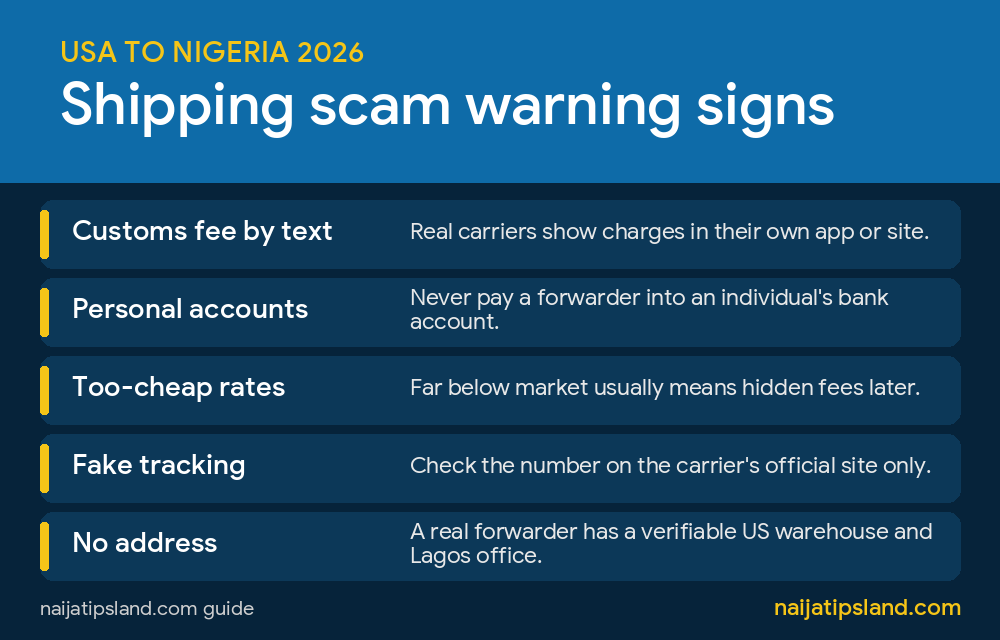
- Ignore “customs fee” texts and emails asking you to pay through a link. Real carriers show charges in their own app or website, and Nigeria Customs does not call or text individuals for payment.
- Never pay into a personal account for freight or duty. Use a company account, card or official payment portal.
- Verify the forwarder: a real address for the US warehouse, a Lagos office, a CAC registration number, and reviews outside their own social media.
- Be wary of rates far below the market. Very cheap per-lb prices often come with surprise clearing charges in Lagos.
- Get everything in writing: rate, what is included (clearing, delivery), transit time and what happens if goods are lost or damaged. Consider insurance for high-value items.
For paying US forwarders, a dollar virtual card or a domiciliary dollar account can help. If you live abroad, our guide to opening a Nigerian bank account from abroad covers paying for delivery and clearing at home. Importing to resell? Read our guide to dropshipping in Nigeria first.
Frequently asked questions
What is the cheapest way to ship from the USA to Nigeria?
For heavy, non-urgent goods, sea groupage is usually cheapest. For 10kg to 50kg that you need within two weeks, a forwarder’s air cargo is usually cheaper than express couriers.
How much is shipping per kg from the USA to Nigeria?
Forwarder air cargo rates published in 2026 range from about $7.70 to $12.70 per kg to Lagos, with higher rates for other states and special items.
Do I pay customs duty on gifts sent from the USA?
Gifts can still be assessed for duty and VAT based on their value. Express couriers will tell you if anything is due before delivery.
Can I send used clothes to Nigeria?
Second-hand clothing is on Nigeria’s absolute prohibition list, so it can be seized at customs, even in personal boxes.
How long does sea shipping from the USA to Lagos take?
Usually 3 to 6 weeks at sea, and roughly 4 to 12 weeks door to door once loading, clearing and delivery are included.
Disclaimer: this guide is general information based on carrier and forwarder websites, DHL Nigeria and US government summaries of Nigerian import rules available on 2 November 2026. It is not legal or customs advice. Companies named are examples, not endorsements. Rates and rules change often, so confirm with the carrier and the Nigeria Customs Service before shipping.








Measure your box before you book: air cargo is charged on volumetric weight if it is higher than the real weight, so tight packing can save you a lot. Which forwarder have you used from the US to Nigeria, and how long did your goods take?