

Last updated: 14 November 2026 · By Naijatipsland Editorial Team · Editorial policy
A cough and a blocked or runny nose are two of the most common reasons people reach for a home remedy, and the harmattan months from about November onwards make them even more familiar for readers in Nigeria. In the UK, where I live, the damp and cold bring the same complaints. The sensible question is not which remedy is most famous, but which ones have some evidence, which are only comforting, and which can do harm. This guide goes through the evidence from the NHS, Cochrane reviews and the US National Center for Complementary and Integrative Health, explains how to use common Nigerian remedies safely, and sets out the warning signs that mean you should see a doctor. Facts are as of 14 November 2026.
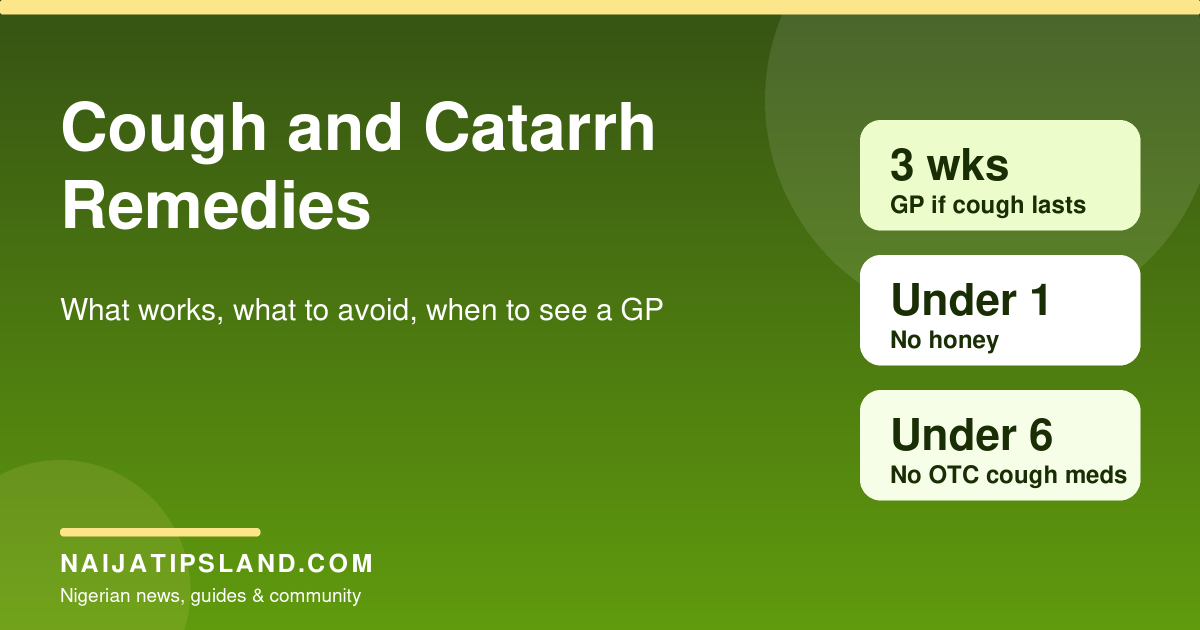
The short answer: most coughs and colds clear up on their own, so rest, fluids and simple comfort measures are reasonable, and honey (for over-ones) and a salt-water gargle (for adults) are low-risk options. No home remedy cures a cold, and a cough that lasts more than three weeks, brings up blood or comes with breathlessness needs a doctor, not another remedy.
How long should a cough or cold last?
The NHS says a cough will usually clear up on its own within three to four weeks. For a cold, symptoms build over two to three days and most people feel better within about one to two weeks. You can be contagious until the symptoms have gone, and germs can survive on hands and surfaces for up to 24 hours, so washing your hands and using tissues matters.
Knowing the normal timeline helps you avoid two mistakes: panicking on day three, and ignoring a cough that has dragged on for months.
Home remedies that are reasonable to try
Honey and lemon
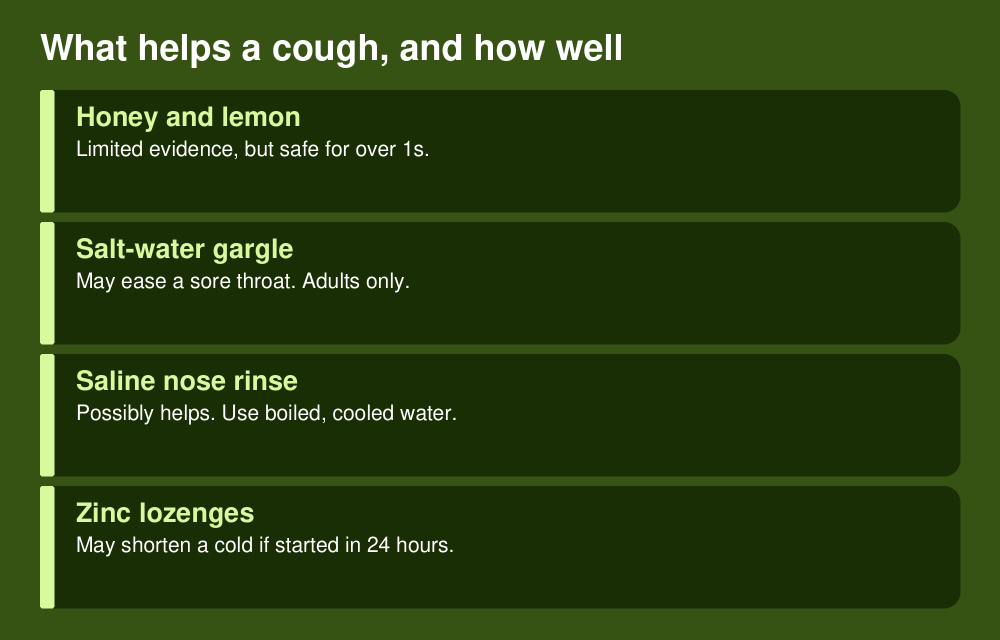
The NHS says hot lemon and honey may work in a similar way to cough syrup, but adds that there is limited evidence for it. Its recipe is half a lemon squeezed into a mug of boiled water with one to two teaspoons of honey, drunk while warm. It is not suitable for babies under one year old, and small children should not be given hot drinks.
For children over one, the best evidence is a Cochrane review (2018) of six trials with 899 children aged 12 months to 18 years. It found honey probably reduces cough better than no treatment or placebo (moderate certainty) and may work about as well as the cough suppressant dextromethorphan (low certainty). The authors still concluded that there is no strong evidence for or against honey, because many children received it for only one night. Honey must never be given to babies under 12 months because of the risk of infant botulism.
Fluids, rest and warmth
The NHS advice is simple: rest, drink plenty of fluids and eat well, and stay at home if you have a high temperature or cannot manage normal activities. Paracetamol or ibuprofen can ease aches and fever. If you take other cold or cough products, check the label so that you do not double up on paracetamol or ibuprofen by accident. Do not give aspirin to anyone under 16.
Salt-water gargle
For a sore throat, the NHS suggests gargling with salt water, but not for children. It is cheap and low-risk for adults, though it only soothes the throat and does not treat the infection.
Steam from a hot shower
For a blocked nose, the NHS suggests breathing in steam from a hot shower. It specifically says children should not inhale steam from a bowl of hot water because of the risk of scalding, and published case reports describe severe scalds from steam inhalation. If you use a bowl as an adult, keep it stable and away from children, and prefer the shower. It will relieve the feeling of congestion for a short time, but I did not find good trial evidence that it shortens a cold.
Saline nose rinses and sprays
A Cochrane review (2015) of five trials with 749 participants concluded that saline nasal irrigation “possibly has benefits” for relieving symptoms, with minor irritation as the only side effect reported. The evidence was low certainty because the trials were small, and the benefits in adults were not clinically significant. The US National Center for Complementary and Integrative Health warns that untreated tap water is unsafe for nasal rinsing, so use sterile, distilled or previously boiled and cooled water. Pharmacy saline sprays are the simplest route.
Zinc, vitamin C, echinacea and garlic
The same US source says zinc lozenges may shorten a cold if started within 24 hours of the first symptoms, but nasal zinc products should be avoided because they can cause lasting loss of smell. Vitamin C does not prevent colds in most people and only slightly reduces their length. The evidence for echinacea is weak, and for garlic it says there is insufficient clinical trial evidence either to prevent or to treat colds. The NHS likewise says there is little evidence that vitamin C, echinacea or garlic prevent or shorten colds.
Common Nigerian remedies: what is sensible and what to avoid
Many of us grew up on ginger tea, lime and honey, garlic, lemongrass (fever grass) tea, bitter leaf and steam with eucalyptus leaves. I could not find strong clinical trial evidence that any of these treat a cough or catarrh, apart from honey and lemon as above. That does not make them dangerous, and a warm drink does help with hydration and comfort, but it does mean you should not expect a cure. A few practical rules:
- Keep it a drink, not a dose. Ginger, lime, lemongrass and garlic in normal food or tea amounts are fine for most healthy adults. Concentrated extracts, capsules and strong boiled mixtures are different, so ask a pharmacist first if you take regular medicines such as blood thinners or diabetes tablets, or if you are pregnant.
- Be careful with unlabelled herbal mixtures (agbo). If you cannot tell what is in a bottle, how strong it is or who made it, do not give it to a child or take it with other medicines. Look for a NAFDAC registration number on any packaged herbal product and be wary of claims that it “cures” cough, catarrh or TB.
- Never use kerosene, petrol or alcohol-based mixtures on or in the body, and do not put menthol rubs or camphor products near a baby’s nose or face. Ask a pharmacist what is suitable for small children.
- Do not skip care because a remedy is traditional. If the cough is long, bloody or comes with fever and weight loss, the cause may be something a remedy cannot fix.
Our guide to natural remedies for common illnesses in Nigeria covers what works and what does not for other complaints, and our piece on traditional Nigerian foods and their health benefits looks at the evidence behind everyday ingredients.
Cough medicines: what a pharmacist can and cannot do
The NHS says cough syrups, medicines and sweets “will not stop your cough, but may help you cough less”, and that decongestants and codeine-containing cough medicines will not stop a cough. For a blocked nose, a pharmacist can suggest a decongestant spray, drops or tablets, but the NHS says decongestants are not for children under six and nasal sprays should not be used for more than a week. Pelargonium, a herbal medicine, is suitable for people aged 12 or over.
In Nigeria, buy medicines only from a licensed pharmacy and check the packaging and NAFDAC number. The federal government announced a ban on the production and importation of codeine-containing cough syrups in May 2018 after an addiction exposé, and NAFDAC has repeatedly warned about substandard or contaminated syrups, including a 2024 recall of a children’s cough syrup over a toxic substance. If a product looks fake, is sold without packaging or is offered by a street seller, do not use it.
Babies and children
Children need extra care. The UK medicines regulator (the MHRA) advised in 2009 that over-the-counter cough and cold medicines, including cough suppressants, expectorants, decongestants and antihistamines, should no longer be used in children under six, and for ages six to twelve they should be bought only from a pharmacy where advice can be given. The MHRA also noted there is no robust evidence that these ingredients work. The NHS adds that some cough medicines should not be given to children under 12.
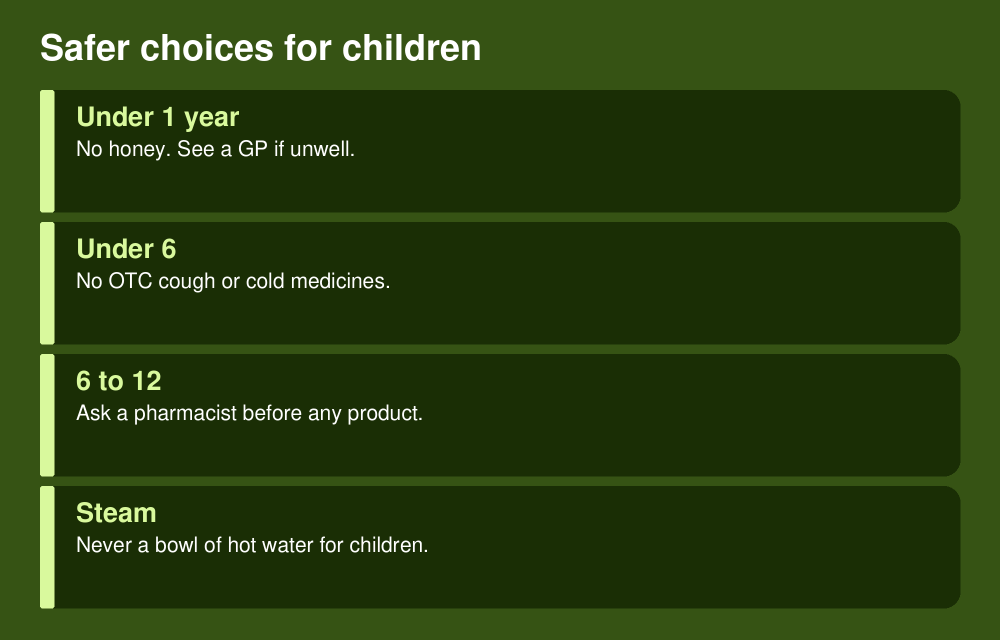
For a child with a cough, the safest approach is rest, fluids, honey for those over one (a teaspoon at bedtime is a common suggestion, but check the NHS or your pharmacist for the right amount for your child’s age), a cool-mist or shower steam for congestion without any bowl of hot water, and a medical check if the child is very young, feeding poorly or breathing quickly. Do not wait for a cough to “run its course” in a baby.
When a cough is not just a cough
The NHS lists these reasons to get medical help:
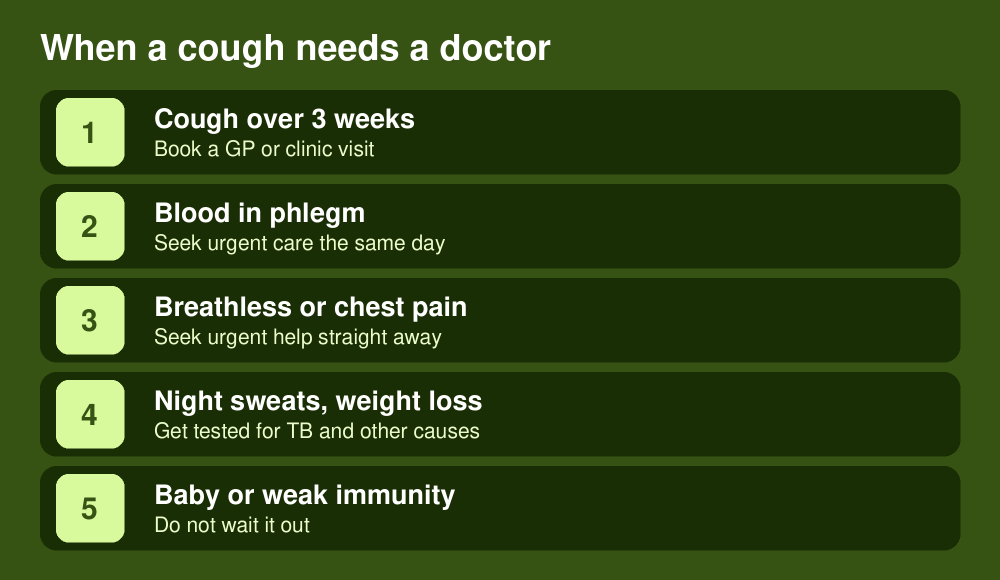
- See a GP (non-urgent) if your cough lasts more than three weeks, you have unexplained weight loss, or you have a weakened immune system, for example through chemotherapy or diabetes. For colds, see a GP if symptoms get worse or do not improve after 10 days, a high temperature lasts more than three days, or you have shortness of breath or chest pain.
- Get urgent help (call NHS 111 or an urgent GP appointment in the UK) if the cough is very bad or quickly getting worse, you feel very unwell, you have chest pain, a swollen painful side of the neck, difficulty breathing, or you are coughing up blood. In Nigeria, go to the nearest hospital or clinic.
A cough lasting more than three weeks is also a symptom to check for tuberculosis (TB). The NHS lists a cough of more than three weeks, sometimes with blood in the mucus, a high temperature or night sweats, unexplained weight loss, loss of appetite and constant tiredness. Risk is higher for people who live with someone with active TB, people born in or who have lived in areas where TB is more common, and people with weakened immunity, such as HIV or diabetes. TB is treatable, so do not delay a test out of fear or because a herbal mixture seems to help. Diaspora readers should mention their travel history when they see a GP.
Cough and fever can also overlap with other illnesses; if you have fever, chills and body ache after mosquito exposure, read our guide to typhoid vs malaria symptoms. If you have just moved to the UK, our first 30 days checklist explains how to register with a GP so that you can get seen when you need to.
Practical tips for harmattan and cold weather
- Drink water regularly, because dry air and fever both dry you out.
- Keep your room ventilated but avoid sleeping directly in a draught.
- Do not smoke and avoid smoky cooking spaces, because the NHS says smoking can worsen cold symptoms.
- Wash your hands and use tissues, then bin them promptly.
- Stay home if you have a high temperature or feel too unwell for normal activities.
FAQ
What is the best home remedy for cough and catarrh?
There is no single best remedy. Rest, plenty of fluids and, for adults and children over one, a warm drink with lemon and honey are low-risk options. The NHS says evidence for hot lemon and honey is limited.
How long does a cough last?
The NHS says a cough usually clears up on its own within three to four weeks, and a cold usually improves within about one to two weeks. See a GP if a cough lasts more than three weeks.
Is honey safe for children?
It is considered safe for children over 12 months, but never for babies under one year because of the risk of infant botulism.
Does steam help catarrh?
Steam from a hot shower may ease the feeling of a blocked nose for a short time, according to NHS advice. Children should not inhale steam from a bowl of hot water because of scalding risk.
Do antibiotics help a cough or cold?
Usually not. The NHS says GPs do not recommend antibiotics for colds because colds are caused by viruses.
Can garlic or ginger cure catarrh?
I found no good clinical evidence that they cure it. The US National Center for Complementary and Integrative Health says there is insufficient trial evidence on garlic for treating or preventing colds. They are fine in food and tea for most people, but they are not a substitute for medical care.
When should I worry about a cough?
Get help if it lasts more than three weeks, brings up blood, comes with chest pain, breathlessness, night sweats or weight loss, or if a baby or someone with weak immunity is affected.
This article is general health information, not a diagnosis or personal medical advice. It is not a substitute for seeing a doctor, nurse or pharmacist. If you are worried about your symptoms or your child’s, seek medical help. Guidance and product advice can change.
Sources
- NHS: Cough
- NHS: Common cold
- NHS: Tuberculosis (TB)
- Cochrane: Honey for acute cough in children (Oduwole et al., 2018)
- Cochrane: Saline nasal irrigation for acute upper respiratory tract infections (King et al., 2015)
- NCCIH: Cold science (zinc, vitamin C, echinacea, garlic, saline, honey)
- MHRA Drug Safety Update: Over-the-counter cough and cold medicines for children (2009)
- PubMed: Steam inhalation therapy, severe scalds as an adverse side effect
- Africanews: Nigeria bans codeine-based cough syrups after BBC addiction exposé (2018)
- Engineering News: Nigeria recalls children’s cough syrup over toxic substance (April 2024)
Join the discussion
Have you tried this, or do you have a question we did not answer? 1 reader has already shared their view. Naijatipsland members help each other with real, first-hand experience.






Editor’s note: this guide is general health information, not a diagnosis or personal medical advice. Remedies here are for ordinary coughs and colds in otherwise healthy people. If you or your child are unwell, struggling to breathe or coughing blood, get medical help rather than trying home treatment. – Ade