
Your First 30 Days in the UK: A Checklist for Nigerians (NI Number, GP, Bank Account and eVisa) (2026)

Last updated: 13 November 2026 · By Naijatipsland Editorial Team · Editorial policy
Landing in the UK is exciting, and the first month is also the busiest. In a few weeks you need to prove your immigration status, find a doctor, open a bank account, get a National Insurance (NI) number if you plan to work, and learn which bills are coming. None of it is hard, but the order matters, and a few official-looking websites are happy to charge you for things that are free.
This checklist is written for Nigerians and other new arrivals who are starting from zero. It covers your eVisa and share code, GP registration, a bank account, your NI number, the bills to expect, driving rules and the scams to avoid. It is general information for England as of November 2026. Rules and fees change, so confirm the key points on GOV.UK before you pay or submit anything.
Before you start: what to keep in your bag
Keep these with you for the first two weeks, and keep digital copies somewhere safe:
- your passport (and your visa sticker or entry clearance, if you were given one)
- your visa decision email or the details of your UKVI account
- proof of your UK address, such as a tenancy agreement or a letter from your landlord or university
- your job offer or university letter
- a UK phone number you can receive texts on
If you have not yet found a place to live or a way to budget, read our guides on the cost of relocating from Nigeria to the UK and the cost of living in the UK first.
Week one: the essentials
1. Check your eVisa and UKVI account
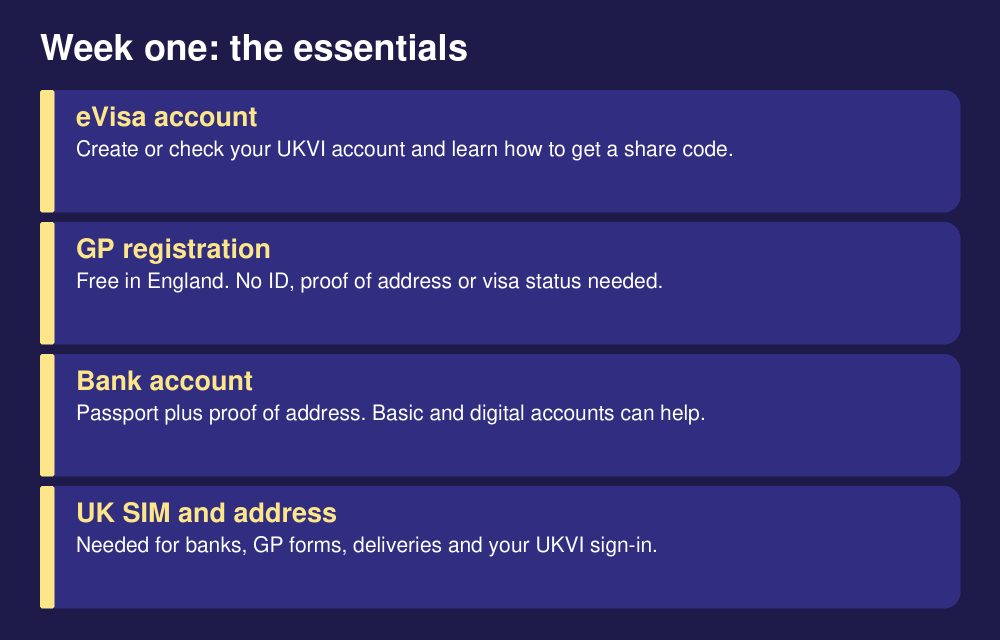
The UK has been moving away from physical immigration documents. GOV.UK says that eVisas have replaced physical immigration documents: an eVisa is a digital record of your identity and immigration status, including the type of visa you hold and its conditions, such as whether you can work or study. You get one when your visa is granted, and you view it by signing in to your UK Visas and Immigration (UKVI) account.
Here is what to do:
- Do not create a second account. If you already used a UKVI account for your visa application, sign in to that one.
- Link your account to your eVisa. You usually confirm your identity with a smartphone app. GOV.UK says access can take up to 24 hours.
- Learn how to get a share code. A share code lets an employer or landlord check your status without seeing a physical document. GOV.UK says a share code lasts 90 days, can be used more than once, and you can generate a new one whenever you need it.
- Keep your passport details up to date. If you renew your Nigerian passport, update your UKVI account. With a biometric passport you can update the number and expiry date online.
If you have an older biometric residence permit (BRP) card, GOV.UK says an expired BRP can still be used to set up your account until 31 December 2026, or 24 months after it expired, whichever comes first. That date is close, so do not wait.
Your employer will check your right to work and your landlord will check your right to rent, both usually with your share code. If either asks for money to run the check, something is wrong.
2. Get a UK phone number and a stable address
Almost everything else on this list needs a UK mobile number (for text codes) and an address where you can receive post. A prepaid SIM is the quickest start and does not require a credit check. If your accommodation is temporary, tell your landlord, university or employer that you need official letters, because they will help with proof of address later.
3. Register with a GP (it is free)
A GP is your family doctor and the front door to the NHS. In England, registering is free, and the NHS says plainly that you do not need ID, proof of address or proof of immigration status to register. You also do not need an NHS number first.
- Search for surgeries near your home on the NHS website and choose one that offers online registration. The form takes about 15 minutes per person, and you should hear back within about five days.
- You will be asked for your name, date of birth, address and an emergency contact.
- If a surgery refuses you (because it is full or you live outside its area), it must write to you within 14 days explaining why. You can then contact your local integrated care board, Citizens Advice or Healthwatch.
- You can ask for temporary registration, which lasts up to three months, if you are only staying briefly.
Register even if you feel well. If you fall ill at night or need urgent advice, call NHS 111. In an emergency, call 999.
Most people on a work or study visa have paid the Immigration Health Surcharge as part of their visa application. GOV.UK currently lists it at 1,035 pounds a year for most applicants and 776 pounds a year for students, their dependants and Youth Mobility Scheme visa holders. This gives you access to NHS care on broadly the same basis as a UK resident. Some routes, such as certain health and care workers, are treated differently, so check your own visa conditions.
4. Open a bank account
Most banks ask for two things: proof of identity (your passport) and proof of address. For proof of address, the usual options are a recent bank statement, a utility bill, a council tax bill or an official letter. If you do not have these yet, some providers accept a university or employer letter, or a letter from HMRC. Digital providers such as Monzo and Revolut can be quicker to open and may ask for less paperwork, though their rules vary.
- Ask for a basic or standard current account. Entry-level accounts normally have no monthly fee and no overdraft, which means banks usually do not need a credit history.
- Do not pay anyone to open an account for you. Nobody legitimate sells bank accounts.
- Never share your PIN, card or one-time passcodes. A real bank never asks for them.
Once your account is open, you can set up a way to send money home. See our comparison of the cheapest money transfer apps for Nigerians in the UK and the Diaspora Money Guide.
Weeks two and three: work and tax
5. Apply for your National Insurance number
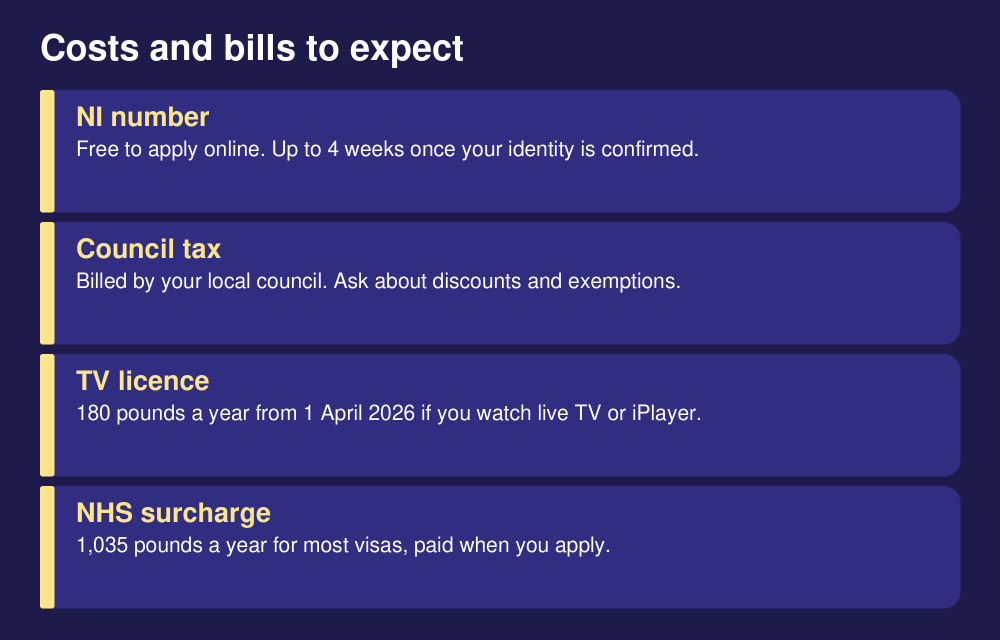
Your NI number is your personal reference for tax and benefits. GOV.UK says you can apply if you live in the UK, have the right to work and are working, looking for work or have a job offer. It stays the same for life, and you can only apply while you are in the UK.
- Check first. If you have a BRP, the number may be on the back. If you have an eVisa, you may be able to see it in your UKVI account. If you already have one, you do not need another.
- Apply online. You upload a photo of yourself holding your passport and photos of other ID documents, then submit the application. You receive an application reference number by email.
- Allow up to four weeks. GOV.UK says it can take up to four weeks after you prove your identity. If you cannot upload photos, you may have to attend an appointment or post copies.
- You can start work before it arrives. If you can prove your right to work, you can start work while you wait. Give your employer your reference when you have it.
Applying for an NI number is free. There is one helpline for England, Scotland and Wales on 0800 141 2079 (Monday to Friday, 8am to 5pm). Only use gov.uk links, because copycat sites exist.
6. Understand your payslip and tax code
When you start work, your employer puts you on payroll and HMRC gives you a tax code. Check your first payslip: it should show your name, NI number, tax code, pay, tax and NI deducted. If you start a second job or your pay looks wrong, contact HMRC through your online account rather than waiting for the year-end.
Weeks three and four: bills, driving and money
7. Council tax and your other bills
Council tax pays for local services and is billed by your local council. Whether you pay depends on your home and who lives in it: full-time students are normally exempt, and a person living alone can usually claim a discount. Ask your landlord whether the rent includes bills, and contact the council once you move in.
You also need a TV licence if you watch live TV on any channel or use BBC iPlayer. GOV.UK says the colour licence fee is 180 pounds a year from 1 April 2026. If you only stream catch-up services that are not BBC iPlayer and never watch live broadcasts, you may not need one.
8. Driving in the UK
You can usually drive in Great Britain on a foreign licence for a limited time after you arrive, but the time limit and the rules for getting a UK licence depend on your licence and the country that issued it. Nigeria does not appear on the usual lists of countries with simple licence-exchange agreements, so most Nigerians should expect to take the UK theory and practical tests. Use the official checker on GOV.UK (search for “driving in Great Britain on a non-GB licence”) before you drive, and make sure you have insurance.
9. Make a simple monthly budget
By day 30 you should know your rent, bills and travel costs. A simple budget, with a small amount you send home and a small emergency fund, will protect you from the surprises that catch new arrivals. Our Japa Guide pulls together the visa, job and cost guides for each route.
Scams to avoid in your first month
New arrivals are targeted because they are busy and unfamiliar with the system. Watch for these:
- Fake NI or eVisa websites. The real services are on GOV.UK. If a site asks you to pay to apply for an NI number or to “unlock” your eVisa, close it.
- Rental deposit scams. Do not send a deposit for a property you have not seen, and do not pay by gift card or to a personal account without checking the landlord’s identity.
- “Bank account for sale” offers. Selling or lending your account is a crime in the UK, and you can be held responsible if it is used for fraud.
- Fake job agents. Do not pay for a job offer, sponsorship or a “placement fee”. See our guide to UK recruitment agencies and how to avoid scams.
- Impersonators. HMRC, your bank and the Home Office will not demand immediate payment by gift card or crypto over the phone.
Your 30 day checklist
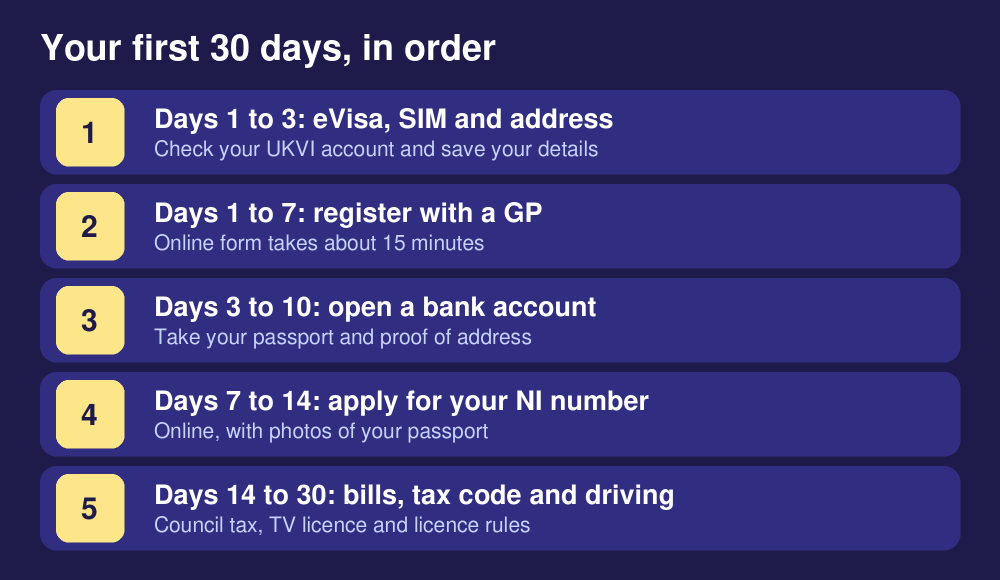
- Sign in to your UKVI account, confirm your eVisa and practise generating a share code.
- Get a UK SIM and keep a record of your address.
- Register with a GP and save the surgery details.
- Open a bank account with a basic or standard current account.
- Check whether you already have an NI number, and apply online if not.
- Give your employer your right-to-work share code, bank details and NI number.
- Ask your landlord or council about council tax and your other bills.
- Check whether you need a TV licence.
- Check the driving rules before you drive.
- Set up a simple budget and a safe way to send money home.
Frequently asked questions
Can I work in the UK before I get my NI number?
Yes. GOV.UK says you can start work before you receive your NI number if you can prove your right to work, usually with your eVisa share code. Your employer will ask for the number once you have it.
Do I need proof of address or ID to register with a GP?
No. In England the NHS says you do not need ID, proof of address or proof of immigration status to register with a GP surgery. Registration is free.
How long does a share code last?
GOV.UK says a share code lasts 90 days and can be used more than once. You can get a new one whenever you need it.
How much does it cost to apply for an NI number?
Nothing. Applying through GOV.UK is free. Be careful of any site that asks for a fee.
What if my BRP has expired?
GOV.UK says an expired BRP can still be used to create or access your UKVI account until 31 December 2026, or 24 months after it expired, whichever is earlier. Set up your account as soon as you can.
This article is general information for England and is not legal, immigration, tax or medical advice. Check GOV.UK, the NHS and your local council for your own situation.
Sources
- GOV.UK: Apply for a National Insurance number
- GOV.UK: How to apply for a National Insurance number
- GOV.UK: eVisas, access and use your online immigration status
- NHS: How to register with a GP surgery
- GOV.UK: Immigration Health Surcharge, how much you pay
- GOV.UK: Cost of TV licence fee set for 2026/27
- GOV.UK: Driving in Great Britain on a non-GB licence
- Wise: How to open a bank account in the UK (provider guide)
Join the discussion
Have you tried this, or do you have a question we did not answer? 1 reader has already shared their view. Naijatipsland members help each other with real, first-hand experience.





Editor’s note: rules and fees change, and the details here are for England. Scotland, Wales and Northern Ireland differ on some points (especially health services), so always confirm on GOV.UK or with your local council before you pay or sign anything. This is general information, not legal or immigration advice. – Ade