Last updated: 30 October 2026 · By Naijatipsland Editorial Team · Editorial policy
Shopify is one of the easiest ways to build an online store without a developer, and a promotional offer makes the first few months cheap. But a Shopify store is not free, it is not available with every Nigerian payment setup out of the box, and it will not bring customers by itself. This guide explains what it really costs, how Nigerians usually take payments, how to keep the budget small, and when a cheaper route makes more sense. Checked 30 October 2026. Prices and features change and may differ by region, so confirm on Shopify’s own site before you pay. This is general information, not financial advice, and no income is guaranteed.
What does a Shopify store cost?
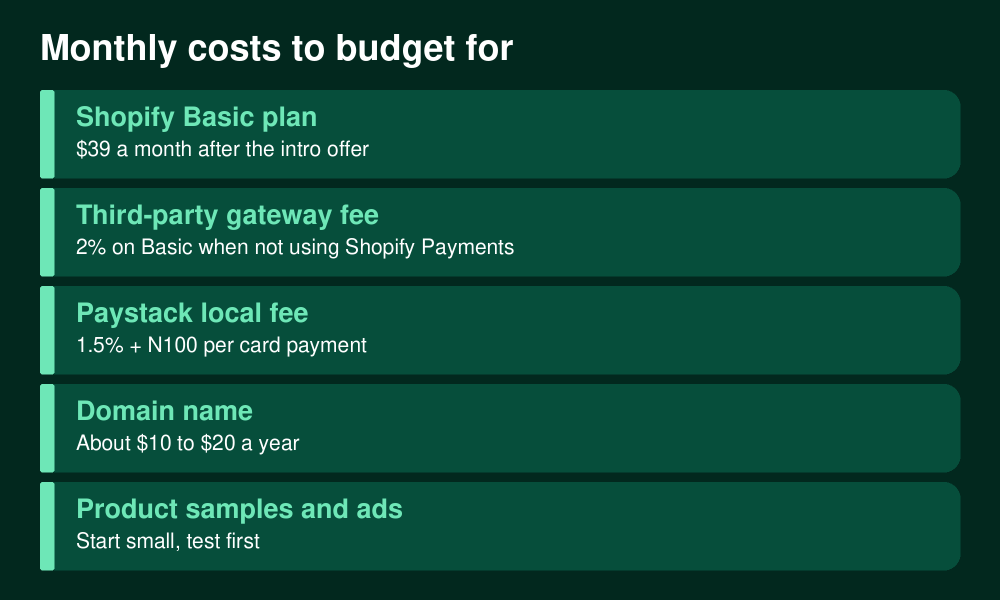
- Plan: Shopify’s pricing page lists the Basic plan at $39 a month, with an offer of 3 days free and then $1 a month for the first 3 months. Higher plans cost more, and the offer can change.
- Payment gateway fees: Shopify lists a 2% fee on the Basic plan when you use a third-party payment provider instead of Shopify Payments. Your payment provider also charges its own fee.
- Domain name: Stripe’s dropshipping guide estimates roughly $10 to $20 a year for a custom domain.
- Apps and themes: many apps have free tiers. Add paid apps only after you have sales.
- Stock, samples and ads: usually the biggest costs. Start small.
Remember that your plan is billed in dollars, so a weaker naira raises your real cost. Check how your bank card or dollar virtual card handles foreign subscriptions.
Can Nigerians take payments on Shopify?
Shopify Payments, Shopify’s own processor, is only available in selected countries, and Nigeria does not appear on Shopify’s supported-countries list at the time of writing. Nigerian merchants therefore use third-party providers. Paystack has an app for Shopify, and Flutterwave appears on Shopify’s list of payment providers. Paystack’s published local price is 1.5% plus ₦100 per transaction, with the ₦100 waived for transactions under ₦2,500. Fees, settlement options and business requirements can change, so read each provider’s current terms. Because Shopify adds its own third-party gateway fee on top, include both when you set prices.
Step-by-step: launch on a small budget
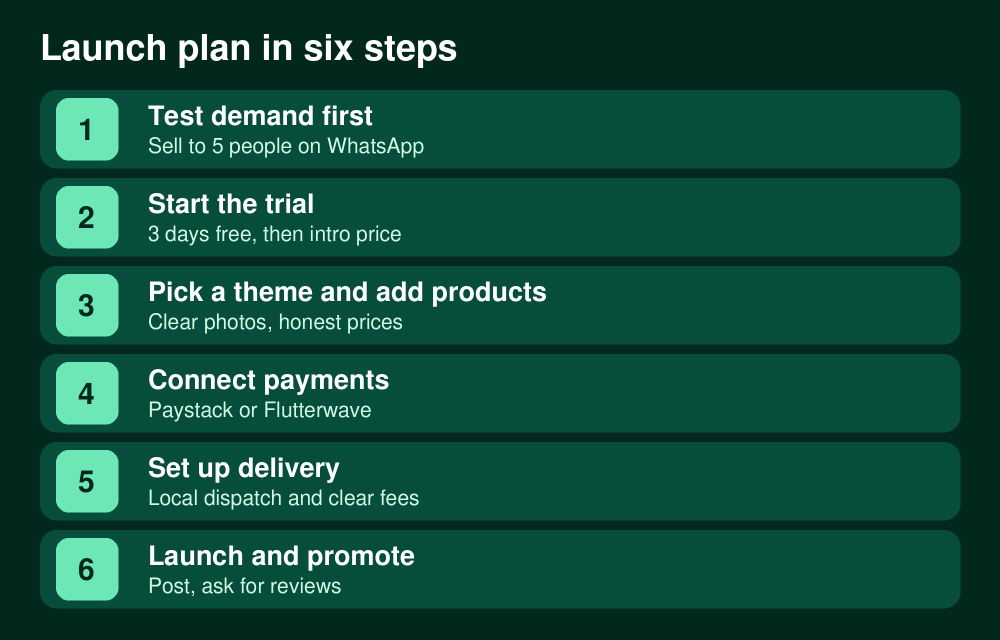
- Test demand before you pay. Post your product on WhatsApp status, Instagram or Facebook and try to get your first few orders by direct message. If nobody wants it, a store will not fix that.
- Start the trial. Create a store with the promotional offer and use the first days to set up, not to browse apps.
- Choose a simple theme. Use a free theme. Fast, clean and mobile-friendly beats fancy, because most Nigerian shoppers browse on phones.
- Add a few products. Use clear photos, honest descriptions, weight or size, price and delivery time. Ten good listings beat a hundred weak ones.
- Connect payments. Install your payment provider’s Shopify app, complete its business verification, then run a small test order. Consider offering bank transfer or pay-on-delivery for trust, if you can manage the risk.
- Plan delivery. Decide who delivers, how much it costs by area and how long it takes. Put the shipping rates and your return policy on the site. Local dispatch riders and couriers work for in-city orders, and you can partner with a courier for other states.
- Add the trust pages. Include contact details, a refund policy, privacy policy and terms. Buyers are wary of unknown online shops.
- Launch and promote. Share your link on social media, ask early buyers for reviews, and reply fast. Our guide to using TikTok for sales is a good place to start free marketing.
What can you sell?
You can hold your own stock, take pre-orders, make products yourself, or use dropshipping. Own-stock and local products often work best at first because delivery is faster and you control quality. Whatever you choose, check that the items are legal, safe and not counterfeit, and that you can fulfil an order within the time you promise.

Cheaper alternatives to start with
- WhatsApp, Instagram and Facebook: zero platform fees and instant conversations, but it is manual and you are dependent on the platform.
- WooCommerce on WordPress: an open-source store plugin you can install on your own hosting. You pay for hosting, a domain and some extensions, and you manage updates and security yourself.
- Marketplaces: selling through an existing marketplace gives you traffic without building a store, in exchange for commissions and rules.
- Shopify later: move to Shopify when regular orders make the monthly fee and gateway costs worthwhile.
Common mistakes
- Paying for apps, ads and a premium theme before the first sale.
- Ignoring the dollar-based subscription and gateway fees when pricing in naira.
- Promising fast delivery you cannot deliver.
- Skipping a refund policy, which reduces buyer trust and creates disputes.
- Relying on one traffic source such as paid ads.
- Falling for “store-in-a-box” or “winning product” packages that sell recycled advice. See our warnings on internet scams.
Tax, registration and records
As your sales grow, consider registering your business and keeping clear records of income, costs and customer orders. Tax and registration rules depend on your circumstances, so ask a qualified accountant or the relevant authority instead of relying on social media advice.
Frequently asked questions
Is Shopify free in Nigeria?
There is a short free trial and a promotional first-months price, but you will pay a monthly fee afterwards, plus payment and domain costs.
Which payment gateway should I use?
Many Nigerian merchants use Paystack or Flutterwave. Compare fees and settlement terms, and test with a small order.
Do I need a registered business?
You can test an idea informally, but payment providers may ask for business details, and registration helps as you grow. Check each provider’s requirements.
Can I use Shopify without a lot of money?
Yes, if you start with a small catalogue, use free themes and apps, and test demand first. Treat the monthly fee as a cost you must earn back.
Bottom line
You can open a Shopify store for very little in the first months, but the true cost includes the dollar-priced plan, gateway fees and the work of getting customers. Prove demand on social media, set up payments and delivery carefully, price in the fees, and expand only when orders justify it.