Last updated: 13 October 2026. Remittance rules, fees and exchange rates change often. Check the provider’s current quote, and confirm that the provider is licensed, before you send money.
Sending money to Nigeria at a glance (October 2026)
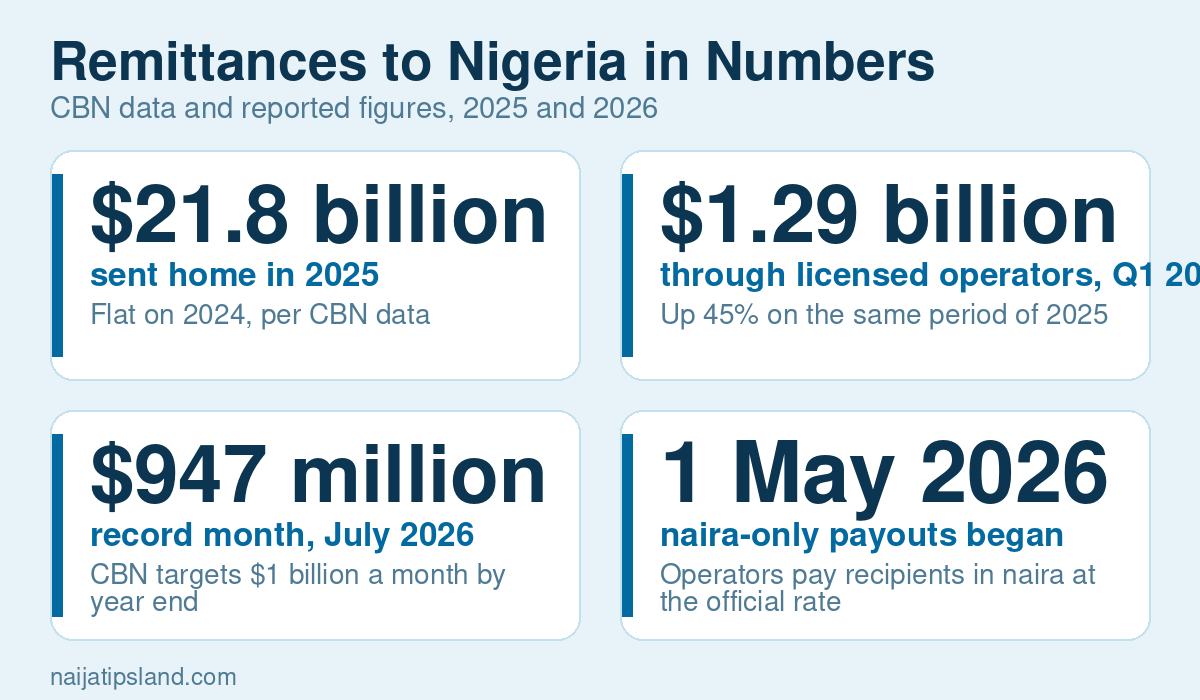
- Paid in naira: since 1 May 2026, the CBN requires international money transfer operators to pay recipients in naira, at a market-based official rate, and to route transactions through designated naira settlement accounts in banks. Your recipient will not receive dollars from a licensed operator.
- The scale: Nigeria received about $21.8 billion in diaspora remittances in 2025, according to CBN data. Formal flows through licensed operators reached a record $1.29 billion in the first quarter of 2026, and about $947 million in July 2026.
- The cost: sending $200 to Sub-Saharan Africa costs 8.46% on average, against 6.36% globally, according to the World Bank. Digital channels averaged 4.59% and banks 14.99%.
- The biggest risk: scammers who impersonate providers or recipients. Use official apps and verify account details before you pay.
Millions of Nigerian families depend on money sent from abroad, and the way it is sent has changed a lot in the past two years. New CBN rules, a more market-based exchange rate and more licensed operators mean the process is more formal, but the total cost and the risk of scams still depend on the choices you make. This guide explains what changed, how to compare providers, the steps to send money safely and what recipients should expect. It replaces an older version that used outdated figures.
What Changed in 2026
- Naira-only payouts. From 1 May 2026, licensed international money transfer operators (IMTOs), including well-known names such as Western Union, MoneyGram and Remitly and their competitors, must pay recipients in naira, converted at the official market rate, rather than in dollars. The CBN says the aim is to bring more diaspora money into the formal system and narrow the gap between official and parallel exchange rates.
- Naira settlement accounts. Operators must route transactions through designated naira settlement accounts in Nigerian banks, which the CBN says improves transparency and traceability.
- More operators and a more market-based rate. The CBN’s January 2024 guidelines opened the way for more licensed operators, and the central bank credits a more market-determined exchange rate and other reforms, including a non-resident BVN, for the rise in official inflows.
- Official inflows are rising. Formal remittances through licensed operators were up about 43% in 2024 to roughly $4.7 billion, and the CBN says it is aiming for about $1 billion a month by the end of 2026.
Some recipients, especially small business owners, have complained that naira payouts expose them to exchange rate swings on the day the money arrives. Informal channels still exist, but they carry legal and fraud risks, and the central bank says licensed operators are the formal route.
What It Really Costs
The cost of sending money has two parts: the transfer fee and the exchange rate margin, which is the gap between the rate you get and the real market rate. Many people compare only the fee and miss the margin. According to the World Bank’s Remittance Prices Worldwide report for the third quarter of 2025:
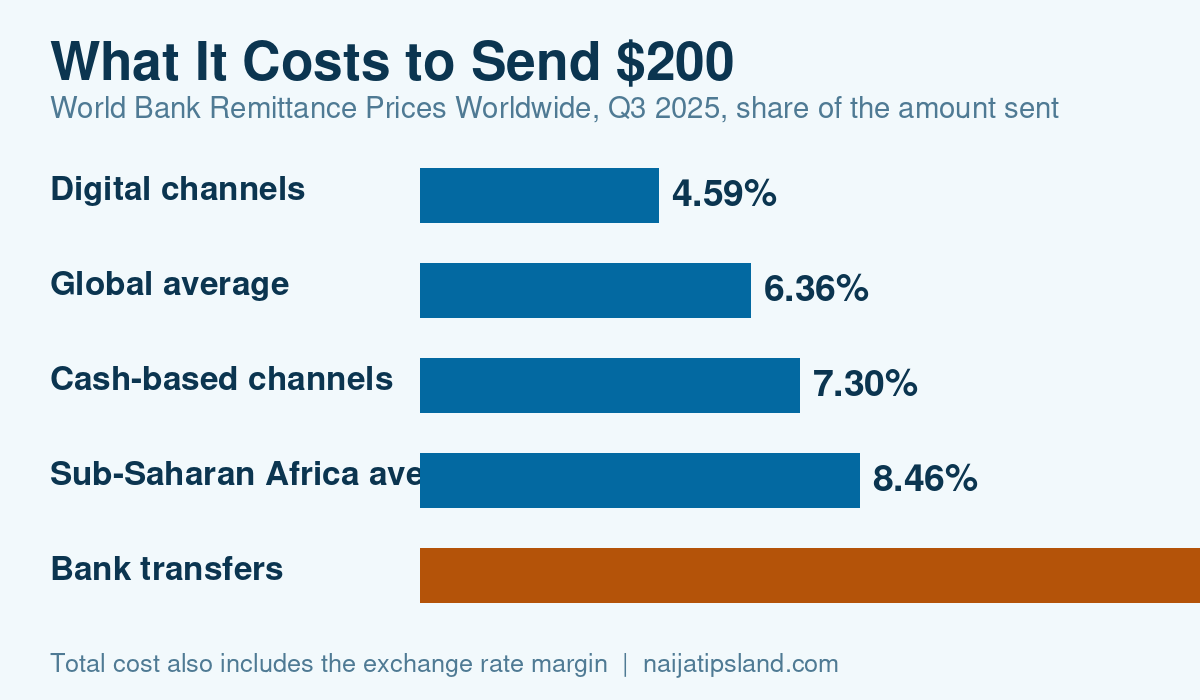
- Sub-Saharan Africa is the most expensive region to send to, at 8.46% on a $200 transfer, against a global average of 6.36%.
- Digital channels averaged 4.59%, compared with 7.30% for cash-based ones.
- Bank transfers averaged 14.99%, so a bank wire is often the costliest option for small amounts.
A quick way to compare: ask each provider the exact amount your recipient will receive in naira for the same amount sent, then compare that figure with the market rate. For example, if you send $200 and one provider delivers ₦262,000 while another delivers ₦255,000 at similar speed, the first is cheaper by ₦7,000, whatever the advertised fee. Our dollar to naira rate page gives an indicative reference rate.
How to Send Money to Nigeria Safely: Six Steps
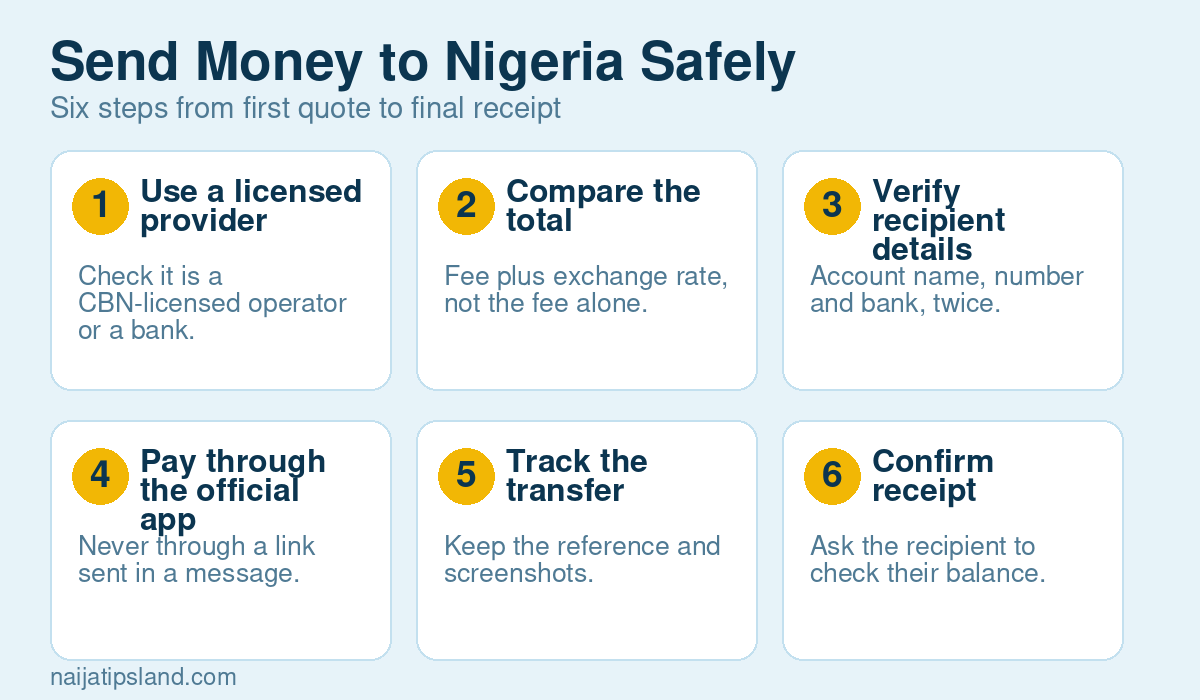
- Use a licensed provider. Choose a bank or an operator that is licensed in your country and approved by the CBN to pay out in Nigeria. Check the CBN’s list of approved operators, and be wary of unknown apps and social media sellers.
- Compare the total. Look at the fee, the exchange rate and the amount your recipient will get in naira, and check speed and payout options.
- Verify recipient details. Confirm the account name, number and bank, or the cash pickup details, with the recipient by a separate call or message. A single wrong digit can send money to a stranger.
- Pay through the official app or website. Type the web address yourself or use an app downloaded from an official store. Do not follow payment links sent through messages.
- Track the transfer. Save the reference number and screenshots, and check the status in the app.
- Confirm receipt. Ask your recipient to check their balance, and contact the provider quickly if the money does not arrive in the stated time.
Choosing a Payout Method
- Bank account: usually the safest and most traceable. Make sure the account is in the recipient’s own name.
- Cash pickup: convenient for people without accounts, but the recipient needs ID and must follow the pickup instructions carefully.
- Mobile wallet: fast, but check that the wallet provider is regulated.
Whichever method you pick, the money is paid out in naira.
Advice for Recipients in Nigeria
- Expect naira, and ask the sender for the expected amount and the rate used.
- Keep your BVN and NIN records accurate, because banks and operators verify them. See our guide on verifying your NIN.
- Check your balance in your own banking app. Do not rely on SMS screenshots, which can be faked.
- Never pay a “release fee”, “tax” or “clearance charge” to collect a transfer. Genuine operators do not ask for that.
- If you use the money to save or invest, read our guides on saving money and financial literacy.
Scams to Avoid
- Fake provider sites and apps: look-alike pages that collect your card details or payments. Always check the address and publisher.
- Overpayment scams: a sender or buyer sends too much money and asks you to refund the difference before their payment fails.
- Advance-fee scams: you are told a transfer is waiting but must pay fees or taxes to release it.
- Romance and emergency scams: someone you have not met in person asks you to send money urgently.
- Impersonation: a message pretends to be from a relative or an official asking for a quick transfer.
Read our guides on internet scams and WhatsApp scams. If you are scammed, tell your bank or provider immediately and report to the police or the EFCC.
What About Crypto and Informal Channels?
Some people use stablecoins or informal agents because they can look cheaper. They carry price swings, fraud and legal risks, and informal agents offer little protection if something goes wrong. Regulators want remittances to flow through licensed channels. If you are curious about digital assets, read our guide on buying Bitcoin and USDT in Nigeria before you act.
A Worked Example: Comparing Two Quotes (Hypothetical)
You want to send $300 to your sister in Lagos, and two licensed providers give you these quotes. Provider A charges a fee of $2 and pays ₦395,000, while Provider B charges no fee and pays ₦388,000. If the market reference rate that day is about ₦1,331 per dollar, the amount at that rate would be roughly ₦399,300 for $300. Provider A’s margin is therefore about ₦4,300 plus the $2 fee, while Provider B’s margin is about ₦11,300 even though it advertises zero fees. The lesson: the headline fee is only part of the cost, so compare what lands in the account. Quotes change through the day, so check again before you pay.
Common Questions From Senders Abroad
- Can I send a large amount? Providers have limits and may ask for proof of source of funds, ID and the purpose of the transfer. Be ready to provide documents.
- Should I send to a business account? Only if you are paying for a genuine service and have verified the business. Do not send personal funds to unknown businesses.
- What if the recipient has no account? Use cash pickup through a licensed operator, or help them open an account first. Make sure they keep their BVN and NIN information up to date.
- Is it safe to use crypto? It involves price swings and fraud risk, and recipients may struggle to convert it. Regulated channels are simpler.
Frequently Asked Questions
Can my family in Nigeria receive dollars?
Not from a licensed money transfer operator. Since 1 May 2026, such operators pay recipients in naira at the official rate.
What is the cheapest way to send money to Nigeria?
Digital channels are generally cheaper than banks, but compare the amount your recipient will actually receive in naira, because exchange rate margins vary.
How long does a transfer take?
It depends on the provider and payout method. Many digital transfers arrive within minutes or hours, while bank transfers can take days. Check the estimate before you pay.
How do I know a provider is legitimate?
Check that it is licensed in your country and approved by the CBN, read independent reviews and avoid anyone who asks you to pay by gift card or to a personal account.
What should I do if the money does not arrive?
Contact the provider with your reference number, ask the recipient to check their account, and escalate to your bank, the regulator or the CBN if the provider does not resolve it.
Related Guides
- Dollar to naira exchange rate today
- How to avoid internet scams
- How to verify your NIN in Nigeria
- Nigeria’s cashless policy in 2026
Sources
- Vanguard: Diaspora remittances stabilise at $21.8bn in 2025
- Leadership: From $250m to $947m, CBN reforms transform diaspora remittance inflows
- BusinessDay: CBN targets $1bn monthly diaspora remittances by year-end
- BusinessDay: CBN mandates IMTOs to use naira settlement accounts
- Technext: CBN naira payout directive and what it means for families
- Ecofin Agency: Nigeria targets $1 billion in monthly diaspora remittances
- Krave: What Nigeria’s record $947 million remittance inflow really means
- TrustSwap: Stablecoin remittances to Nigeria and West Africa (citing the World Bank)
Sending money the other way? See our guide to the cheapest ways to send money abroad from Nigeria.