
How to Start Print on Demand From Nigeria (2026): Platforms That Pay, Real Margins and the Local Option

Last updated 22 November 2026. Platform rules, fees and payout countries change, so check each company’s own pages before you upload designs or pay for anything. This is general information, not financial or tax advice.
Print on demand (POD) looks like a perfect side hustle from Lagos or Ibadan. You upload a design, a company prints it on a T-shirt or mug only when someone orders, and you never hold stock. The printing side works fine from Nigeria. Getting paid is the hard part, because some of the best-known POD marketplaces either don’t accept sellers living in Nigeria or only pay through routes that are closed to Nigerian residents. This guide goes through what each platform says, what a sale really leaves you, and a local version of the business that doesn’t need dollars at all.
How print on demand works
There are two models. On a marketplace such as Redbubble or Amazon Merch on Demand, the platform brings the buyers, sets a base price, prints and ships the order and deals with complaints. You earn a margin or royalty on each sale. In the second model you run your own shop (Shopify, WooCommerce or a social media page) and connect a print supplier such as Printful, Printify or Gelato. When a buyer pays you, the supplier prints and ships the order and charges you its base cost. You keep the difference.
Either way, the printing happens close to the buyer. Printful and Printify print mostly in the US and Europe, so the model suits selling to buyers abroad. Shipping a US-printed shirt into Nigeria adds cost and customs time, which is why selling to Nigerians usually means working with a printer here.
Which platforms you can use from Nigeria
Etsy
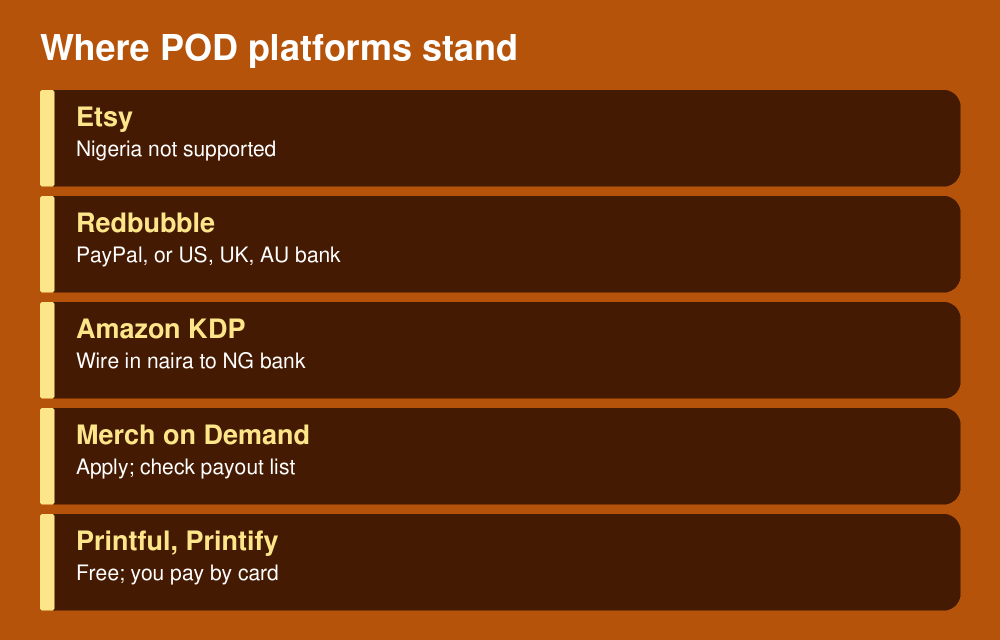
Etsy is where many POD sellers start, but Nigeria is not on its list of Etsy Payments countries, so a seller living in Nigeria cannot open a shop. We covered the details and the risky workarounds in our guide to selling on Etsy from Nigeria. Be careful with any POD course built around Etsy if the person selling it to you lives here.
Redbubble
Signing up is free, and Redbubble handles the printing and delivery. It pays artists by PayPal or by bank transfer, and its help pages list bank payments only for US, UK and Australian accounts. That leaves PayPal for Nigerian artists. PayPal was send-only in Nigeria for years, but since January 2026 a partnership with Paga lets Nigerians link a PayPal account to a Paga wallet, receive money and withdraw it in naira. I could not find anything from Redbubble confirming that it pays to these accounts, so try a small payout before you count on it.
Fees matter as well. Since March 2026 Redbubble puts each artist in a tier: Standard accounts pay 50% of monthly earnings as an account fee, Premium accounts pay 20% and Pro accounts pay nothing, with the fee capped at $150 a month. Redbubble’s own example is a classic T-shirt with a $20 base price. A 20% markup earns $4 before fees, which comes to about $3.20 on Premium or $2 on Standard. Its help page gives a payout threshold of $20 (or £20 or €20), and one seller guide reports it dropped to $10 in July 2026, so check your dashboard.
Amazon Merch on Demand
Amazon’s own T-shirt programme sells through Amazon stores in the US, UK, Germany, France, Italy, Spain and Japan. You apply at merch.amazon.com and Amazon reviews every request, so approval isn’t guaranteed. Royalties go by direct deposit or wire only, with no PayPal, and Amazon says the list of supported bank countries is shown inside your account under payment settings. I could not confirm whether Nigerian banks are on that list, so check it before you spend weeks on designs. You also complete a US tax interview (Form W-8BEN). The US has no income tax treaty with Nigeria, so expect 30% to be withheld from royalties on US sales.
Amazon KDP for books, journals and planners
Print on demand isn’t only clothing. Kindle Direct Publishing prints a paperback only when someone orders it, and low-content books such as journals, planners and colouring books are popular with POD sellers. KDP’s own payment page lists Nigeria with no direct deposit, and with wire transfer paid in naira for Amazon.com, Amazon.co.uk, the EU stores and several others. Some blogs still tell Nigerians to enter Payoneer details, but KDP’s page is the one to follow. Wires only go out once your balance passes a minimum, and your bank may charge you to receive them. Our guide to selling ebooks from Nigeria covers the publishing side.
Your own store with Printful or Printify
This route gets round the marketplace bans because you collect the money yourself. Printful and Printify are both free to join. Printful’s optional Growth plan costs $24.99 a month, and Printify Premium is $39 a month, or $24.99 a month billed yearly. Both give discounts of up to about a third on products. You pay the supplier by card for each order, so you need a card that works for foreign payments. Many Nigerian banks limit what a naira card can spend abroad, so ask your bank first or use a dollar card. To take payments on a Shopify or WooCommerce store, Nigerian sellers usually use Paystack or Flutterwave. Our guide to starting a Shopify store in Nigeria walks through the setup, and selling on Amazon from Nigeria is another way to reach buyers abroad.
Getting your money home
Work out the payout route before you design a single shirt. These are the points that catch people out:
- Wise is not a receiving option for people living in Nigeria. Nigeria is not on Wise’s list of places where you can hold a balance, and Wise does not give USD account details to customers with a Nigerian address.
- Payoneer works for Nigerian residents. Its pricing page puts the fee for withdrawing to a bank in a different currency at up to 2%, and some 2026 guides quote higher figures, so read the fee and rate on screen before you confirm. There is also a $29.95 yearly fee if you receive less than $6,000 in any 12 months.
- A domiciliary account lets you hold dollars and convert them when the rate suits you. See our guide to opening a domiciliary account and our comparison of ways to receive international payments.
- Use your real name and address everywhere. Opening accounts with a foreign address you don’t live at breaks the platforms’ rules, and accounts get frozen with money still in them.
What a sale really leaves you
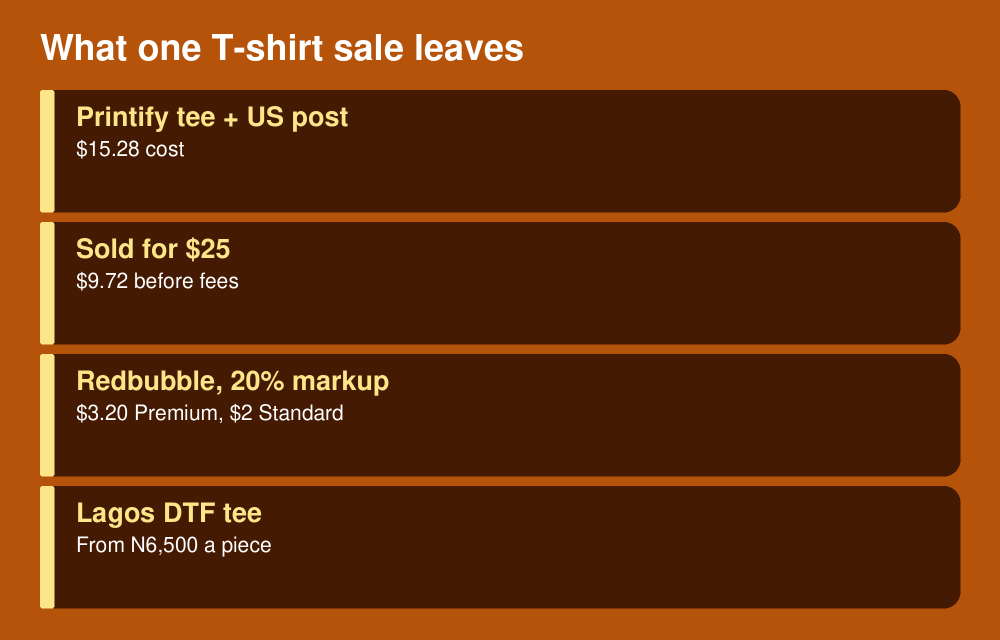
Printify’s own comparison, using October 2026 prices, puts a Bella+Canvas 3001 T-shirt at $11.29 plus $3.99 shipping in the US, so $15.28 in total. Sell it for $25 and you keep $9.72 before store fees, payment fees and the cost of bringing the money home. Printful’s price for the same shirt in that comparison was $16.87 with shipping. Take off a few percent for card processing and Payoneer and you are left with roughly $8 a shirt, before anything you spend on adverts.
That is why the POD sellers who make real money either sell in volume or charge more for designs people can’t find elsewhere. A shop with 20 designs and no promotion usually sells very little.
The local version: print on demand for Nigerian buyers
You can run the same no-stock model inside Nigeria with a local printer, and several Lagos print shops now print single pieces. Fashklo in Surulere prints DTG from one piece, with A4 print-only rates from ₦3,500 down to ₦1,850 a piece on its October 2026 rate card (the blank shirt is extra). Hafex Creation in Bariga advertises a full-colour DTF printed T-shirt from ₦6,500 for one piece, shirt included. Pziel lists DTF T-shirts from ₦7,000 each for five to ten pieces.
The flow is simple. Show mockups on Instagram, TikTok or a WhatsApp catalogue, take payment by transfer or a Paystack link, send the order to your printer, and have it delivered by a dispatch rider or courier. If a shirt costs you ₦6,500 and you sell it for ₦13,000, delivery and the odd reprint come out of that ₦6,500 difference, so price with delivery in mind. Custom orders for birthdays, church programmes, aso ebi for owambe parties and company end-of-year events are where local sellers tend to find steady demand, and December is busy.
Some Nigerian platforms, Vendblue for example, say they offer print on demand with payouts in naira. I haven’t tested them, so read reviews and terms before you rely on one.
How to start, step by step
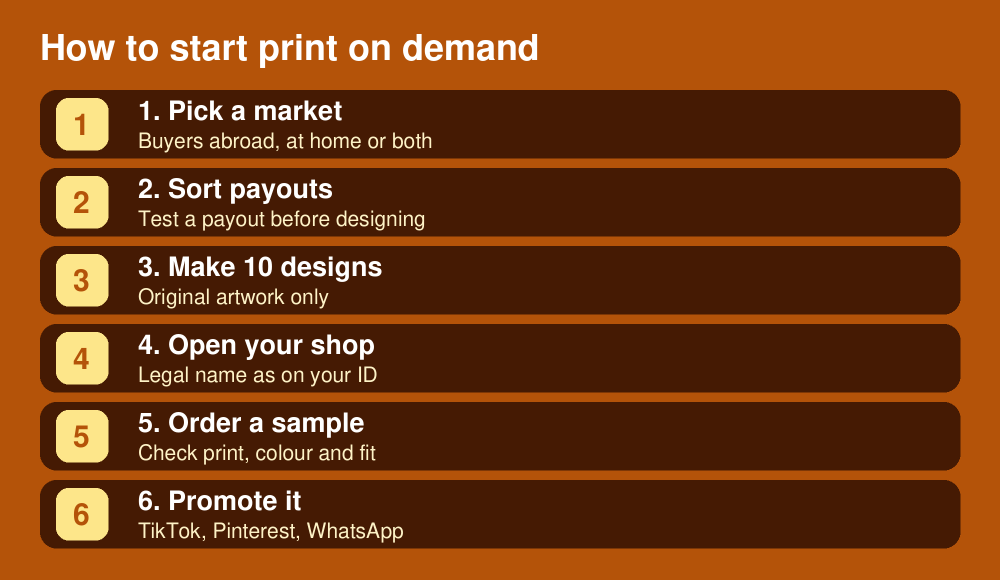
- Choose your market: buyers abroad, buyers in Nigeria, or both. That choice decides your platform.
- Sort out payouts first. Open Payoneer or a domiciliary account, check that the platform you want can pay you, and do a small test payout where you can.
- Make at least 10 original designs. Free tools such as Canva are enough to start. Pick a niche you understand: Nigerian proverbs, pidgin phrases, city pride, faith, football fandom without club badges, or professions like nursing and engineering.
- Set up your shop or marketplace account with your legal name exactly as it appears on your ID.
- Order a sample of your best design and check the print, colours and fit before you promote it.
- Promote it. Pinterest and TikTok send buyers to POD shops abroad, while WhatsApp status and Instagram work well for local sales. Post the product being worn, not only a flat mockup.
- Keep records of sales, fees and payouts for tax. If the business grows, think about registering it with the CAC.
Copyright and trademarks
This is where most new sellers lose their accounts. Don’t use club badges, the NFF or Super Eagles crest, musicians’ names or faces, film characters, brand logos or song lyrics. Redbubble, Amazon and the print suppliers remove infringing designs, and repeated takedowns can end an account. Make your own artwork, or use stock files whose licence clearly allows use on products for sale.
Mistakes to avoid
- Paying for an expensive POD course before checking that the platforms it teaches can actually pay someone living in Nigeria.
- Pricing too close to cost, which leaves nothing for adverts, discounts or reprints.
- Uploading hundreds of copied or low-effort designs. On Redbubble that can put you in the Standard tier, where half your earnings go in fees.
- Forgetting how long money takes. KDP pays about 60 days after the end of the month of sale, and Redbubble pays once a month.
Frequently asked questions
Can I do print on demand from Nigeria?
Yes. Running your own store with Printful or Printify, publishing paperbacks and journals on KDP, and selling locally through a Lagos printer all work. Etsy is closed to sellers living in Nigeria, and Redbubble depends on whether PayPal through Paga works for you.
How much do I need to start?
Printful, Printify and Redbubble cost nothing to join. If you run your own store, a Shopify plan, a domain and one or two samples are the main costs. For local sales, a sample shirt at about ₦6,500 to ₦7,000 and data for posting are enough to begin.
Which option is best for a beginner in Nigeria?
If you can design journals or planners, KDP has the clearest payout route because it wires naira to a Nigerian bank. For clothing, start with local orders to test your designs, then add a Printify or Printful store for buyers abroad once your payout account works.
Do I pay tax on print on demand income?
Business income is taxable in Nigeria, and US platforms may withhold tax on royalties. Keep records and speak to a tax adviser once you earn regularly. Our guide to filing your personal tax return online explains the basics.
Sources
- Printify: Printify vs Printful (prices collected October 2026)
- Retailpresso: Printful pricing 2026 (30 October 2026)
- Redbubble Help: Getting paid to your PayPal account
- Redbubble Help: Processing times for artist payments
- Freelance Sites: Redbubble fees and payouts (September 2026)
- The Paypers: PayPal goes live in Nigeria through Paga (27 January 2026)
- Amazon KDP: Payment options
- Amazon Merch on Demand: FAQs
- SellerSonar: How Merch by Amazon works and pays
- Site2US: Who can get Wise USD details (November 2026)
- Lilach Bullock: Payoneer in Nigeria, fees (19 October 2026)
- Pryme: Print on demand from Nigeria (19 October 2026)
- Fashklo: T-shirt printing in Lagos, rate card
- Hafex Creation: T-shirt printing prices, Lagos
- Pziel: Custom T-shirt printing price list
Join the discussion
Have you tried this, or do you have a question we did not answer? Be the first to share your experience. Leave a comment below. Every comment is read by the editor before it appears.




Editor note: have you sold print on demand products from Nigeria? Tell us which platform paid you and how you received the money, because readers learn most from real payouts. Please leave out account numbers and other private details. – Ade