
How Nigerians in the Diaspora Can Invest in Nigeria Safely (2026 Guide)


Last updated: 4 November 2026 · By Naijatipsland Editorial Team · Editorial policy
Almost every Nigerian abroad has had the same thought: the naira rate is high, interest rates in Nigeria look attractive, and I would like to put some money to work back home. The opportunity is real, but so are the risks. Currency swings, unregulated schemes, relatives holding your money informally, and difficulty getting it out again have cost many diaspora investors dearly. This guide explains the main ways Nigerians in the UK and elsewhere can invest in Nigeria, how to check safety, what the tax and currency issues look like, and the mistakes to avoid. Checked 4 November 2026. Rates and rules change often, so confirm every figure with the provider or regulator. I am not a licensed financial adviser and this is general information, not personalised advice.
The golden rule: safety before returns
In Nigeria, as anywhere, the biggest losses usually come from schemes that promise guaranteed, unusually high returns, not from honest market risk. Before comparing yields, check four things.
- Is the company or fund licensed? Investment products should be offered by firms registered with the Securities and Exchange Commission (SEC) Nigeria. Banks are regulated by the Central Bank of Nigeria (CBN).
- Where does your money actually go? It should go into a corporate account or a custodian, never a personal account.
- Can you get the money out? Ask how redemptions work, how long they take and in what currency.
- Is the return realistic? Guaranteed monthly returns of 10, 20 or 30 percent are a red flag. Nigeria has seen several well-publicised collapses of schemes that promised exactly that.
Step one: set up the right banking and identity
Remote investing usually starts with banking. Many Nigerian banks and fund platforms ask diaspora customers for a non-resident BVN (often called NRBVN), proof of foreign address and a valid ID. Read our full guide to opening a Nigerian bank account from abroad and the guide to opening a domiciliary account, which lets you hold dollars, pounds or euros in Nigeria.
When you bring money in, send it through a licensed channel such as a bank transfer or an authorised money transfer operator, keep the evidence, and ask the receiving bank about a Certificate of Capital Importation (CCI). Banks generally issue a CCI for inflows used for investment, and it supports your ability to repatriate returns later. Requirements change, so confirm with your bank at the time. For cheaper ways to move money, see how to send money to Nigeria safely and the cheapest money transfer apps for Nigerians in the UK.
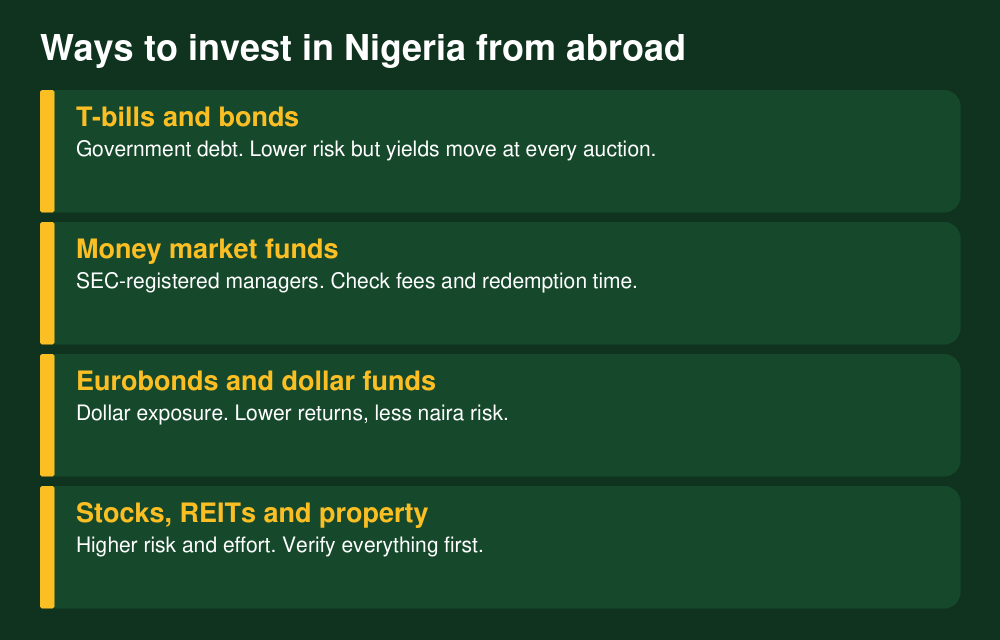
Main ways to invest in Nigeria from abroad
1. Treasury bills and government bonds
Treasury bills are short-term government debt, typically 91, 182 or 364 days. Federal Government bonds run longer. They are considered among the lowest-risk naira assets because the government is the borrower, though that still does not remove inflation or currency risk. Late 2025 comparisons reported T-bill yields in the high teens to about 20 percent a year before a 10 percent withholding tax on interest for non-residents, but yields move at every auction, so check the latest CBN and DMO data. Diaspora investors normally buy through a bank or a licensed broker and custody account.
2. Money market and fixed income funds
These pool investors’ money into short-term instruments, with lower minimums, often from ₦10,000 on local apps. Funds from SEC-registered managers such as those offered by major asset managers are common starting points. Check the management fee, redemption time and whether the fund accepts non-resident investors.
3. Nigerian Eurobonds and dollar funds
Eurobonds are dollar-denominated bonds issued by the Nigerian government or companies, and some dollar-denominated mutual funds invest in them. They remove the naira risk but not the credit risk, and returns are lower than naira instruments. Minimums for direct Eurobonds are high, so most diaspora investors use funds.
4. Nigerian stocks (NGX)
You can buy shares on the Nigerian Exchange through a licensed stockbroking firm that opens a CSCS account for you. Stocks can rise sharply and fall sharply. Dividends may carry withholding tax. If you want to learn how IPOs work, see our guide on buying Dangote Refinery IPO shares (offer closed 27 October 2026, so read it as a how-it-worked guide).
5. Real estate and REITs
Property is the most popular diaspora investment and also the one with the most fraud. Real estate investment trusts and real estate funds regulated by the SEC are a safer way to get exposure without buying land. If you plan to buy property directly, read our dedicated guide to investing in Nigerian real estate from abroad and the checklist on buying land without getting scammed.
6. Starting or backing a business
Business investment can pay well but is the hardest to monitor from abroad. Use a lawyer, a written shareholder or loan agreement, regular reporting and staged funding, and avoid handing over a large lump sum to a relative or friend on trust alone.
7. Cryptocurrency
Crypto is volatile and carries its own rules. Read our crypto explainer first. It is not a substitute for regulated investments, and it is a favourite hook for scammers.
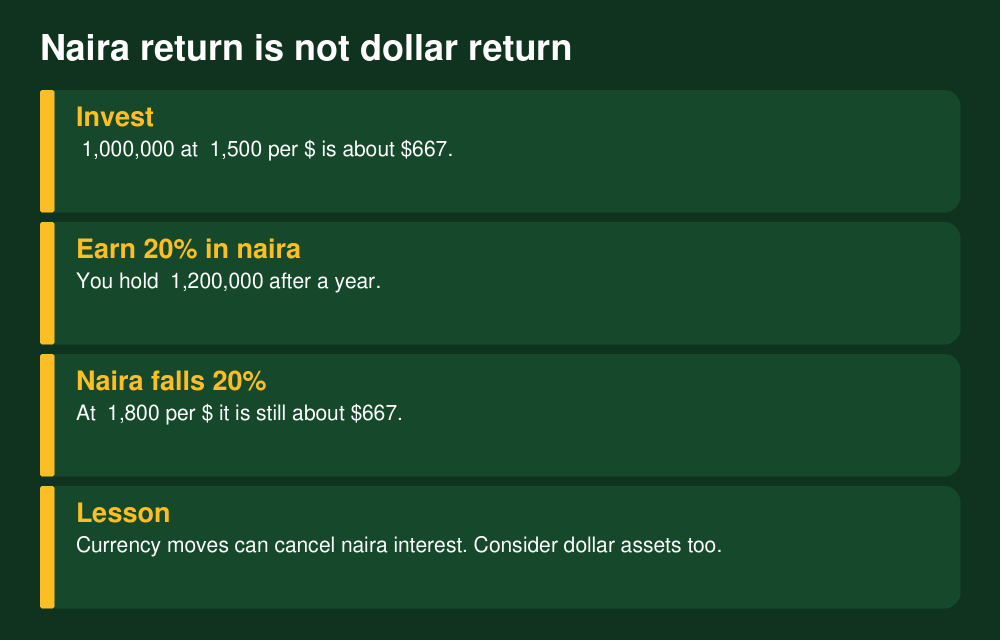
The naira problem: currency risk in plain numbers
The headline interest rate in naira is not your real return if you will eventually convert back to pounds or dollars. Here is a simple, hypothetical example.
- You invest ₦1,000,000 when the rate is ₦1,500 to $1. That is about $667.
- After a year at a 20 percent naira return you have ₦1,200,000.
- If the naira weakens to ₦1,800 to $1 (also a 20 percent move), your ₦1,200,000 is still about $667.
You earned 20 percent in naira and nothing in dollars. If the naira weakens further, you lose in dollar terms. The reverse also happens: a stable or stronger naira boosts your dollar return. Track the trend in our dollar to naira rate guide and our analysis of Nigeria’s economy in 2026. Many diaspora investors split money between naira assets, which carry higher nominal returns, and dollar-denominated assets for stability, depending on their goals.
Tax: Nigeria and your home country
Tax rules for non-residents typically include withholding tax on interest, dividends and rent, and capital gains rules that depend on the asset. Nigeria introduced significant tax reforms for 2026, so check the current rates with the Federal Inland Revenue Service or a Nigerian tax professional rather than relying on older articles.
In the UK, residents are generally taxed on worldwide income, so Nigerian interest, dividends and rental income may need to go on a Self Assessment return. A UK-Nigeria double taxation agreement exists to prevent double tax, but you usually have to claim relief properly. Keep bank statements, contract notes and tax receipts. If you live in another country, the rules differ, so ask a local accountant who understands diaspora finances.
A simple checklist before you send any money
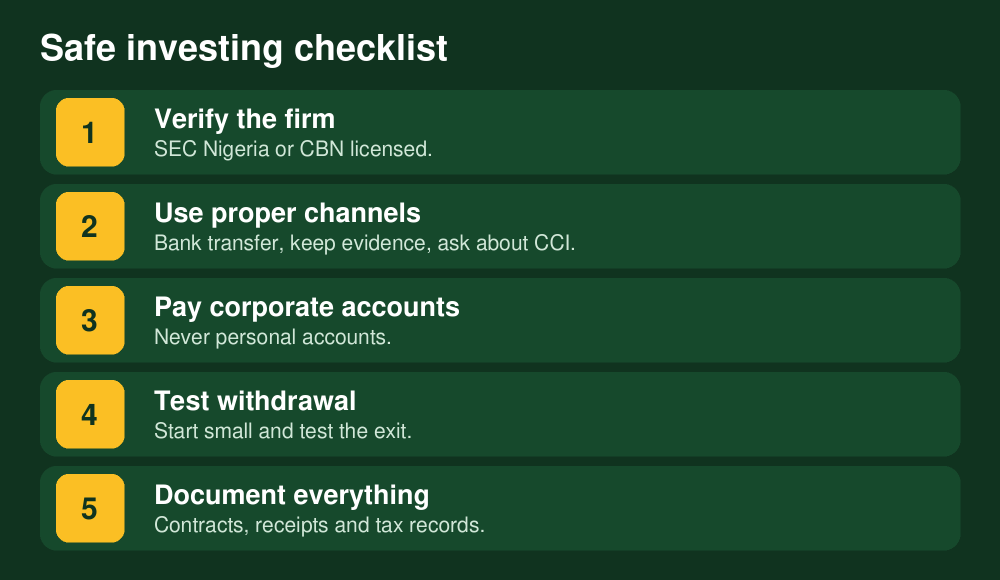
- Confirm the firm on the SEC Nigeria register or the CBN list of licensed institutions.
- Read the full terms: fees, lock-up periods and redemption currency.
- Pay only into a verified corporate or custodian account.
- Keep evidence of how the money entered Nigeria.
- Start with a small amount and test a withdrawal before scaling up.
- Never rely on a single relative or agent to manage everything.
- Keep a written record of every instruction and receipt.
Common mistakes to avoid
- Falling for guaranteed returns. If someone guarantees high returns, assume it is a scam until proven otherwise.
- Informal arrangements. Giving money to a cousin to “buy land” or “run a shop” without paperwork is one of the most common causes of loss.
- Ignoring exit routes. Always understand how and when you can convert and repatriate.
- Putting everything in one asset. Diversification limits the damage of any one failure.
- Investing before you have savings in your country of residence. See our UK guide to the best investment apps for Nigerians in the UK if you live in Britain.
FAQ
Can Nigerians living abroad invest in Nigeria?
Yes. Non-residents can invest in Nigerian treasury bills, bonds, funds, stocks and property, usually through a bank, licensed stockbroker or SEC-registered fund manager, with identity documents and a funded account.
What is the safest way to invest in Nigeria from abroad?
No investment is risk-free. Government securities and SEC-regulated funds from licensed managers are generally considered lower risk than unregulated schemes, but they still carry inflation and currency risk.
Do I need a Nigerian bank account?
Usually yes. A diaspora or domiciliary account makes investing and repatriation easier. See our guide to opening one from abroad.
What is a Certificate of Capital Importation?
It is a document issued by an authorised dealer bank to show that foreign currency was brought into Nigeria for investment, and it supports later repatriation of returns. Ask your bank what is currently required.
How do I avoid investment scams?
Verify registration with SEC Nigeria, avoid guaranteed returns, never pay into personal accounts, and be suspicious of pressure to act quickly or recruit friends.
Is it better to invest in naira or dollars?
It depends on your goal and time frame. Naira assets offer higher nominal rates but exchange rate risk; dollar assets are steadier but pay less. Many investors hold both.
Will I pay tax twice?
Possibly on the same income unless you claim relief under a double taxation agreement. Seek advice from a qualified tax professional.
Bottom line
Investing in Nigeria from abroad can be rewarding, but it rewards patience and paperwork. Start with regulated products, move money through proper channels, understand the currency risk, and treat any offer that sounds too good to be true as exactly that. I am not a licensed financial adviser, so for personal advice speak to a qualified professional.









Ade Adeniyi here. The biggest lesson I hear from diaspora readers is simple: informal deals with family or agents cause more losses than market risk. Put things in writing, use regulated products and test a withdrawal early. Have you invested in Nigeria from abroad? Share what worked and what you would do differently. General information only, not financial advice.