
How to Write a Cover Letter for a Nigerian Job (2026): Format, Samples and Mistakes

Last updated: 16 October 2026 · By Naijatipsland Editorial Team · Editorial policy
A cover letter is the one part of a job application where you speak to the reader in your own voice. Your CV lists what you have done. The letter explains why this job, why this employer and why you, in about a page. Not every employer reads one, and some tell you not to send it, but when a vacancy asks for a letter, or when you are applying by email and the message is all the recruiter sees first, a clear letter can separate you from a pile of near-identical CVs. This guide explains when to send one, how to format it, how to write each part, shows two original sample letters for a Nigerian graduate and an experienced professional, and lists the mistakes that cost interviews.
The advice here is drawn from Nigerian career guides and international hiring surveys. Several of the guides are commercial or independent sites that give opinions rather than measured results, and the survey figures we quote are from US samples, so we flag them. The most important rule is the employer’s own instruction: if the advert tells you what to send, do that. This is general advice, not a guarantee of an interview.
The short answer
- Follow the advert first. If it asks for a cover letter, send one. If it says no extra documents, do not send one.
- One page, four parts: a hook, proof, fit and a short close. Name the job, give two or three results with numbers you can defend, connect them to what the employer needs, then ask for an interview.
- Tailor every letter. The most common failures are a letter copied from another application (with the wrong company name still in it), a letter that repeats the CV, and one full of adjectives with no evidence.
- Use a name when you can. Address the hiring manager by name, or a team such as Hiring Team or Recruitment Team. A Nigerian guide notes that Dear Sir/Ma is not always wrong, but a name or team is better.
- Send a PDF unless the employer asks for Word, and put your name in the file name.
Do Nigerian employers read cover letters?
It depends on the employer, the role and who is screening. Some hiring teams read the letter only if the CV is strong, some skip it, and some applicant tracking systems never show it to a person. Novorésumé’s 2025 hiring survey of more than 200 HR professionals, which is based in the US and which sells CV products, found that about 60% of HR professionals read cover letters, while 52.8% of recruiters skip them. Its 2026 survey of 1,000 US job seekers found that 57.2% believed a cover letter definitely or perhaps changed whether they got a job, but that is perception, not a measured interview rate. We found no Nigerian survey data.
The practical conclusion is simple. A good letter helps when it is read, a bad one hurts, and a missing one is a problem only when the employer asks for it. If you are applying by email, your message acts as a short cover letter anyway, so it is worth getting right.
The format
- Length: one page. One Nigerian guide suggests three to four short paragraphs and advises against chasing a word count.
- Font and spacing: a plain font such as Arial, Calibri or Times New Roman at 10 to 12 points, with standard one-inch margins and left-aligned text.
- Header: your name, phone number and a professional email address. Add your LinkedIn address if it is complete and current.
- Recipient: the name and title of the hiring manager, the company and its address, or the team if you cannot find a name.
- Caption: a one-line subject naming the role and any reference number from the advert.
- File: PDF, or Word only if the employer requires it. Name it with your name and the role, not Document1.
How to write each part
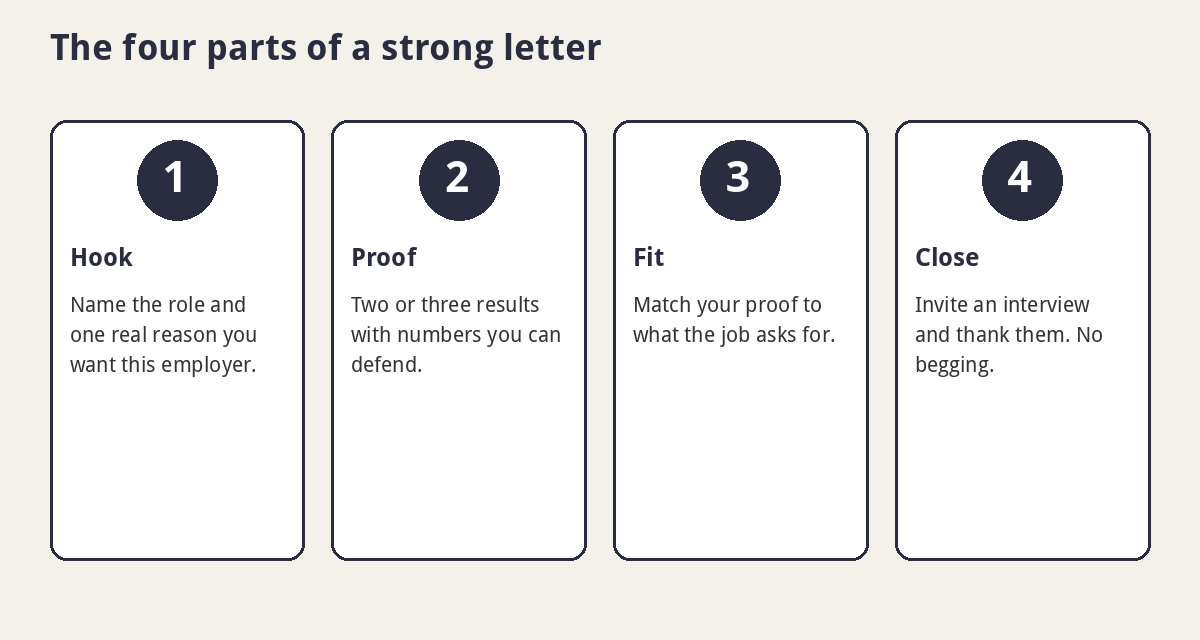
1. The hook
Say who you are, which job you are applying for and one specific reason you want this employer. Avoid the stale opening that begins with I am writing to apply for the position of. Lead with something concrete: a result, a project, a campaign you admired, a skill the job needs. If you were referred by someone, say so in the first line.
2. The proof
Pick two or three achievements that match the advert and describe each as action, context and result. Use numbers only if you can defend them in the interview: how many customers, how much money, how much time saved, what grew and by how much. If you are a graduate, evidence can come from your final-year project, an internship, student leadership, volunteering, a side project and your NYSC service. Describe only what you actually did.
3. The fit
Show that you understand the employer. Mention the company’s product, a recent campaign, the sector or the team you would join, and connect your evidence to it. Read the advert twice and use its language for the two or three skills that matter most. This is also where you handle any awkward facts honestly. A second-class lower degree needs no apology: put the weight on relevant experience and do not misstate your class of degree. Mention salary only if the employer asks. Explain a career gap only if it is relevant.
4. The close
Keep it short. Say you would welcome an interview, say how you can be reached, and thank the reader. Do not beg, and do not promise to work for free.
Sample letter 1: a graduate applying for a customer service role
This sample is fictional. Replace every detail with your own, and do not copy it.
Subject: Customer Service Associate (Ref. CS-014), Chinedu Okafor
Dear Hiring Team,
I am a 2025 Economics graduate of the University of Ibadan, and I am applying for the Customer Service Associate role at Kora Telecoms. During my NYSC year at a mobile network retail outlet in Enugu, I handled about 40 customer visits a day and helped reduce repeat complaints about SIM registration by creating a one-page guide that the branch still uses.
At the outlet I resolved most issues on the first visit, escalated the rest with a short written summary and followed up by phone within a day. I also trained two new colleagues on the NIN linkage process, which cut average waiting time at the desk during our busiest weeks. I enjoy explaining technical rules in plain language, and I am comfortable with spreadsheets and ticketing tools.
Kora’s work to bring data plans to smaller towns is the reason I am applying. I would like to bring the same patience and attention to detail to your support team in Lagos.
I would welcome the chance to discuss the role. You can reach me on 0800 000 0000 or at chinedu.okafor@example.com. Thank you for your time.
Yours sincerely,
Chinedu Okafor
Sample letter 2: an experienced professional applying for an operations role
This sample is also fictional.
Subject: Operations Manager application, Amina Bello
Dear Mr Adeyemi,
Your advert for an Operations Manager at Northgate Logistics describes a problem I have spent five years solving: late deliveries caused by weak handovers between depots. At Pioneer Haulage I rebuilt the dispatch handover process, and on-time delivery rose from 78% to 91% over twelve months while fuel costs per trip fell by about 6%.
I manage a team of 24 drivers and dispatchers across three depots, report weekly to the managing director and run the monthly cost review. I also introduced a simple route checklist that cut avoidable breakdowns, and I have worked with the vendors and regulators your business depends on.
I have followed Northgate’s expansion into the North-Central corridor, and I believe my experience of opening a depot in Abuja would help you open the next one smoothly.
I would be glad to discuss the role in an interview. I can be reached on 0800 000 0001 or at amina.bello@example.com. Thank you for your consideration.
Yours sincerely,
Amina Bello
Notice what both letters do. Each opens with a specific link to the job. Each gives results with numbers, shows the person can explain how they did it, and ends briefly. Neither tells the reader the applicant is hardworking.
Mistakes that sink a cover letter
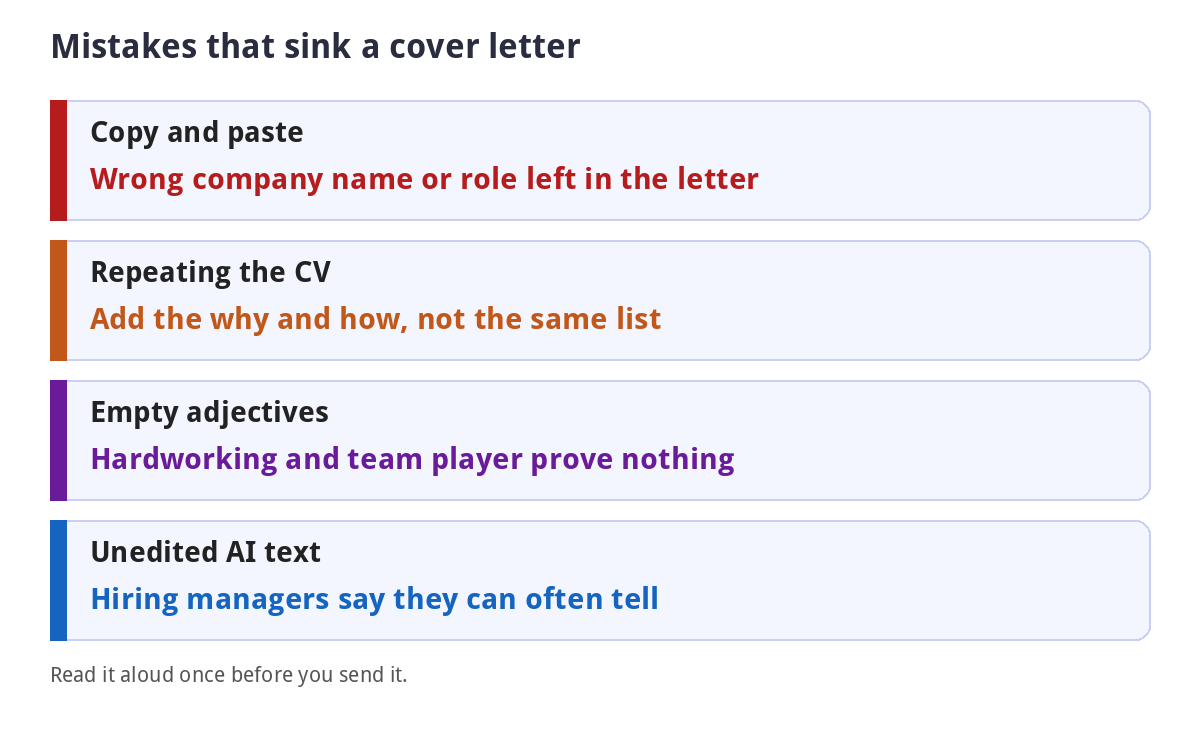
- One letter for every job. It is the most common error and the easiest to spot. Check the company name, role and dates every time.
- Repeating your CV. The letter should add context the CV cannot: why this role, how you did something, what you learned.
- Clichés. Hardworking, team player and results-driven prove nothing. Show it with an example instead.
- Focusing on what you want. Talk about what the employer needs and how you can help.
- Sounding desperate. Confidence is not arrogance, and begging does not help.
- Typos and the wrong name. One wrong company name can end an application.
- An informal email address or subject line. Use your name, not a nickname.
- Unedited AI drafts. A 2025 Insight Global survey of 1,005 US hiring managers found 88% said they could tell when candidates used AI, and 54% said they would care. That is self-reported, but the lesson holds: use a tool for ideas if you like, then rewrite it in your own words with your own facts.
- Claims you cannot support. Only write what you can explain at an interview.
Sending it by email
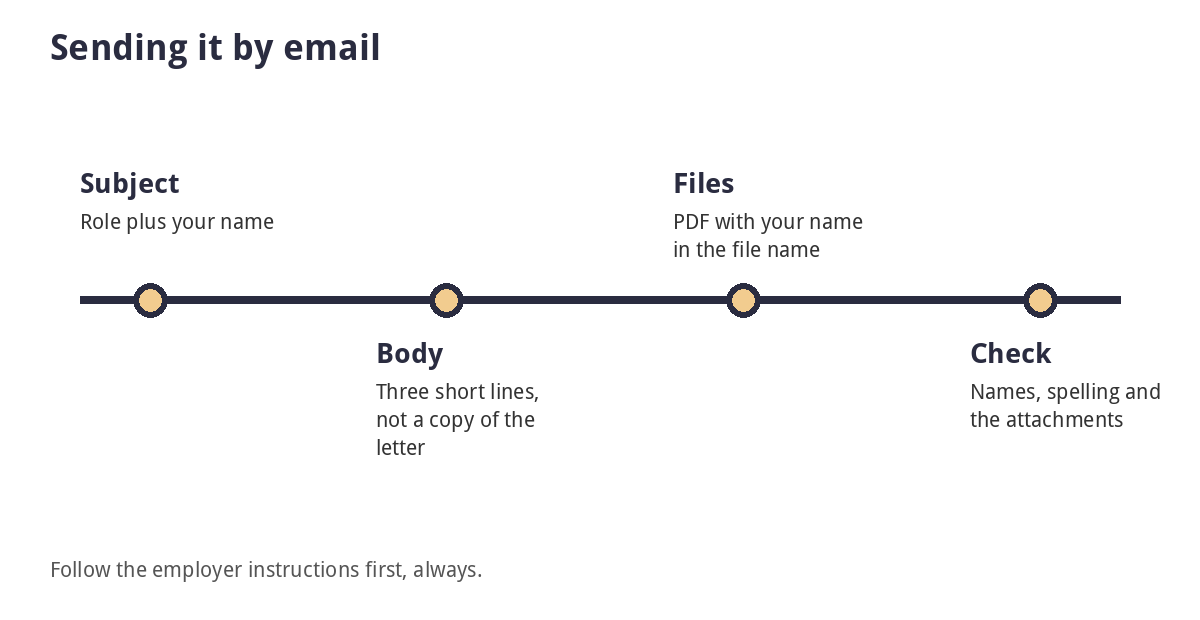
Many Nigerian applications go by email. Follow the advert’s instructions on the address, subject line and attachments. If it gives none, a safe approach is:
- Subject: the role and your name, for example Application for Graduate Trainee Position, Chinedu Okafor, or the exact subject the employer requests.
- Body: two or three lines saying what you are applying for and what is attached, with your phone number. Or paste the letter itself into the body if no separate letter is requested.
- Attachments: your CV and letter as PDFs named with your name. Check they open and are not too large.
- Final check: the recipient’s name, the role, spelling and the attachments before you press send.
Be careful with the address you send to. Fake recruiters copy real companies’ names, so read how to spot fake job ads in Nigeria before you send documents to an unfamiliar address. Never pay to apply.
Tailoring for different situations
- Fresh graduate or NYSC corps member: lead with projects, internships, leadership and service. Explain what you did and what changed because of it.
- Career changer: name the transferable skills and one small proof of interest in the new field, such as a course or project.
- Banking and finance: stress accuracy, compliance and analysis.
- NGO and development roles: stress reporting, stakeholder work and field experience.
- Tech: link to a project, a GitHub profile or a portfolio and name the tools you used.
- Sales: use numbers on customers won, revenue and retention.
- Remote jobs for foreign employers: keep it shorter and more direct, and stress written communication and time-zone fit. See remote jobs for Nigerians paid in dollars.
Before you send: a checklist
- Does it match the advert’s instructions?
- Is it addressed to a person or a team, with the right company name?
- Does the first paragraph name the role and one specific reason?
- Do you give two or three results with numbers you can defend?
- Is it under one page and free of typos?
- Is the file a PDF with your name on it?
Pair the letter with a strong CV (see how to write a CV for Nigerian jobs) and prepare for the interview with job interview tips for young Nigerian adults, common interview questions and an interview checklist. If you are choosing what to learn next, the digital skills checklist helps.
Frequently asked questions
Is a cover letter compulsory in Nigeria?
Only if the employer asks for it. If the advert is silent, a short letter or a well-written email can still help, but never ignore instructions.
How long should it be?
One page, usually three to four short paragraphs.
Should I write Dear Sir or Ma?
Use a name if you can find one, or a team such as Hiring Team. If you do not know, Dear Sir/Ma is not always wrong, but a name or team shows more effort.
Should I mention salary?
Not unless the employer asks.
Can I use a template?
You can use a structure, but rewrite the content in your own words with your own facts. A template with the wrong name left in is an instant rejection.
Should I attach the letter or paste it into the email?
Follow the advert. If it is silent, send a short email and attach the letter and CV, or paste a short letter into the email body if there is no attachment slot.
Does a cover letter help a fresh graduate?
Yes, because it lets you explain projects, service and potential when your work history is short.
Bottom line
Follow the advert, write one page for one job, open with a specific reason, back it with two or three numbers you can defend, match them to what the employer needs and end politely. Proofread it, send a PDF with your name on it, and keep your documents back from anyone who asks you to pay.
Sources
- JobhardER (independent site): Cover letter for Nigerian jobs 2026
- CVJury (commercial site): How to write a cover letter in Nigeria
- Novorésumé (commercial site): Cover letter statistics and trends for 2026
- Profolio.ng: Nigerian cover letter sample
Related: LinkedIn profile guide for Nigerian job seekers: headline, About and scam checks
Related: How to write a resignation letter in Nigeria
Join the discussion
Have you tried this, or do you have a question we did not answer? 2 readers have already shared their views. Naijatipsland members help each other with real, first-hand experience.





The most common failure is a letter copied from another application with the wrong company name still in it. It happens more often than you’d think. If you’ve screened applications, what mistake made you stop reading?
In a survey of US hiring managers, 88% said they could tell when candidates had used AI. A tool can help with ideas, but the final letter should sound like you. Do you use AI when writing applications, and how?