Last updated: 13 October 2026. This is an informational profile, not a ranking. We have kept to facts we can source and left out net worth figures, which change constantly and are often unreliable. An earlier version of this article was titled “Top 10”, and we have narrowed it to people whose records we could verify.
Reading about entrepreneurs is only useful if you take away something you can use. These profiles focus on what each person built and what their path teaches. They are drawn from public records and press reports.
Aliko Dangote: building the hard thing
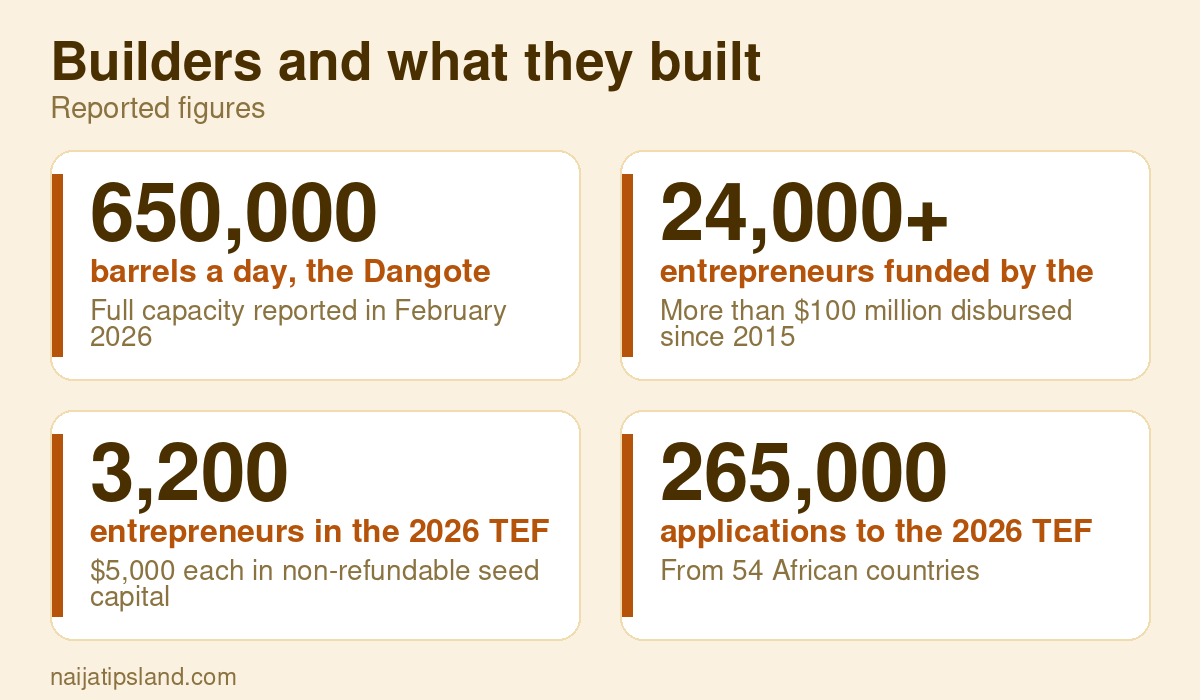
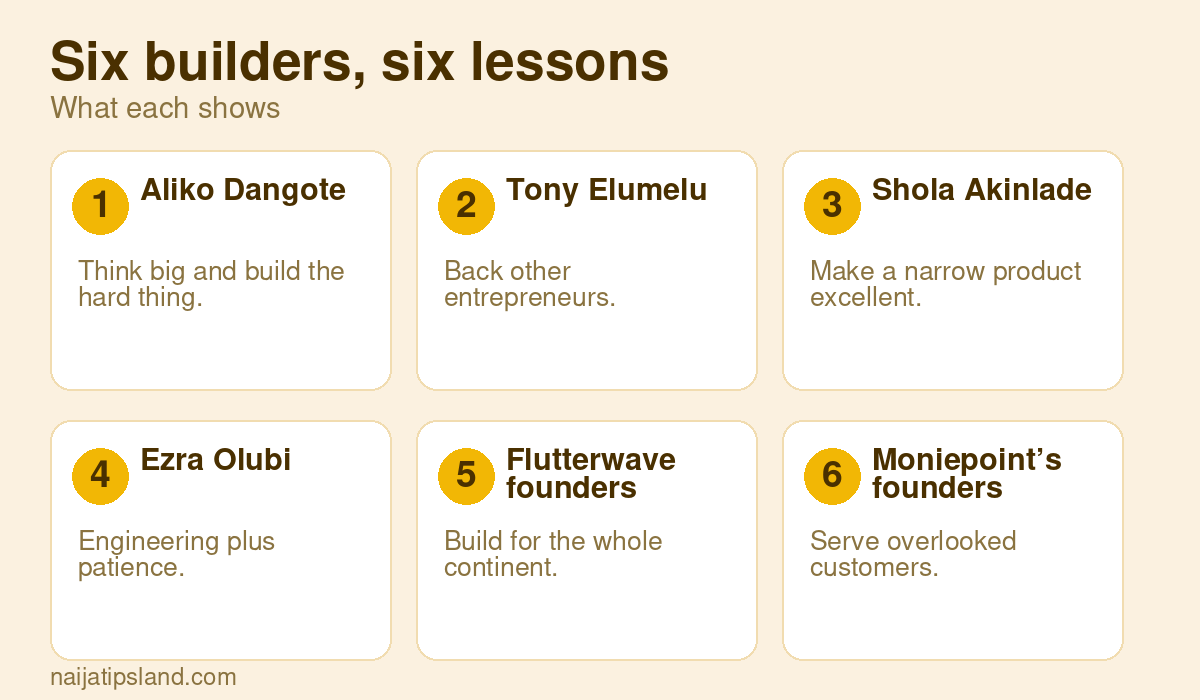
Founder of the Dangote Group, Aliko Dangote built a business empire in cement, sugar and other goods before turning to the Dangote refinery in Lagos. By early 2026 the refinery had reached its full capacity of 650,000 barrels a day, and reports said it was supplying roughly 71% of Nigeria’s petrol in August 2026, though it has faced problems getting enough domestic crude. In October 2025 the company announced plans to expand to 1.4 million barrels a day. Lesson: big projects take years, cost more than planned and attract fights over supply and pricing, so patience and financing matter. See our guide to the role of oil in Nigeria.
Tony Elumelu: backing other entrepreneurs
Tony Elumelu chairs Heirs Holdings and the United Bank for Africa, and founded the Tony Elumelu Foundation in 2010. Its flagship entrepreneurship programme began with a $100 million, ten-year pledge to support 10,000 African entrepreneurs. By 2026 it said it had disbursed more than $100 million to over 24,000 entrepreneurs, and the 2026 cohort of 3,200 entrepreneurs each receives $5,000 in non-refundable seed capital after more than 265,000 applications from 54 countries. The Foundation reports that its alumni have created around 1.5 million jobs. These figures come from the Foundation itself. Lesson: successful founders often build ecosystems, not just companies. See our guides on startup funding and entrepreneurship mistakes.
Shola Akinlade and Ezra Olubi: Paystack
The two co-founders started Paystack in 2015 to make online payments easier for Nigerian merchants. Stripe acquired the company in 2020 for a reported $200 million, then the largest acquisition of an African tech start-up. Lesson: pick a narrow problem, make the product excellent and let trust build. See our guide to Nigerian startups.
The Flutterwave founders: building for a continent
Flutterwave, co-founded by Olugbenga Agboola and Iyinoluwa Aboyeji among others, grew into a payments company that operates across many African countries. It became a unicorn in 2021 and was valued at around $3 billion after its 2022 round. Lesson: scale across borders needs deep work on regulation and local partners.
Tosin Eniolorunda and Moniepoint
Moniepoint, formerly TeamApt, grew by serving agents and small businesses that banks had overlooked. It became a unicorn in October 2024 after a $110 million round. Lesson: serve the customers others ignore, and keep reliability as your brand. See our fintech apps comparison.
Habits worth copying
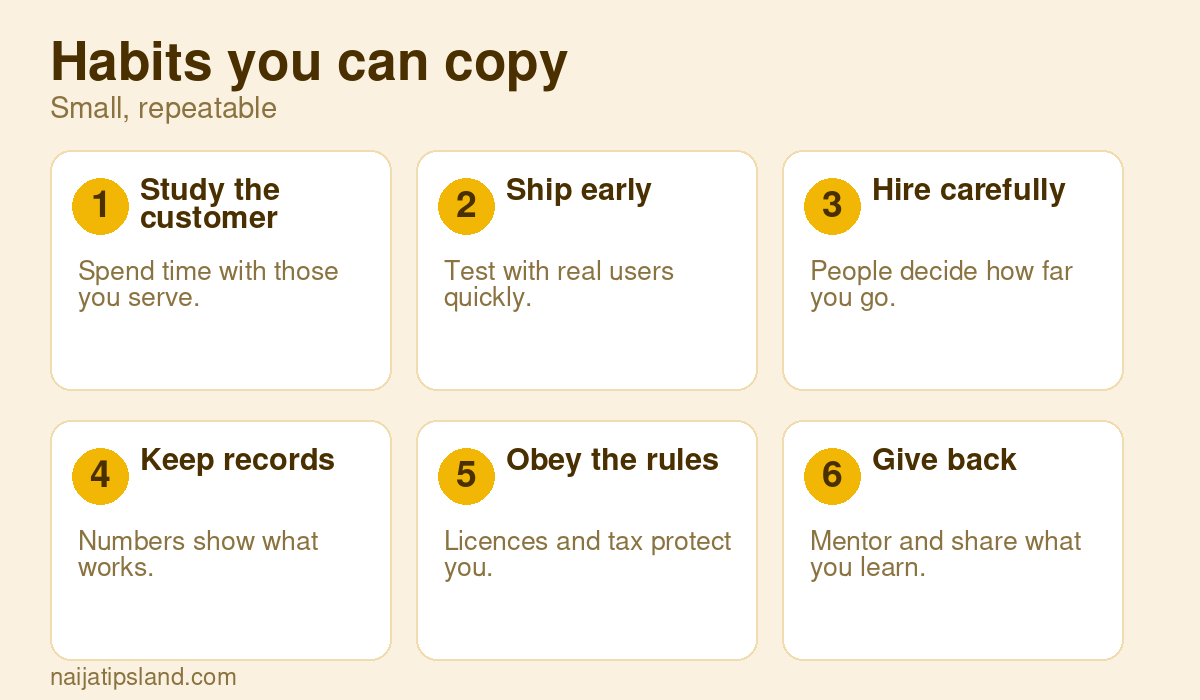
- Know your customer. Spend time in the market, not only in meetings.
- Test small before you scale. Start with one product or one area.
- Keep clean books and obey the rules. Licences, tax and records protect you. See business structures in Nigeria.
- Hire for character and skill, and share credit.
- Expect setbacks. Even the best-known companies have had regulatory problems, losses or leadership changes.
If you are starting small, our guides to small businesses that succeed and online business ideas without capital are a better place to begin.
Lessons Any Entrepreneur Can Use
- Start with a real customer problem, not a trend.
- Build distribution early. In many Nigerian markets, reaching customers is harder than building the product.
- Stay close to cash. Many well-known closures came from running out of money, not from lack of ideas.
- Hire for trust and skill, and write down roles and equity.
- Adapt, but stay compliant: tax, registration and data rules are part of the job. See our guide on small businesses that succeed.
- Look after yourself: burnout and isolation are common, so build a network of peers and mentors.
Questions to Ask Before You Copy a Founder
- Which part of their story is luck, timing or inherited advantage, and which part is repeatable?
- What was their market, and does yours look similar?
- How did they fund the first year?
Where to Learn More
Read founder interviews critically and treat promotional articles with caution. Our guides on Nigerian start-ups and what founders can learn and entrepreneurship mistakes add context.
Frequently Asked Questions
How do Nigerian entrepreneurs usually raise money?
Through savings, family, grants, loans and, for scalable businesses, venture capital. The Tony Elumelu Foundation offers $5,000 grants in a competitive process.
Do I need a lot of capital to start?
No. Many successful companies began with a small team and a narrow product.
Where can I learn from successful founders?
Read interviews, join founder communities, find a mentor and learn from companies’ public filings and reports.
Sources
- IT Edge News: Tony Elumelu announces 3,200 African entrepreneurs for 2026
- Daba Finance: Tony Elumelu Foundation backs 3,200 entrepreneurs with $5,000 grants
- World Economic Forum: Tony O. Elumelu
- BusinessDay: A decade on, Flutterwave, Paystack and Moniepoint compete for Africa’s financial plumbing
- Discovery Alert: Dangote refinery and Nigeria’s petrol market, September 2026
- Awajis: Nigeria refineries 2026
- Techeconomy: The Nigerian startup graveyard
Join the discussion
Have you tried this, or do you have a question we did not answer? Be the first to share your experience. Leave a comment below. Every comment is read by the editor before it appears.