Last updated: 13 October 2026. Oil output, prices and fuel costs change quickly. Figures below come from the National Bureau of Statistics (NBS), OPEC-linked reports, the regulator and press reports, and we say which source we mean. This version replaces an earlier one that carried outdated claims, such as oil being about 9% of GDP.
Oil in Nigeria’s economy at a glance (2026)
- A small share of output: oil accounted for 4.16% of real GDP in the second quarter of 2026, according to the NBS. The non-oil economy was 95.84%.
- A big role in dollars and public money: oil remains central to export earnings and government revenue, which is why prices and output still shape the budget and the naira.
- Output is recovering: the NBS put average daily crude oil production at 1.72 million barrels in Q2 2026, up from 1.55 million in Q1. The 2026 budget assumes about 1.84 million barrels at $64.85 a barrel.
- Refining has changed: the 650,000-barrel-a-day Dangote refinery reached full capacity in February 2026 and now supplies most of the petrol market, according to reports.
- The risks remain: theft, insecurity, price swings and the way oil prices feed into fuel costs at home.
Nigeria is Africa’s largest oil producer, and oil shapes almost every national conversation, from the budget and the exchange rate to the price of petrol at your local station. But the numbers are more nuanced than the slogans. This guide explains how big oil really is in the economy, how much Nigeria produces, how refining and fuel prices connect to your costs, what the main risks are and what policy choices matter.

How Big Is Oil in the Economy?
In GDP terms, oil is small. In the second quarter of 2026 the oil sector contributed 4.16% of real GDP, up slightly from 4.05% a year earlier, while the non-oil economy made up 95.84%. Services, agriculture, telecoms, trade and real estate dominate output. But GDP shares understate oil’s importance. Crude oil exports bring in much of the country’s foreign exchange, and oil taxes, royalties and profits feed a large part of federal revenue. When oil prices or production fall, the government has less money and dollars become scarcer. When they rise, the budget gets room to breathe. Older sources that claim oil is about 9% of GDP or more than 90% of revenue use outdated or narrower definitions, so check the date and definition of any figure you see.
How Much Oil Does Nigeria Produce?
Production fell for years because of theft, vandalism, underinvestment and insecurity, and has been recovering since 2024. The NBS reported average daily output of 1.41 million barrels in Q2 2024, 1.68 million in Q2 2025, 1.55 million in Q1 2026 and 1.72 million in Q2 2026. The oil sector grew 7.31% in real terms in Q2 2026 compared with a year earlier.
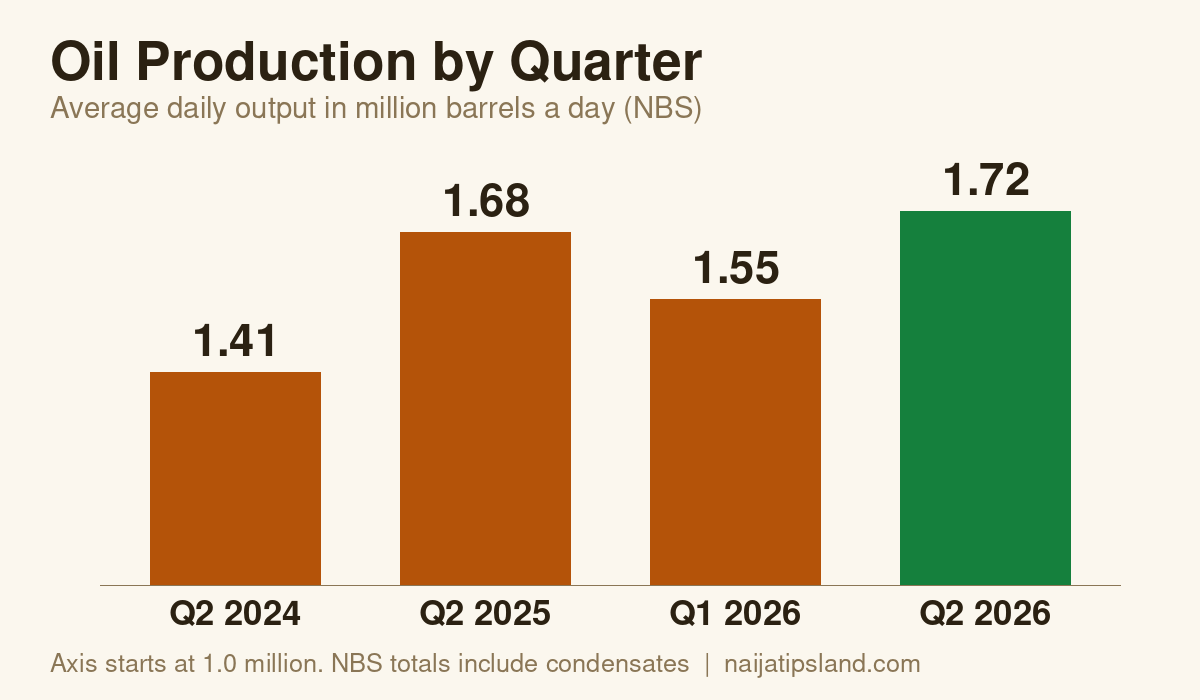
Different sources give different numbers because they measure different things. The NBS figure includes condensates, while OPEC-based data on crude oil alone were lower, around 1.5 million barrels a day in mid-2026. The regulator reported that total production including condensates reached about 1.735 million barrels a day in June 2026. NUPRC put reserves at 37.01 billion barrels of crude and condensate and 215.19 trillion cubic feet of gas at the start of 2026. Analysts at the Nigerian Economic Summit Group expect output to exceed 1.7 million barrels a day in the second half of the year, still below the 1.84 million assumed in the 2026 budget.
Prices, the Budget and the Naira
The 2026 federal budget uses a benchmark of $64.85 a barrel. In September 2026, Brent crude was reported at around $107 a barrel amid Middle East tensions, well above the benchmark, which helps government revenue and reserves. Reserves rose past $54 billion in September, an 18-year high. High crude prices, though, also push up the cost of imported fuel inputs and of petrol at home, which hurts households. Our guides on the fuel subsidy and cost of living show how this plays out.
Refining: The Dangote Effect
The Dangote refinery in Lagos has a capacity of 650,000 barrels a day, reached full nameplate capacity in February 2026 and has announced plans to expand towards 1.4 million barrels a day. Reports say it supplied about 71% of Nigeria’s petrol in August 2026, and that Nigeria’s seaborne petroleum product exports rose from about 46,000 barrels a day in 2023 to about 350,000 in the second quarter of 2026. That makes Nigeria a net exporter of petrol and diesel for the first time in decades, according to some reports. NNPC holds a 7.25% stake in the refinery, while its own refineries in Port Harcourt, Warri and Kaduna have operated well below standard, and it planned to pick private partners to overhaul them.
The refinery has also faced a crude supply problem. Reports said it received far less domestic crude than it needed between late 2025 and early 2026, forcing it to import some feedstock even as Nigeria exports crude. Pump prices still follow crude prices and the refinery’s gantry price, which is why petrol cost about ₦1,350 to ₦1,430 a litre in late 2026.
What Oil Gives and What It Risks

Policy and Law
- The Petroleum Industry Act 2021 restructured the sector, creating regulators for upstream and midstream and downstream activity, and converting NNPC into a limited liability company.
- Licensing of oil blocks has resumed, which could support new investment, according to the NESG.
- Subsidy removal: the petrol subsidy ended on 29 May 2023. Labour has pressed for lower pump prices again in October 2026, and officials argue that a return to subsidy would amount to subsidising foreign exchange. Read our fuel subsidy guide.
- Security and theft: better pipeline security and less crude theft have helped output recover, but they need to be sustained.
Diversification and the Energy Transition
Oil’s small share of GDP shows that the economy has already moved a long way from oil, with telecoms, agriculture, real estate and trade driving growth in 2026. See our guides to Nigeria’s economy and resilience and the digital economy. Gas, refining and petrochemicals are growth areas within energy, while solar, grid upgrades and efficiency offer new jobs. The world’s demand for oil may fall over time, so a country that depends on oil dollars is exposed.
What It Means for You
- Fuel and transport costs follow crude prices and the refinery’s pricing, so budget for swings.
- Prices and the naira are influenced by oil earnings, so keep an eye on reserves and the exchange rate. See our dollar to naira page.
- Jobs are growing in energy services, gas and solar as well as the wider economy.
- Savings: inflation and fuel shocks erode cash, so read our guide on how to save money in Nigeria.
A Short Timeline of Oil and Fuel Policy
- 2021: the Petroleum Industry Act reorganises the sector.
- 29 May 2023: the petrol subsidy is removed, and pump prices rise sharply.
- 2024: the Dangote refinery begins processing crude, and NNPC ends its exclusive purchase arrangement, so marketers can buy directly.
- 2025: production recovers to a multi-year high, and the Dangote refinery announces an expansion plan.
- February 2026: the Dangote refinery reaches full nameplate capacity of 650,000 barrels a day.
- September to October 2026: crude prices near USD 107 push pump prices higher, and labour issues an ultimatum over petrol prices.
Key Terms Explained
- Barrel per day (bpd): the standard measure of oil output, one barrel being about 159 litres.
- Condensates: light liquid hydrocarbons produced with gas, counted in some totals but not in crude-only figures.
- Budget benchmark: the oil price the government assumes when planning revenue.
- Gantry price: the price a refinery or depot charges marketers, before the marketers add their costs and margin.
Frequently Asked Questions
How much of Nigeria’s GDP is oil?
The NBS says oil was 4.16% of real GDP in Q2 2026. Its importance is bigger in exports and government revenue than in GDP.
How much oil does Nigeria produce?
The NBS reported an average of 1.72 million barrels a day in Q2 2026 including condensates. Crude-only figures from OPEC-linked sources were lower, around 1.5 million barrels a day.
Why is petrol so expensive if Nigeria produces oil?
Refined fuel is priced against crude and exchange rates, not just local production. The subsidy ended in 2023, so pump prices now reflect market costs.
What is the Dangote refinery’s capacity?
650,000 barrels a day, with plans to expand towards 1.4 million.
Is Nigeria still dependent on oil?
It is less dependent in output terms, but still highly exposed through exports, revenue and foreign exchange.
Related Guides
- Fuel subsidy in Nigeria: what happened and what comes next
- Nigeria’s economy: strategies for resilience and growth
- Nigeria’s cost of living in 2026
- Dollar to naira exchange rate today
Sources
- Proshare: Nigeria’s GDP growth accelerates to 4.43% in Q2 2026
- Credit Direct: GDP Q2 2026 report
- Nairametrics: Dangote Group projects crude oil production to rise to 1.72 million bpd in Q4 2026
- NESG half-year outlook: oil output could exceed 1.7 mbpd in H2 2026
- Discovery Alert: Nigeria oil output six-year high (NUPRC data)
- Discovery Alert: Dangote refinery and Nigeria’s petrol market, September 2026
- Awajis: Nigeria refineries 2026
- Legit.ng: NNPC announces petrol prices, with Brent near $107
- Money Africa: Nigeria’s economy grows 4.43% in Q2 2026, reserves at 18-year high