
Last updated: 13 October 2026. Use this as a self-assessment. Tools change quickly, so focus on the skills rather than on particular products.
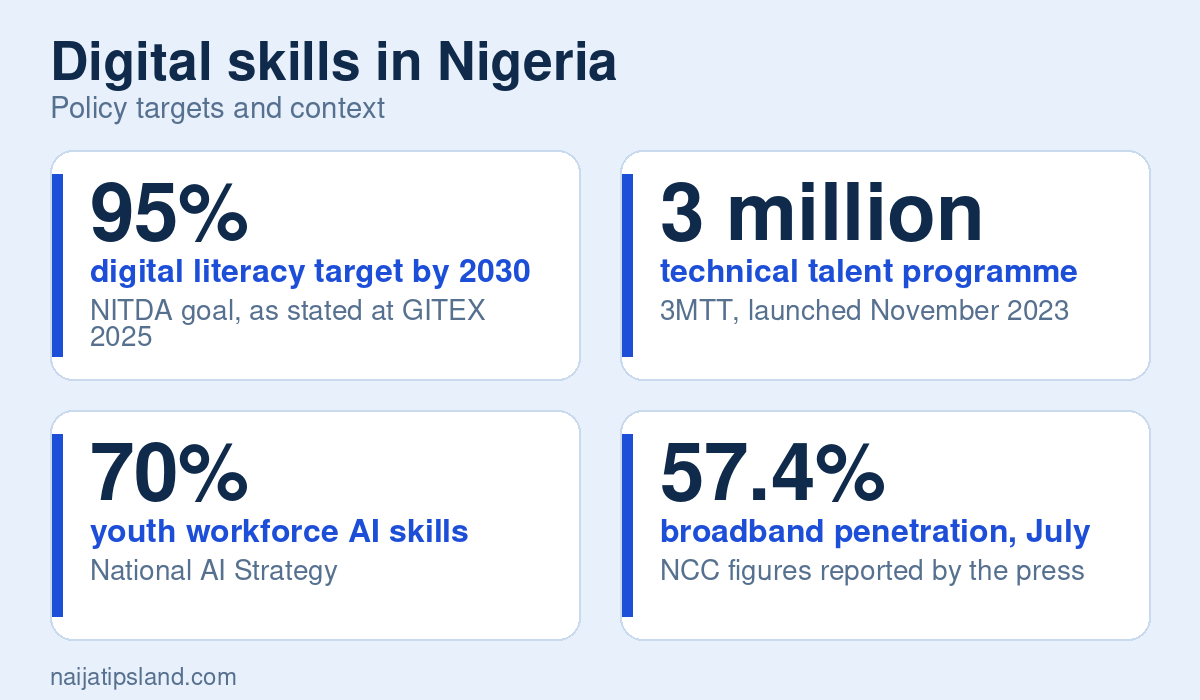
Almost every job now involves a screen. The WEF expects technological literacy, AI and big data, and networks and cybersecurity to be among the fastest-growing skills to 2030, and Nigerian policy points the same way: NITDA has talked of 95% digital literacy by 2030, the 3 Million Technical Talent programme aims to train three million Nigerians and the National AI Strategy sets a goal of foundational AI skills for 70% of the youth workforce. Use this checklist to see where you stand.
1. Everyday office tools
- ☐ I can write and format documents, and use templates, headings and comments.
- ☐ I can use spreadsheets: sort, filter, simple formulas and charts.
- ☐ I can create clear presentations without clutter.
- ☐ I can run and join video meetings, share a screen and use chat politely.
- ☐ I manage files in cloud storage and can find a document quickly.
2. Data basics
- ☐ I can read a table or chart and spot what looks wrong.
- ☐ I can clean a list, remove duplicates and check totals.
- ☐ I can summarise numbers in a few sentences for a decision maker.
- ☐ I know the difference between an average, a total and a percentage change.
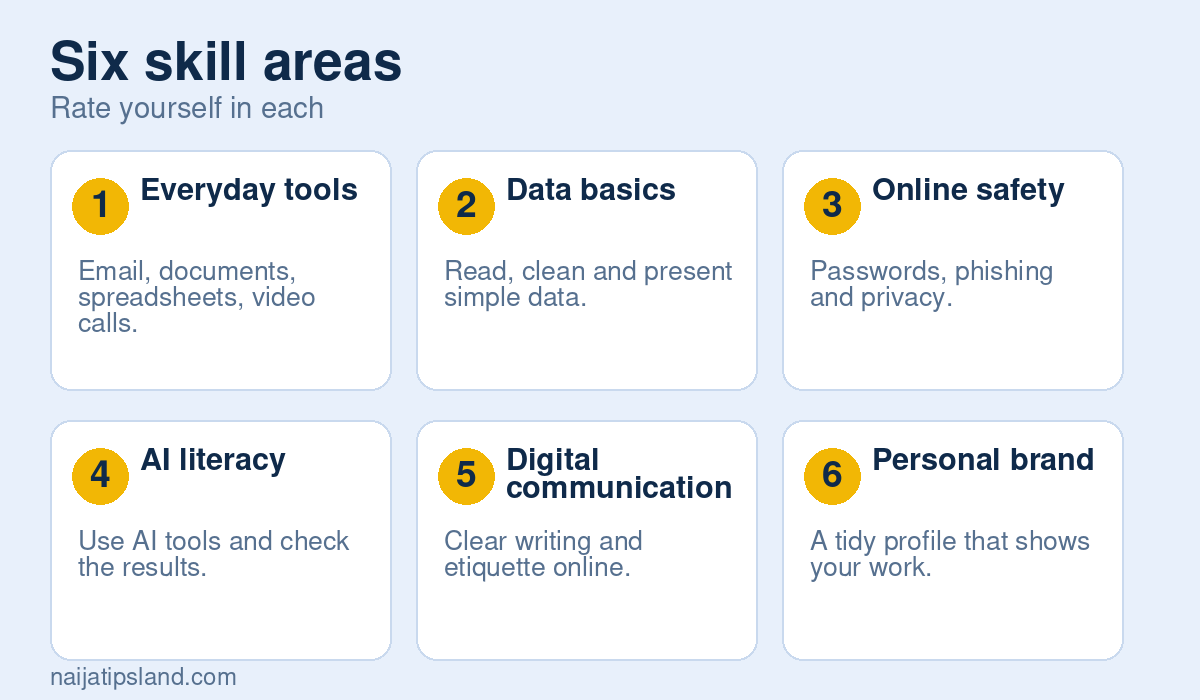
3. Online safety and privacy
- ☐ I use strong, unique passwords and two-step login on important accounts.
- ☐ I can spot a phishing message and know not to click or share OTPs. See our guides on cyber security and online safety tips.
- ☐ I keep my phone and laptop updated and backed up.
- ☐ I know my rights over personal data. See our guide to data privacy.
- ☐ I know how to protect my identity details. See our guide to digital identity.
4. AI literacy
- ☐ I can use an AI assistant to draft, summarise or brainstorm, and I always check facts and sources before using the result.
- ☐ I do not paste confidential or personal information into public tools.
- ☐ I know AI can be wrong, biased or out of date.
- ☐ I understand my employer’s rules on AI use.
For the policy background, read our guide on responsible AI adoption in Nigeria.
5. Digital communication
- ☐ I write clear emails with specific subject lines.
- ☐ I use work chat professionally, and avoid sensitive topics in casual messaging.
- ☐ I respond within a reasonable time and confirm deadlines in writing.
See our guide to communication skills.
6. Money and payments online
- ☐ I can use banking and payment apps safely and confirm credits in my own account.
- ☐ I understand fees, limits and how to dispute a failed transfer. See our fintech apps comparison.
- ☐ I can tell a legitimate loan or investment app from a scam. See our guide on internet scams.
7. Your digital presence
- ☐ My LinkedIn profile is complete, accurate and shows results.
- ☐ My public social media does not harm my reputation.
- ☐ I keep a simple portfolio or document of my best work. See our CV guide.
Scoring yourself
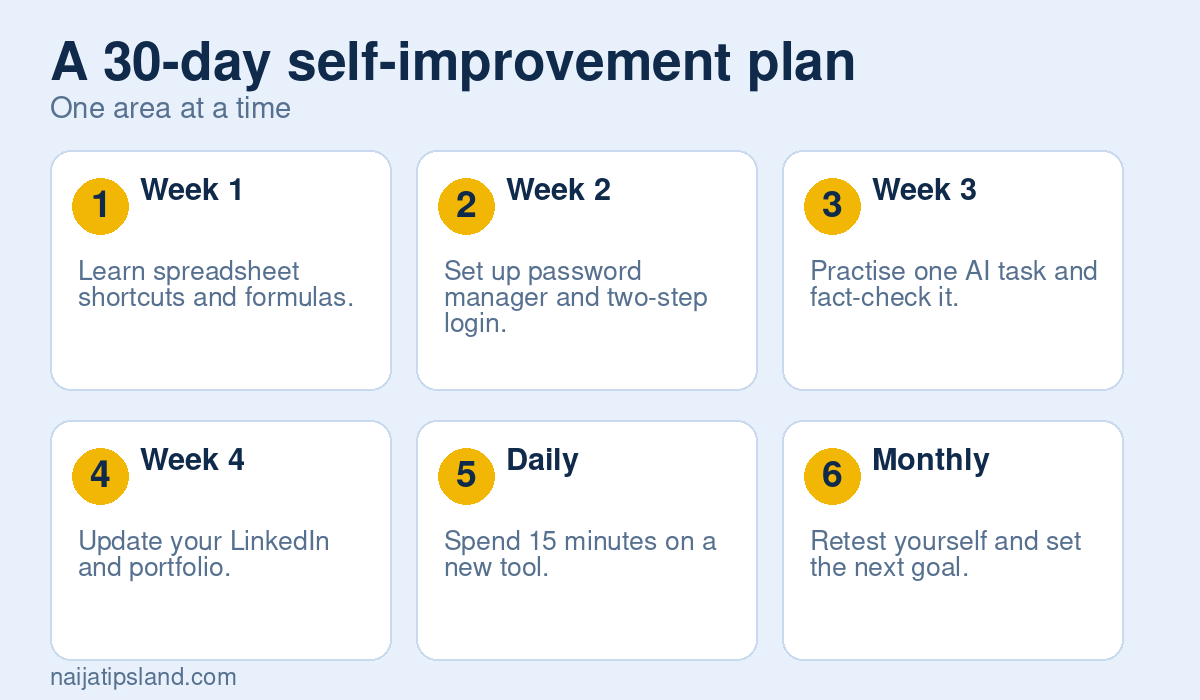
Count your ticks. Strong in most areas: look at more advanced skills in data, security or AI. Gaps in two or three: pick one and follow the 30-day plan above. Gaps in many: start with everyday tools and online safety, because they protect you and make everything else easier. Free courses, workplace training and programmes such as 3MTT can help, but check that what you pay for is recognised by employers.
A Skills Ladder
- Foundation: typing, email, spreadsheets, online safety and file management. See digital literacy and online safety tips.
- Workplace: collaboration tools, video calls, basic data analysis and clear writing.
- Specialist: design, programming, digital marketing, cybersecurity or cloud, chosen for your target job.
- Future-facing: using AI tools carefully, and checking what they produce, since employers now expect staff to understand how these tools work and use them responsibly.
A 30-Day Learning Plan
- Week 1: pick one skill and one beginner course or tutorial series.
- Week 2: practise daily for 30 to 45 minutes, and take notes.
- Week 3: build a small project that solves a real problem for someone you know.
- Week 4: publish it, ask for feedback and add it to your CV and profile.
Prove Your Skills
Employers are paying closer attention to completed projects and demonstrable work than to certificates alone. Keep a short portfolio, with a clear description of the problem, what you did and the result. Certificates help, but projects convince.
Learning Without Spending Much
- Use free tutorials and low-cost courses before paying for expensive programmes. Do not pay for “guaranteed job” courses.
- Study offline when data is expensive. See our guide to data plans.
- Join study groups or communities for accountability.
Frequently Asked Questions
What are digital skills?
The abilities to use digital tools, find and judge information, communicate online, protect yourself and create or analyse digital content.
Do I need to learn to code?
Not for most jobs. Basic digital literacy, data skills and safe tool use matter for almost everyone, and coding matters if you want a technical role.
How can I learn digital skills cheaply?
Use free tutorials and courses, employer training and community programmes, and practise on real tasks.