Co-Parenting Successfully After Divorce in Nigeria: The Law, the Habits and the Routines That Protect Your Children


Last updated: 23 October 2026 · By Naijatipsland Editorial Team · Editorial policy
Divorce ends a marriage, but not parenthood. For Nigerian parents, co-parenting after a split means working with a former partner for the sake of your children, often while family members, church, community and your own hurt pull in other directions. It is hard, but the choices you make now shape how your children feel about both of you for years.
This guide explains how Nigerian law approaches custody, what research says about different parenting patterns after divorce, and gives practical ground rules, communication tips and routines to help you co-parent more calmly.
What Nigerian law says about custody
This is general information, not legal advice. Custody law in Nigeria draws on several sources: the Matrimonial Causes Act, the Child’s Rights Act 2003 and state child rights laws, plus customary and Islamic law for some marriages. The key principles, as summarised by a Nigerian law firm in a 2022 article on Mondaq, are:
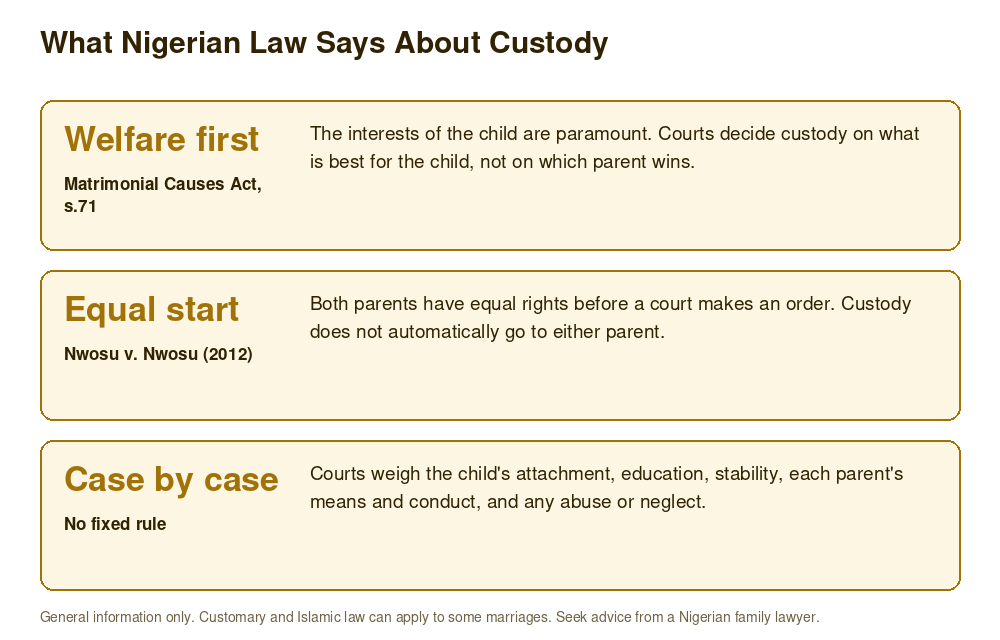
- The child’s welfare is paramount. Section 71(1) of the Matrimonial Causes Act makes the interests of the child the paramount consideration, and section 71(3) allows a court to place a child with a third party where neither parent is suitable.
- Both parents start equal. In Nwosu v. Nwosu (2012), the courts stressed that both parents have equal rights before an order is made, and custody does not automatically go to one parent.
- There is no fixed formula. Courts look at factors such as the child’s attachment to each parent, education and upbringing opportunities, each parent’s income and home, and conduct. Abuse, neglect or domestic violence can lead to restrictions or sole custody.
- Young children and the mother. Some cases have said very young children should normally stay with the mother unless other considerations make that undesirable, but courts are not bound by a rule that girls go with mothers and boys with fathers.
- Customary and Islamic law. Traditionally, many customary systems favour the father’s rights, and Islamic law has its own age-based rules. Courts have held that these yield where they would harm the child’s welfare.
- Types of arrangements. The same article describes divided custody (the child alternates between parents), split custody, joint custody (shared responsibility, not necessarily equal time), temporary custody and third-party custody.
A legal commentary from LawPavilion adds that enforcement of court orders for payment is often weak and that cost and delays are real barriers. If you are going through a custody dispute or need a maintenance order, speak to a family lawyer early.
What research says about co-parenting
A study by Amato, Kane and James (2011), published in Family Relations and covering over 900 families, grouped separated parents into three patterns:

- Cooperative co-parents: parents got along, coordinated well and had little conflict.
- Parallel parents: the non-resident parent had less contact, more conflict and less cooperation.
- Single parents: the other parent rarely saw the children and had little influence on their lives.
Children of cooperative co-parents had fewer behaviour problems and rated their relationships with their fathers more highly. But the study also found they did no better on school grades, self-esteem, substance use or early sexual activity than children raised by a single parent. The takeaway: cooperation helps, particularly with behaviour and the parent-child bond, but divorce is still a big change for children and many find it upsetting. Low conflict, regular contact and a positive tone matter, and so does giving children time and support.
Seven ground rules for co-parenting

- Keep children out of the middle. Do not use them to carry messages, spy on the other parent or listen to bad-mouthing.
- Use one shared calendar. Put pick-ups, school events, holidays and birthdays in one place.
- Speak respectfully. Keep messages short, polite and child-focused, even when you feel angry.
- Agree money basics in writing. School fees, health costs, uniforms, transport and extras. Clarity prevents fights and children missing out.
- Keep rules consistent. Similar bedtimes, homework routines and discipline across both homes.
- Share key information. School reports, health issues and safety concerns should go both ways.
- Review the plan yearly. Children’s needs change, and your plan should too.
How to talk to your co-parent
- Treat it like a business conversation. Be brief, specific and polite. Ask “Can you collect Ada on Friday at 4pm?” rather than raising old issues.
- Use writing when emotions are high. A message gives you time to think before you send.
- Pause before replying. If a message makes you angry, wait an hour.
- Stay on one topic at a time. Do not mix parenting questions with disagreements about the marriage.
- Acknowledge the other parent’s role. A short “Thanks for handling that” helps keep things cooperative.
Handling money and maintenance
- List the child’s regular costs and agree who pays what, with a payment date.
- Keep records of payments, receipts and messages.
- If payments are not honoured, speak to a lawyer about formal options rather than punishing the child.
- Review the amount when income, school level or the child’s needs change.
Family, church and community
Relatives can help or harm. Ask grandparents and other family to support the child’s relationship with both parents, and not to criticise the other parent in front of the child. If one side is turning the child against the other, calmly address it with that person and, if needed, involve a respected elder or a counsellor.
New partners and blended families
- Take time before introducing a new partner to your children.
- Keep the other parent informed, calmly and respectfully, if a new partner will be around the children regularly.
- New partners are supports, not replacements. Do not expect them to discipline the child early on.
When parallel parenting is better
Where there is high conflict, or the relationship is unsafe, a more structured approach called parallel parenting can work better. Each parent handles their own time with the child, communication is limited to essential topics and often in writing, and handovers happen in neutral places. If there is abuse or violence, safety comes first: talk to a lawyer, a counsellor or a support organisation, and consider a court order for protection.
Supporting your child emotionally
- Tell them it is not their fault, as often as they need to hear it.
- Let them love both parents without guilt.
- Keep routines steady: meals, school, bedtime.
- Watch for changes such as withdrawal, anger, falling grades or sleep problems, and speak to a school counsellor or a professional if they persist.
- Look after yourself. Children cope better when parents are supported.
Frequently asked questions
Does the mother always get custody in Nigeria?
No. The law makes the child’s welfare paramount, and both parents start with equal rights. Some cases mention that young children normally stay with the mother, but there is no automatic rule.
Can parents agree custody without going to court?
Parents can agree an arrangement between themselves, and many do. If you need it to be enforceable, or the divorce is going through court, ask a lawyer how to formalise it.
What if my ex does not pay child support?
Keep records and speak to a family lawyer about formal options. Do not stop the other parent’s access as punishment, as that can harm the child and your case.
How do I co-parent with someone I do not get along with?
Keep communication short, polite and about the child, and use writing when needed. If conflict is high, consider structured parallel parenting and mediation or counselling.
When should I involve a counsellor or mediator?
If you keep having the same arguments, the child is visibly distressed, or you cannot agree on basic arrangements, a mediator or counsellor can help. Seek legal help if safety is a concern.
This article is general information and not legal advice. Laws and court practice vary by state and type of marriage.
Sources
- S.P.A. Ajibade and Co. on Mondaq, Child Custody in Nigeria: A Fallout of Irretrievable Breakdown of Marriages (3 August 2022)
- LawPavilion, Custody Battles and Property Wars: Legal Rights in Modern Marriages and Divorce
- University of Florida IFAS, For Kids, Is There Such a Thing as a Good Divorce? (summarising Amato, Kane and James, 2011, Family Relations)