Last updated: 23 October 2026 · By Naijatipsland Editorial Team · Editorial policy
For many Nigerian couples, one partner is in Lagos, Abuja or Port Harcourt while the other is in London, Houston, Toronto or Dubai. Whether you are dating, engaged or already married, distance adds real strain: different time zones, slow visa processes, expensive flights and the quiet worry about whether the plan will ever come together.
This guide pulls together what research suggests about long-distance relationships, then turns it into practical steps for Nigerian diaspora couples: how to communicate, how to plan the reunion, how to handle visas, money and family, and what to watch for once you finally live in the same place.
Why this is so common for Nigerians
Migration has put many couples in this position. The UK Office for National Statistics reported about 141,000 Nigerians moving to the UK between June 2022 and June 2023, according to a 2026 Within Nigeria article, making Nigeria the second-largest source of immigration to the UK after India. The same article reports Nigerians abroad send nearly 21 billion US dollars home each year in remittances, citing CBN data for 2024. These are headline numbers, but the point is simple: distance is now a normal part of Nigerian love stories.
What the research says

- Distance can increase intimacy. A study by researchers at Cornell University and City University of Hong Kong, reported by Pacific Standard, found that long-distance couples reported greater intimacy than couples living in the same place, partly because they disclosed more about themselves.
- Idealisation is a risk. Communication researchers Laura Stafford and Andy Merolla (2007) found that long-distance couples who idealised each other most were the least stable after reunion. Moderate idealisation, rather than too much or too little, seemed to work best. In practice, it means showing your real self, not only your best moments.
- A plan helps. A 2026 Within Nigeria article reports that couples with a concrete reunion plan and timeline succeed far more often (71 percent) than those with no end date (37 percent). The article attributes these figures to a meta-analysis but does not clearly name it, so treat the exact numbers as indicative. The direction fits common sense: an open-ended arrangement is harder to sustain.
- Routine matters. Karen Tracy, a communications professor at the University of Colorado Boulder, notes that everyday routine interactions are the basic ingredients for building and maintaining relationships.
Build a communication rhythm that you can keep
Quality matters more than quantity. A routine that fits both your schedules is easier to sustain than a perfect one that collapses in week three.
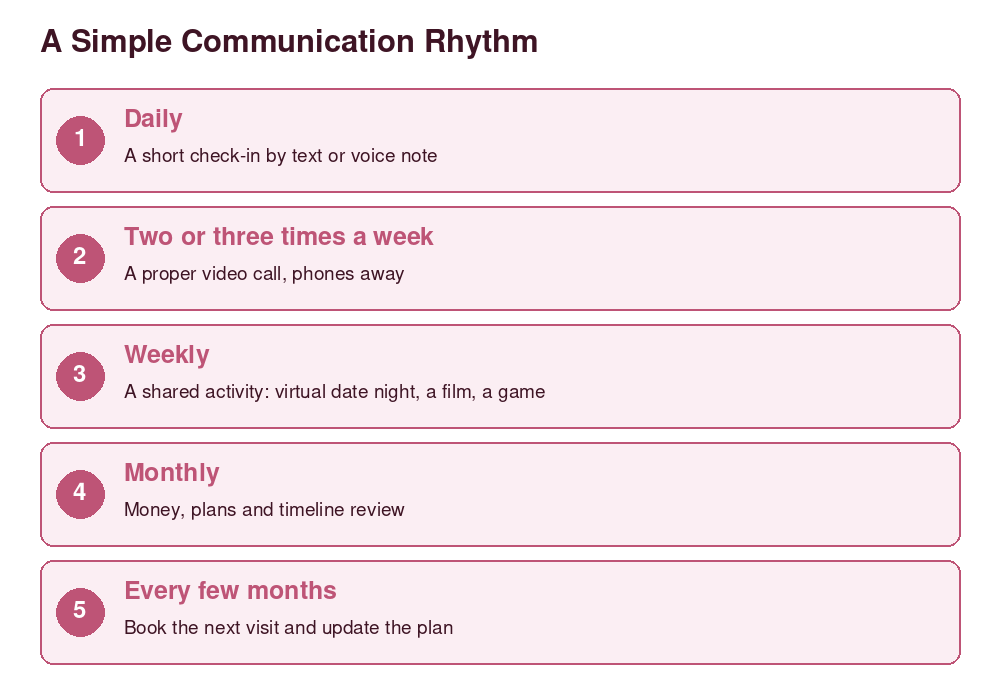
- Daily: a short check-in by text or voice note, even if it is just “thinking of you”.
- Two or three times a week: a proper video call with phones away.
- Weekly: a shared activity, such as a virtual date night, a film, a game or cooking the same meal.
- Monthly: a money, plans and timeline review.
- Every few months: book the next visit and update the plan.
Handle time zones without resentment
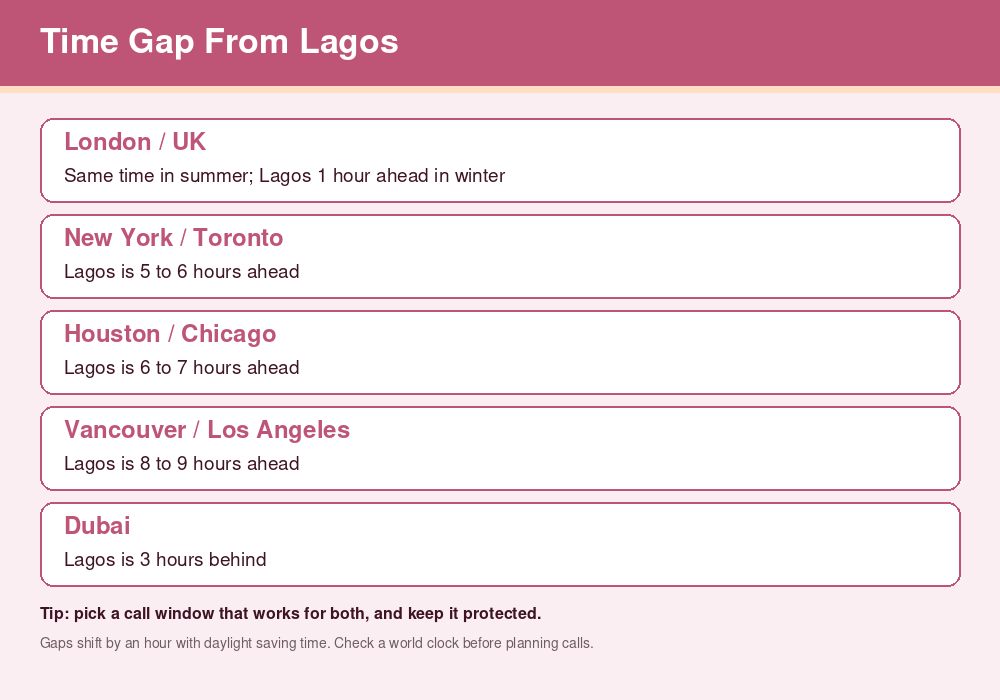
- London / UK: same time in UK summer; Lagos is one hour ahead in winter.
- New York / Toronto: Lagos is 5 to 6 hours ahead.
- Houston / Chicago: Lagos is 6 to 7 hours ahead.
- Vancouver / Los Angeles: Lagos is 8 to 9 hours ahead.
- Dubai: Lagos is 3 hours behind.
Gaps change by an hour with daylight saving, so check a world clock. Pick one call window that works for both, rotate who stays up late, and protect the time as you would an appointment.
Plan the reunion, not just the relationship
The biggest source of stress is usually the unknown: who moves, when, and how. Work through these together:
- Decide who moves. Consider careers, family, cost of living and legal options.
- Agree a timeline with a review date. Plans can change, but a date to revisit keeps hope alive and gives both of you a say.
- Check the immigration route with a licensed adviser. Visa rules change often, so rely on official government websites and a registered immigration lawyer or adviser, not rumours or agents promising guaranteed results.
- Gather evidence early. Many spousal and partner applications ask for proof of relationship, such as photos, chat history, travel records and proof of visits.
- Have a plan B. If the visa is delayed or refused, what is your next option, and how long will you wait before reassessing?
Be wary of anyone who asks for large sums in exchange for a guaranteed visa. If an offer sounds too good to be true, it probably is.
Money across borders
- Agree on who pays for travel. Flights, visa fees and accommodation add up. Decide openly rather than assume.
- Be clear about remittances. If either of you supports family, discuss how that fits your joint plans.
- Use safe payment channels and be careful about sending money to a partner you have not met in person. Romance scams are a real risk in online relationships.
- Keep records of shared costs, especially if you are building evidence for a visa.
Family and community expectations
In Nigerian culture, long gaps between a couple’s wedding and living together may raise questions from both families. Agree a simple, shared answer, and keep both families updated on the plan. If you are already married, remember that your spouse may feel excluded from decisions made by your relatives while they are abroad. Include them in every important discussion, even by video call.
Keep trust strong
- Be consistent. Do what you say, call when you said you would.
- Be honest about loneliness. Say when you are struggling, rather than hiding it.
- Share your real life, including bad days, so reunion is not a shock.
- Agree on boundaries around friendships, social media and nights out.
- Raise doubts early. A calm conversation now prevents resentment later.
Preparing for reunion
Reunion is exciting and also a risk period. Many couples find that living together reveals differences that distance had hidden. Before you move in together:
- Talk about daily habits, chores, privacy, money and how you will handle disagreements.
- Discuss the adjustment of the partner who moves, including a new country, work and community.
- Expect some friction in the first months and treat it as normal.
- Build a support network of friends, faith community or diaspora groups.
Signs it may be time to reassess
- Communication keeps shrinking, and visits are always postponed.
- There is no end date, and the subject is avoided.
- One partner carries all the cost, travel and effort.
- Trust is damaged by secrecy or broken promises.
- You feel anxious or lonely more often than hopeful.
Reassessing is not failure. It is how you protect your wellbeing and your partner’s. A counsellor, especially one used to working with couples across borders, can help you decide.
Frequently asked questions
Can long-distance relationships work for Nigerian couples abroad?
Yes. Research suggests they can be as satisfying as other relationships when couples communicate well and have a clear plan to close the distance.
How often should we talk?
There is no magic number. A short daily check-in and two or three proper video calls a week works for many couples. Choose a rhythm you can keep.
What if the visa is delayed?
Stay in touch with your adviser, keep your evidence up to date and agree on a decision date. Delays are common and out of your control, so how you support each other matters most.
Should we wait to marry until we live together?
It depends on your circumstances, families and legal route. Speak to an immigration adviser, and make sure you both feel ready regardless of pressure.
How do we avoid growing apart?
Share ordinary daily life, not only highlights. Keep routines, plan visits and review your goals together regularly.
This article is general information, not legal or immigration advice. Visa rules change frequently, so check official sources.