
How to Track, Lock or Block a Lost or Stolen Phone Using IMEI in Nigeria (2026)

Last updated: 8 November 2026 · By Naijatipsland Editorial Team · Editorial policy
Your phone has been stolen or lost, and someone tells you that if you have the IMEI, the police can “track” it for you. That is only partly true, and in Nigeria it is also the opening line of several scams. This guide explains what an IMEI number is, how to find it, what you can realistically do to track, lock and block a lost or stolen phone in Nigeria in 2026, and what the Nigerian Communications Commission (NCC) says it can and cannot do. It is written from the UK for Nigerians at home and abroad.
The short answer
You cannot look up a phone’s live location from an IMEI yourself, and no public website can do that for you. What does work, in order: use your phone’s own tracking tool (Apple’s Find My or Google’s Find Hub) while it is still switched on, report the theft to the police and keep the report, ask your network to suspend the SIM, and give the IMEI to the NCC so the handset can be blocked on Nigerian networks. Blocking makes the phone far less useful to a thief, but it does not guarantee that you get the phone back.
What is an IMEI?
The IMEI (International Mobile Equipment Identity) is a unique 15-digit number that identifies your handset, not your SIM. A dual-SIM phone has two. The SIM tells the network who the subscriber is; the IMEI tells it which physical device is connecting. That is why a thief changing your SIM does not change the IMEI, and why networks and regulators can use it to block a handset.
How to find your IMEI
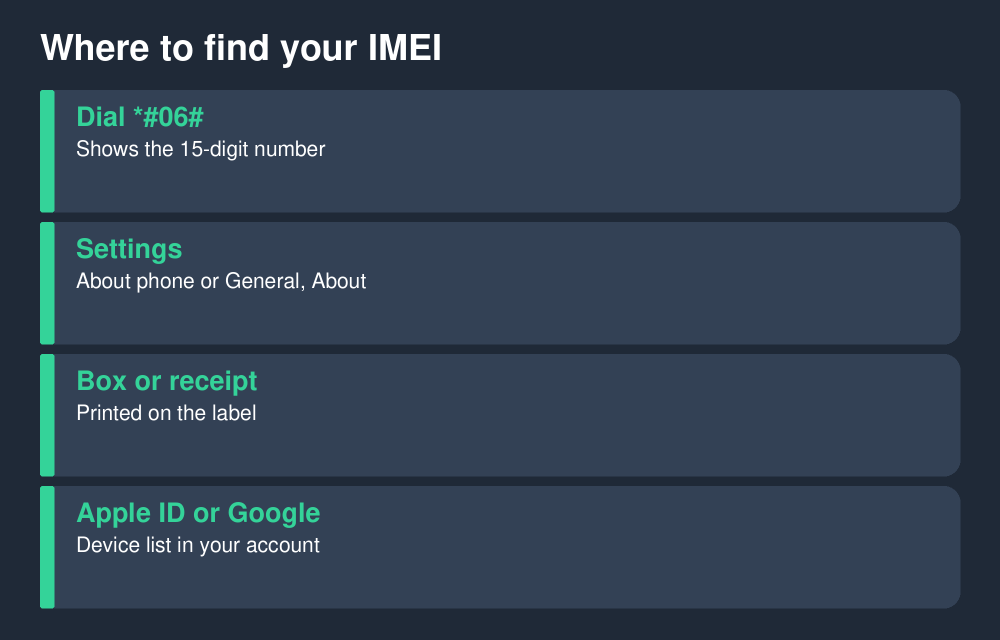
- On a working phone: dial *#06# and the number appears on screen.
- In settings: on Android, Settings, About phone; on iPhone, Settings, General, About.
- If the phone is gone: check the box and receipt, the invoice from the shop, your Apple ID or Google account device list, or your phone insurance or network account. iPhone owners can see the IMEI by signing in at appleid.apple.com and opening the device list.
Write it down and keep a photo of the receipt in your email or cloud storage now, before anything happens. If you are buying a second-hand phone, our guide to checking an IMEI before buying a used phone explains how IMEI checks protect you from buying a blocked or fake handset.
What to do in the first hour
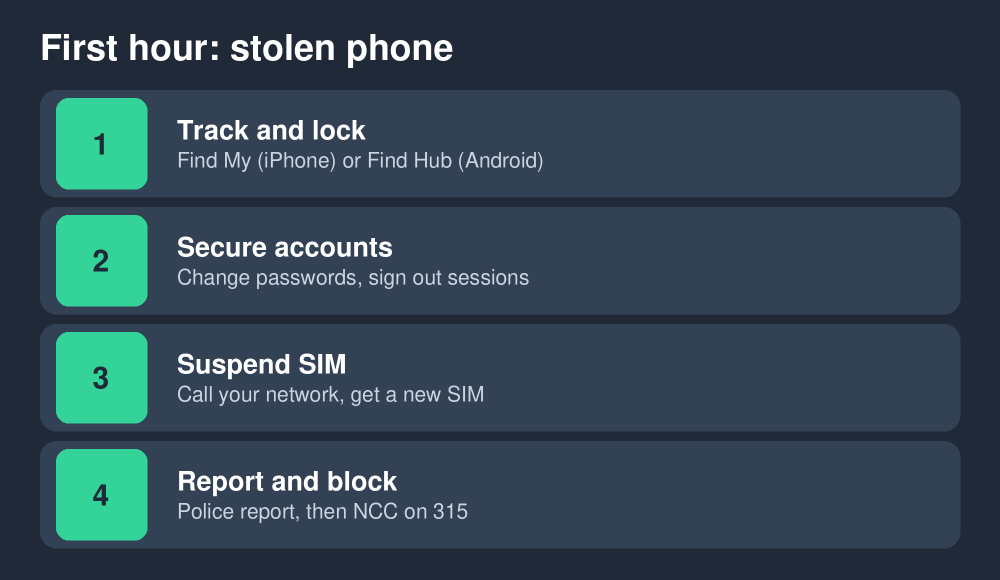
- Use the phone’s tracking tool at once. On iPhone, sign in at icloud.com/find or use another Apple device; on Android, use Google’s Find Hub (formerly Find My Device) with your Google account. If the phone is on, you may see its location, can play a sound, lock it with a message or erase it. Do not confront anyone; give the location to the police.
- Lock and secure your accounts from another device. Change your email, Apple or Google, WhatsApp, social media and banking passwords, sign out of active sessions and turn on two-step verification. If you suspect misuse, follow our guide to how to recover a hacked Facebook or WhatsApp account.
- Call your network provider and ask them to suspend or block the SIM. Ask them to issue you a replacement SIM on your registered NIN details. Our guide to SIM registration and replacement in Nigeria explains the process and SIM-swap risks.
- Tell your bank if you use mobile banking, and consider freezing the app, cards linked to the phone or digital wallets until you are sure it is secure.
- Report to the police and keep the reference or extract. Give the IMEI, make and model, colour, serial number and where and when it was lost. Many insurers and the NCC process will ask for this report.
- Contact the NCC to ask for the handset to be blocked (details below).
What the NCC says about blocking a stolen phone
The NCC’s Device Checker service identifies phones by IMEI and checks whether a device meets Nigeria’s type-approval standards. According to the NCC, a stolen phone can be blocked on all Nigerian mobile networks once the theft is reported and ownership is verified, and the block holds even if a thief inserts a different SIM. Have ready the IMEI, proof of ownership such as the receipt or box, and your police report.
- NCC Device Checker line: 315
- NCC consumer support: 622
- Online: the Device Checker page on ncc.gov.ng
Check the NCC website for the current procedure, because the NCC has not published a detailed public step-by-step process for victims and the service is still developing. The NCC’s wider Device Management System (DMS), a national database that is meant to blacklist stolen, cloned and unapproved devices automatically, is being introduced in stages and was not described as fully operational when we checked. Treat any claim that you can instantly “IMEI-lock” a phone nationwide with caution.
What an IMEI cannot do
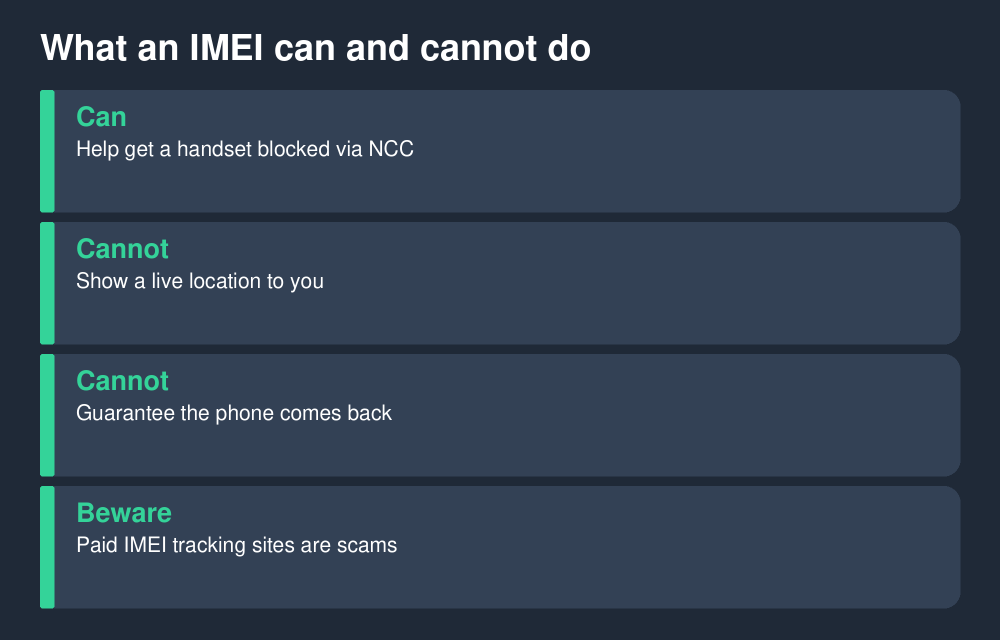
- It does not give you a live location. The NCC says Device Checker does not track, monitor or record where a phone is. Only networks and law enforcement, under legal process, can use network data, and results are not guaranteed.
- Blocking is not recovery. It stops the phone connecting to Nigerian cellular networks, but a thief can still use it on Wi-Fi, strip it for parts or take it abroad.
- Cloned IMEIs exist. The NCC warns that cloned devices can copy another phone’s IMEI and that unauthorised IMEI changes can undermine checks. That is a reason to buy used phones carefully.
Scams to avoid
- “IMEI tracking” websites and apps that promise to show a stolen phone’s location for a fee or a code. No public service can do that. Do not pay, and do not enter your Apple ID, Google password or bank details.
- “Recovery agents” on social media who ask for upfront money to find the phone with the IMEI.
- Messages saying your phone has been found with a link asking you to sign in to your Apple or Google account. These are phishing. Always go to the official site yourself.
- Cash-only buyers of cheap phones. If a price looks too good, the handset may be stolen or blocked. Check the IMEI before you pay.
If you are targeted, our guide to how to report cybercrime in Nigeria explains how to report scams and fraud.
If you are in the UK or abroad
If your Nigerian phone is lost while you are visiting the UK, report the loss to the local police and your UK or Nigerian network. UK networks can bar a handset by IMEI on the UK’s national register, which stops it working on UK networks, but this does not by itself block it in Nigeria, so contact your Nigerian network and the NCC as well.
FAQ
Can the police track my phone with the IMEI in Nigeria?
Police can request information from networks as part of an investigation, but there is no guarantee of a result, and you cannot do this yourself. File a report and keep the reference.
Does blocking an IMEI stop WhatsApp from working?
It blocks the phone on Nigerian cellular networks. A thief can still use WhatsApp over Wi-Fi with a new number, which is why you must also secure your accounts and deregister WhatsApp.
Can I track a phone that is switched off?
Not in real time. Find My and Find Hub may show the last known location. They update when the phone reconnects.
What if I did not keep the IMEI?
Look at the box, receipt, your Apple ID or Google account device list, or your phone insurer. Without any proof of ownership, blocking is harder.
Will I be charged to block my phone?
We did not find any published fee for a stolen-phone block. Confirm with the NCC or your network before paying anyone.
Is it legal to buy a phone without checking the IMEI?
It is risky. Buying a stolen handset can leave you without a working phone and, in some cases, in legal trouble. Always check the IMEI and keep the receipt.
This is general information, not legal advice. Contact the NCC, your network and the police for your situation. Phone numbers and procedures can change. Last updated 8 November 2026.
Join the discussion
Have you tried this, or do you have a question we did not answer? 1 reader has already shared their view. Naijatipsland members help each other with real, first-hand experience.





Do not wait to find your IMEI after a phone is stolen. Take a photo of the box and receipt today and store it in your email. Tell us below if the NCC process has changed. Ade Adeniyi