
How to Invite Your Parents From Nigeria to Visit the UK (2026): Visa Fees, Invitation Letter and Documents


Last updated: 1 November 2026 · By Naijatipsland Editorial Team · Editorial policy
Checked 1 November 2026. Bringing your mum and dad from Nigeria to see the grandchildren, attend a naming ceremony or spend Christmas with you in the UK is one of the biggest joys of life abroad. It is also one of the most refused applications. Home Office data shows the UK refused 38.6% of visit visa applications from Nigerians in 2025, and parents are often refused for reasons that a better-prepared application would have avoided.
This guide explains how to invite your parents from Nigeria to visit the UK in 2026: which visa they need, the new fees, what goes into an invitation letter, the documents both sides should prepare, how long it takes, and the refusal reasons to plan around.
Which visa do Nigerian parents need?
Nigerian citizens need a Standard Visitor visa before travelling to the UK. Nigerians can’t use the UK’s Electronic Travel Authorisation (ETA). The visitor visa lets your parents:
- stay for up to 6 months on each visit,
- visit family and friends, attend events such as weddings, graduations and christenings, and do tourism,
- receive private medical treatment if they pay for it.
It does not let them work (including unpaid childcare as a job), access public funds, or live in the UK through back-to-back visits. If your parents need to live with you permanently because they need long-term care, that is a different and much stricter route: the Adult Dependent Relative visa.
UK visit visa fees in 2026
Visa fees rose on 8 April 2026. Your parents can choose a short visa or a long-term visa that covers several years of visits.
| Visa | Fee from 8 April 2026 | Best for |
|---|---|---|
| Up to 6 months | £135 | A first visit or a one-off trip |
| 2-year visit visa | £506 | Parents planning visits two years running |
| 5-year visit visa | £903 | Parents with a good UK travel record |
| 10-year visit visa | £1,128 | Frequent visitors with strong ties at home |
| Priority service (optional) | +£500 | Decision in about 5 working days |
| Super priority (optional) | +£1,000 | Decision usually by the next working day |
Each person pays separately, so two parents on 6-month visas pay £270 before any priority fee. Long-term visas still limit each stay to 6 months, and the Home Office expects to see a good history of previous compliant visits before granting one, so most parents start with the 6-month visa. If a long-term visa is in an old passport, your parents can travel with both the old and new passports.

Step-by-step: how to bring your parents to the UK
1. Agree dates and who pays
Decide the length of the visit (keep it realistic: 3 to 8 weeks is easier to justify than a full 6 months for a first visit), and agree who pays for flights, food, transport and health insurance. Every document must tell the same story.
2. Apply online on GOV.UK
Your parents (or you on their behalf, using their details) complete the visitor visa application on GOV.UK, pay the fee and book a biometrics appointment. Each parent needs a separate application, but you can link them as family members travelling together. They can apply up to 3 months before travel.
3. Attend biometrics at a VFS Global centre
UK visa application centres in Nigeria are run by VFS Global, with main centres in Lagos and Abuja and premium options in some other cities. Your parents give fingerprints and a photo and submit their passports. Upload documents online before the appointment if the system asks you to.
4. Wait for the decision
Standard decisions usually take about 3 weeks, but they can take longer in peak months like June to August and November to December. Apply early for Christmas or summer visits.
5. Prepare for arrival
Once the visa is granted, buy travel insurance that covers medical treatment, book flights and keep copies of the invitation letter and your address in their hand luggage, as border officers may ask about the visit.
The invitation letter: what to include
An invitation letter isn’t legally required, but for parents it is one of the most useful documents in the bundle because it explains the visit in your own words. Write it, sign it and include:
- Your details: full name, date of birth, UK address, phone number, email, occupation and immigration status (British citizen, ILR, Skilled Worker, etc.).
- Their details: full names, dates of birth, passport numbers and Nigerian address.
- Your relationship: “my mother and father”.
- The purpose: for example, to meet their new grandchild, attend your graduation or spend the festive season with family.
- Dates: intended arrival and departure dates.
- Accommodation: that they will stay with you, and how many bedrooms your home has.
- Costs: exactly what you will pay for and what they will pay for.
- Their return: a short note on why they will go home, such as their house, business, church or other children in Nigeria.
- A line inviting the Home Office to contact you to verify anything.
Keep the letter honest and specific. Generic templates copied from the internet, or letters that promise things your payslips can’t support, do more harm than good.
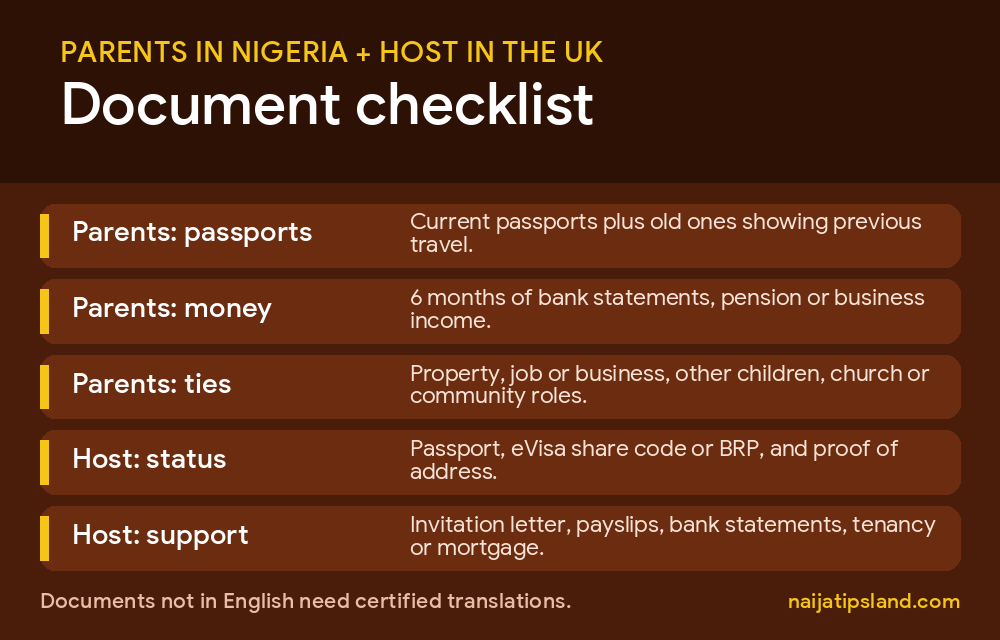
Documents checklist
From your parents in Nigeria
- Current passports, valid for the whole trip, plus old passports showing previous international travel.
- Bank statements for the last 6 months, showing regular income rather than one big recent deposit.
- Proof of income: pension slips, salary letter, business registration (CAC) and business account statements, or rent receipts if they own property they let out.
- Proof of ties: property documents, a letter from their employer or church, evidence of caring duties or other children living in Nigeria.
- Marriage certificate, and a birth certificate or affidavit that shows you are their child.
From you in the UK
- Your signed invitation letter.
- Your passport and proof of status (eVisa share code, BRP if you still have one, or British passport).
- Proof of address: tenancy agreement or mortgage statement, plus a council tax bill.
- If you are paying: your last 3 to 6 months of payslips and bank statements, and an employment letter.
- Your child’s birth certificate if the visit is for a new baby.
Anything not in English needs a certified translation. If you send money for their application, send it by bank transfer so there is a paper trail. Our comparison of the cheapest money transfer apps from the UK to Nigeria can help you do that cheaply.
Why parents’ UK visit visas get refused
Most refusals come down to the Home Office not being satisfied that the visit is genuine and that your parents will leave at the end of it. The usual triggers are:
- Weak ties to Nigeria: no evidence of a home, income, business or family responsibilities to return to.
- Unexplained lump sums: a large deposit shortly before applying, with no explanation, is treated as “funds parking”. If you sent money, say so and show the transfer.
- Inconsistent details: different dates, addresses or costs on the form, invitation letter and bank statements.
- Unclear funding: it isn’t clear who pays, or the sponsor’s income doesn’t support the trip.
- Long or frequent stays: parents who spent most of the past year in the UK may be seen as living there.
- Previous refusals not declared: always declare past refusals from any country. Hiding one is treated as deception and can lead to a 10-year ban.
If your parents are refused, read the refusal letter carefully. There is no appeal for visit visas, but you can reapply with a stronger application that directly answers each point the caseworker raised. Our guide to common reasons UK visas are refused in Nigeria covers this in more depth.

Health cover: don’t skip travel insurance
Visitors aren’t covered by the NHS for most hospital treatment. Emergency care in A&E is free at the point of use, but if your parent is admitted to hospital, the NHS charges visitors 150% of the standard tariff, which can run into thousands of pounds. Older parents with conditions such as high blood pressure or diabetes should buy visitor medical insurance that covers pre-existing conditions, and bring enough of their regular medication, with a doctor’s letter, for the whole stay.
Practical tips for a smooth visit
- Time the trip: UK winters are cold and dark. Spring and summer visits are kinder to older parents used to Nigerian weather.
- Prepare warm clothing: buy coats and thermals in the UK rather than packing heavy items.
- Know the food rules: some Nigerian foodstuffs, especially meat, fish and dairy products, can’t be brought into the UK. Check GOV.UK before packing.
- Keep the visit within the dates you gave, and keep boarding passes. A good travel record makes the next application, and a long-term visa, much easier.
Planning a trip home yourself? See our guide to getting a Nigerian visa from the UK if your children hold British passports, and our overview of visa types for Nigerians.
Frequently asked questions
Can my parents stay with me for 6 months?
Yes, the visitor visa allows up to 6 months per visit. But a request for the full 6 months on a first visit gets more scrutiny, so explain clearly why (for example, helping after a birth) and show strong ties at home.
Do I need to earn a certain amount to sponsor my parents?
No fixed minimum applies to visitors. Your income only needs to show you can realistically cover what you promise in your letter, alongside your own living costs.
Can my parents look after my children while visiting?
Informal help as family is fine. Working as your paid childminder, or coming mainly to provide childcare so you can work, isn’t allowed on a visitor visa.
Can my parents switch to another visa once in the UK?
Generally no. Visitors can’t switch into most other visa routes from inside the UK, so any long-term plan must be applied for from Nigeria.
How long does it take to get the visa?
Usually about 3 weeks after biometrics with the standard service, or around 5 working days with priority, where available.
Disclaimer: this guide is general information based on GOV.UK and Home Office guidance available on 1 November 2026. It is not legal advice. Fees and rules change, so check GOV.UK before applying, and consider a regulated immigration adviser for complex cases.








Most refusals for parents come down to weak ties at home or a big unexplained deposit, not the visit itself. If your parents have visited you in the UK, what document do you think made the difference?