
Solar Panel Installation for Homes in Lagos (2026): Costs, System Sizes and Installers

Last updated: 2 November 2026 · By Naijatipsland Editorial Team · Editorial policy
Checked 2 November 2026. With band A tariffs high and many Lagos streets still on a few hours of grid supply a day, more households are pricing solar instead of another petrol generator. The problem is that quotes for “a 5kVA system” can range from ₦3 million to well over ₦6 million, and the cheapest ones often hide weak batteries, fake panels or poor wiring.
This guide explains what each system size can actually power, what panels, inverters and lithium batteries cost in Lagos in 2026, which companies you can check, how pay-as-you-go and instalment plans work, and how to avoid being sold a system that fails in its first rainy season.
Start with your load, not the kVA
A solar system has three main parts, and each answers a different question:
- Inverter (kVA or kW): how much you can run at the same time. A 5kVA inverter handles roughly 4kW of appliances at once.
- Battery (kWh): how long you can run things when there is no sun or grid. This is what decides your night-time backup.
- Panels (kWp): how fast you can recharge the battery and run daytime loads. In Lagos, a good rule of thumb is about 4 to 5 useful sun hours a day, less in the rainy season.
Before asking for quotes, list every appliance you want on solar, its wattage (on the label) and how many hours you use it at night. A fridge, a freezer and a pumping machine change the size you need far more than extra bulbs do. Irons, electric cookers, kettles and conventional (non-inverter) air conditioners are usually best kept off a home solar system.

What 1kVA to 10kVA systems can power
These are typical examples drawn from installer guides and TechCabal’s 2025 breakdown of off-grid costs. Your own result depends on battery size and how carefully you manage loads.
- 1kVA to 1.5kVA: lights, two fans, a TV, a laptop, Wi-Fi router and phones. Good for a self-contain or as a small backup. Usually no fridge.
- 2kVA to 3kVA: a one- or two-bedroom flat with lights, fans, TVs, a small fridge and laptops. Not for air conditioners or a borehole pump.
- 5kVA: the most common choice for Lagos family homes. Runs lights, fans, two TVs, a fridge or freezer, a washing machine and, with enough battery, one inverter AC for part of the night, but not everything at once.
- 7.5kVA to 10kVA: larger duplexes. Can carry several freezers, two or three inverter ACs, a pumping machine and kitchen appliances, provided the battery bank is 10kWh or more.
Solar equipment prices in Lagos, 2026
Prices move with the exchange rate, because almost all panels, inverters and cells are imported. The figures below come from Lagos price lists published between May and September 2026, mainly PVPro Nigeria’s September 2026 survey, and from brand websites. Treat them as a guide and always ask for a dated, itemised quote.
| Item | Typical 2026 price (₦) | Notes |
|---|---|---|
| 550W to 590W mono panel | 115,000 to 165,000 each | Tier-1 brands such as Jinko and LONGi sit at the top of the range |
| 1.5kVA hybrid inverter | From about 259,000 | Entry-level, 12V or 24V |
| 5kVA/5kW hybrid inverter | 350,000 to 950,000 | Budget brands to Deye, Growatt, SunSynk class |
| 11kVA inverter | About 1.7 million | Brand-dependent |
| 5kWh 48V lithium (LiFePO4) | 1.0 million to 2.4 million | Wide spread between brands and warranties |
| 10kWh 48V lithium | 1.9 million to 4.9 million | Premium Pylontech-class at the top |
| 200Ah tubular (lead-acid) battery | From about 155,000 | Cheaper upfront, shorter life |
| Cabling, breakers, racking | 200,000 to 300,000 | For a 5kVA job |
| Installation and transport | 150,000 to 250,000 | For a 5kVA job in Lagos |
Full installed cost by system size
Put together, a complete installed hybrid system with lithium batteries in Lagos currently falls roughly into these ranges:
- 1kVA with about 2.4kWh lithium and one or two panels: about ₦1 million in TechCabal’s 2025 example; budget for more in 2026.
- 3kVA with about 5kWh lithium and 2.4kWp of panels: ₦2.3 million to ₦3.4 million.
- 5kVA with 5kWh lithium: ₦3.6 million to ₦5.7 million. Adding a second 5kWh battery for overnight AC pushes most quotes above ₦6 million.
- 10kVA with 10kWh lithium: ₦7.9 million to ₦12.3 million, and more for premium brands or larger battery banks.

Lithium (LiFePO4) batteries cost more upfront than tubular batteries but usually last several times as many charge cycles, can be discharged more deeply and need no water top-ups. For most Lagos homes cycling every night, lithium is now the better value over five years or more.
Lagos installers and brands you can check
The companies below appear on their own websites and in Nigerian business media as operating in Lagos. This is not an endorsement or a ranking. Visit their sites, ask for references from recent home installs, and compare at least three quotes.
- Sun King Nigeria (ng.sunking.com): solar home kits and inverter systems with published prices and the EasyBuy instalment plan.
- Arnergy (arnergy.com): Lagos-based solar company known for financed and pay-as-you-go systems, mainly for SMEs and homes.
- SunFi (sunfi.co): a Lagos platform that connects buyers with vetted installers and financing.
- Auxano Solar (auxanosolar.com): Nigerian panel manufacturer with residential and commercial installations.
- Rubitec Solar (rubitecsolar.com): Lagos installer focused on commercial and agricultural projects, also does design and maintenance.
- Daystar Power (daystar-power.com): lease and solar-as-a-service, mainly for businesses and larger sites.
- PVPro Nigeria (pvpro.com.ng): Lagos equipment supplier with online price listings for inverters and batteries.
Common equipment brands in the Lagos market include Jinko, LONGi and Canadian Solar for panels; Deye, Growatt, SunSynk, Felicity and Victron for inverters; and Pylontech, Felicity and various LiFePO4 brands for batteries. Buy from authorised distributors where possible.
Pay-as-you-go, instalments and financing
If ₦4 million upfront is out of reach, there are three main routes:
- Pay-as-you-go (PAYG): you pay a deposit and then daily, weekly or monthly instalments, and the system is remotely locked if you miss payments. Sun King’s EasyBuy, for example, listed the PowerHub Core at ₦2,275,000 cash or ₦113,750 down then ₦45,500 a week for 80 weeks (July 2026 prices). Add up the total so you can see the real cost against paying cash.
- Financing platforms: companies such as SunFi and Arnergy offer plans spread over months or years, sometimes through partner banks and microfinance banks.
- Bank or salary loans: some Nigerian banks offer solar loans. Compare the effective interest rate, and only use lenders you can confirm are licensed (see our guide to checking whether a loan app or fintech is licensed).
Standards and rules: SON, NEMSA and NERC
- SON (Standards Organisation of Nigeria) sets Nigerian Industrial Standards for solar panels, inverters, batteries and charge controllers, and runs SONCAP certification for imported goods. Ask the seller whether the product has SONCAP documentation and look for international test marks such as IEC 61215 and IEC 61730 for panels.
- NEMSA (Nigerian Electricity Management Services Agency) is responsible for electrical safety standards and the certification of electrical installation personnel. A competent installer should be able to show qualifications and follow safe wiring practice.
- NERC regulates the electricity market. A rooftop system for your own home does not need a generation licence, but if you stay connected to the grid, your installer must wire the system so it cannot feed power back into DisCo lines without approval.
How to avoid fake panels and poor installers
In July 2026, energy experts quoted in Nigerian media warned that counterfeit batteries, inverters and panels are causing fires and early failures. Protect yourself with these checks:
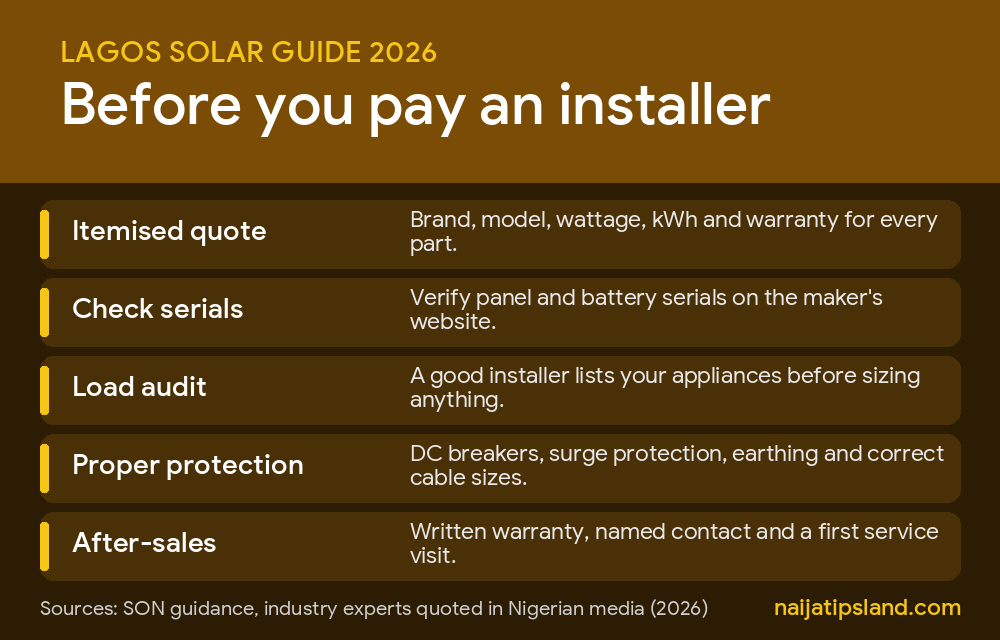
- Get an itemised quote listing brand, model, wattage, kWh, quantity and warranty for every component, plus labour.
- Verify serial numbers and QR codes on the manufacturer’s official website before installation.
- Be wary of very low prices. A “5kVA with lithium” for ₦2 million in 2026 almost certainly cuts corners somewhere.
- Check the panel label for rated power, voltage and current. Fake panels often show 550W on the label but deliver far less.
- Insist on protection: DC and AC breakers, surge protection, proper earthing and correctly sized cables. Undersized cables are a major fire risk.
- Ask for references and photos of recent home installations, ideally in your part of Lagos.
- Get warranties in writing: typically 10 years or more on quality panels, several years on inverters and lithium batteries, plus a workmanship guarantee.
Maintenance in Lagos conditions
- Clean the panels every few weeks in the dry season (harmattan dust and soot reduce output) with clean water and a soft brush, early in the morning.
- Keep the inverter and batteries in a cool, ventilated, dry space, away from direct sun and rain.
- Check the app or display regularly. Most hybrid inverters show battery level, solar input and faults.
- Book an annual check of connections, breakers, roof fixings and earthing, especially after the rainy season.
- Don’t overload the system at night. Running an AC, freezer and pump together drains a small battery quickly and shortens its life.
A solar system won’t replace every other backup. Keep a good power bank for phones and Wi-Fi during long cloudy spells (see our guide to the best power banks in Nigeria).
Is solar worth it for your home?
Compare the monthly cost of your current setup. A household spending ₦150,000 or more a month on petrol or diesel plus generator repairs can often recover the cost of a 5kVA system within a few years. If you rent, a portable inverter system you can take with you may make more sense than a rooftop install. For wider household budgeting, see our cost of living in Nigeria guide, our tips on how to save money in Nigeria, and the cheapest areas to live in Lagos. Because equipment is priced off the dollar, it also helps to watch the dollar to naira rate before you buy.
Frequently asked questions
How much does a 5kVA solar system cost in Lagos in 2026?
Most complete installed 5kVA hybrid systems with a 5kWh lithium battery cost between ₦3.6 million and ₦5.7 million, depending on brands, panel count and installer.
Can a 5kVA solar system power an air conditioner?
Yes, usually one inverter AC, as long as you have enough battery capacity for the hours you want and you avoid running other heavy loads at the same time.
How long do lithium solar batteries last?
Quality LiFePO4 batteries are commonly rated for several thousand cycles, which can mean many years of daily use. Check the warranty in years and cycles before buying.
Is pay-as-you-go solar more expensive?
Usually, yes. You pay more in total than the cash price, in exchange for a small deposit. Add up all the instalments before you sign.
How do I know if a solar panel is fake?
Check the label, verify the serial number on the maker’s website, buy from authorised dealers and be suspicious of prices far below the market range.
Disclaimer: this guide is general information based on Lagos price lists, company websites and Nigerian media reports available on 2 November 2026. Prices change with the exchange rate and vary between sellers. Companies named are examples, not endorsements. Get several itemised quotes and use a qualified installer.









Before you accept any solar quote, ask for the brand and model of every part and check the serial numbers on the manufacturer’s website. Have you installed solar in Lagos recently? Share what you paid and what it powers so other readers can compare.