Last updated: 22 October 2026 · By Naijatipsland Editorial Team · Editorial policy
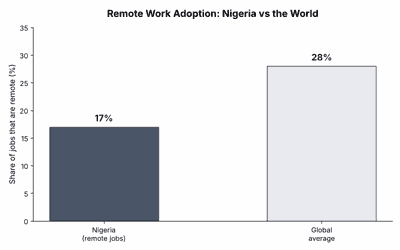
Working from home in Nigeria comes with a very different stress profile than it does in countries with reliable power and cheap broadband. Only about 17% of Nigerian jobs are remote, compared with a global average of roughly 28%, according to data reported by Vanguard Nigeria — and the gap isn’t really about preference. It’s about what it actually costs, in money and mental energy, to keep a home “office” running when the national grid can’t be trusted.
Why remote work is harder here than the statistics suggest
Nigeria’s ICT sector has grown fast — contributing about 11.31% of GDP in the first quarter of 2026 — and the World Bank estimates roughly 17.5 million people across Nigeria, Ghana, and South Africa now work as online freelancers. On paper, remote and freelance work looks like a growth story. In practice, for many Nigerian professionals, it means doing a job that assumes stable electricity and internet in a country where neither is guaranteed.
The power problem: more than an inconvenience
Techpoint Africa has documented 244 separate national grid collapses between 2010 and 2025 — meaning the entire national power supply has failed and had to be rebuilt from scratch, not just a local outage. For anyone whose income depends on being online during business hours, that’s not a minor annoyance; it’s a direct threat to their livelihood. Add to this the Service Band Tariff system, where supply hours vary sharply depending on which band your area is billed under — Band A customers get 20+ hours a day, Band B around 16+, Band C about 12+, Band D roughly 8, and Band E closer to 4 — and it’s clear that where you live in Nigeria can determine how viable remote work even is for you.
The real cost of staying powered — and online
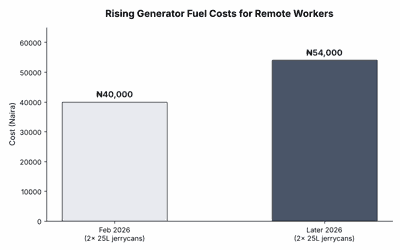
When grid power isn’t there, the backup is usually a generator, and generator fuel has become dramatically more expensive. Petrol prices climbed from around ₦1,000 to roughly ₦1,300 per litre, and Dangote refinery pricing moved through several hikes — from about ₦774, to ₦995, to ₦1,175 per litre — over the course of 2026. One freelancer’s account captured this starkly: two 25-litre jerrycans that cost about ₦40,000 in February 2026 had risen to around ₦54,000 later in the year, a roughly 35% jump in the cost of just staying powered on.
Other remote workers report spending ₦10,000 to ₦13,000 a day — ₦300,000 to ₦390,000 a month — just on generator fuel to keep working. Some have lost clients entirely when repeated power and connectivity failures made them unreliable to work with, which adds a layer of stress that has nothing to do with the actual work itself: the fear that infrastructure outside your control could cost you your income.
The mental load nobody talks about
Beyond the direct financial strain, there’s a quieter cost: the constant low-level vigilance of watching your phone’s network bars, tracking how much fuel is left in the generator, and mentally rescheduling your day around unpredictable power windows. This kind of background stress is harder to name than a missed deadline, but it builds the same way — and because the problem is external and largely outside your control, it can feel even more draining than ordinary work pressure.
Practical ways to manage it
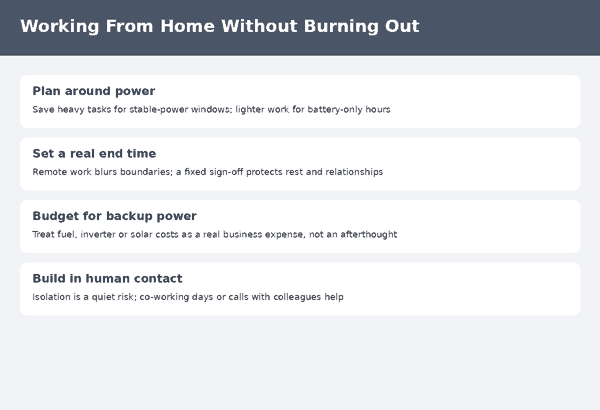
- Plan your day around power, not the clock. Where possible, shift heavy or time-sensitive tasks (calls, uploads, video work) to windows when grid power or your Band’s scheduled hours are most reliable, and save lighter, battery-friendly tasks for the gaps.
- Set a real end time. Remote work already blurs the line between “on” and “off,” and in Nigeria the pressure to keep working whenever power is available can make that worse. A fixed sign-off time, even an imperfect one, protects both rest and relationships.
- Treat backup power as a real business cost, not an afterthought. Whether it’s generator fuel, an inverter, or a solar setup, budgeting for it properly — rather than treating every price hike as a fresh shock — makes the expense easier to plan around and absorb.
- Build in human contact on purpose. Remote work can be isolating even without Nigeria’s specific pressures. Occasional co-working days, calls with colleagues, or simply working from a shared space with reliable power can ease both the isolation and the infrastructure burden at once.
- Communicate proactively with clients about outages. Several freelancers report losing clients after unexplained downtime. A short, upfront heads-up when power or connectivity is affecting your availability tends to preserve trust far better than silence does.
The bottom line
Remote work in Nigeria carries a genuine, quantifiable stress load that doesn’t show up in most “working from home” advice written for other markets — grid collapses, rising fuel costs, and tiered power access all add pressure that has nothing to do with the work itself. Naming that cost clearly, budgeting for it honestly, and building firm boundaries around your time are the most realistic ways to protect both your income and your wellbeing while working from home here.