
UK Health and Care Worker Visa for Nigerians After the Care Route Closure (2026): Who Can Still Apply

Last updated 16 November 2026. Visa rules, fees and salary levels change often. Check the official GOV.UK pages linked in the sources before you apply, and speak to a regulated immigration adviser if your case is complicated. This article is general information and not legal advice.
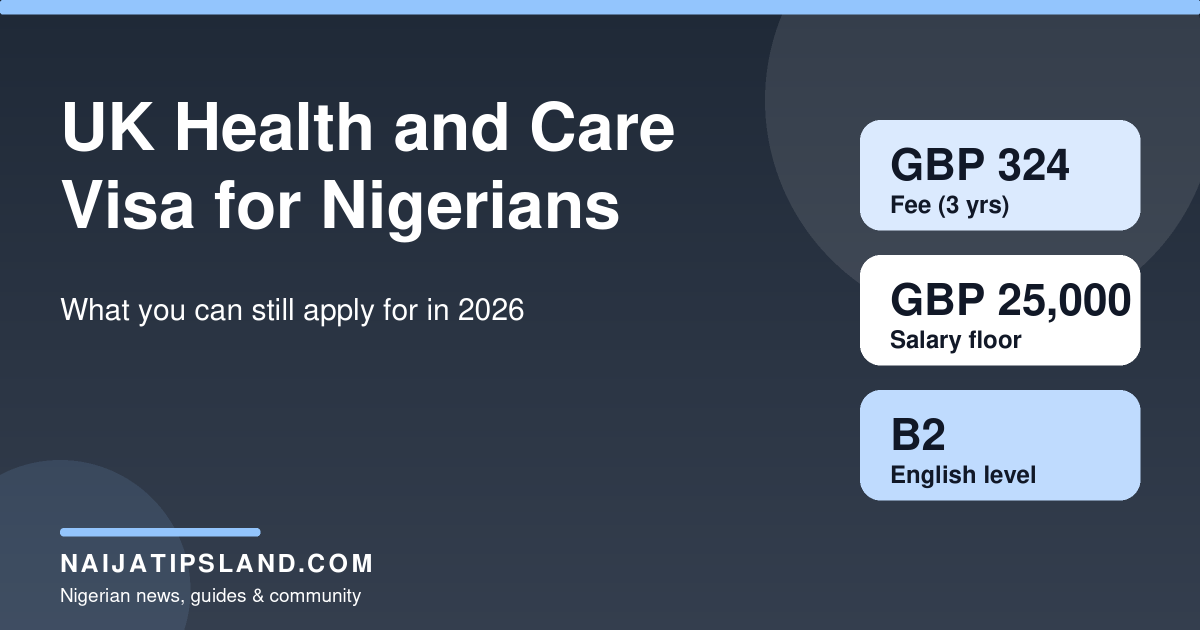
If you have been following the japa conversation, you have probably heard that the UK care worker visa is finished. That is partly true, and the details matter a lot if you are planning to move or you already have a family member working in care. The care worker route has closed to people applying from outside the UK. The wider Health and Care Worker visa is still open for a defined list of qualified roles, and that is where most Nigerians with a genuine route should look.
This guide explains what changed, which jobs still qualify, what the visa costs, and how the settlement changes announced on 2 November 2026 affect people already in the UK.
What changed when the care route closed
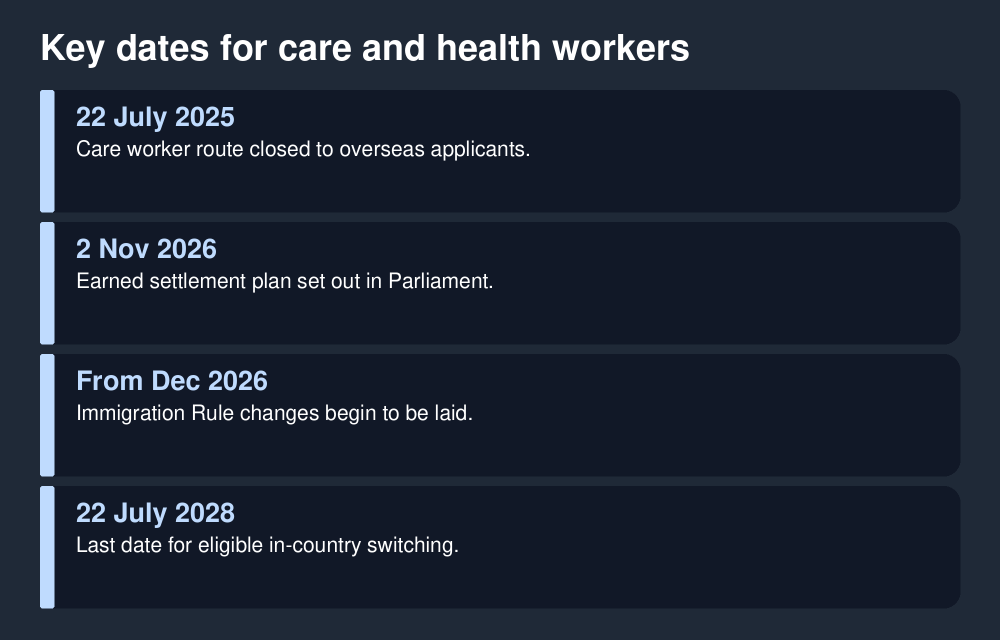
The Home Office stopped accepting entry clearance applications from overseas care workers and senior care workers on 22 July 2025, according to law firm Pinsent Masons. That covers the two job groups most Nigerians associated with the route. If you are outside the UK, you can no longer get a visa as a care worker or a senior care worker.
The same Pinsent Masons note says workers already in the UK can still switch in-country until 22 July 2028, but only if they have worked for the sponsoring employer for at least three months before the certificate of sponsorship is issued. GOV.UK says the same thing in different words: care workers and senior care workers are allowed only for extending, updating or switching, and switching from another visa needs at least three months of legal work for your sponsor.
So the practical split is simple. People already in the UK on a care route have a path to stay, subject to conditions. People abroad who hoped to arrive as a care worker no longer do.
Which jobs can still get a Health and Care Worker visa
GOV.UK describes the visa as being for qualified doctors, nurses, health professionals and adult social care professionals who have a job offer from an approved UK employer. The page lists the occupation codes that are open for new applications:
- Doctors, codes 2211 and 2212
- Nurses and midwives, codes 2231 to 2237
- Therapy professionals, codes 2221 to 2229
- Other health professionals, codes 2251 to 2259
- Social work, code 2461
- Scientists, codes 2113 and 2114
- Managers, codes 1171 and 1232
- Technicians and support roles, codes 3111, 3212 and 6131
A second group of medium-skilled codes, including 1231, 3211, 3213, 3219, 6132 and 6133, can only be used for extending or updating, and only if your certificate of sponsorship was issued before 22 July 2025. Care workers and senior care workers, codes 6135 and 6136, sit in the same restricted category.
If you are a nurse or midwife, the first job is registration with the Nursing and Midwifery Council. Our NMC registration guide for Nigerians explains the exam and the costs. Doctors register with the General Medical Council, and other professions have their own regulators. You will usually need registration, or a clear route to it, before an employer will sponsor you.
For care roles in England, GOV.UK adds that the employer must be registered with the Care Quality Commission.
Salary rules
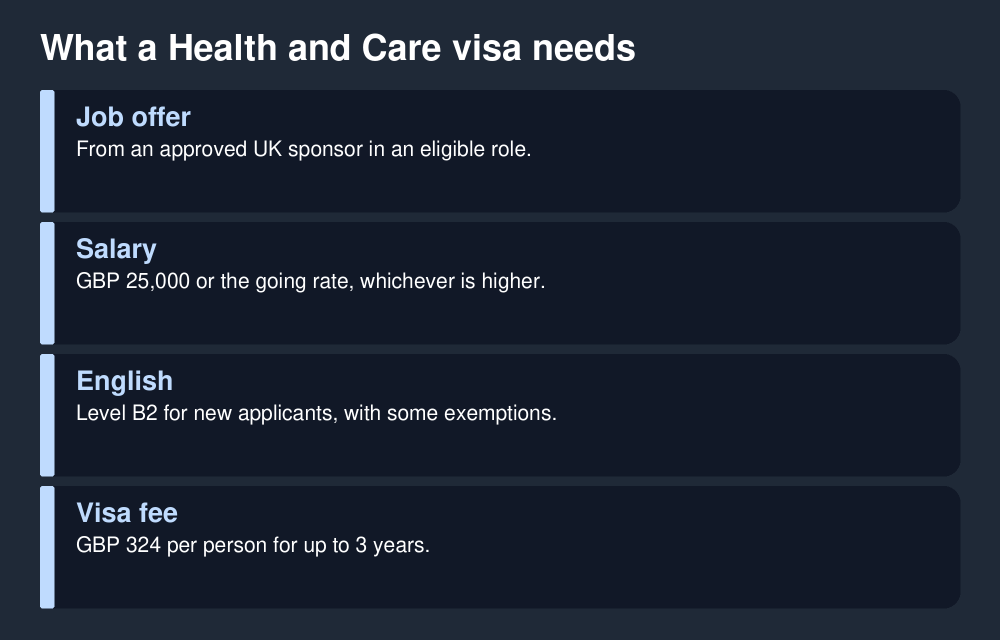
GOV.UK says you will usually need to be paid at least £25,000 a year. If the going rate for your occupation code is higher, you usually need to be paid at least that rate. Some codes have different rules, including 1171, 1231, 1232, 2113, 2114, 3111, 3211, 3212, 6135 and 6136. For other health and care jobs, GOV.UK points to the national pay scales by NHS pay band and area of the UK. In practice, an NHS nurse’s pay is set by the band they are hired into, so ask the employer which band and point you will be on before you accept.
The employer must also pay at least the national minimum wage and follow UK working-time rules.
Fees and savings
GOV.UK gives these figures for the visa:
| Item | Amount |
|---|---|
| Visa fee, up to 3 years | £324 per person |
| Visa fee, more than 3 years | £628 per person |
| Personal savings for you | £1,270, held for 28 days in a row |
| Savings for a partner | £285 |
| Savings for one child | £315 |
| Savings for each extra child | £200 |
The savings can be waived if you have been in the UK on a valid visa for at least 12 months, or if your employer covers your costs for your first month and confirms it on your certificate of sponsorship. Day 28 of the savings period must fall within 31 days of your application.
GOV.UK also says you, your partner and your children do not pay the Immigration Health Surcharge on this visa. NHS use is free from the start date, though some services such as prescriptions, dental treatment and eye tests are still charged. Dependants pay the same visa fee as you.
English language rules
New applicants must prove English at level B2 on the CEFR scale, according to GOV.UK. People extending a visa they held before 8 January 2026 only need B1. You can prove English with a UK school qualification started before 18, a UK degree, a degree taught in English from outside the UK with an Ecctis assessment, or an approved Secure English Language Test. Doctors, dentists, nurses and midwives who have already passed an English assessment accepted by their regulator are exempt. Nigeria is not on the list of exempt nationalities.
If you are weighing up exams, our comparison of IELTS, PTE and TOEFL for Nigerians may help you choose.
Bringing your family
For roles still open to new applicants, a partner and children under 18 can usually join you, if the relationship rules are met. A partner must be a spouse, civil partner, or an unmarried partner of at least two years.
Care workers and senior care workers are treated differently. Dependants are allowed only in narrow cases, such as being continuously employed in the UK in that role since before 11 March 2024, or applying for a child born in the UK. For medium-skilled roles, the continuous employment date is 22 July 2025.
How to apply, step by step
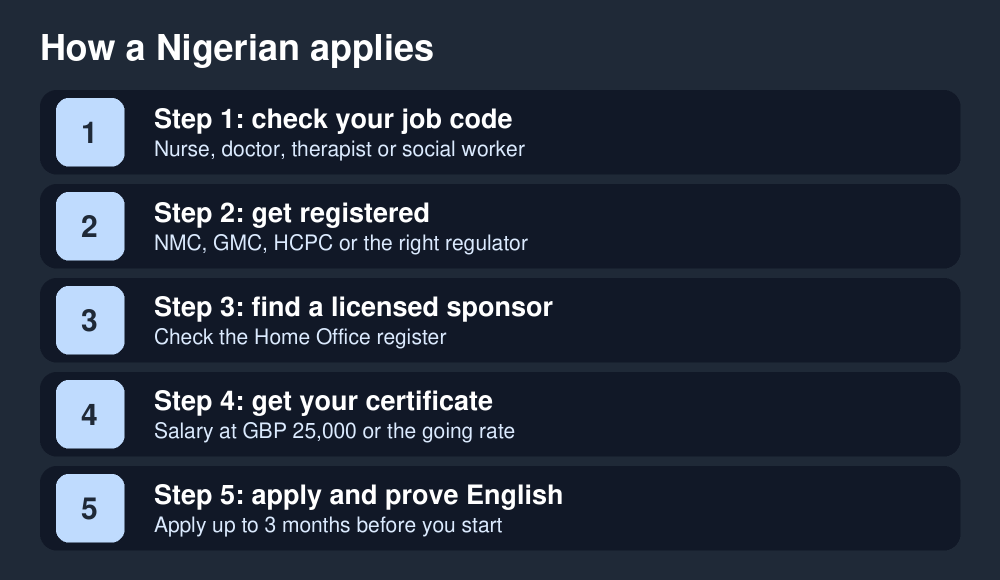
- Check that your job code is on the open list.
- Get your professional registration in order, or a plan for it.
- Find an employer that holds a sponsor licence. The Home Office publishes a register of licensed sponsors, and you should check the employer’s name on it yourself.
- Ask the employer for a certificate of sponsorship that states your salary and job code.
- Apply within three months of receiving the certificate, and prove your English and savings.
You can apply up to three months before your job start date. GOV.UK says decisions usually take about three weeks from outside the UK and about eight weeks from inside it.
The visa lasts up to five years and can be extended as many times as you meet the rules. After five years, some holders have been able to apply for settlement, and that is the part that is now changing.
The settlement changes announced on 2 November 2026
In a statement to the House of Commons on 2 November 2026, the Home Secretary set out a revised earned settlement framework. Law firm Lewis Silkin summarised it on 3 November. The key points, as reported:
- The standard qualifying period for settlement moves from five to ten years, with shorter pathways of 3, 5, 10 or 20 years depending on earnings and compliance.
- Care workers who entered or switched into the care worker route before 12 May 2025 keep a five-year period if they meet the £25,000 salary, sponsorship and employment rules plus the mandatory requirements. Other care workers fall on the ten-year pathway.
- Doctors, nurses and other health and education workers on national pay scales are covered by the five-year public service pathway.
- Applicants will need English at B2, no outstanding government debt including NHS debt, good character and a pass in the Life in the UK test.
These changes are not law yet. Lewis Silkin reports that Immigration Rule changes begin to be laid from December 2026 and will be implemented over the course of 2027, and until then the existing rules apply. Details such as how earnings are assessed are still to be finalised. Treat any article or agent that gives you a firm date for your own settlement with caution.
What if you do not fit any open job?
For many Nigerians the honest answer is that the Health and Care route is not available. Other routes exist, such as study followed by the Graduate Route, covered in our Graduate Route guide for Nigerian students. Our Japa guide compares the main options. Whichever you choose, do your sums first. Our relocation cost breakdown shows what the first year usually costs.
Avoiding job scams
The end of the overseas care route has not ended the scams. If anything, people who still want a UK job are easier to target. NAPTIP and the British High Commission warned in February 2026 that genuine employers do not recruit through social media and do not ask for upfront payments. That warning was about fake overseas job offers, and it applies here.
- Check the employer’s name on the Home Office sponsor register yourself.
- Be wary of anyone who offers a care job from abroad, because that route is closed.
- Do not pay a person or agency for a certificate of sponsorship or a promised job.
- Never accept travel on a visit visa to take up work.
If you have already arrived in the UK, our first 30 days checklist covers the practical setup.
Frequently asked questions
Can I still get a UK care worker visa from Nigeria?
No. The route closed to new overseas applicants on 22 July 2025. Only people already in the UK on eligible visas can extend, update or switch, with conditions.
Is the Health and Care Worker visa still open?
Yes, for the occupation codes GOV.UK lists as open, including doctors, nurses, midwives, therapy professionals and social workers, with an approved sponsor.
How much is the Health and Care Worker visa?
GOV.UK lists £324 per person for up to three years and £628 for more than three years, with no Immigration Health Surcharge for you or your dependants.
What is the minimum salary?
Usually at least £25,000 a year, or the going rate for your occupation code if that is higher. Health roles on national pay scales follow the pay band table.
What English level do I need?
Level B2 for new applicants. People extending a visa held before 8 January 2026 need B1. Some doctors, nurses and midwives are exempt if their regulator has accepted an English assessment.
Can care workers bring their families?
Only in narrow cases, such as continuous employment in the role since before 11 March 2024 or a child born in the UK.
How long can a care worker wait for settlement now?
Under the plan announced on 2 November 2026, care workers who arrived before 12 May 2025 and meet the conditions keep five years. Others face ten years. The plan is not law yet.
Sources
- GOV.UK: Health and Care Worker visa
- GOV.UK: Your job and salary
- GOV.UK: How much it costs
- GOV.UK: Knowledge of English
- GOV.UK: Your partner and children
- Pinsent Masons: UK care worker visa route closes
- Lewis Silkin: Home Office sets out revised earned settlement framework (3 November 2026)
- Hextons: Earned settlement, care worker relief
- allAfrica: Govt, UK to Nigerians, beware of fake overseas job offers (24 February 2026)








Editor’s note: immigration rules change quickly, and the settlement plans announced this month are not law yet. Check the GOV.UK pages linked below before you pay for anything or accept a job offer. I am not an immigration adviser. – Ade