
How to Start a Small-Scale Rice Milling Business in Nigeria (2026): Machines, Paddy Prices, NAFDAC and Real Margins

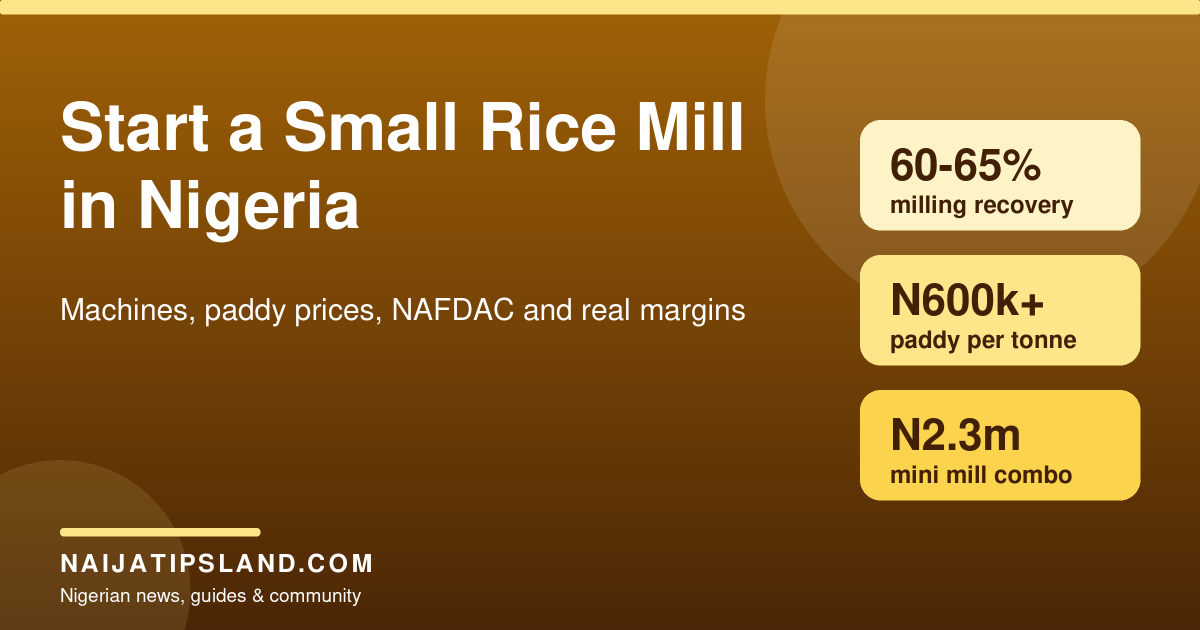
Last updated 29 November 2026. Prices are from market reports and supplier listings published in November 2026. They change quickly, so treat every figure as a starting point and get your own quotes.
Rice is the one food almost every Nigerian household buys every week, so a rice mill looks like a sure thing on paper. The reality in 2026 is tougher. Paddy is expensive, cheap imported rice is coming in through the borders, and the Rice Millers Association of Nigeria says more than 90 of the country’s 260 integrated mills have shut down. That doesn’t mean a small mill can’t work. It means you need to go in with your eyes open, buy paddy well and sell clean rice that people will pay for.
I’ve put this guide together for people at home and in the diaspora who are thinking about a small mill, from a single service mill in a farming town to a modest parboil-mill-and-bag operation with its own brand. If you are still weighing up which farm business to go into, our guide to profitable agricultural businesses for beginners is a good companion read.
What is happening in the rice market right now
Before spending a kobo on machines, it helps to know the market you are walking into.
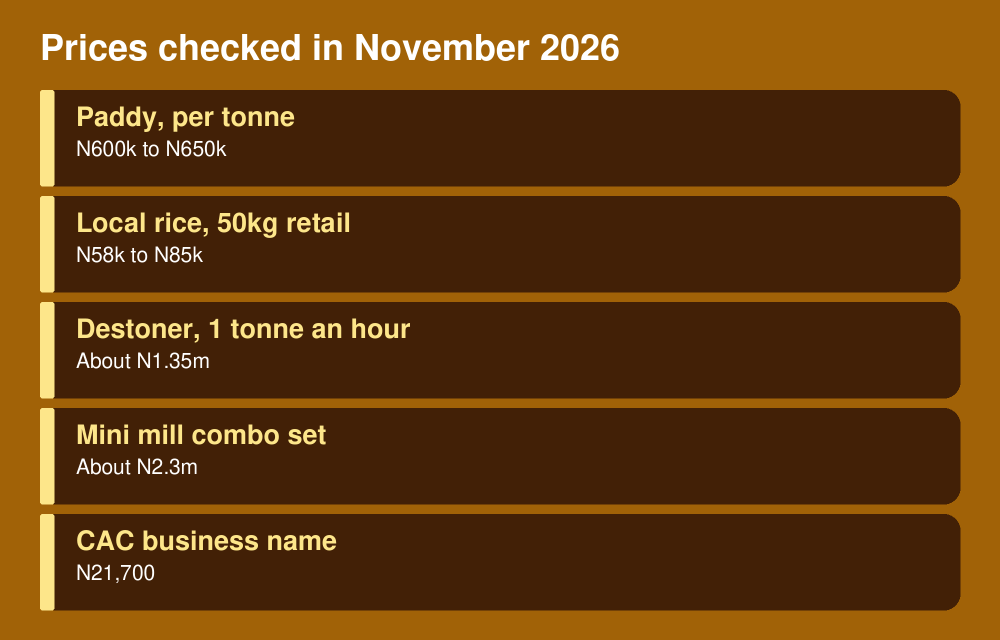
- Paddy is dear. Peter Dama, national chairman of the Rice Millers Association of Nigeria, told Financial Vanguard in November 2026 that a tonne of paddy which sold for about ₦180,000 in 2021 now costs between ₦600,000 and ₦650,000. Prices do swing, though. BusinessDay reported that paddy fell to about ₦350,800 a tonne in June 2026 from a 2025 peak of ₦720,000.
- Imported rice is undercutting local rice. The same report put imported rice at ₦52,000 to ₦60,000 per 50kg bag against ₦75,000 to ₦80,000 for local brands. Dama alleged that more than 2.5 million tonnes of foreign rice came in through Cotonou and land borders this year.
- Retail prices vary by town. A Useagrios snapshot reported by TheRadar gave a national average of ₦79,429 for a 50kg bag on 24 November 2026, while the Lagos State market survey showed local rice at ₦60,000 a bag in Oyingbo in early November.
- Big mills are running below capacity. Operators say even large players like Umza in Kano are working below half their installed capacity because paddy supply is weak.
The lesson for a small miller is simple. Your profit lives in the gap between what you pay for paddy and what you sell milled rice for. If that gap is thin, nothing else saves you.
Choose your model first
There are two main ways to run a small mill, and they need very different amounts of money.
Service milling
Farmers and small traders bring their own paddy and pay you a fee per bag to mill it. You don’t buy paddy, so you need far less working capital. Your income depends on how many bags pass through your machine each day, so location matters a lot. A mill close to farms in places like Argungu in Kebbi, Bida in Niger State, Abakaliki in Ebonyi or the farm clusters around Kano will see steady traffic during harvest. Ask the nearest mills what they charge per bag before you set your price.
Buy, process and sell your own rice
You buy paddy at harvest, parboil it, mill it, bag it under your own name and sell to markets, shops, schools, caterers and wholesalers. This is where the bigger margins can be, but you carry the risk of paddy prices, storage and slow sales. You will also need NAFDAC registration before you put a branded, packaged product on shelves.
Many people start with service milling to learn the machines and the local market, then add parboiling and their own brand once cash flow is steady.
How the process works
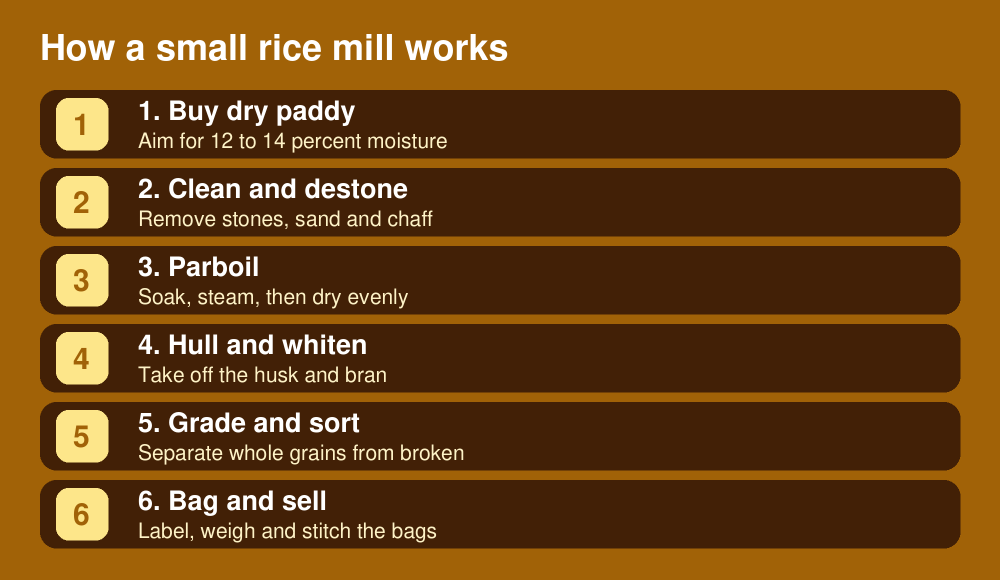
Most rice eaten in Nigeria is parboiled. That means the paddy is soaked, steamed and dried before milling. Parboiling hardens the grain, so fewer grains break in the machine, and it gives local rice its familiar yellowish colour.
- Buy dry, clean paddy. Paddy with high moisture breaks more during milling and can go mouldy. Buy from farmers you trust and check moisture before you pay.
- Clean and destone. Stones are the number one complaint about local rice. A good destoner removes stones, sand and straw and also protects your huller from damage.
- Parboil. Soak the paddy, steam it and dry it evenly on a clean surface or in a dryer. Uneven drying is a common cause of broken grains.
- Hull and whiten. The huller removes the husk, then the whitener or polisher removes the bran layer.
- Grade and sort. Separate whole grains from broken ones. Broken rice still sells, but at a lower price.
- Bag and sell. Weigh accurately, stitch the bag and label it properly.
Equipment and what it costs in 2026
Prices below come from Nigerian suppliers’ own listings in October and November 2026. Get at least three quotes and ask about installation, spare parts and training before you pay.
- Rice destoner, 1 tonne an hour: FarmPays in Ibadan listed one at ₦1,350,000 on 16 November 2026. Afrimash has listed a 1 tonne an hour destoner at ₦1,200,000.
- Mini rice mill combo: Afrimash lists a set with a 200kg an hour mini rice miller, a 1 tonne an hour destoner and a rechargeable bag closer at ₦2,335,000, with a promotional price of ₦1,950,000 shown on the page.
- Rice miller and polisher, 22hp: listed by Afrimash at about ₦2,350,000.
- Imported 1 tonne an hour combined line: Chinese factories quote roughly US$5,200 to US$6,800 for a compact line with cleaner, destoner, husker, separator and whitener. Add shipping, clearing, import duty and installation, which can add a lot to the bill.
On top of the mill, budget for parboiling tanks or drums, a steaming setup, a clean drying floor or tarpaulins, weighing scales, a moisture meter, bags and labels, and power. Many small mills run on diesel generators, so fuel is a big monthly cost. If your area has steady grid power, check whether three-phase supply is available.
How much rice you get from a tonne of paddy
Milled rice usually comes to about 60 to 65 percent of the paddy weight, depending on the variety, how well it was dried and how good your machine is. A CGIAR study put Nigeria’s average conversion at around 58 percent, lower than Thailand, mostly because of older machines and poor drying. A Yobe State study found processors getting about 44kg of milled rice from a 75kg bag of paddy, which is close to 59 percent.
Every extra percentage point of recovery is money in your pocket, which is why drying and destoning matter so much.

A rough worked example
This is a simplified example to show how the numbers fit together. Your own figures will be different, so plug in local prices.
- You buy 1 tonne of paddy at ₦620,000.
- At 62 percent recovery you get about 620kg of milled rice, or roughly 12 bags of 50kg.
- If you sell to wholesalers at ₦62,000 a bag, that is about ₦744,000.
- You may also sell 80 to 100kg of bran to feed makers and livestock farmers.
Out of the gap of roughly ₦124,000 you still have to pay for diesel, firewood or gas for parboiling, water, labour, bags, transport, machine repairs and loan interest. In a bad month, that gap can shrink to almost nothing. Research on Nigerian millers has long shown that small mills earn thinner margins than large ones, and the CISH Africa guide warns that with bank lending rates around 33 percent in 2026, paddy stock and working capital decide whether the business survives more than the machines do.
So the practical tips are: buy most of your paddy at harvest when it is cheapest, store it well, keep your rice stone-free so you can charge a fair price, and find steady buyers before you scale up.
Registration and permits
CAC registration
Register a business name or company with the Corporate Affairs Commission. For an ordinary business name, CAC’s charges in 2026 come to about ₦21,700, made up of ₦1,000 for name reservation, ₦20,000 for registration and ₦700 in service charges added from April 2026. If you plan to borrow from a bank or the Bank of Industry, a limited company usually looks better to lenders. You can confirm a business is genuinely registered using our guide on how to check a company on CAC.
NAFDAC registration
If you only mill other people’s paddy for a fee, you are offering a service. Once you package rice under your own name for sale, the product must be registered with NAFDAC. Parboiled rice and Ofada rice are named on NAFDAC’s MSME page as examples of local packaged products.
For micro and small producers, NAFDAC asks for things like an application letter, standard operating procedures for production, cleaning, hygiene and recall, a food handler’s medical certificate for your staff, a fumigation certificate, a list of raw materials and their source, and your label. Labels must show the product name, net weight, batch number, production and best-before dates, the maker’s address and the NAFDAC number. NAFDAC’s MSME pages put micro-scale food registration fees at roughly ₦35,000 to ₦37,000, and its timeline is up to 90 working days. Confirm the current tariff on the NAFDAC portal before you pay. We walked through a similar process in our sachet water business guide.
Local permits
Check with your local government about any business premises permit, and keep your site clean and away from homes, because husk dust and generator noise cause complaints.
Funding options
- Bank of Industry: BOI lists rice milling among the agro-processing businesses it supports, and its Food and Agro Commodity Processing product covers equipment and working capital. Apply through the MyBOI portal and check the current terms on BOI’s site.
- NIRSAL: NIRSAL is not a lender. It offers credit guarantees of up to 75 percent to banks that lend to agribusinesses, so ask your bank whether it has a NIRSAL-backed product.
- Bank of Agriculture: BOA lists an agro-processing facility and equipment leasing, but its site says you have to go to a branch to apply.
- Cooperatives: a group of farmers or traders can pool money to buy a mill and share it. Our guide on how to start a cooperative society explains the registration steps.
For a wider look at loans, rates and lenders to avoid, read how to get a small business loan in Nigeria.
Running it from abroad
Plenty of Nigerians in the UK and elsewhere want to invest in a mill back home. It can work, but only with a trusted manager on the ground and tight records. Insist on weekly reports of paddy bought, bags milled and bags sold, visit or send someone you trust to do surprise checks, and pay suppliers directly into business accounts rather than through relatives. Start small. A service mill teaches you the business at a fraction of the risk.
Risks to plan for
- Paddy price swings between harvest and the lean season.
- Cheap imported rice pulling buyers away from local brands.
- Insecurity in some farming areas, which affects both farmers and transport.
- Power and fuel costs, especially diesel.
- Machine breakdowns with slow access to spare parts.
- Policy changes on rice imports and duties, which can shift prices overnight.
None of these are a reason to give up, but they are reasons to keep your first mill small, keep cash aside for paddy and repairs, and grow only when the numbers prove themselves. Our start a business in Nigeria hub has more on registration, tax and growth.
Frequently asked questions
How much do I need to start a small rice mill in Nigeria?
A basic service mill with a mini miller and destoner can start from around ₦2 million to ₦3 million for machines, plus a shed, power and some running cash. A parboiling and branding setup needs more, mainly for paddy stock, which is the biggest cost.
Is rice milling still profitable in 2026?
It can be, but margins are thin right now because paddy is expensive and imported rice is cheaper. Mills that buy paddy well, produce clean stone-free rice and have steady buyers do better.
How much rice do I get from a tonne of paddy?
Roughly 600kg to 650kg of milled rice, depending on variety, drying and machine quality. That is about 12 to 13 bags of 50kg.
Do I need NAFDAC to mill rice?
Not if you only mill farmers’ paddy for a fee. You do need NAFDAC registration to sell packaged rice under your own brand.
Which states are best for a rice mill?
Kebbi, Niger, Kano, Ebonyi, Benue, Jigawa and Nasarawa are among the main rice-growing states. Being close to paddy cuts your transport costs, while being close to big markets like Lagos and Abuja helps you sell.
What can I do with husk and bran?
Bran sells to feed makers and livestock farmers. Husk can be sold or used as fuel, including for parboiling.
Sources
- Northlink, reporting Financial Vanguard: Nigeria’s rice revolution collapses as 90 mills shut down (23 November 2026)
- BusinessDay: Nigeria’s shifting rice policies leave farmers flying blind (25 November 2026)
- TheRadar: A bag of rice averages ₦79,429 nationally (November 2026)
- FoodPrices.ng: Oyingbo raises 24 of 27 food prices (22 November 2026)
- FarmPays: Rice destoner 1 tonne/hr price
- Afrimash: Rice processing combo set
- NAFDAC: Micro, Small and Medium Enterprises
- NAFDAC: Getting started with MSMEs
- Qrafteq: CAC business name fees 2026
- Comilmart: Agro-processing loans in Nigeria, BOA, NIRSAL and BOI (October 2026)
- CISH Africa: How to start a rice mill business in Nigeria (November 2026)
- Nigerian Journal of Agriculture and Agricultural Technology: Profitability of rice processing in Yobe State
Join the discussion
Have you tried this, or do you have a question we did not answer? Be the first to share your experience. Leave a comment below. Every comment is read by the editor before it appears.








Editor note: do you run a mill or buy paddy in Kebbi, Niger, Kano or Ebonyi? Tell us what paddy cost you this month and what you charge per bag. It helps other readers plan. – Ade