
Opinion. Last updated 28 November 2026. This piece makes the case for one candidate in the 2027 Oyo State governorship election. Figures on the state’s record and plans come from the Omituntun 3.0 manifesto and from news reports cited in the text.
On 6 February 2027, Oyo voters will pick the person who moves into Agodi Government House on 29 May. Sixteen parties are on the INEC ballot. Only one of those candidates has run the state’s treasury, worked inside the governor’s office, chaired the committee turning Ibadan’s airport into an international gateway, and spent years in banking and public finance in Nigeria and the United Kingdom before any of that.
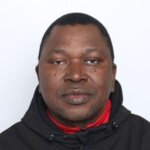
That candidate is Hon. Abimbola “Bimbo” Adekanmbi, FCCA, of the Allied Peoples’ Movement (APM). His campaign calls itself Bimadek 2027, and his manifesto is titled Omituntun 3.0. This article sets out why he is the strongest choice on the ballot, using his record, his plan and a straight comparison with the other major names.
If you want the bigger picture of the 2027 polls across the country, our 2027 Nigeria Election Hub covers dates, offices and how voting works. Our rundown of the 28 states voting for governor on 6 February lists every race. This piece is about Oyo.
Who is Bimbo Adekanmbi?
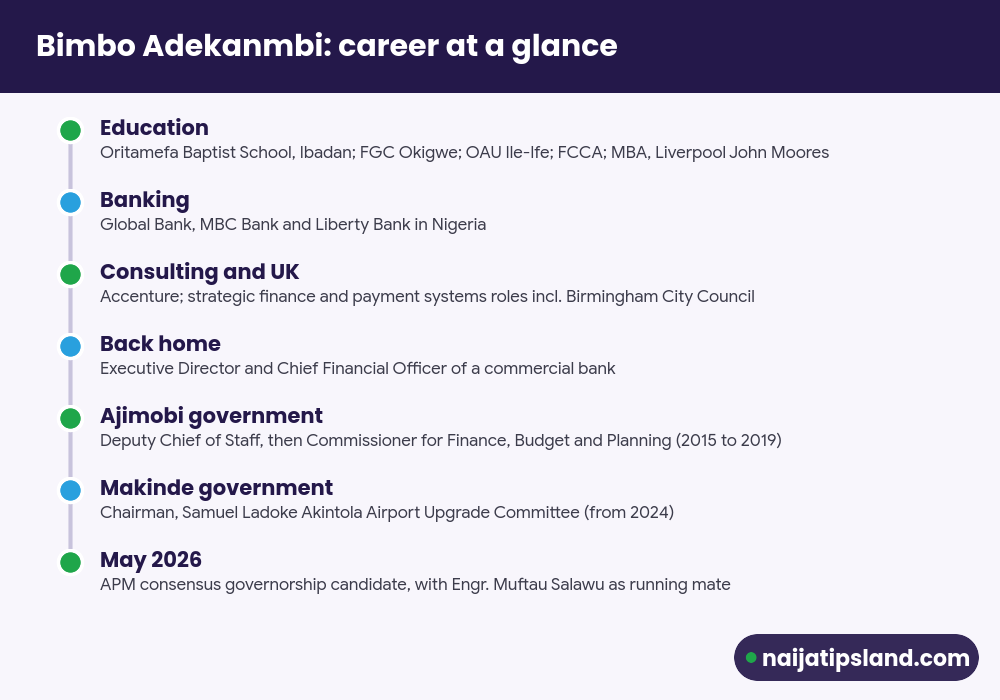
Adekanmbi is an Ibadan man who started school at Oritamefa Baptist School, went on to Federal Government College, Okigwe, and then studied at Obafemi Awolowo University, Ile-Ife. He is a Fellow of the Association of Chartered Certified Accountants (FCCA) and holds an MBA in Strategy and Finance from Liverpool John Moores University.
His working life began in Nigerian banking, with spells at Global Bank, MBC Bank and Liberty Bank. He then moved into consulting with Accenture, and later took strategic finance and payment systems roles in the United Kingdom, including at Birmingham City Council. That last detail matters more than it looks. A British council runs on strict budget rules, audited spending and published accounts. Anyone who has worked inside one has seen how public money is supposed to be tracked.
He came back home and rose to Executive Director and Chief Financial Officer of a commercial bank. Then he moved into government.
His years under Ajimobi
Under the late Governor Abiola Ajimobi, Adekanmbi served first as Deputy Chief of Staff and then as Commissioner for Finance, Budget and Planning, the post he held from 2015 to 2019. The Deputy Chief of Staff job is where the governor’s office meets the ministries. You learn why a project stalls, which file is sitting on whose desk, and who can move it. The finance job is where every promise a government makes meets the money that is actually in the account.
His manifesto puts it plainly: a successor who spends his first two years learning where the levers sit has lost two years. Adekanmbi has already pulled those levers.
His work under Governor Seyi Makinde
Here is something many people outside Oyo politics don’t know. Adekanmbi was not Makinde’s man in 2019. He served the government Makinde defeated. Yet after the 2023 elections, Makinde trusted him enough to nominate him for a federal ministerial slot. Makinde said in October 2026 that he put Adekanmbi’s name forward even though he knew and rated Adebayo Adelabu, the man President Tinubu eventually picked. A governor does not spend that kind of political capital on someone he only half trusts.
When the ministerial nomination did not go through, Makinde gave him a harder job at home.
Turning Alakia into an international airport
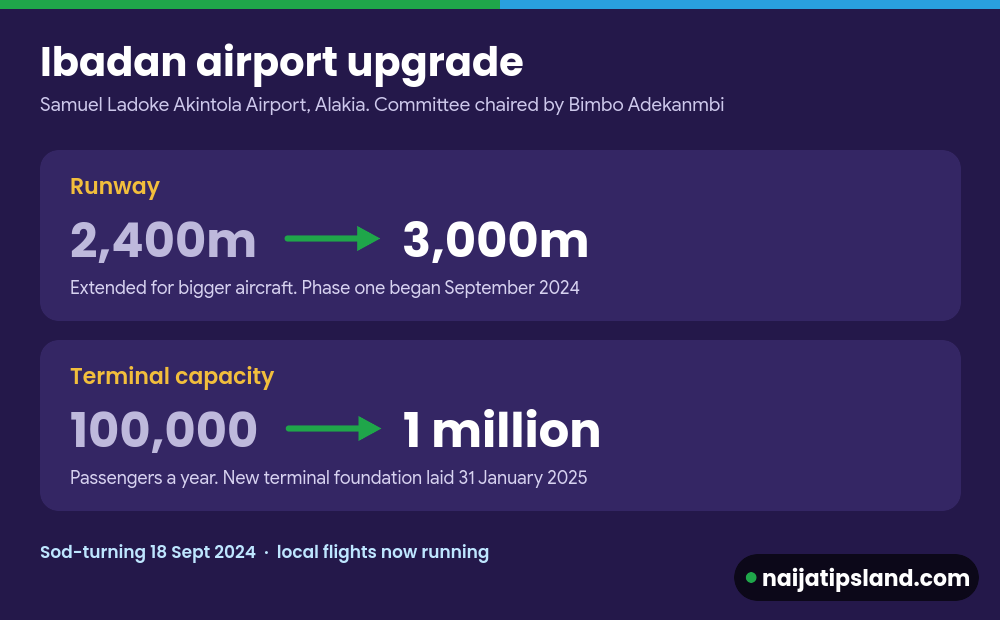
In 2024 Makinde set up an 11-member committee to oversee the upgrade of Samuel Ladoke Akintola Airport, Alakia, Ibadan, to international standard, and made Adekanmbi its chairman. The committee’s first task was a white paper on how to do it. Then came the work.
The sod-turning took place on 18 September 2024. Phase one extended the runway from 2,400 metres to 3,000 metres, long enough for bigger aircraft. On 31 January 2025, Adekanmbi laid the foundation of a new terminal building on the governor’s behalf. He told reporters then that the old terminal handled about 100,000 passengers a year and the new one is built for up to one million.
He did not stop at ceremonies. In November 2025 his committee handed four operational vehicles to the airport’s management because, as he put it, the state could not wait on federal agencies to supply everything an international airport needs. In April 2026 the committee gave the Nigerian Airspace Management Agency a customised vehicle fitted with communication equipment. By then local flights were running on the new runway while work continued on the international terminal.
This is the biggest infrastructure project of Makinde’s second term. The man who chaired it is now asking for the job of finishing everything else.
Why Makinde chose him
Seyi Makinde became governor in 2019 on the Omituntun 1.0 agenda and was re-elected in 2023 on Omituntun 2.0. He leaves office on 29 May 2027 and is running for president on the APM ticket after the PDP-APM alliance he built this year. On 28 May 2026, at the Watershed Event Centre on Old Ife Road, Ibadan, the APM adopted Adekanmbi as its consensus governorship candidate, and Makinde named him as his preferred successor in front of the crowd.
In the foreword to the Omituntun 3.0 manifesto, Makinde writes that his successor “understands this vision” and has the competence and character to lead the next phase. He asks Oyo people directly to give their mandate to Adekanmbi.
The support came from more than the governor. Two weeks before the primary, on 13 May 2026, Speaker Adebo Ogundoyin led a group of lawmakers from the 10th Oyo State House of Assembly to endorse him. Deputy Governor Bayo Lawal, former Deputy Governor Hamid Gbadamosi, the Secretary to the State Government and a long list of council chairmen attended the primary.
The running mate and the campaign team
Adekanmbi picked Engr. Muftau Salawu, an Ogbomoso-born engineer and businessman, as his running mate. That puts an Ibadan finance man and an Ogbomoso engineer on one ticket, which covers the two biggest population centres in the state and two different kinds of skill.
The campaign council is led by Hon. Nureni Adeniran, chairman of the Oyo State Universal Basic Education Board (SUBEB), as Director-General. The APM’s joint presidential and governorship campaign was flagged off at the Durbar Stadium, Oyo, on Saturday 14 November 2026, in front of thousands of supporters.
What Omituntun 3.0 actually promises
Most Nigerian campaign manifestos are a list of good intentions with no dates. Omituntun 3.0 is different, and you can read it yourself. It is a 144-page document with seven “anchor pillars”, eleven supporting ones, and a date beside almost every promise. Here is what stands out.
Money the state raises for itself
The manifesto shows Oyo’s monthly internally generated revenue (IGR) rising from about ₦0.6 billion in 2011 to ₦1.7 billion in 2019 and around ₦8.7 billion a month in 2025. That is roughly five times the 2019 level, and it is the money that pays teachers and fixes roads when federal allocation falls short.
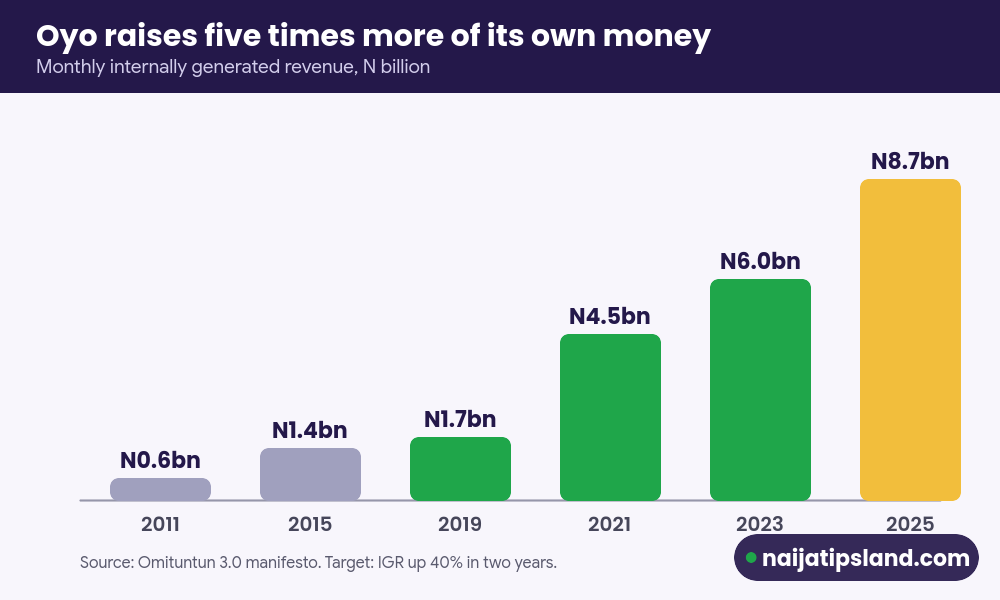
Adekanmbi’s plan is to make that revenue survive a change of government. His targets: every revenue office on one electronic collection platform within six months, 95 percent of all state taxes and levies collected electronically within a year, and IGR up at least 40 percent within two years without arbitrary new taxes. No third-party collection agents standing between the trader and the treasury. Quarterly budget performance reports published within 30 days of each quarter, every quarter.
The manifesto puts the trader’s experience simply. She pays her levy on her phone, gets an electronic receipt, and nobody stands between her money and the state account. Anyone who has dealt with touts at a motor park knows why that matters.
Agriculture that ends in a factory
Oyo has the largest landmass in the South-West, 28,454 square kilometres, and about 7.98 million people, second only to Lagos. Yet agriculture is only about 7.71 percent of the state economy and manufacturing 5.66 percent. The manifesto’s argument is that Oyo grows plenty and processes too little.
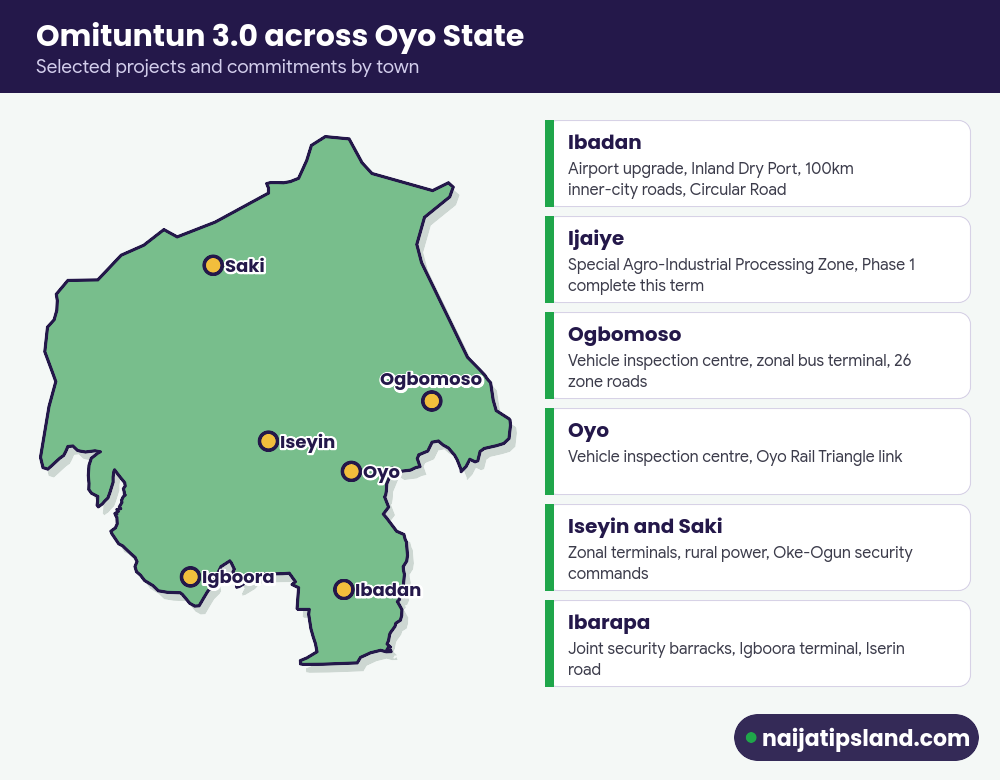
The record it builds on includes US$165 million in blended development finance for agriculture, the Special Agro-Industrial Processing Zone (SAPZ) at Ijaiye, 18 agro-processing companies with more than ₦75 billion in combined investment, over 50,000 farmers on a digital register, and 72,253 hectares ploughed for 15,908 farmers.
The Omituntun 3.0 targets are specific: 200,000 new agricultural jobs within four years, 3,000 kilometres of feeder roads within three, mechanisation across all 28 farming local governments covering at least 150,000 hectares a year, irrigation for 25,000 hectares, 500 digitally equipped extension officers by 2029 and a soil laboratory in every agricultural zone by 2030. The end-of-term goals are smallholder income up at least 60 percent and post-harvest losses cut in half.
Adekanmbi has made this a campaign theme, pointing to Oyo’s cassava output as an area where the state already has an edge. A cassava farmer in Iseyin who can sell to a processor 40 minutes away, at a price agreed before planting, is the picture the manifesto paints. It is a realistic one.
Light for homes and factories
The manifesto says Oyo has 183 megawatts of electricity capacity against demand of about 350MW. Makinde’s government built a 12MW independent gas plant and a 5MW hybrid plant, the first state-backed generation of its kind in Oyo. Adekanmbi wants to close the remaining 167MW gap, conclude gas supply agreements with NIPCO Gas and Shell Nigeria Gas in his first year, electrify 100 rural and peri-urban communities within two years, and build a gas-to-power corridor that serves the Ijaiye processing zone and the Oluyole Free Trade Zone.
Roads that connect to something
The manifesto admits something politicians rarely say out loud: Oyo has more kilometres of road than ever, but not yet a transport system. Omituntun 3.0 promises 100 kilometres of inner-city roads rehabilitated at 25km a year, completion of outstanding projects such as Ogbooro to Agbonle and 26 roads in the Ogbomoso zone, zonal bus terminals, computerised vehicle inspection centres at Oyo II and Ogbomoso in year one, 50 electric buses and an Ibadan Inland Dry Port running within two years. In the first 100 days, the state will publish the condition of every state road “so no road is announced twice”.
Young people as the workforce
About 300,000 people went through the Oyo Digital skills programme under Omituntun 2.0, and over 3,000 were trained in artificial intelligence. Adekanmbi’s manifesto says the problem now is the gap between a certificate and a pay slip. His answer is a public Oyo Talent Registry, open by application and assessment rather than by connection, a Youth Industrial Cluster where young people build and sell products, and a rule reserving technical roles for young Oyo professionals on projects the state funds. The target is 100,000 young people with market-ready skills by year three.
Teachers, schools and civil servants
The current government spends over 20 percent of the budget on education and recruited 15,783 education personnel. Omituntun 3.0 sets a ceiling of 30 pupils per teacher in every state school, 7,500 more teachers recruited by need, and basic education enrolment of 98 percent by 2031.
For civil servants, the manifesto promises to keep salaries paid on or before the 25th of each month, with the 13th-month allowance and leave bonus, and to clear the path from first posting to retirement. Adekanmbi has said on the campaign trail that regular payment of salaries and pensions will be a priority, which is what you would expect from an accountant who once managed the state’s payroll.
Security
Oyo’s Amotekun corps now has more than 2,400 personnel, the largest in the South-West, backed by two surveillance aircraft, six new Operation Burst commands in Oke-Ogun and a modernised 615 emergency line. Omituntun 3.0 adds 600 more Amotekun personnel, 1,000 forest guards and agro rangers, 50 more security posts at known flashpoints, a joint security barracks in Ibarapa and an Oyo Security Trust Fund law drafted in the first 100 days.
The first 100 days
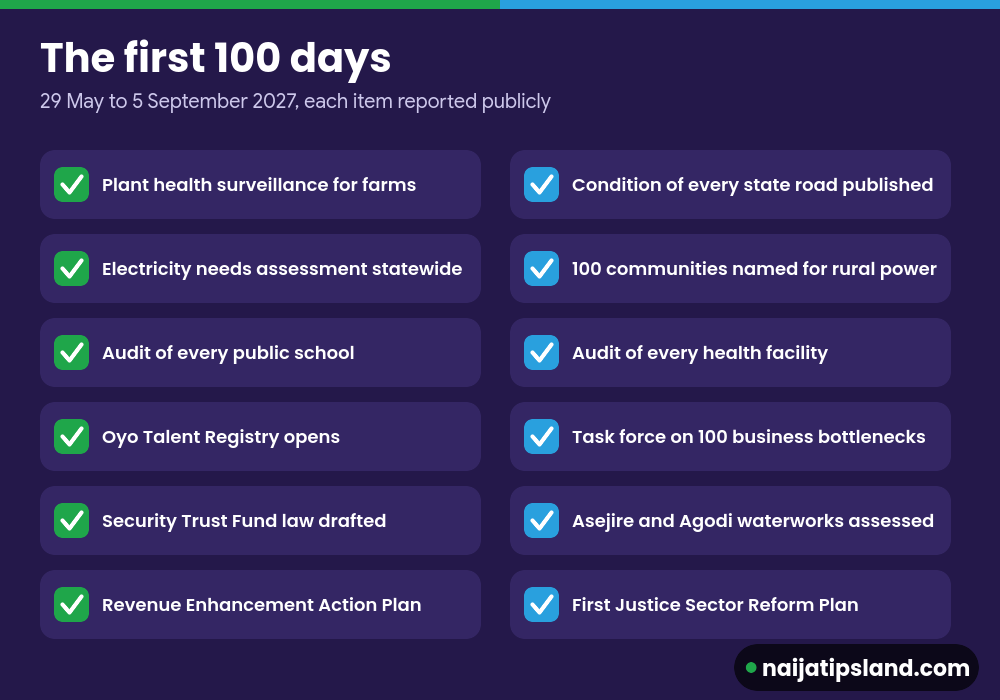
The manifesto lists what starts on 29 May 2027 and must be reported on 5 September 2027. It says plainly that where a commitment is missed, it will be recorded as missed, with the reason. Some of the items:
- A plant health surveillance and rapid response system for farms
- Publication of the condition of every state road
- A statewide electricity needs assessment and 100 priority communities named for rural electrification
- An audit of every public school and every health facility before money is committed
- The Oyo Talent Registry opened for registration
- A Business Regulatory Reform Task Force to remove at least 100 bottlenecks for investors
- A multi-agency security committee and draft Security Trust Fund law
- Technical assessment of the Asejire and Agodi waterworks
- The first Justice Sector Reform Plan
Voters also get four ways to check the work: a published account against every commitment, an annual fiscal assessment by an independent panel the government does not write or edit, a public portal where you can look up any capital project in your local government, and community charters that must be answered in writing before the budget is prepared.
How he stacks up against the other candidates
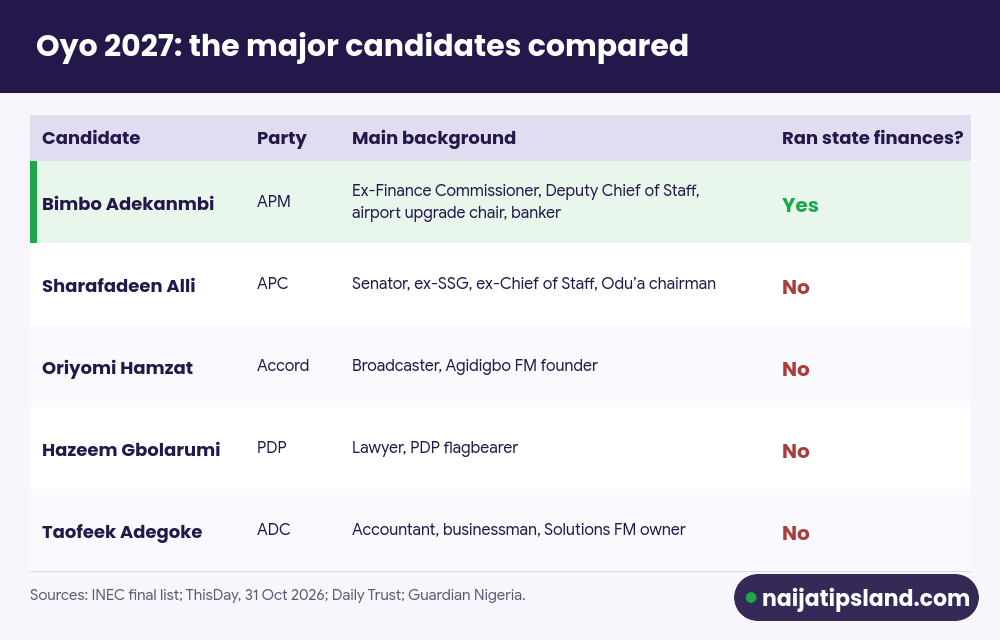
INEC’s final list has 16 governorship candidates. Four others get most of the attention: Senator Sharafadeen Alli (APC), Oriyomi Hamzat (Accord), Barrister Hazeem Gbolarumi (PDP) and Olooye Adegboyega Taofeek Adegoke (ADC). Each has real support. Here is how they compare on the job itself.
Sharafadeen Alli (APC)
Senator Alli is an experienced politician. He has been chairman of Ibadan North Local Government, Secretary to the State Government, Chief of Staff to Governor Rashidi Ladoja and chairman of Odu’a Investment Company, and he won the Oyo South senatorial seat in 2023. Nobody should take him lightly.
But his campaign carries two weights. The first is his own party: former Minister of Power Adebayo Adelabu rejected the outcome of the APC primary that produced him, and that split has not gone away. The second is that an APC governor would be judged alongside the federal government’s economic record, and Oyo households have felt the fuel and food prices of the last three years. Adekanmbi, by contrast, runs on a state record people can see in Alakia, Ijaiye and on their own feeder roads.
Oriyomi Hamzat (Accord)
Hamzat is a well-known broadcaster, founder of Agidigbo 88.7 FM and host of the Kokoro Alate programme. Many traders, artisans and drivers see him as someone who speaks for them, and he has earned that following. What he has not done is run a ministry, a budget or a state agency. His support is also concentrated in Ibadan. Governing Oyo means managing a payroll of tens of thousands, a capital programme across 33 local governments and relationships with federal agencies. A radio studio is good training for speaking to the people. It is not training for running the treasury.
Hazeem Gbolarumi (PDP)
Gbolarumi carries the PDP name in a state where the party’s leading figures, including the governor, much of the cabinet, the Speaker and many lawmakers, have moved into the PDP-APM alliance behind Adekanmbi. The party is also still dealing with the fallout of its national crisis, including the Supreme Court’s split ruling of 1 May 2026 on the November 2025 convention. Voters who backed Makinde in 2019 and 2023 on the PDP ticket will find the people and the programme they voted for on the APM line this time.
Taofeek Adegoke (ADC)
Olooye Adegoke is a Fellow of the Institute of Chartered Accountants of Nigeria, a businessman who has worked at Deloitte, Schlumberger and Oando, a philanthropist and the owner of Solutions 93.9 FM in Ibadan. On paper he is the candidate whose private-sector profile looks most like Adekanmbi’s. The difference is government. Adegoke has not held a state office, has no record managing public money, and has moved through the PDP, Accord, the APC and back to the PDP before joining the ADC.
Put the five side by side and only one has been commissioner for finance, sat in the governor’s office and led a flagship state project to completion. That is the case in one sentence.
Answering the critics
A fair case has to deal with the strongest arguments on the other side. There are three.
“He is Makinde’s stooge”
This is the charge his opponents repeat most. Adekanmbi has answered it directly, including on Arise Television, where he said he will give independent, people-focused leadership. Makinde himself has said he will not interfere in his successor’s government.
The better answer is in Adekanmbi’s own history. In a 2021 newspaper interview, while he was still in the opposition, he criticised the Makinde government’s handling of the state’s debt. The APC has been circulating that interview to embarrass him. Read it the other way. Here is a man who was willing to question Makinde’s numbers in public, and Makinde still decided he was the best person to take over. Stooges are not chosen that way. Continuity of policy is also not the same as taking orders. Lagos is the clearest Nigerian example of what happens when a state keeps the same development plan across several governors.
“He has changed parties”
True. He was in the APC, made an unsuccessful bid for the Oyo South Senate seat in the 2023 cycle, moved to the PDP and is now in the APM. Look at the other ballot names and you will find the same pattern almost everywhere: Adegoke has been in four parties, and much of the APC’s Oyo leadership has crossed lines over the years. In Oyo, as in the rest of Nigeria, parties are often platforms. What a voter should ask is what a candidate did with the offices he held. Adekanmbi’s answer is the treasury, the governor’s office and the airport.
“His finance record under Ajimobi will be scrutinised”
It should be, and that is a strength of his candidacy. He is the only major candidate with a finance record to check. His manifesto goes further than any rival’s on fiscal openness: quarterly reports within 30 days, capital spending reported project by project, an independent annual fiscal assessment and a Fiscal Credibility Charter that applies to the state and its 33 councils. A candidate who expected his record to hurt him would not write commitments like those.
Support on the ground
Since his adoption, Adekanmbi and Salawu have done a statewide thank-you tour, met party structures in every zone and taken the campaign into communities that often feel left out of Ibadan politics. In Ibarapa, the Onilala of Lanlate, Oba Sunday Oladejo, said the people of Lanlate and Ibarapa East had adopted him as their candidate, and former federal lawmaker Hon. Yemi Taiwo promised the area’s full backing. Adekanmbi promised Ibarapa its fair share of projects and opportunities.
The campaign also opened an office at the Adamasingba Shopping Complex in Sabo, Ibadan, to reach the Hausa and wider Arewa community, and APM leaders in Oke-Ogun say Iseyin and the rest of Oyo North are lined up behind the ticket. He has also promised an open door to the press, saying journalists will have access to his government and be free to ask questions.
What a vote for Adekanmbi means
Adekanmbi described his candidacy in one line in Ibadan: “Governor Seyi Makinde has built a bridge, and I will take the people of Oyo across the bridge.” It is a good summary. The roads, the airport runway, the processing zone and the revenue system are built or half-built. The next governor decides whether they are finished, maintained and turned into jobs, or renamed and left to rot like so many Nigerian projects after a change of government.
The manifesto’s own promise is that nothing finished will be renamed, nothing in progress will be dropped, and everything promised and not yet started will be followed through. On the record, the person most able to keep that promise is the one who chaired the airport project, ran the state’s finances and helped write the plan.
On 6 February 2027, make sure your PVC is ready (our guide shows how to check and collect it) and find your polling unit early. Our guide on how to vote on election day walks through accreditation and what to bring. Read the Omituntun 3.0 document for yourself, compare it with what the other candidates have put in writing, and then decide. On experience and on the detail of the plan, Bimbo Adekanmbi is the candidate to beat.
Join the discussion
Have you tried this, or do you have a question we did not answer? Be the first to share your experience. Leave a comment below. Every comment is read by the editor before it appears.