
How to Start an Event Planning Business in Nigeria (2026): Costs, CAC, Permits, Pricing and First Clients

Last updated 20 November 2026. Fees, permits and tax rules change, so treat every naira figure here as a planning estimate and confirm it before you pay or sign anything. This is general information, not legal or tax advice.
Walk into any Lagos wedding hall on a Saturday and you will see the business in action. Someone in black is holding a clipboard, someone else is chasing the caterer, and the hosts are smiling because the person with the clipboard has solved six problems they never saw. That person is an event planner, and in Nigeria you can start the same work with a phone, a laptop and a good reputation among vendors. Starting is cheap. Surviving the first year is the hard part, so this guide covers the money, the paperwork, the rules and the pricing in plain terms.
Is event planning still worth doing in 2026?
Demand has not gone away. Weddings, naming ceremonies, birthdays, burials, product launches and company year-end parties keep happening, and hosts increasingly pay someone to run them. Published 2026 fee guides put wedding planners at roughly ₦150,000 for day-of coordination up to ₦2 million or more for full luxury planning, with most Lagos and Abuja couples paying ₦400,000 to ₦900,000 for full planning of a 200 to 400 guest wedding. Those are estimates from industry sites, not official statistics, but they show the range.
The catch is that your income arrives in lumps around event dates, while your costs (transport, deposits, phone data, assistants) arrive all month. Planners who last tend to price carefully, collect deposits and keep a cash reserve. Planners who struggle usually say yes to everything and discover in week three that they are funding a client’s generator.
Choose one niche before you spend anything
It is tempting to advertise weddings, corporate events, burials and children’s parties all at once. Clients can tell when you have not done any of them properly. Pick one and get good at it.
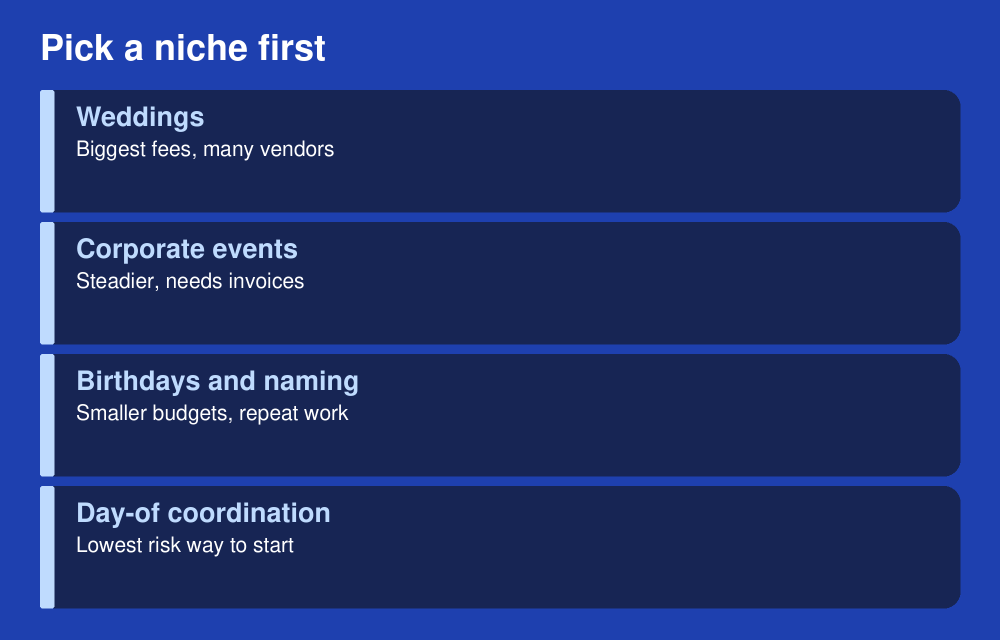
Weddings carry the biggest fees and the best referrals, because every guest at a well-run wedding is a possible future client. They are also the most stressful, with several ceremonies (introduction, church or mosque, reception) and many vendors. Corporate events pay more steadily, but companies want a registered business, proper invoices and a portfolio before they will book you. Birthdays and naming ceremonies have smaller budgets but are quicker to repeat. Day-of coordination, where the host has already booked the venue and caterer and just needs someone to run the day, is the lowest-risk way to begin because you are not holding anyone’s deposit money.
What it costs to start
Published estimates vary a lot, which is itself useful to know. One 2026 Nigerian guide puts a planning-only start (no décor) at about ₦31,000 to ₦80,000, and a fuller start with branding, a few décor items and a portfolio page at ₦100,000 to ₦500,000. Another says a service business of this kind can launch under ₦100,000 in working capital. The gap comes down to whether you own décor stock or rent it.
A realistic starter budget looks like this:
- CAC business name registration (see below), plus a business bank account.
- Logo and basic branding, usually ₦15,000 to ₦50,000 if you pay a designer.
- Business cards and printed proposals. Physical cards still get used at vendor meetings.
- An Instagram business page for your portfolio. A website can wait until you chase corporate clients.
- Free tools such as Trello or Airtable for timelines and vendor contacts.
- Transport money, because you will be at venues before dawn.
- A cash cushion for deposits you may have to advance before the client pays.
If you are short of capital, our guide to small business loans in Nigeria covers safer lenders. Rent décor from a supplier for your first few events instead of buying it. You can buy once you know which items you actually use.
Register the business and sort out tax
Corporate clients and many venues will not pay an unregistered vendor, so register early. For most solo planners a business name is enough, and it is the cheaper route. Our step-by-step guide to registering a business name with CAC walks through the portal. If you expect partners or large corporate contracts, look at registering a limited company instead.
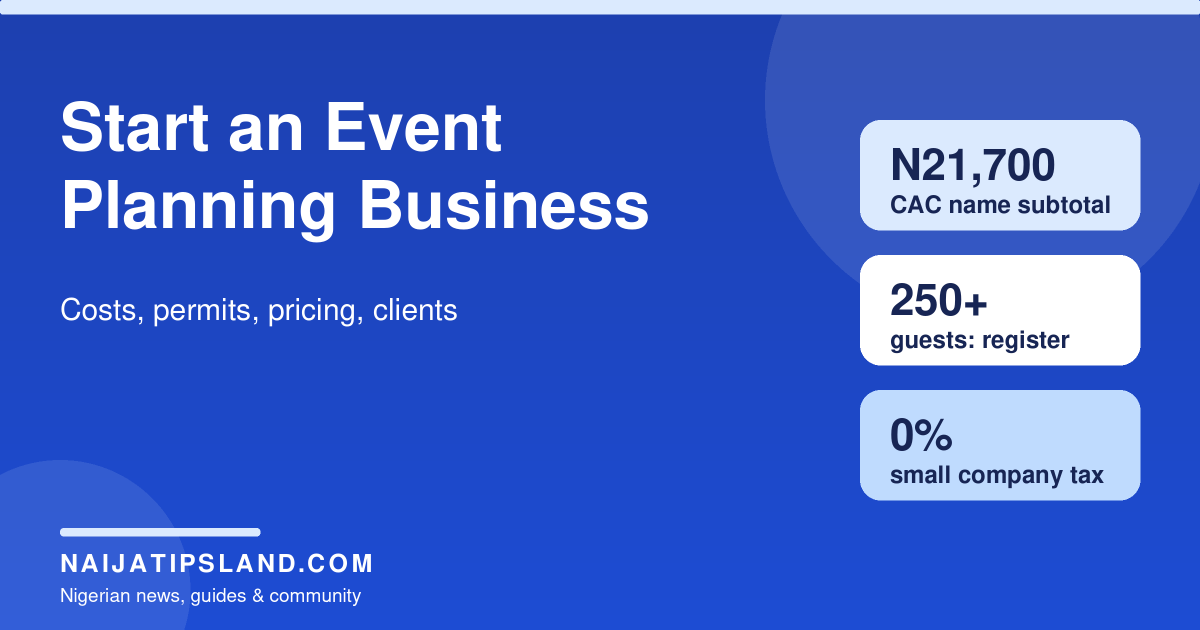
On fees, sources disagree because the CAC schedule changed. The May 2025 gazette lists business name registration at ₦20,000 and a standard name reservation at ₦1,000. CAC also announced an AI service charge from 1 April 2026 of ₦200 for name reservation and ₦500 for business name registration. One 2026 guide adds those up to ₦21,700, while others still quote older figures of ₦10,000 to ₦12,000. The only number that counts is the invoice on the CAC portal on the day you pay. Agents charge on top, with published ranges of ₦20,000 to ₦40,000, and you do not need one to use the portal.
After registration, get a Tax Identification Number. Our guide to getting a TIN in Nigeria shows how. Under the Nigeria Tax Act 2025, which took effect on 1 January 2026, a “small company” with annual turnover of ₦100 million or less and fixed assets below ₦250 million pays 0% company income tax and is exempt from the 4% development levy. Two things to remember. The exemption is not automatic, since you still need a TIN, records and annual returns filed with the Nigeria Revenue Service even when you owe nothing. And some professional services are excluded from the small company definition, so ask an accountant to confirm where event services sit for your structure. VAT thresholds also changed under the reforms, so check the current figure with the tax authority rather than relying on an old blog post.
Permits and safety, especially in Lagos
There is no single national licence for event planners. What you need depends on the event and the state. In Lagos, the state government has said events with more than 250 guests should be pre-registered with the Lagos State Safety Commission, and that events above 500 need trained safety marshals on site. That statement dates from December 2022, so confirm the current threshold with the Commission before you quote. The same official said a noise permit is needed before a safety certificate is issued.
For sound, the Lagos State Environmental Protection Agency (LASEPA) has digitised its sound permit application, and the state has tightened rules on amplified sound at nightclubs, lounges and worship centres. Do not assume the venue has covered everything. Ask in writing which approvals the venue already holds and which ones are yours. Also check fire exits, first aid, food handler licences for your caterer and, if you put up outdoor signs or banners, the rules of the Lagos State Signage and Advertisement Agency (LASAA).
Other states have their own agencies, so make one phone call to the local government or state ministry before the first booking in a new place.
How to price your services
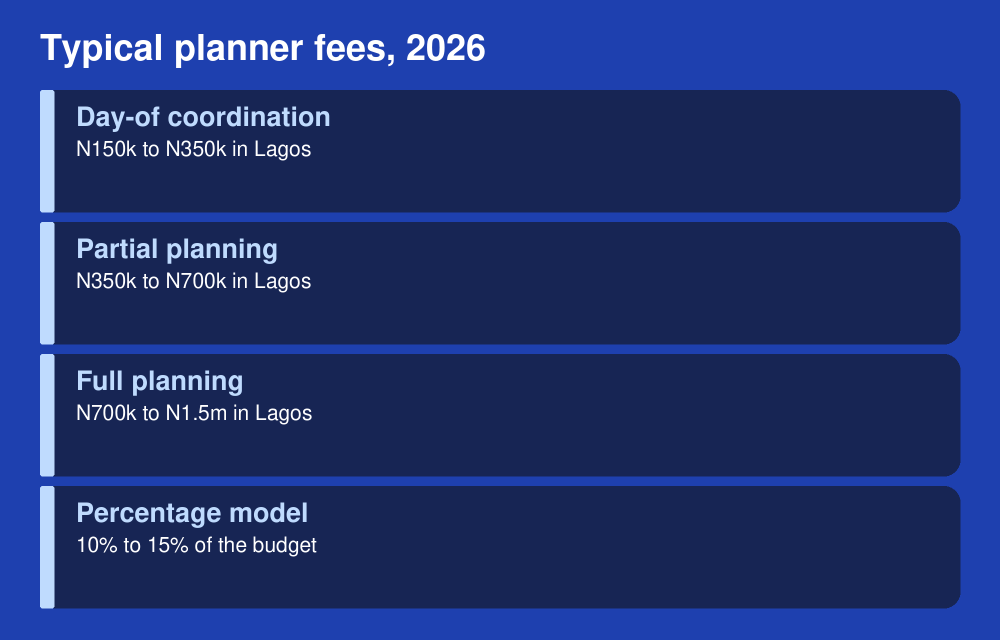
There are three common models. A flat fee is easiest for the client to budget. A percentage of the total event budget, commonly quoted at 10% to 15% (some guides say up to 20%), rewards planners on big events but can look like a reason to push the client to spend more, so many planners cap it at a fixed amount. A hybrid uses a base fee plus a small percentage of spend above a threshold.
For reference, one 2026 guide lists Lagos and Abuja ranges of about ₦150,000 to ₦350,000 for day-of coordination, ₦350,000 to ₦700,000 for partial planning and ₦700,000 to ₦1.5 million for full planning, with other cities 30% to 40% lower. Another places entry-level freelancers at ₦80,000 to ₦200,000 per event. Your own price should follow your hours, your costs and your track record. Beginners who undercharge end up working for free once transport and assistants are counted.
Build a vendor network that you can trust
Your name sits on every vendor’s mistake. Keep a private list with at least two options in each category: venue, caterer, décor, sound, photographer, MC, makeup, ushers, cake, cars, security and power. Note their real prices, how they behave when something goes wrong and whether they turn up on time. Our guide to starting a catering and small chops business is useful reading if food will be a big part of your service, and the budget breakdown in planning a Nigerian traditional wedding on a budget gives you a feel for what clients expect to spend on each line.
Power deserves its own line. A generator that runs through a reception is a real cost, and fuel prices move. One 2026 planner guide cites the national average petrol price at about ₦1,596 a litre in May 2026, so ask for generator and fuel to be written into the quote.
Contracts, deposits and cash flow
Put everything in writing, even for a cousin’s wedding. A simple contract should name the date and venue, list what you will and will not do, state the fee and the payment schedule, and say what happens if the date changes or the event is cancelled. Collect a non-refundable booking fee to hold the date, a second payment before you pay vendors, and the balance before the event day, not after. Keep client money for vendors in a clear record, or better, ask the client to pay big vendors directly so you never hold large sums.
Agree in advance who pays for overtime at the venue, extra guests and anything guests do on the day. For example, spraying naira at events is an offence under section 21 of the CBN Act according to one wedding cost guide, and venues may have house rules about it, so say how you will handle it.
Getting your first clients
Plan two or three events for friends or family at cost, and photograph them well. Then ask the people at those events to share your page. Venue managers are worth befriending because they see which hosts need help. Join an industry group, such as the Association of Professional Party Organizers and Event Managers of Nigeria, which describes itself as a network of planners, decorators and vendors. For corporate work, a short LinkedIn message to HR and admin managers with a one-page portfolio works better than a mass broadcast on WhatsApp. Answer enquiries quickly. A client who messages three planners usually books the one who replies first with a clear quote.
Mistakes that sink new planners
- Quoting before you know the guest count, venue and date.
- Paying vendors from your own pocket without a signed agreement.
- Counting the whole event budget as your income when only your fee is yours.
- Taking a booking on the same date as another event with no trusted assistant.
- Skipping the backup plan for rain, power and late vendors.
- Not filing tax returns because “the profit is small”.
A simple 30-day launch plan
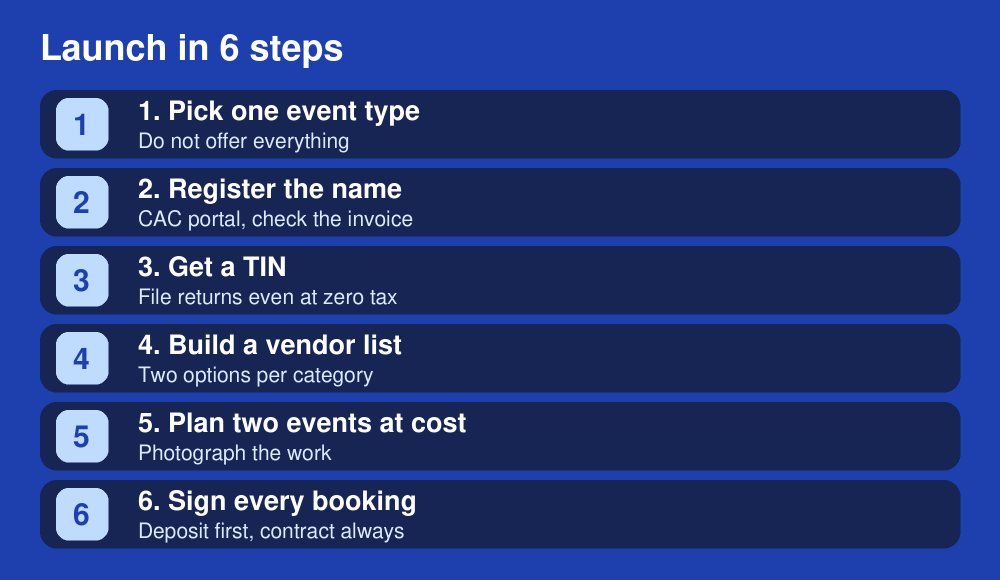
In week one, choose your niche, check names on the CAC portal and open your Instagram page. In week two, register the name, get a TIN and open a business account. In week three, build your vendor list and plan a small event at cost. In week four, publish photos, write a one-page price guide and send it to ten possible clients. Then review what the first event actually cost you in time and money, and set your fees from that number.
For the wider picture on registration, tax and funding, see our complete guide to starting a business in Nigeria.
FAQ
How much money do I need to start an event planning business in Nigeria?
Published estimates range from under ₦100,000 for a planning-only start to ₦500,000 if you add branding and décor items. Rent décor at first and keep a cash cushion for deposits.
Do I need a licence to be an event planner in Nigeria?
There is no single national licence. You should register the business with CAC and get a TIN. Specific events may need permits, such as safety registration and sound permits in Lagos, so ask the venue and the relevant state agency.
How much does CAC business name registration cost now?
Check the invoice on the CAC portal. The May 2025 gazette lists ₦20,000 for registration and ₦1,000 for name reservation, plus the April 2026 AI service charges of ₦200 and ₦500. Older figures of about ₦10,000 still appear on some sites.
Do small event businesses pay company income tax?
A small company with turnover of ₦100 million or less and fixed assets below ₦250 million pays 0% company income tax under the Nigeria Tax Act 2025, but you must still have a TIN and file returns. Ask an accountant to confirm your case.
Should I charge a flat fee or a percentage?
Either works. Flat fees are easier for clients to plan around. Percentages of 10% to 15% suit large events but are better with a cap. Many planners combine a base fee with a smaller percentage.
Can I run the business from home?
Yes. Most of the work is phone calls, venue visits and event-day coordination. You may want a small storage space once you own décor items.
This article gives general information and is not legal, tax or financial advice. Rules, fees and prices change, so confirm current figures with CAC, the tax authority and your state agencies before you act.
Sources
- Naijasabi: How to start an event planning business in Nigeria 2026 (22 September 2026)
- ElitePlanners.ng: How much do wedding planners charge in Nigeria, 2026 fee guide (20 June 2026)
- Profolio: Event planner salary in Nigeria (2026)
- Pryme: How event planners charge and get paid in Nigeria (19 October 2026)
- AfroTools: CAC registration in Nigeria 2026, fees and steps (18 March 2026)
- WithinNigeria: CAC business name registration guide (10 July 2026)
- Legit.ng: CAC registration fees in Nigeria in 2026 (14 May 2026)
- Techpoint Africa: Nigerian tax reform acts 2026 explained for small businesses (5 May 2026)
- Legal 500: The Nigeria Tax Reform Act 2025 and how it affects businesses
- TheCable: Events for over 250 attendees must be pre-registered, Lagos tells organisers (22 December 2022)
- Emergency Response Africa: Safety guide for event planners in Lagos, 2026 festive season (18 November 2026)
- Lagos State Government: LASEPA and International Noise Awareness Day (2 May 2025)
- The Guardian Nigeria: Lagos directs nightclubs, worship centres to obtain noise permits (December 2024)
- ElitePlanners.ng: Cost of a wedding in Nigeria 2026
- LinkedIn: Association of Professional Party Organizers and Event Managers of Nigeria
Join the discussion
Have you tried this, or do you have a question we did not answer? Be the first to share your experience. Leave a comment below. Every comment is read by the editor before it appears.






Editor note: are you already planning events, or thinking about starting? Tell us in the comments which niche you are drawn to and what has been the hardest part so far, whether that is clients, vendors or pricing. Please leave out phone numbers and client names. We read every comment. – Ade