
Best Crops to Grow for Profit in Nigeria (2026): Prices, Costs and Risks by Crop

Last updated: 5 November 2026 · By Naijatipsland Editorial Team · Editorial policy
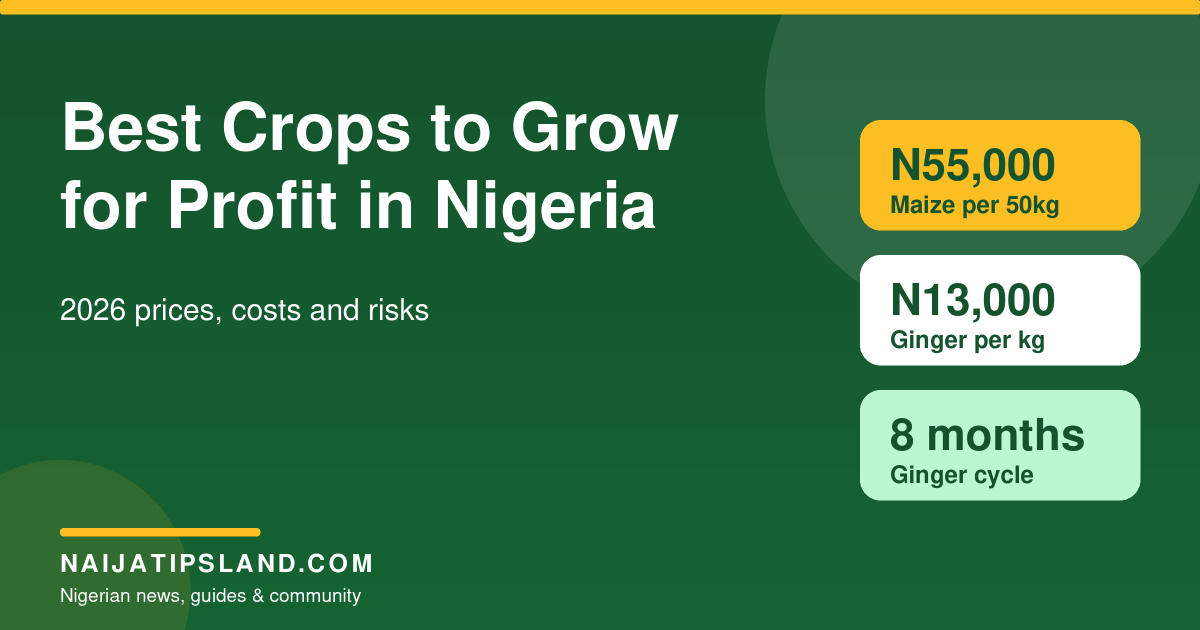
Ask ten Nigerians which crop pays best and you will get ten answers: ginger, cassava, sesame, maize, rice, cocoa. The honest answer is that it depends on your land, your money, your location and, above all, whether you have a buyer waiting at harvest. Prices have also moved sharply this year, so advice that was right in 2024 can lose you money in 2026. This guide compares the main cash crops using the latest price reports I could find (to early November 2026), then shows you how to choose one without gambling your savings.
How to read the figures: prices below come from named market reports and are snapshots, not promises. Costs and profits quoted per hectare come from older published estimates and are shown only to compare crops against each other. Your own numbers will differ by state, soil, season and input prices. Nothing here is financial advice.
The reality check: prices swing, so plan for the bad month
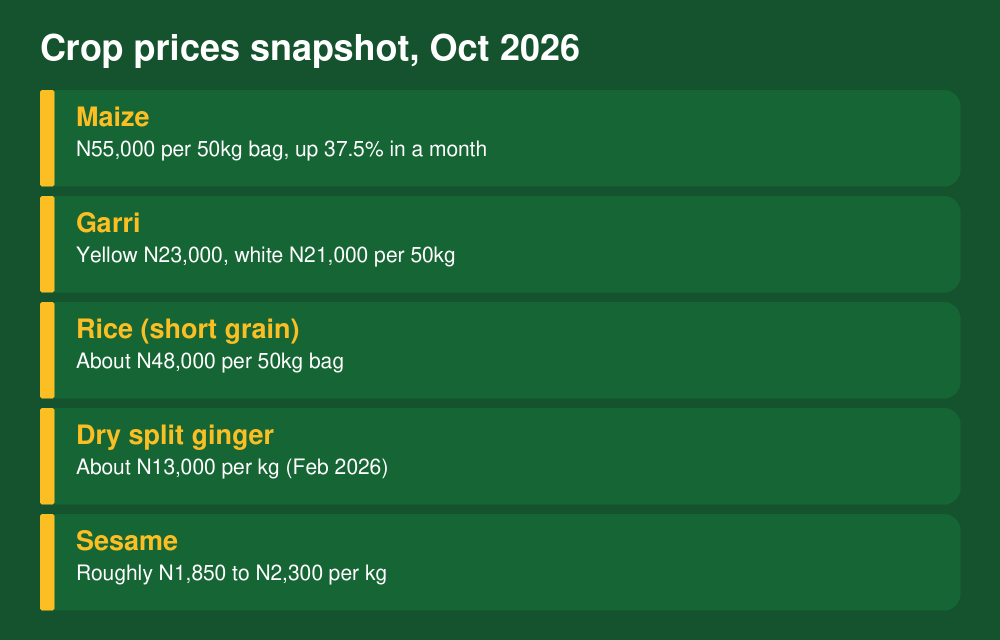
Lagos market data from the Nairametrics Food Price Watch (a monthly survey of four Lagos markets) shows how fast things move. Between September and October 2026 a 50kg bag of maize rose from N40,000 to N55,000 (up 37.5 percent), and a 50kg bag of yellow garri rose from N18,000 to N23,000. At the same time, a big basket of round tomatoes fell from N45,000 to N35,000. Farmers who sold in the wrong week made far less than those who stored or contracted a buyer. You can read the survey on Nairametrics.
1. Ginger: the strongest price story of 2026, but a long wait
Dry split ginger has been the standout. BusinessDay reported in February 2026 that the price rose from about N1,000 per kg in 2022 to about N13,000 per kg, with export-grade dry split ginger quoted at N13 million to N17 million per tonne. Fresh ginger sold for N280,000 to N400,000 per 50kg bag, and roughly three 50kg bags of fresh ginger make one 40kg bag of dry split ginger. The rally followed a 2023 blight that destroyed seed stock, plus a seedbank programme that asks farmers to replant most of their harvest.
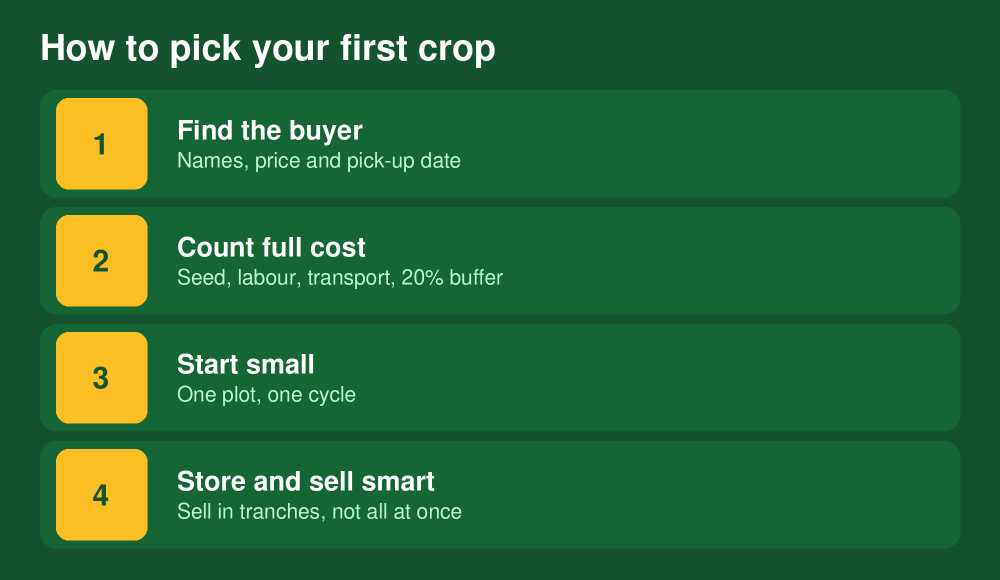
The catch: ginger takes about eight months, seed (rhizomes) is scarce and costly, and prices this high usually attract more planters. If many farmers plant at once, prices can fall by the time your crop is ready. Land, funding and quality seed were named as the main barriers. Best for: patient farmers with capital, access to good seed and a processing or buyer plan.
2. Sesame: steady export demand, but quality decides your price
Sesame is a dry-season-friendly crop grown across Nasarawa, Benue, Jigawa and other northern states. One tracker (Mansa Markets, via Finelib) put spot prices at around N2.3 million per tonne in October 2026, with a typical range of N1.85 million to N2.3 million per tonne, which is roughly N1,850 to N2,300 per kg. That source rates its own confidence as low, so confirm with local aggregators before planning around it. Nairametrics reported in February 2026 that international rejection rates for Nigerian sesame were above 30 percent, often because of contamination. Clean, well-dried, sorted seed fetches a premium; dirty seed gets discounted or rejected. Best for: farmers near aggregators who will follow good post-harvest handling.
3. Maize: easy to grow, hard to price
Maize matures in about 90 to 120 days and has a ready market with feed millers, breweries and households. That is why it is the classic starter crop. The risk is price: farm-gate prices often crash right after harvest when everyone sells together, then recover months later. With a 50kg bag at N55,000 in Lagos markets in October 2026, farmers who stored grain did well; those who sold in September at N40,000 did not. If you grow maize, plan dry storage and sell in tranches. A 2025 BusinessDay estimate put startup at N100,000 to N200,000 per hectare with profit of N200,000 to N400,000, but input prices have risen since, so treat that as a rough ratio only.
4. Cassava: cheap to start and flexible to sell
Cassava needs little money and little attention, and you can sell it fresh, as garri, fufu or starch. Yellow garri averaged N23,000 per 50kg in Lagos in October 2026 and white garri N21,000, but both had been lower a month earlier, and garri prices fell sharply at other points in 2026. The same BusinessDay list estimated startup of N50,000 to N100,000 per hectare, with profit of up to N500,000, which is why cassava is so popular with beginners. The money is in processing: selling garri instead of raw roots gives you more margin, but you will need a grater, press and frying space. Best for: low-capital beginners willing to process.
5. Rice: high demand, higher capital
Nigeria eats more rice than it grows, so demand is not the problem. A 50kg bag of local short-grain rice averaged about N48,000 in Lagos in October 2026, slightly down from September. Rice is more capital-intensive than maize or cassava: the BusinessDay estimate was N500,000 to N1 million to start per hectare, with N800,000 to N1.5 million profit. Irrigated rice does best; rain-fed rice is riskier. You also need a nearby mill or a buyer who will collect.
6. Tomatoes and pepper: quick money, quick losses
Tomatoes pay well in the dry season but spoil within days, and Nigeria loses a large share of its harvest to poor storage and transport. A big basket of round tomatoes fell from N45,000 to N35,000 in a month, and oval tomatoes fell from N80,000 to N70,000. If you farm tomatoes, secure transport and a market in advance, or consider drying and processing. Best for: farmers close to a big market with irrigation.
7. Cocoa: a warning, not a get-rich-quick plan
Cocoa was the dream crop in 2024 and early 2025. Then prices collapsed. Nairametrics reported in March 2026 that farmers in Ondo, Osun and Ekiti were seeing prices of N2,000 to N2,500 per kg, compared with N14,500 per kg in January 2025, and many were in debt. Global prices fell sharply as Côte d’Ivoire and other producers recovered and chocolate demand softened. Cocoa takes years to mature, so planting now is a bet on a price recovery. Cocoa can still make sense for existing farms and long-term investors, but it is not a beginner’s quick win.
Other crops people ask about
Plantain, pineapple, watermelon, soybeans and oil palm all appear on popular lists. The same BusinessDay list put plantain and pineapple startup at N200,000 to N600,000 per hectare, soybeans at N200,000 to N400,000 and oil palm at N1 million to N3 million, with oil palm and cocoa taking years before they pay. Watermelon matures in roughly 80 to 90 days and suits short-season cash flow, but prices drop when supply floods the market. Use these as a rough comparison only; those estimates date from January 2025 and Nigerian input prices have risen since.
Which crop should you choose?
Rank crops by speed of cash, capital needed, buyer certainty and risk of spoilage. Maize and vegetables give quick returns but small margins. Cassava is cheap and flexible. Rice and ginger need more capital but have strong demand. Sesame suits those who can control quality. Cocoa and oil palm suit patient, long-horizon investors.
Whatever you pick, learn the main risks before you plant:
Practical steps before you plant
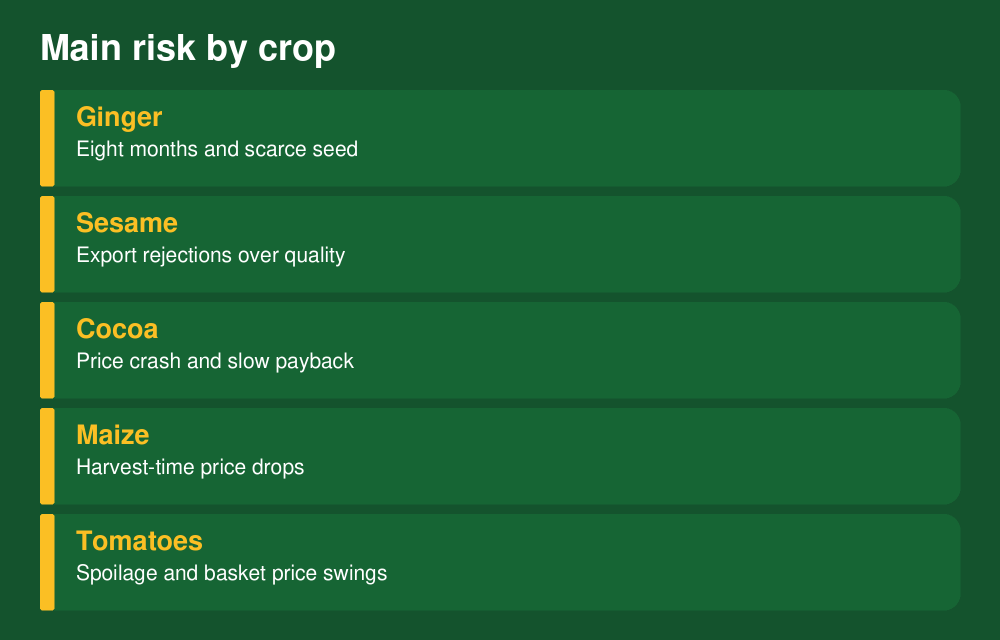
First, write down your first three buyers and the price each will pay. If you cannot, keep researching. Second, get written quotes for seed, fertiliser, labour and transport and add 20 percent for price shocks. Third, start with a small plot for one cycle so mistakes are cheap. Fourth, plan storage: grain, garri and dried ginger keep; tomatoes do not. Fifth, record every expense so you know your real profit. If you want to spread risk, consider pairing a quick crop (vegetables or maize) with a slower one (ginger or oil palm).
If you are weighing farming against other agribusiness options, see our guide to profitable agricultural businesses for beginners, the costs in starting fish farming with low capital and the numbers in poultry farming in Nigeria. For wider planning, our start a business in Nigeria hub covers registration and tax.
Frequently asked questions
What is the most profitable crop to grow in Nigeria in 2026?
By price movement, ginger has led in 2026, with dry split ginger reported at about N13,000 per kg in February. But it takes about eight months and needs scarce seed, and prices may fall as supply recovers. For most beginners, cassava, maize or vegetables are safer starting points.
Which crop gives the fastest return?
Leafy vegetables are ready in weeks, maize in about 90 to 120 days and watermelon in about 80 to 90 days. Faster crops usually mean thinner margins and more price risk at harvest.
Is cocoa still worth planting in 2026?
Farm-gate prices fell by well over 70 percent from their peak by March 2026, and cocoa takes years to bear. It is a long-term bet, not a quick profit. Existing farmers may hold on; new planters should be cautious.
How much money do I need to start crop farming?
Published estimates range from about N50,000 per hectare for cassava to N1 million or more for rice and oil palm, but 2025 estimates are already out of date. Get fresh written quotes locally and keep a reserve.
Do I need to own land?
No. Many farmers lease land per season. Get the lease in writing, confirm the owner’s right to lease and avoid paying everything upfront without documents.
How do I find buyers?
Speak to aggregators, millers, feed companies, processors and market traders before planting, and ask for written or recorded commitments on price and pick-up. Join a farmers’ cooperative if possible.
Sources and notes: Nairametrics Food Price Watch (1 November 2026) for maize, garri, rice and tomato prices; BusinessDay (26 February 2026) for ginger; Nairametrics (22 March 2026) for cocoa; Finelib/Mansa Markets (October 2026) for sesame; BusinessDay (3 January 2025) for per-hectare cost and profit ranges. Figures are indicative and not financial advice.
Join the discussion
Have you tried this, or do you have a question we did not answer? 3 readers have already shared their views. Naijatipsland members help each other with real, first-hand experience.








Ade here. Before you plant anything, write down your first three buyers and the price each will pay. Prices for maize, garri and tomatoes moved by double digits in a single month this year, so a buyer and a storage plan matter as much as the seed. Which crop are you thinking of starting, and in which state? Tell us below and other readers may share local prices. General information, not financial advice. – Ade Adeniyi
Ade here. Before you plant anything, write down your first three buyers and the price each will pay. Prices for maize, garri and tomatoes moved by double digits in a single month this year, so a buyer and a storage plan matter as much as the seed. Which crop are you thinking of starting, and in which state? Tell us below and other readers may share local prices. General information, not financial advice. – Ade Adeniyi
Ade here. Before you plant anything, write down your first three buyers and the price each will pay. Prices for maize, garri and tomatoes moved by double digits in a single month this year, so a buyer and a storage plan matter as much as the seed. Which crop are you thinking of starting, and in which state? Tell us below and other readers may share local prices. General information, not financial advice. – Ade Adeniyi