Last updated: 7 November 2026 · By Naijatipsland Editorial Team · Editorial policy
Nigeria’s youth are facing a health picture their parents’ generation didn’t see at the same age. Conditions once associated with older adulthood — high blood pressure, metabolic disease — are now showing up in people in their 20s and 30s, while mental health strain among young Nigerians has become severe enough that the country now ranks among the worst in the world on key wellbeing measures. Add a large population of young people struggling with substance use, and the picture is clear: the health risks facing young Nigerians today are different from a generation ago, and in some ways more urgent. This article lays out what the data actually shows, and what can realistically be done about it — personally, within families, and at a community level.
Hypertension is rising fast, and it’s hitting younger people
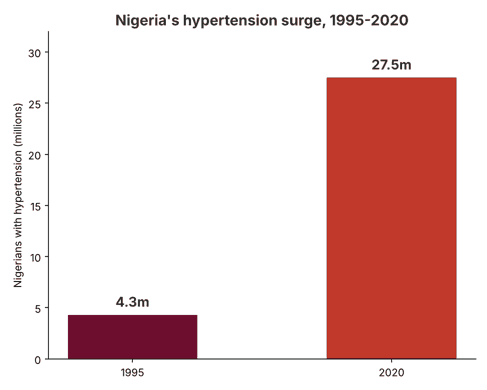
Hypertension (high blood pressure) used to be thought of as an “older person’s” condition in Nigeria. That has changed dramatically. National prevalence has climbed from around 4.3% in the mid-1990s to roughly 27.5% today — more than a six-fold increase in about three decades.
What makes this especially concerning is how much of that growth is now happening in adults under 40, not just the elderly population the condition was traditionally associated with. Several factors are driving it: diets increasingly built around processed, salty, and fried foods; rising urban stress; more sedentary lifestyles tied to desk jobs and long commutes; and — critically — very low rates of screening. Many young Nigerians with hypertension don’t know they have it, because blood pressure checks simply aren’t part of their routine the way they would be in a country with stronger primary care screening habits. Left undetected, hypertension quietly raises the risk of stroke, kidney disease, and heart disease years before any obvious symptoms appear.
What helps
- Get checked, even without symptoms. Free or low-cost blood pressure checks are often available at pharmacies and community health posts — use them at least once or twice a year starting in your 20s.
- Cut back on bouillon cubes, table salt, and processed snacks. These are major, often invisible sources of sodium in the Nigerian diet.
- Build movement into your day even if you can’t afford a gym — walking, taking stairs, and short home workouts all measurably lower blood pressure over time.
A mental health crisis among Nigeria’s young adults
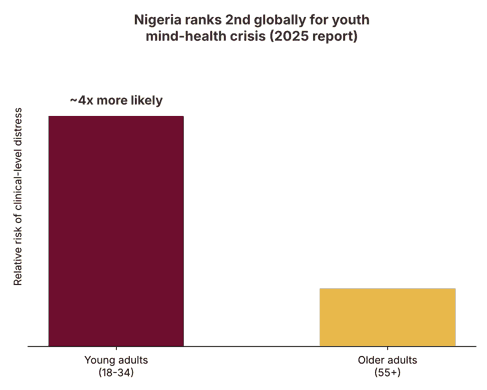
The scale of mental health strain among young Nigerians is stark. Recent wellbeing research found that around 41% of Nigerians aged 18-34 report being in what’s described as a “mind health crisis” — a level of distress significantly higher than that reported by older adults (55+), and high enough to place Nigeria second globally on this measure.
This isn’t just a statistic — it reflects real, compounding pressure: tough economic conditions, high youth unemployment and underemployment, pressure to support extended family, relationship and marriage pressure, and, for many, the stress of trying to build a life in a system that often feels stacked against them. Add to that the ongoing stigma around discussing mental health openly in many Nigerian communities, and a lot of young people are carrying this alone rather than getting support.
What helps
- Normalize talking about stress and burnout with friends and family, even in small ways — silence is part of what makes this worse.
- Use free or low-cost support options where available, including community helplines and campus or workplace counseling services, rather than assuming therapy is out of reach entirely.
- Protect basic routines — sleep, meals, and some social connection — since these are often the first things that slip during periods of high stress, and their absence makes everything else harder.
Diabetes, obesity, and substance use: the other side of the picture
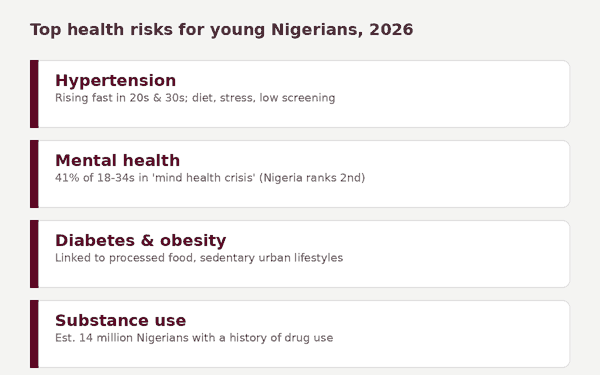
Hypertension and mental health strain aren’t the only risks rising among Nigeria’s youth. Diabetes and obesity are increasingly linked to the same drivers — processed food consumption and sedentary, urban lifestyles — and are showing up at younger ages than before. At the same time, substance use has grown into a significant public health concern: Nigeria is estimated to have around 14 million people with a history of drug use, a figure that includes a large share of young adults, with real consequences for mental health, family stability, and productivity.
These risks tend to overlap and reinforce each other. Chronic stress raises the risk of substance use as a coping mechanism; poor diet and inactivity feed both hypertension and metabolic disease; and the exhaustion of dealing with any one of these makes it harder to address the others. That’s why prevention works best when it’s approached as a whole-lifestyle issue rather than one health problem at a time.
Five practical steps young Nigerians can take now
- Get a baseline health check. Blood pressure, blood sugar, and weight — know your numbers before a problem develops, not after.
- Treat sleep as non-negotiable. Chronic sleep deprivation worsens blood pressure, mood, and decision-making, and is often the easiest lever to pull first.
- Build a support circle you can actually talk to about stress, money pressure, or low mood — even one or two trusted people make a measurable difference.
- Reduce processed food and added salt where you can, without aiming for perfection — small, consistent changes beat short-lived strict diets.
- Move your body most days, even briefly — a 20-30 minute walk has a real, documented effect on both blood pressure and mood.
The bottom line
Young Nigerians are facing a health landscape that looks different from their parents’ — rising hypertension, a severe mental health burden, and growing metabolic and substance-use risks, often hitting people in their 20s and 30s rather than waiting for middle age. None of this is inevitable. Regular screening, open conversations about stress and mental health, and small, sustainable lifestyle changes can meaningfully reduce these risks — but they have to start now, not after symptoms appear.
Related guide (updated 7 November 2026)
Natural ways to improve sleep and reduce stress (evidence-based habits)
Join the discussion
Have you tried this, or do you have a question we did not answer? Be the first to share your experience. Naijatipsland members help each other with real, first-hand experience.