
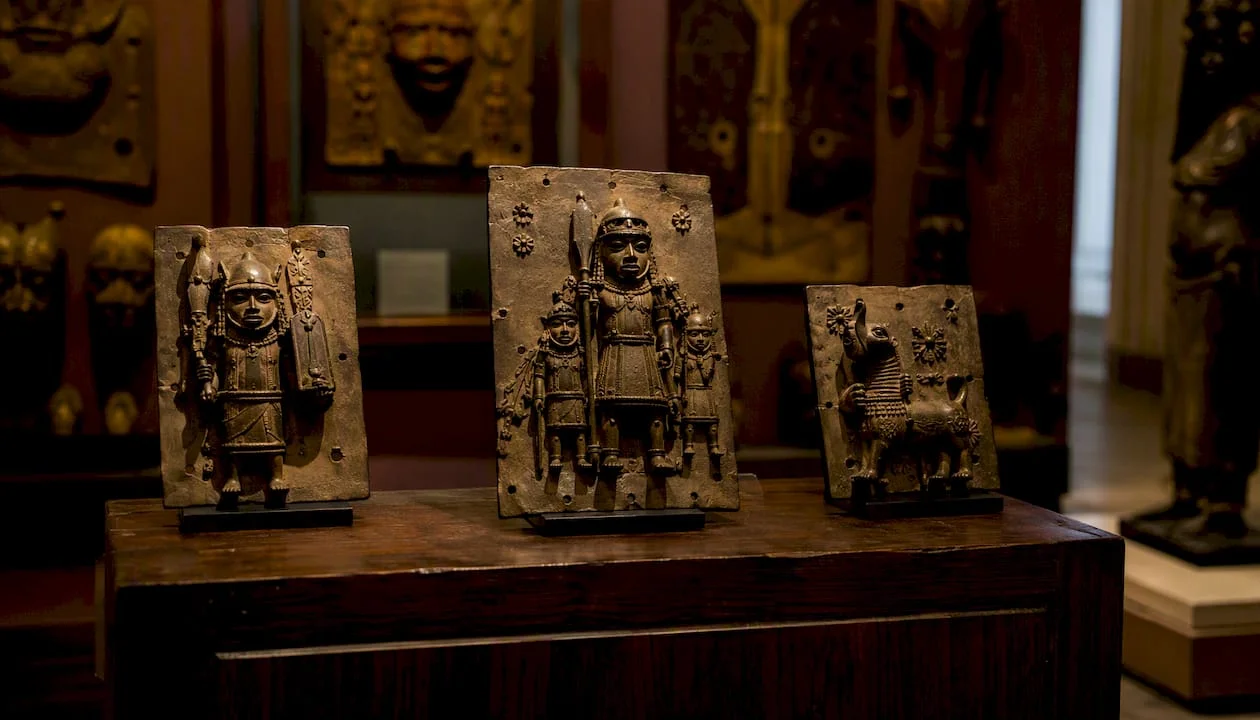
The Benin Bronzes are metal plaques, sculpted heads, ivory carvings, and royal regalia produced from at least the 14th century by the Guild of Benin Bronze Casters on Igun Street in Benin City, the capital of the Kingdom of Benin in what is now Edo State, Nigeria. In February 1897, a British military force sacked Benin City, destroyed the royal palace, exiled Oba Ovonramwen, and seized thousands of these objects. The Digital Benin database has catalogued over 5,000 of them, now scattered across institutions in Europe, North America, and beyond. Their artistic mastery, documentary value, and the circumstances of their removal have made the Benin bronzes history one of the most consequential debates in global museum practice today.
Why they matter right now:
- Artistic significance: The bronzes represent one of the most technically sophisticated metalworking traditions in world history, produced centuries before European contact.
- Historical record: The plaques and commemorative heads document Benin’s royal lineage, diplomatic relationships, and court life with extraordinary precision.
- Repatriation momentum: Major institutions including the University of Cambridge, the Horniman Museum, the Smithsonian, and several German and Swiss museums have transferred or are transferring objects back to Nigeria.
- Custodianship debate: A 2023 presidential declaration recognized Oba Ewuare II as owner and custodian of returned bronzes, creating tension with Nigeria’s National Commission for Museums and Monuments (NCMM).
Key Takeaways
The Benin bronzes history is a story of extraordinary artistic achievement, colonial seizure in 1897, and an accelerating but contested process of return, reshaping global museum practice.
| Point | Details |
|---|---|
| Origin and makers | Produced from at least the 14th century by the Guild of Benin Bronze Casters on Igun Street, Benin City, for the royal court of the Kingdom of Benin. |
| Scale of dispersal | The Digital Benin database has catalogued over 5,000 objects now held across institutions worldwide, taken after the 1897 British punitive expedition. |
| Recent returns | Cambridge transferred 116 bronzes in 2026; Switzerland returned 18 in June 2026; Germany, the Horniman, Smithsonian, and MFA Boston have all completed transfers. |
| Custodianship tension | A 2023 presidential declaration recognized Oba Ewuare II as custodian of returned bronzes, creating friction with the NCMM’s statutory role as federal receiver. |
| Where to follow the story | The Digital Benin database and EMOWAA project are key public resources for tracking provenance research and museum development in Benin City. |
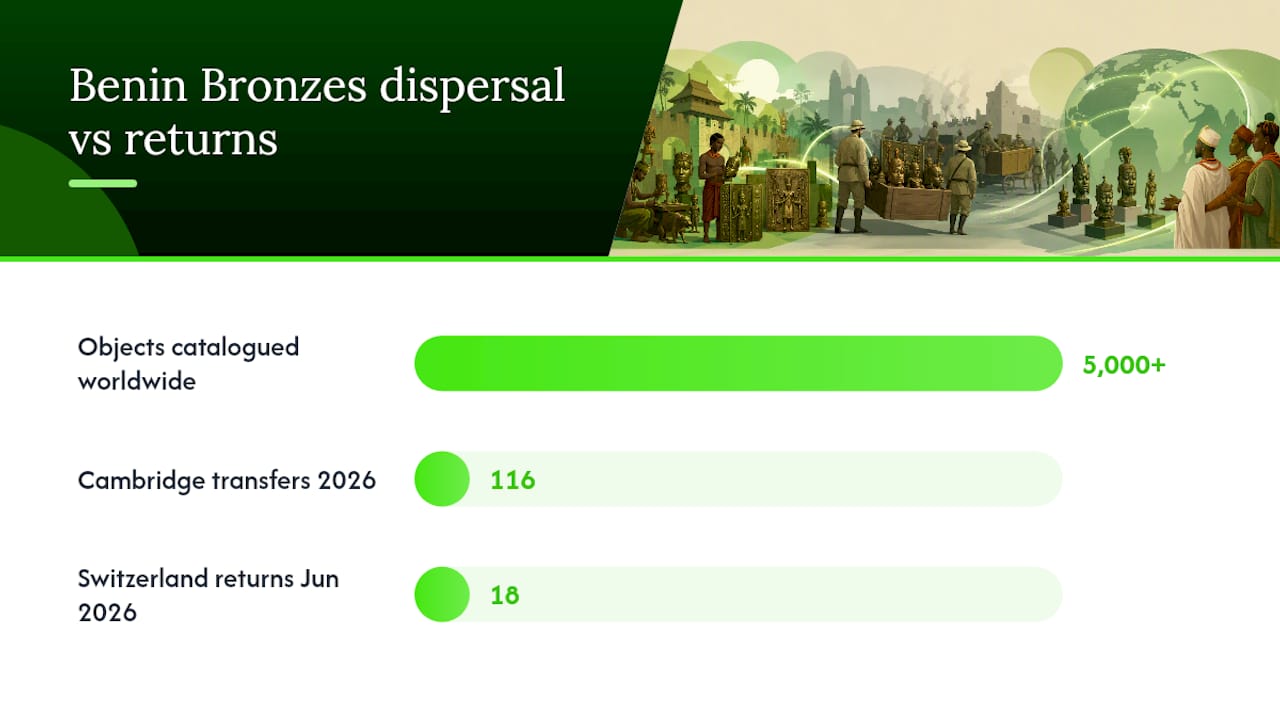
Table of Contents
- The history of the Benin Bronzes begins in the Kingdom of Benin
- How the bronzes functioned inside the palace and royal rituals
- What the 1897 British punitive expedition actually did to Benin City
- Where the bronzes went after 1897 and which institutions hold them today
- Why the Benin Bronzes matter beyond their beauty
- The history of repatriation efforts and key case studies
- How repatriation actually works in practice
- The debates that make repatriation more complicated than it looks
- Where returned bronzes are now in Nigeria and what comes next
- What Nigerian stakeholders and international scholars say about restitution
- Why cultural restitution matters beyond the objects themselves
- Sources
The history of the Benin Bronzes begins in the Kingdom of Benin
The Kingdom of Benin was a centralized, sophisticated state with its capital at Benin City, in present-day Edo State. Its royal court began commissioning cast metal objects as early as the 13th or 14th century, and production intensified significantly from the 15th century onward. Britannica records that pieces were produced from the 15th through the 19th century in materials including brass, wood, ivory, leather, and bone.
The craftsmen responsible were members of a hereditary guild, the Guild of Benin Bronze Casters, based on Igun Street in Benin City. Membership passed from father to son, and the guild worked exclusively for the Oba (king). No private individual could commission a cast metal object. That monopoly gave the court complete control over how Benin’s history and power were represented in material form.
A note on the name: “Benin Bronzes” is a misnomer on two counts. Most pieces are brass rather than true bronze, and the broader collection includes ivory, wood, and textiles produced by different palace guilds. The British Museum acknowledges that the objects include brass and bronze relief plaques, commemorative heads, and regalia. The name has stuck for historical and popular reasons, but accurate technical description matters when you are reading provenance records or museum catalogs.
The primary casting method was lost-wax casting (known in French as cire perdue). An artist modeled the object in wax, encased it in clay, melted the wax out, and poured molten metal into the resulting mold. The technique allowed extraordinary surface detail, including fine portrait features, textured costumes, and intricate decorative patterns. Raw material came partly from European manillas, brass bracelets traded along the West African coast, which the Benin court melted down and recast.
Pro Tip: If you want to understand the technical sophistication of lost-wax casting, the Pitt Rivers Museum’s Kingdom of Benin collection holds archival photographs and documentation that show the process and the objects side by side.
Production peaked in two broad periods: an early phase from roughly the 14th to 16th centuries, and a later “golden age” in the 17th and 18th centuries when the palace expanded its use of commemorative plaques. By the 19th century, the court was still commissioning objects, though the political pressures of colonial encroachment were already reshaping Benin’s world.
How the bronzes functioned inside the palace and royal rituals
The objects were not decorative in any casual sense. Each category had a specific location and purpose within the palace complex, and their placement was governed by protocol.
- Commemorative heads were placed on ancestral altars dedicated to deceased Obas and Iyobas (queen mothers). Rituals performed at these altars maintained the spiritual connection between the living court and its royal ancestors.
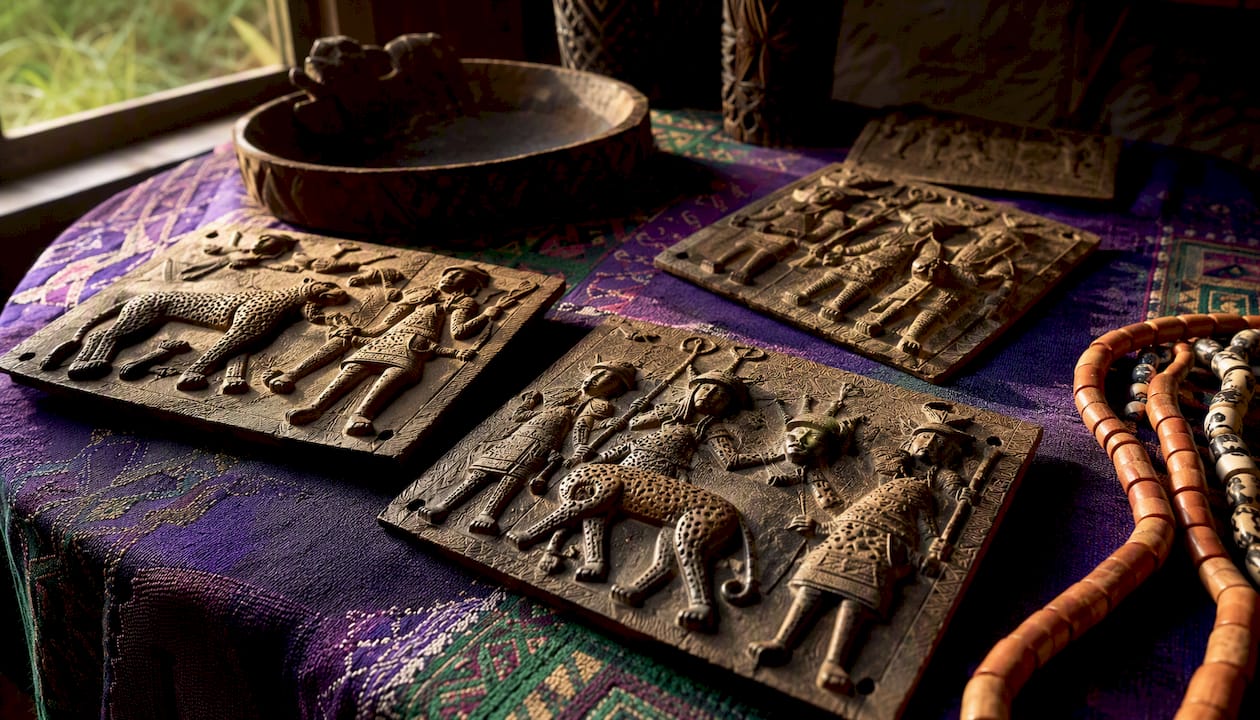
- Brass plaques lined the wooden pillars of the palace’s reception halls. Hundreds of them recorded court ceremonies, military victories, diplomatic encounters with Portuguese traders, and the hierarchy of palace officials.
- Regalia and ritual objects including staffs, bells, and ceremonial swords were used in festivals and investiture ceremonies that publicly confirmed the Oba’s authority.
- Ivory tusks were mounted upright in the commemorative heads on altars, their carved surfaces narrating royal histories in a continuous visual text.
The Oba’s authority in Benin was both political and spiritual. He was the intermediary between the living and the ancestors, and the bronzes were the material proof of that continuity. An altar head was not simply a portrait; it was a functional object through which the current Oba communicated with his predecessors. Removing these objects from Benin City did not just strip the palace of decoration. It severed a living ritual system.
The iconography on the plaques is also a historical archive. Recurring motifs include Portuguese soldiers and traders (evidence of Benin’s 15th-century diplomatic and commercial relationships with Europe), warriors in full regalia, court officials ranked by their costume, and animals with symbolic meanings such as the leopard (royal power) and the mudfish (the Oba’s connection to Olokun, god of the sea). Scholars have used these images to reconstruct aspects of Benin’s political and social history that written records do not capture.
What the 1897 British punitive expedition actually did to Benin City
In January 1897, a British delegation led by Acting Consul-General James Phillips set out for Benin City without the Oba’s permission, during a period of restricted access related to a royal ceremony. Benin forces ambushed the party, killing Phillips and most of his escort. The British government used the ambush as justification for a military response.
A British force under Admiral Harry Rawson reached Benin City in February 1897. They met resistance but took the city within days. The royal palace was looted and then burned. Oba Ovonramwen was captured, tried, and exiled to Calabar, where he died in 1914. The Kingdom of Benin was absorbed into the British Protectorate of Southern Nigeria.
The 1897 punitive expedition was framed by British actors as retaliation for an ambush, but many historians argue the invasion was also shaped by economic motives and pretexts that enabled colonial consolidation.
The V&A’s commentary by Tony Phillips frames the removal of the bronzes explicitly as an act of colonial appropriation, not simply a consequence of military action. The trade and political control that Britain sought over the Niger Delta region gave the expedition a strategic logic that went well beyond punishing an ambush.
The immediate aftermath was systematic. British officers and soldiers took objects from the palace and surrounding compounds. Some were kept as personal trophies. Others were handed to the Admiralty and the Foreign Office, which sold many of them to recover expedition costs. Dealers and auction houses moved objects into private collections and museum acquisitions across Europe within months of the expedition.
Where the bronzes went after 1897 and which institutions hold them today
The dispersal happened through several channels simultaneously. The Admiralty and Foreign Office sold objects directly. Individual officers kept pieces or donated them to institutions. Dealers including William Downing Webster supplied objects to museums across Britain, Germany, Austria, and the United States within a few years of 1897.
The Digital Benin database has catalogued over 5,000 objects from the Kingdom of Benin now held in collections worldwide. That figure covers objects in public institutions; the number in private hands is not fully known.
Major institutional holders include:
- British Museum (London): Holds one of the largest single collections, including hundreds of plaques and commemorative heads.
- Ethnologisches Museum (Berlin): Germany’s largest holding, with over 500 objects; Germany has been among the most active countries in organizing returns.
- Weltmuseum Wien (Vienna): Significant Austrian collection.
- Horniman Museum (London): Has participated in transfers and restitution dialogues.
- Smithsonian Institution (Washington, D.C.): Transferred objects to Nigeria following restitution negotiations.
- Museum of Fine Arts, Boston (MFA Boston): Completed a transfer of bronzes to Nigeria.
- University of Cambridge collections: Transferred legal title of 116 objects to Nigeria in 2026.
- Various Swiss institutions: Returned 18 objects in June 2026 through the Benin Initiative Switzerland.
The pattern of holdings reflects the 1897 dispersal routes. British institutions received the largest early influx. German museums acquired heavily through dealers in the years immediately after 1897. American institutions acquired objects later, primarily through the 20th-century art market. This geography shapes the restitution landscape: different countries operate under different legal frameworks, and each institution has its own governance rules about deaccessioning.
Why the Benin Bronzes matter beyond their beauty
When the bronzes arrived in Europe in 1897, the dominant European view held that sub-Saharan Africa had no tradition of fine art or sophisticated material culture. The objects immediately contradicted that view. European scholars, curators, and artists who encountered them were forced to acknowledge a level of technical mastery and artistic complexity that their assumptions had not allowed for.
Tony Phillips, writing for the V&A, argues that the bronzes exposed European audiences to African technical sophistication and critiqued the colonial appropriation that brought them there. The objects did not just enter museum collections; they destabilized the intellectual framework that justified colonialism in part by denying African civilizations their achievements.
That art-historical impact has a direct line to contemporary restitution arguments. If the bronzes are acknowledged as masterworks of world art, produced by a sophisticated civilization with its own historical record, then their removal in 1897 looks less like the collection of curiosities and more like the theft of a civilization’s archive.
For Nigeria and for Edo State specifically, the bronzes carry a weight that goes beyond museum policy. They are the material record of a royal lineage that still exists. Oba Ewuare II is the current Oba of Benin, a direct descendant of Ovonramwen. The objects on display in London or Berlin are, from the Benin court’s perspective, ancestral property removed by force. Their return is not an abstract gesture of goodwill; it is the restoration of objects to the ritual and historical system they were made for.
The history of repatriation efforts and key case studies
Calls for the return of the bronzes are not new, but the pace of actual transfers accelerated sharply in the 2020s. Early returns were isolated: a single piece here, a token gesture there. The shift to systematic institutional transfers began around 2021 and has continued through 2026.
Key case studies:
- Jesus College, Cambridge (2021): One of the earliest UK university returns, transferring a single Benin bronze cockerel that had been used as a dining hall centerpiece. The transfer attracted significant attention and helped normalize the conversation in British universities.
- Germany (2022 onward): The German government and its state museums committed to returning the majority of their holdings. The Ethnologisches Museum in Berlin led the process, with formal handovers beginning in 2022.
- Horniman Museum (2022): The Horniman Museum became the first UK national museum to agree to return its entire Benin collection, transferring 72 objects.
- Smithsonian Institution: Transferred its Benin bronzes to Nigeria, with the objects formally received by Nigerian authorities.
- MFA Boston: Completed a transfer of bronzes to Nigeria following negotiations with Nigerian stakeholders.
- University of Cambridge (2026): Transferred legal title of 116 Benin bronzes to Nigeria following a formal NCMM request, in one of the largest single UK university transfers on record.
- Benin Initiative Switzerland (2026): Switzerland returned 18 looted Benin bronzes to Nigeria in June 2026 through a research-led process that emphasized collaborative provenance documentation between Swiss institutions and Nigerian partners.
The Swiss return in June 2026 was explicitly framed as a research partnership, not a unilateral gift. Swiss institutions and Nigerian counterparts conducted joint provenance work before the handover, establishing a model that other countries are watching closely.
The Benin Dialogue Group, a forum that has included the British Museum, European museums, and Nigerian representatives, has provided a structured space for these negotiations, though its outcomes have been uneven. The group’s work on provenance research and cataloguing has been more consistent than its progress on actual returns.
How repatriation actually works in practice
A return does not happen because a museum decides to be generous. It follows a process that involves archival research, legal review, diplomatic negotiation, and formal agreement between multiple institutions and governments.
Provenance research is the starting point. Institutions use archival records, expedition logs, dealer correspondence, and early museum acquisition records to establish that an object came from Benin City in or after 1897. The Digital Benin database has been central to this work, creating a shared catalog that allows institutions to cross-reference their holdings against a common record. The Pitt Rivers Museum’s archival holdings on colonial-era collecting practices are one example of the documentary resources that support this research.
Return mechanisms vary by institution and jurisdiction:
- Title transfer: The institution formally transfers legal ownership to Nigeria, usually to the NCMM. The University of Cambridge’s 2026 transfer used this model.
- Long-term loan: The institution retains legal title but loans objects to Nigeria indefinitely. Some European museums have used this model where national law prevents deaccessioning.
- Donation agreement: A formal gift, sometimes conditional on display or care standards.
- Conditional access arrangements: Objects are returned with agreed terms about public access, conservation, and future loans back to the original holding institution.
Stakeholders in a typical negotiation include the NCMM as Nigeria’s federal cultural authority, the Benin Royal Palace (represented by Oba Ewuare II and his advisors), the donor institution’s board and legal counsel, the relevant foreign government’s cultural ministry, and in some cases international facilitators like the Benin Initiative Switzerland.
Pro Tip: If you are researching a specific object’s provenance, the Digital Benin database is the most comprehensive starting point. It aggregates catalog records, photographs, and provenance notes from institutions worldwide, and it is publicly accessible.
The NCMM, established under Nigerian federal law, is the body with statutory authority over national cultural properties. Its role as the formal receiving institution for many returns has been complicated by the 2023 presidential declaration, which we cover in the next section.
The debates that make repatriation more complicated than it looks
The ethical case for returning the bronzes is widely accepted. The political and institutional mechanics are considerably messier.
The custodianship dispute within Nigeria is the most acute tension. In 2023, then-President Buhari issued a declaration recognizing Oba Ewuare II as the owner and custodian of returned Benin bronzes. The BBC reported that the declaration surprised NCMM officials and complicated prior arrangements with several foreign institutions that had negotiated returns with the NCMM as the receiving body. Some European institutions had already signed agreements with the NCMM; the presidential declaration created uncertainty about whether those agreements remained valid and who had authority to receive objects.
The core positions in the debate:
- Oba Ewuare II’s position: The bronzes are royal property, created for and by the Benin court, and their rightful custodian is the institution that commissioned them, the Benin Royal Palace.
- NCMM’s position: As the federal statutory body for cultural properties, the NCMM has legal authority over national heritage objects and is the appropriate receiving institution for international returns.
- Federal museum planners: The proposed Edo Museum of West African Art (EMOWAA) in Benin City was conceived as a purpose-built institution that could house returned objects and balance palace custodianship with public access, though its development timeline has faced delays.
Beyond Nigeria, the debates include:
- Whether long-term loans are an acceptable substitute for title transfers, or whether they simply preserve institutional control under a different name.
- How returned objects should be displayed: in a national museum in Abuja, in a Benin City institution, or in the palace itself.
- The role of public access: objects held in the palace may be less accessible to ordinary Nigerians and international visitors than objects in a public museum.
- Legal constraints in countries like the UK, where the British Museum Act currently prevents the museum from deaccessioning most of its collection, regardless of its stated willingness to engage.
Where returned bronzes are now in Nigeria and what comes next
Objects returned to Nigeria have primarily been received by the NCMM, which holds them in federal custody. The Benin City National Museum currently houses some of the most significant pieces accessible to the public in Edo State, and it serves as the primary public-facing institution for Benin Kingdom art within Nigeria.
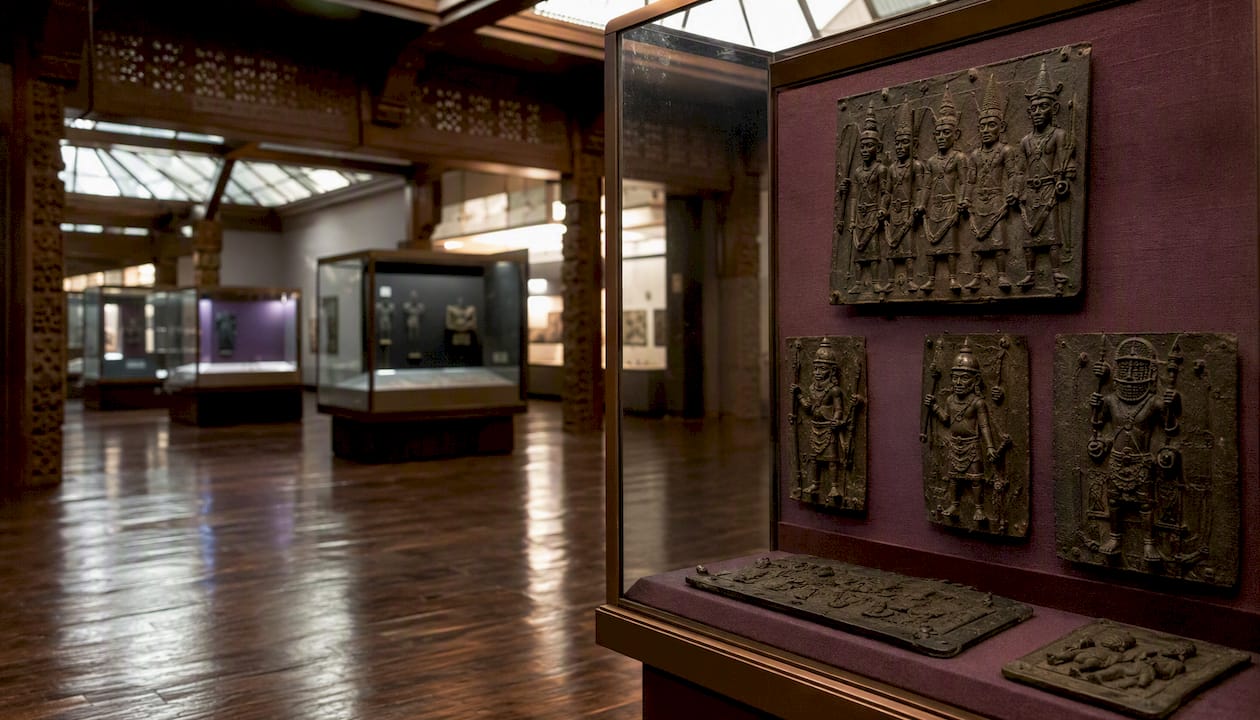
The Edo Museum of West African Art (EMOWAA) was conceived as the long-term home for returned bronzes in Benin City. Designed with input from international architects and cultural institutions, EMOWAA is intended to sit adjacent to the site of the original royal palace and to serve both as a public museum and as a space that respects the palace’s custodial relationship with the objects. Its development has attracted international attention and funding discussions, though the project’s completion timeline remains subject to funding and governance decisions.
For local communities in Edo State, the return of bronzes carries practical cultural significance. Festivals, ceremonies, and educational programs tied to Benin Kingdom history can be enriched by the presence of original objects rather than photographs or replicas. Cultural tourism to Benin City, already built around the city’s history as a royal capital, stands to grow as more objects return and as museum infrastructure develops.
Pro Tip: If you plan to visit Benin City, the Benin City National Museum on Ring Road is the most accessible public site for viewing Benin Kingdom art and historical objects. Contact the NCMM directly for current exhibition information before your visit.
The question of what “return” means in practice is still being worked out. A title transfer to the NCMM with objects remaining in a Lagos storage facility is legally a return but practically not one. The community impact depends on objects being visible, accessible, and integrated into living cultural practice, not just held in federal custody.
What Nigerian stakeholders and international scholars say about restitution
The restitution debate has produced a body of public statements, academic work, and institutional positions that reflect genuine complexity rather than a simple narrative of wronged party and guilty institution.
Oba Ewuare II has been consistent and public in his position. He has stated that the bronzes are the spiritual and historical property of the Benin people and that their return is a matter of justice, not diplomacy. His recognition by the federal government as custodian in 2023 gave that position legal weight, even as it created institutional friction with the NCMM.
The NCMM has emphasized its statutory role and its track record as the negotiating partner for most successful returns. The commission has pointed to its capacity to ensure conservation standards and public access in ways that a royal palace may not be able to guarantee.
International scholars have increasingly framed the bronzes within a broader argument about colonial collections. The work of scholars like Dan Hicks, whose research on the 1897 expedition has been widely cited in museum policy discussions, has shifted the terms of debate from “should museums return objects?” to “what obligations do institutions have for objects acquired through colonial violence?”
The bronzes are not simply art objects that happen to be in the wrong place. They are the material record of a civilization that was deliberately dismantled. Their return is part of the process of acknowledging what was done.
This framing, common in academic and curatorial circles, connects the bronzes to a wider reckoning with how European museums built their collections. The British Museum’s own documentation acknowledges the contested nature of the objects and the museum’s participation in the Benin Dialogue Group and the Digital Benin project.
Key points from the current scholarly and institutional consensus:
- Collaborative provenance research, not unilateral institutional decisions, produces the most durable and respected returns.
- The Benin Dialogue Group model, despite its limitations, has established a framework for ongoing communication between holding institutions and Nigerian stakeholders.
- Transparency about acquisition histories is now a baseline expectation for any museum holding objects from colonial contexts.
- The distinction between title transfer and long-term loan matters enormously to Nigerian stakeholders, even when the physical outcome looks similar.
Why cultural restitution matters beyond the objects themselves
At Naijatipsland, we cover Nigerian governance, culture, and civic life because those stories shape how Nigerians understand themselves and their place in the world. The Benin bronzes story is one of the most important of those stories, and not only because of the objects.
The bronzes’ return is a test of whether international institutions will follow their stated values with concrete action. It is also a test of whether Nigerian institutions, federal and traditional, can resolve their internal disagreements in ways that serve communities rather than bureaucratic interests. The NCMM and the Benin Royal Palace both have legitimate claims. The question is whether those claims can be reconciled in a governance structure that puts the objects in front of the people they belong to.
For young Nigerians, the bronzes represent something that no amount of diplomatic language can fully capture: proof that your ancestors built something extraordinary, and that the world has spent 130 years trying to decide whether to admit it. The answer, increasingly, is yes.
Local media, community organizations, and platforms like Naijatipsland have a role in keeping this story visible between the headline moments of individual returns. Following the Digital Benin database, tracking EMOWAA’s development, and reporting on what happens to objects after they arrive in Nigeria are all part of that work. The return of an object is not the end of the story. It is the beginning of a different one.
Stay informed on Nigerian cultural affairs and civic developments at Naijatipsland, where we cover the stories that shape Edo State, Nigeria, and the wider African world.

Sources
These primary institutional sources offer the most reliable information for deeper research on the Benin bronzes:
British Museum — Benin Bronzes: The museum’s own account of its holdings, the contested status of the objects, and its participation in the Benin Dialogue Group and Digital Benin project. Useful for understanding the largest single UK collection and the institution’s stated policy position.
Britannica — Benin Bronzes: A concise, well-sourced overview of production history, materials, the 1897 expedition, and dispersal. Good starting point for factual background.
V&A — Tony Phillips on the History of the Benin Bronzes: An artist’s extended commentary on the bronzes’ art-historical significance and the colonial context of their removal. Offers interpretive depth beyond catalog description.
Digital Benin: The most comprehensive public database of Benin Kingdom objects in institutional collections worldwide. Includes catalog records, photographs, and provenance notes. Essential for provenance research.
Museums Association — Cambridge transfer: Detailed reporting on the 2026 Cambridge title transfer, including the NCMM request process and campus reaction.
Euronews — Switzerland returns: Coverage of the June 2026 Swiss return, with detail on the collaborative provenance model used by the Benin Initiative Switzerland.
BBC — Buhari declaration: Reporting on the 2023 presidential recognition of Oba Ewuare II as custodian, including NCMM reactions and implications for ongoing negotiations.
NCMM: Nigeria’s National Commission for Museums and Monuments, the federal statutory body for cultural properties and the principal Nigerian negotiating partner for institutional returns.
Pitt Rivers Museum — Kingdom of Benin: Archival photographs and documentation of colonial-era collecting practices, useful for provenance research and understanding how objects entered British collections.
Recommended
- One Dead, Three Injured As Violence Erupts At Lagos Trade Fair Market / Naijatipsland
- Mapping Mali’s Gold And Natural Resource Wealth | Interactive News / Naijatipsland
- Police Retrieve Rifles, Ammunitions From Accident Victims In Niger / Naijatipsland
- LeBron James Breaks NBA Appearance Record In Lakers Win / Naijatipsland