Last updated: 13 October 2026. Turnout figures differ slightly between sources because of how they count votes, so the numbers below use INEC-based data from IFES and Dataphyte. For election dates and rules, check inecnigeria.org.
Voting in Nigeria at a glance
- 2023 turnout: 26.72% of registered voters, about 24.9 million of 93.47 million. It was the lowest since the return to democracy in 1999.
- The trend: presidential turnout fell from about 54% in 2011 to 43.65% in 2015, 34.75% in 2019 and 26.72% in 2023.
- Next elections: presidential and National Assembly on 16 January 2027, governorship and State Assembly on 6 February 2027 in the states on the national cycle.
- The register: INEC says it has reached about 103 million voters.
- You need: to be registered and to hold a valid Permanent Voter’s Card (PVC).
Nigerians often say “my vote does not count”, and the turnout numbers show many people act on that belief. This guide looks at what the data actually says, why so many registered voters stay home, why individual votes can matter more than people assume, and how to be ready for the 2027 elections. We have corrected an earlier version of this article that quoted a statistic about policy reforms and voter mandates that we could not verify. Everything below is tied to a source.
How Turnout Has Changed Since 2011
Voter turnout is the share of registered voters who actually vote. In Nigeria’s presidential elections it has fallen sharply:
| Election | Presidential turnout |
|---|---|
| 2011 | About 54% |
| 2015 | 43.65% |
| 2019 | 34.75% |
| 2023 | 26.72% |

The 2023 election was the lowest since 1999 and fell well short of the 50% target INEC had set. Only the North-West and North-Central regions reached about 30% turnout. No southern zone recorded 25%, and no state reached the 50% turnout that some states had recorded in 2015 and 2019.
The 2023 Election in Numbers

About 93.47 million Nigerians were registered, and roughly 24.9 million voted. In Lagos State, which has more registered voters than almost any other state, turnout in the presidential election was just 18.92%, and Lagos was among the states with the lowest turnout in the last two general elections.
Why Do So Many Registered Voters Stay Home?
No single cause explains it, and researchers and civil society groups point to several. Commonly cited reasons include:
- Distrust: doubts about whether results will reflect the vote.
- Insecurity: fear of violence on election day, especially in some regions.
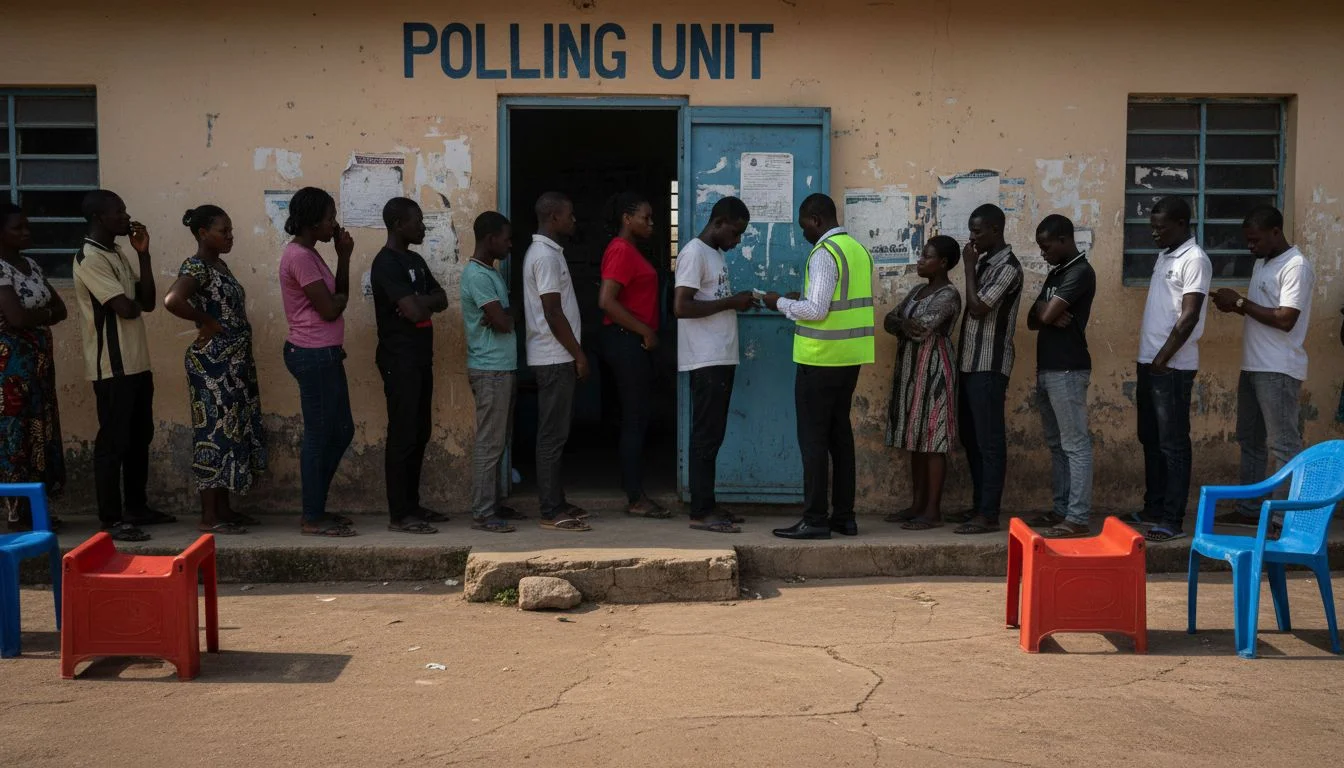
- Practical barriers: uncollected PVCs, travel to a polling unit, queues and technical problems.
- Disinformation: false claims that discourage people from voting or confuse them about the process.
- Apathy and the belief that one vote makes no difference.
It is worth separating these. Some are practical problems that can be fixed with preparation, such as collecting your PVC early. Others, such as trust, depend on how institutions behave.
Can One Vote Really Matter?
One person’s vote rarely decides a national election, but margins in some places are small. In Lagos State in 2023, the Labour Party’s Peter Obi won the presidential vote by nearly 10,000 votes, a margin of about 0.77%. Margins are often thinner still at local government, State Assembly and House of Representatives level, which are decided by far fewer voters. Turnout also shapes who politicians listen to, because candidates focus on groups that reliably vote. Finally, most of the elections in 2027 are local in effect: governorship and State Assembly seats affect your state’s budget, schools, roads and health services. As one fact-checking editor put it, elections are decided in communities, not online.
Common Myths About Voting
- “Nothing will change.” Governments and legislatures do change, and so do the people in them. You cannot influence who they are if you stay away.
- “The result is already decided.” Claims that an outcome is certain are often used to discourage turnout. Check claims against real results.
- “Voting takes too long.” Preparation shortens the process. Know your polling unit and arrive early.
- “I cannot find my details.” Use INEC’s channels to check your registration and PVC status well before election day.
How to Be Ready for the 2027 Elections

- Check the register. INEC displays the voter register before elections so people can confirm their details.
- Collect your PVC. You need a valid card to be accredited and vote.
- Know your polling unit. Find out where you vote and how to get there safely.
- Mark the dates. Currently 16 January 2027 for the presidential and National Assembly elections, and 6 February 2027 for governorship and State Assembly elections. Confirm any changes with INEC.
- Vote, then follow results. Polling unit results are uploaded to INEC’s result viewing portal, so you can compare what was announced with what was recorded.
Our 2027 Nigeria election hub has the full timetable and candidate lists, our voter registration guide explains how registration works, and our list of Nigerian governors shows who is on the ballot at state level.
Protecting Yourself From Election Misinformation
Fact-checkers have already reported AI-made fake newspaper covers and fabricated quotes aimed at 2027 candidates. Before you share anything political, check the source, look for coverage by credible outlets and search the Dubawa, Africa Check and FactCheckHub archives. Our guide on how to discuss politics online has a simple five-step check.
Who Is on the Ballot in 2027?
INEC’s final list for the presidential election has 18 candidates, with 4,408 candidates for National Assembly seats. For the governorship and State Assembly elections, INEC said 21 of the 22 registered parties nominated 936 governorship and deputy governorship candidates across the 28 states that vote on the national cycle, and the final lists were published on 10 October 2026. That is a large field, so take time to compare candidates and parties, read their manifestos and check claims made about them. Our election hub lists the presidential candidates and running mates.
Young Voters and the Register
Young Nigerians are a major part of the electorate. INEC’s register figures reported in October 2026 put voters aged 18 to 34 at about 29.78 million, or around 29% of the register, while those aged 35 to 49 were the largest group at about 43.27 million. Whichever age group you belong to, the point is the same: the register is large, and the share that actually votes decides who holds office.
What Happens on Election Day
- Arrive early at your polling unit with your PVC.
- Accreditation: an official checks you using INEC’s Bimodal Voter Accreditation System (BVAS). Under the Electoral Act 2026, using BVAS or an approved device for accreditation is mandatory.
- Voting: you receive your ballot paper and vote in secret.
- Counting: votes are counted at the polling unit in the open, and the result is recorded on the result sheet.
- Transmission: the Act requires results from the polling unit to be sent electronically to INEC’s result viewing portal, with the paper sheet as the fallback if a network failure prevents it.
If you see a problem at your polling unit, such as intimidation, vote buying or a faulty device, record what you can safely and report it to INEC or a credible election observer group. Do not put yourself in danger.
Why State and Local Races Matter
Presidential contests get the headlines, but the 6 February 2027 governorship and State Assembly elections shape services you use every day. Governors lead state budgets and oversee state-run education, health, roads and water, while State Houses of Assembly make state laws and scrutinise spending. If you care about your local school, clinic or road, those races deserve as much attention as the presidential one. Our list of Nigerian governors shows who currently governs each state and which governors are in their final term.
How to Encourage Friends and Family to Vote
- Offer help, not lectures. Many people stay away because of practical barriers. Help a friend check their registration or find their polling unit.
- Share official information. Point people to INEC’s own channels for dates, rules and PVC collection.
- Listen to doubts. If someone says votes do not count, ask what has made them feel that way before you respond.
- Plan together. Agree a time to go to the polling unit together, because company makes it easier to turn up.
- Respect their choice. Encourage turnout without telling people how to vote.
Your Election Day Checklist
- Your valid PVC, kept safe and easy to find.
- The name and location of your polling unit, and the time you plan to leave home.
- A charged phone, so you can check official information and contact family.
- Water, comfortable shoes and patience, because queues can be long.
- A plan for getting home safely, including a time to head back after you vote.
- Only official sources for updates, because rumours spread fast on election day.
Frequently Asked Questions
What was voter turnout in Nigeria’s 2023 election?
26.72%, with about 24.9 million of 93.47 million registered voters casting ballots. It was the lowest since 1999.
Why has turnout fallen over time?
Researchers cite distrust, insecurity, practical barriers such as PVC collection, disinformation and apathy. No single factor explains it.
When are the next Nigerian elections?
Presidential and National Assembly elections are scheduled for 16 January 2027, and governorship and State Assembly elections for 6 February 2027 in the states on the national cycle.
Do I need a PVC to vote?
Yes. A valid PVC is needed for accreditation at your polling unit.
Does my vote count if I live in a state my preferred party is unlikely to win?
Yes. Your vote still counts towards the margin and the totals, and it affects legislative and local races. Turnout also influences how seriously leaders take voters.
How can I check election results?
Compare announced results with polling unit results on INEC’s official result viewing portal, and rely on official sources rather than social media posts.
Related Guides
- 2027 Nigeria election hub
- Voter registration in Nigeria: step-by-step guide
- List of Nigerian governors 2026
- Nigeria political parties: the full official list
Sources
- Dataphyte: Nigeria records only 26.72% voter turnout in 2023 election
- IFES Election Guide: Nigeria
- Wikipedia: 2023 Nigerian presidential election
- Wikipedia: 2023 Nigerian presidential election in Lagos State
- Channels Television: 103 million voters, will Africa’s largest electorate show up in 2027?
- FactCheckHub: 2027 election, inside Nigeria’s fake promise machine
- Dubawa: 2027 election, how AI use is reshaping political disinformation