Last updated: 13 October 2026. This guide is about how to talk about politics online without spreading falsehoods or fuelling abuse. It is general information and does not endorse any party or candidate.
Respectful political talk at a glance
- The risk is real: fact-checkers say AI-made fake newspaper covers and invented quotes about 2027 candidates have been circulating since August 2026.
- Platforms matter: in 2023, 52 of 83 claims fact-checked from the presidential and National Assembly elections started on Twitter (now X).
- Your best defence: pause, check the source and look for credible coverage before you share.
- Your best habit: argue the idea, cite your source and know when to walk away.
Politics is one of the most talked-about topics in Nigerian online spaces, and the 2027 elections are making conversations louder, faster and angrier. Good discussion can inform voters and hold leaders to account. Bad discussion spreads rumours, deepens divisions and drives thoughtful people away. We have rewritten an earlier version of this guide that claimed a precise percentage improvement in respect that we could not source. The advice below rests on what fact-checkers and researchers have documented, plus practical habits that work.
Why Online Political Discussion Matters in Nigeria
For many Nigerians, social media is where they first hear about candidates, policies and events. Fact-checkers at Dubawa have noted that X has become a hub for political discussion and analysis, while Facebook and TikTok also carry large amounts of political content. That makes online conversations influential, and it makes the quality of those conversations important. A rumour that spreads online can reach voters in communities that never use the platform, because information moves by word of mouth too.
What the Fact-Checkers Have Found
The Nigeria Fact-Checkers’ Coalition, which includes Africa Check, FactCheckHub and Dubawa, fact-checked 127 claims during the 2023 elections. Of the 83 claims linked to the presidential and National Assembly elections, 52 started on Twitter, and videos played a major role in spreading false information. In 2026 the pattern has continued with new tools:
- AI-made front pages: from August 2026 social media users shared fabricated newspaper front pages, imitating outlets such as Punch, Nigeria Tribune and The Guardian, with invented quotes attributed to leaders including President Tinubu and Atiku Abubakar.
- Fake promises: FactCheckHub reported fabricated manifesto promises, from free housing to ₦5,000 petrol, being attributed to presidential candidates.
- Old or foreign videos: real footage from another time or country presented as new local events.

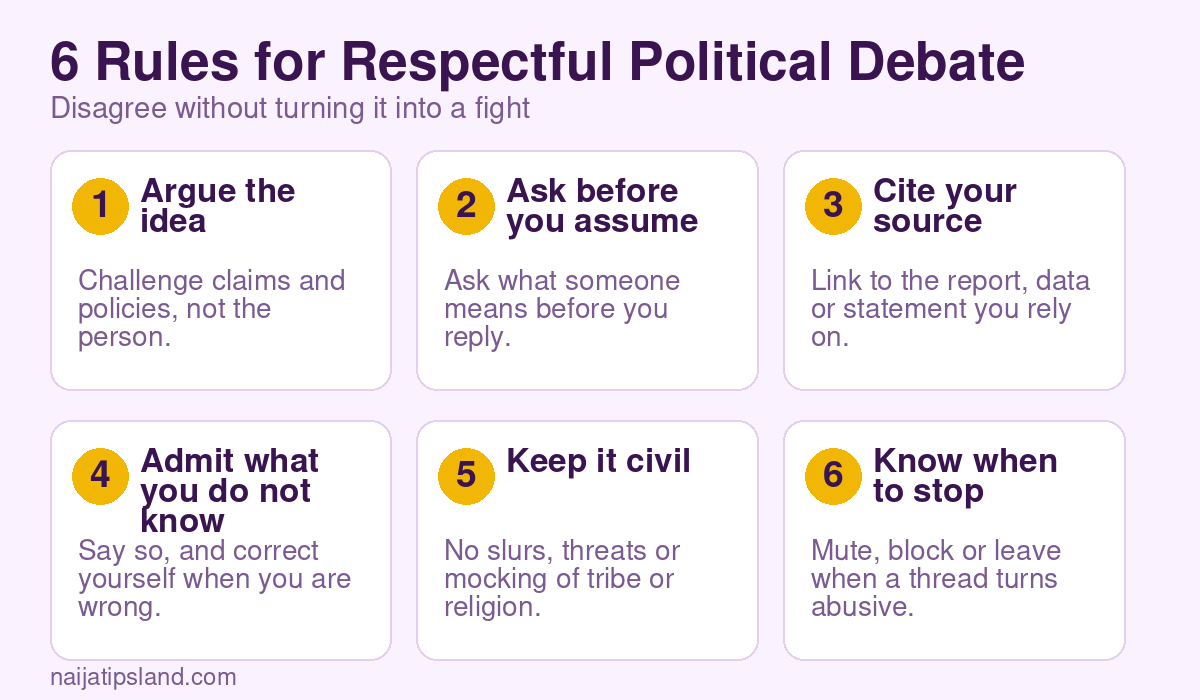
Six Rules for Respectful Political Debate
- Argue the idea, not the person. Challenge a policy or a claim. Do not attack someone’s tribe, religion, family or appearance.
- Ask before you assume. Questions such as “What do you mean by that?” prevent many pointless fights.
- Cite your source. Link to the report, statement or data you rely on, so others can check it.
- Admit what you do not know. Saying “I am not sure” is stronger than defending a claim that falls apart.
- Keep it civil. No slurs, threats or mocking. Humour is fine when it is not aimed at people’s identity.
- Know when to stop. If a thread turns abusive, mute it, block the person or leave. You are not obliged to win.
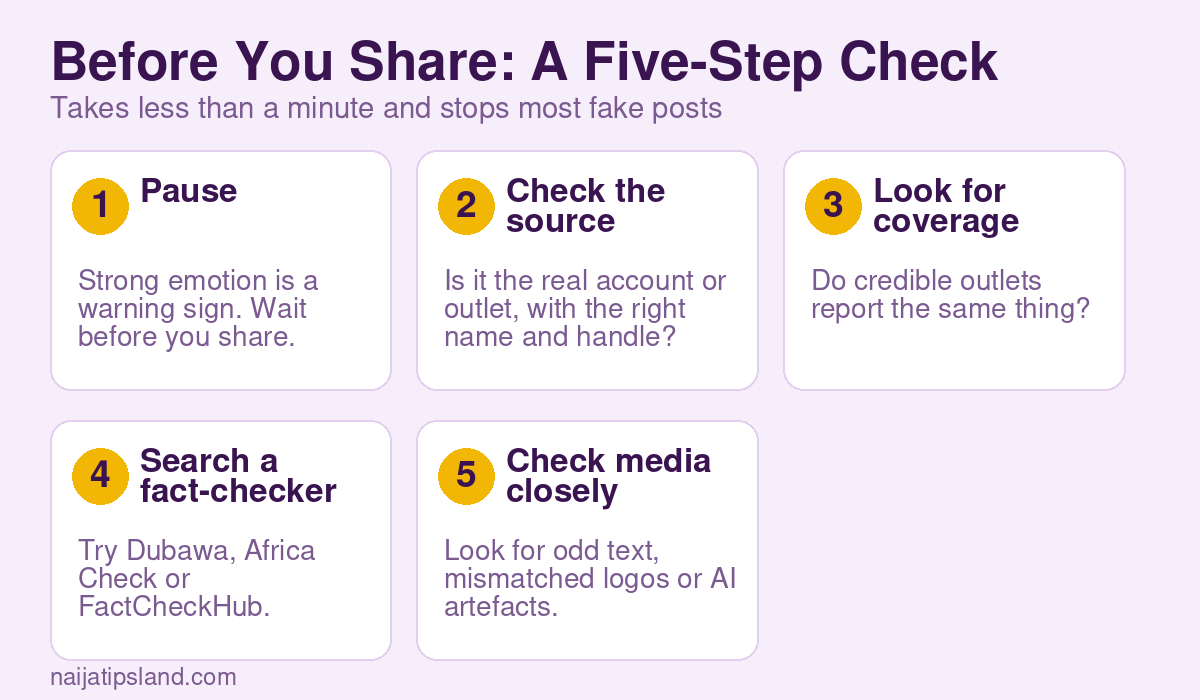
Before You Share: A Five-Step Check
Most fake political posts rely on speed and emotion. A short routine breaks that pattern:
- Pause. If a post makes you furious or delighted, treat that as a warning sign and wait.
- Check the source. Is it the real account or outlet, with the right name and handle? Impersonation is common, and Dubawa found one fake front page used a newspaper name that does not exist.
- Look for coverage. If a major claim is true, credible outlets will usually report it.
- Search a fact-checker. Try Dubawa, Africa Check and FactCheckHub, which publish fact-checks on political claims.
- Look closely at the media. Mismatched logos, odd text, strange lip movements or unnatural audio can point to AI-generated content.
Our guide on how to spot fake news in Nigeria goes into more detail.
Useful Phrases That Lower the Temperature
- “Can you share the source for that?”
- “I see it differently, and here is why.”
- “I may be wrong, so let me check.”
- “Let us agree that we disagree on this and move on.”
Handling Trolls, Abuse and Threats
- Do not feed the trolls. Replies give attention and often escalate things.
- Use the tools. Mute, block and report abusive accounts.
- Keep evidence. Screenshot threats, with dates and usernames, before they are deleted.
- Report serious threats. Threats, stalking and harassment can be reported to the police and may fall under Nigeria’s cybercrime laws. See our guide to Nigeria’s cybercrime laws.
- Do not retaliate with false claims. Sharing fabricated content can expose you to legal risk too.
Respecting Nigeria’s Diversity
Nigerian politics touches ethnicity, religion and region, and careless words can inflame tensions. Fact-checkers have warned that misinformation can deepen ethnic divisions, so avoid generalising about whole groups, do not forward inflammatory claims about communities, and correct stereotypes when you see them. Disagreeing with a politician is not the same as hating the group they come from.
How Communities and Moderators Help
Forums and groups with clear rules produce better conversations. Good communities state what is allowed, remove abuse and fake content, and apply rules fairly. If you run a group, publish rules, appoint moderators and explain decisions. Our guide on why moderating comments matters explains how.
Looking After Yourself
Heated political debate can drain you. Set time limits, take breaks from the news cycle and spend time with people offline. Research on loneliness and connection suggests that healthy community involvement is good for wellbeing, which we cover in our guide to community engagement and mental health. If online conflict leaves you anxious or distressed, talk to someone you trust or a health professional.
Case Study: How to Spot a Fake Front Page
Dubawa found that some fake newspaper covers used a masthead that does not belong to any real outlet, while others imitated real papers such as Punch, Nigeria Tribune and The Guardian. Here is how to test one:
- Search the headline. If a real paper printed a front page with that story, its website and social pages will show it.
- Check the masthead and typography against the paper’s genuine pages. Look for the wrong fonts, a different logo or an odd date.
- Look for the quote. A statement attributed to a leader should appear in a speech, interview or official post you can find.
- Check who first shared it. Anonymous or newly created accounts are a warning sign.
- Search the fact-checkers, who often debunk viral images within days.
Talking Politics in Family and WhatsApp Groups
Political arguments hurt most when they happen among people who have to keep living and working together. In family and community groups, agree simple rules at the start, such as no insults, no forwarding unverified videos and no politics at certain times. If someone shares something false, reply privately first rather than shaming them in front of the group, and send a credible source. WhatsApp labels messages that have been forwarded many times, so treat that label as a prompt to check before you forward again.
When You Spot Misinformation
- Do not amplify it. Quote-posting a false claim to mock it can help it spread, so describe it in your own words instead.
- Share the correction. Link to a fact-check or credible report rather than only saying it is fake.
- Report it. Use the platform’s reporting tools for impersonation, manipulated media and harassment.
- Be kind to the sharer. Many people spread false posts without bad intent.
Curating Your Own Timeline
You control more of your online environment than you think. Follow a mix of sources, including some you do not always agree with. Mute keywords or accounts that trigger endless fights, use lists to follow credible reporters and fact-checkers, and review your follows from time to time. A healthier timeline makes it easier to engage calmly when it matters.
Constructive vs Destructive Replies
The way you reply often matters more than what you say. Compare these pairs:
- Destructive: “Only a fool would believe this.” Constructive: “I could not find a source for this. Can you share where you saw it?”
- Destructive: “People from that region are all the same.” Constructive: “I disagree with that policy, and here is the evidence I am relying on.”
- Destructive: a long thread of insults. Constructive: a short reply with one point and one link, then you step away.
You will not change everyone’s mind, and that is fine. The aim is to leave readers who are following the thread with clearer facts than they had before.
Building the Habit
Respectful debate is a skill that improves with practice. Start by applying the five-step check to one claim a day, then try the constructive reply style in one thread a week. Over time you will find that you share less, argue less and trust your own judgement more, which is exactly what a healthy political conversation needs.
Frequently Asked Questions
How do I know if a political post is fake?
Check the source and handle, look for coverage by credible outlets, search fact-checkers such as Dubawa, Africa Check and FactCheckHub, and examine images and videos for signs of manipulation.
Is it safe to criticise politicians online?
Criticising public policy and public officials is part of democratic debate. Stick to facts, avoid false statements and threats, and be aware that harassment and defamation can carry legal risk.
What should I do if someone threatens me online?
Do not engage, save screenshots, block and report the account, and report serious threats to the police.
Why do political arguments online get so heated?
People often react emotionally to identity-linked topics, algorithms can reward outrage, and anonymous accounts face few consequences.
Can I share a political post if I am not sure it is true?
It is better not to. Wait until you have checked it, because sharing an unverified claim spreads it further even if you add a doubtful comment.
Related Guides
- Why your vote matters in Nigeria: turnout data and 2027
- 2027 Nigeria election hub
- How to spot fake news in Nigeria
- Nigeria’s cybercrime laws: stay protected in 2026
Sources
- Dubawa: 2027 election, how AI use is reshaping political disinformation in Nigeria
- Dubawa: 2027 election disinformation and other top claims fact-checked this week
- Dubawa: Five key insights from our election fact-checks
- FactCheckHub: 2027 election, inside Nigeria’s fake promise machine
- DISA: Disinformation ahead of the 2027 election, fake headlines and false quotes
- allAfrica: Nigeria Fact-Checkers’ Coalition sets up situation rooms