
How to Start a Bakery Business in Nigeria (2026): Costs, Equipment, Licences and Real Profit Margins

Last updated 19 November 2026. Flour, diesel and equipment prices in naira move quickly, so treat every figure here as a starting point and get a fresh quote before you spend. I am a writer, not a business adviser. Several of the cost guides I used are published by equipment sellers and consultancies, and I say so where it matters.
Everyone eats bread, so a bakery looks like the safest business in the country. This month the people who actually run bakeries have been telling a different story. The Premium Breadmakers Association of Nigeria (PBAN) said on 13 November that about 40 per cent of its members have left the industry within two years, and other bakers have warned that bread production is falling because customers cannot afford each price rise.
None of that means you should stay away. It means you should go in with the real numbers. This guide sets out what the sources I checked say about startup costs, equipment, licences, margins and funding, and where they disagree I show the range and explain the gap.
What the industry looks like right now
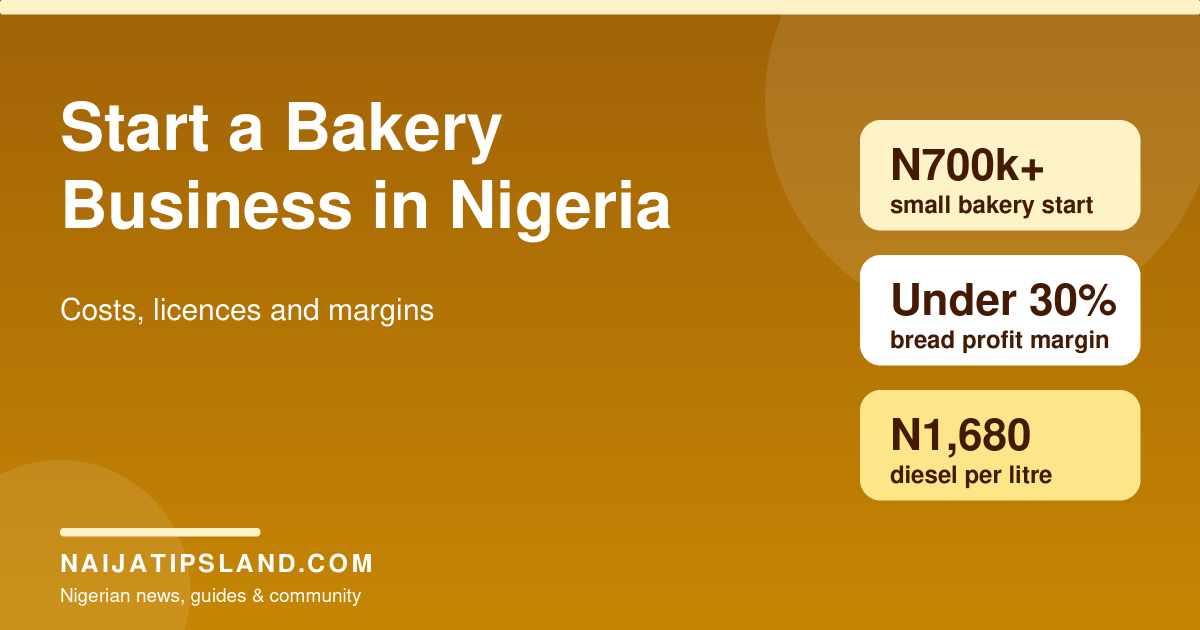
Start with the bad news, because it shapes every choice after it. Speaking at the PBAN Day-Out event in Lagos, association president Emmanuel Onuorah said commercial banks were still charging small businesses 33 to 34 per cent on loans, even after the Central Bank cut its policy rate from 26.5 per cent to 23 per cent in September. A committee chairman at the same event, Hadijat Olopade, said bread margins stay below 30 per cent, that energy takes roughly half of production costs, and that her own bakery’s monthly diesel bill had risen from N9 million to N19 million.
Reports on 14 to 16 November add that bakers say they cannot raise prices because sales are already dropping. One bakery was said to have gone from 120 bags of flour a day to 40. PBAN told members to bake smaller packs rather than lift prices.
There is another view. A manager from Crown Flour Mill, speaking at the same event, rejected the idea that the bread market is saturated and said bakers who improve efficiency and use data still have room to grow. Both things can be true. A big bread plant with a diesel bill and a bank loan is under pressure, while a small bakery with low overheads and a clear product can still find paying customers. The rest of this guide is written with that split in mind.
Choose what you will bake
Your product decides your equipment, your power use and your margin, so settle it before you look at ovens.
- Bread is a volume business. You sell thousands of units at a small profit each, you need a large oven and a spiral mixer, and flour is the biggest cost. One equipment-focused guide says flour is about 65 per cent of input cost.
- Cakes and celebration orders sell by the order. A home-based baker with an electric oven and a stand mixer can start for a few hundred thousand naira, take orders through Instagram and WhatsApp, and set prices that cover costs.
- Pastries, small chops and snacks sit in between. They need a decent oven and some packaging, and they sell well to offices, events and shops.
My reading of the sources: if you have under N2 million, start with cakes or pastries from a rented kitchen or your own home. Bread only makes sense when you have the capital to survive months of thin margins.
How much it costs to start
The startup figures online vary a lot, and the gap comes from describing different businesses. One guide is about a woman baking cakes in a spare room, another is about a bread plant with staff and a delivery van.
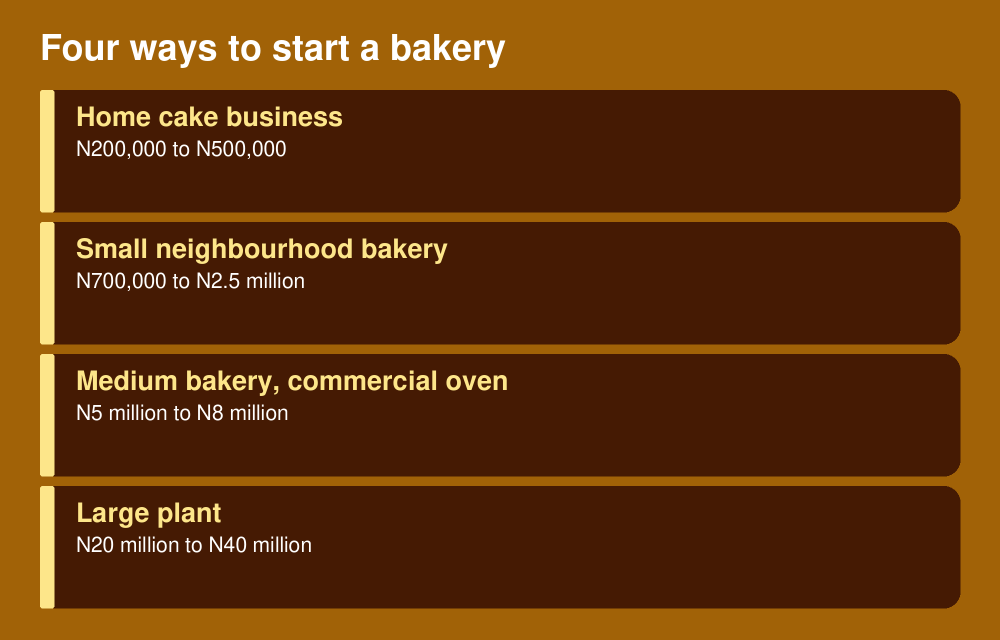
A consultancy guide checked in July 2026 puts a small neighbourhood bakery at N700,000 to N1 million, a medium bakery with commercial ovens at N5 million to N8 million, and a large plant at N20 million to N40 million. It converts these at N1,375 to the dollar. A September 2026 guide gives N200,000 to N500,000 for a home cake business, N800,000 to N2.5 million for a small shop and N2 million to N10 million or more for a commercial bread bakery. A third guide, dated October 2026, puts a standalone bakery with a rented kitchen at N4.2 million to N12.6 million once a year of rent, a generator and three months of working capital are counted.
You can see why people get confused. The N700,000 figure is a tiny shop with a second-hand oven. The N12.6 million figure includes a full year of rent and a buffer. Decide which business you are building and then use the matching row.
Equipment and what it costs
The oven is the biggest single item. Prices swing widely by size and fuel type.
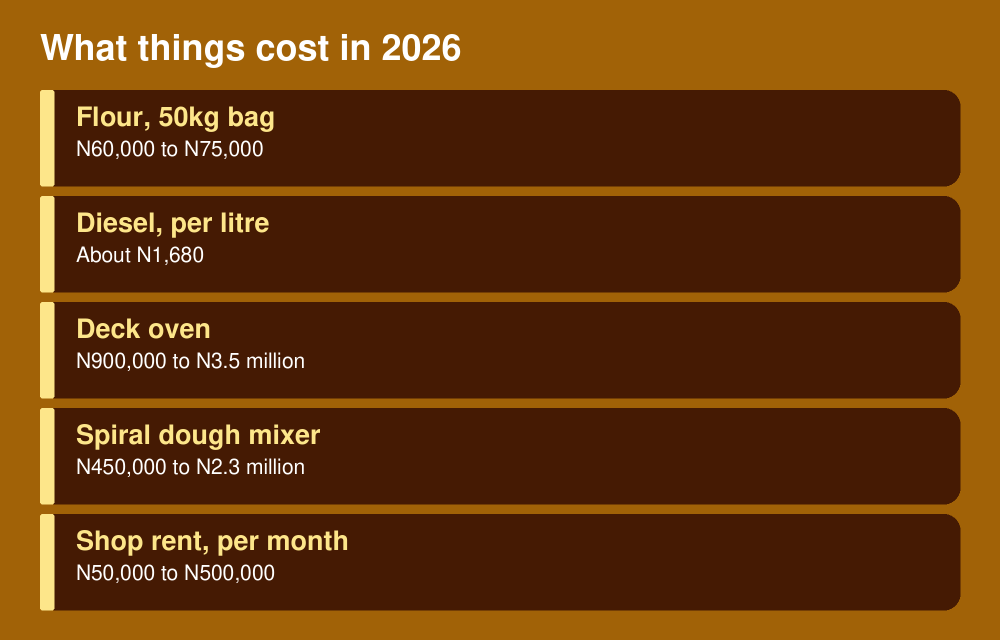
- Ovens. A home electric oven of 40 to 60 litres costs about N60,000 to N150,000. A commercial deck oven for bread runs N900,000 to N1.5 million in one guide and N1.2 million to N3.5 million in another. A YouTube cost breakdown from July 2026 priced a three-deck oven at about N2 million.
- Mixers. A 5-litre stand mixer is N45,000 to N120,000. A commercial spiral dough mixer is N450,000 to N1.2 million in one guide and N1.2 million to N2.3 million in another.
- A slicer at N250,000 to N300,000, plus a proofer, trays, racks, scales and a display chiller. Together these run from N500,000 to N2 million depending on scale.
- A gas cylinder if your oven burns gas. The same video suggests a 50kg cylinder at about N200,000.
- A generator or inverter. Guides put it at N400,000 to N1 million, and it should be on your list from the start.
If you buy a used oven, have a technician test it before you pay. Avoid unusual brands. When a part breaks and has to come from abroad, your bakery sits idle for weeks. The source of most equipment prices in these guides is Lagos, so expect different numbers in other cities.
Flour, fuel and the margin question
Flour first. One consultancy guide lists a 50kg bag at N60,000 to N75,000 in July 2026. A Lagos online retailer listed Golden Penny 50kg at N68,000 in August, and bakers said in December 2025 that a bag averaged about N59,000. Nairametrics reported flour price rises of 2.7 to 10.8 per cent across several brands in Lagos in February 2026. I could not find a single trusted market-wide price, so ask your distributor for today’s figure and buy in bulk if you can store it.
A 50kg bag makes somewhere between 100 and 150 loaves depending on loaf size and recipe. One financial projection assumes 150 loaves of 400g from a bag. A February 2026 cost breakdown estimated total production cost per loaf at N545 to N880 including flour, sugar, yeast, margarine, packaging, energy and labour. That was before the latest rises, so your real cost is probably higher now.
Then fuel. Depot prices for diesel sat around N1,665 per litre on 19 November 2026, with retail around N1,680. PBAN says energy is close to half of production costs, which is why its members are looking at compressed natural gas and hybrid gas-and-diesel burners, though the association puts the conversion at N40 million to N50 million for even a small bakery. You will not afford that at the start. You can choose gas ovens over diesel where you can, keep ovens fully loaded when they run, and avoid half-empty bakes.
Put these together and you see what the bakers mean. If it costs you N700 to bake a loaf and the market will only pay N900, you are making N200 a loaf before rent, wages and repairs. Work out your cost per unit before you set a price, and recheck it each month.
Registration and NAFDAC
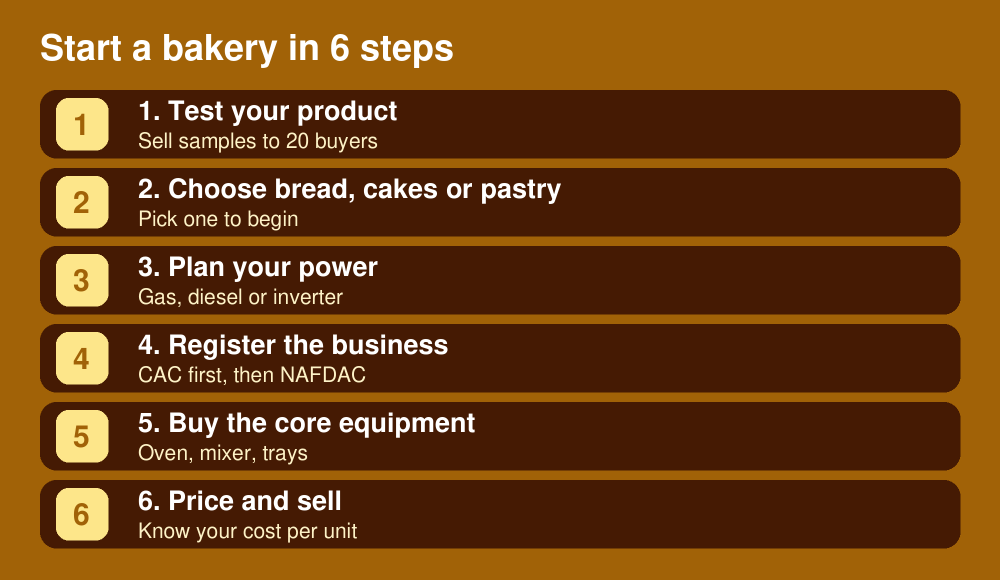
Start by registering the business with the CAC, either a business name or a limited company. Our guides on registering a business name and registering a limited company with the CAC cover the steps. Guides put CAC registration at anywhere from N10,000 to N50,000, so check the current fees on the CAC site.
Bread is a regulated food. NAFDAC’s guidelines for bread and baked products say no food product should be manufactured or sold in Nigeria unless it is registered, and a bread factory must be inspected before it is recognised. The current inspection guideline says applications go through the NAPAMS portal, and the documents NAFDAC asks for include:
- proof of business registration and the brand name registered with the Trademark Registry;
- your label or packaging artwork;
- a list of standard operating procedures for production, cleaning and recalls;
- food handler medical certificates for production staff;
- a current fumigation certificate, done quarterly;
- certificates of analysis for raw materials and the finished product, and a HACCP plan.
The master baker must be present at inspection, and bread must not contain potassium bromate. NAFDAC also published draft Bread Regulations in 2025 that were open for comments. I could not confirm that they are in force, so check the NAFDAC site. An older NAFDAC guideline lists a bread registration fee of N31,500, but fees are revised, so look up the current tariff on NAPAMS before you budget. Our step-by-step NAFDAC guide for small food businesses explains the process in more detail. Home cake bakers selling to friends and neighbours usually start without NAFDAC, but once you package products for shops you will need it. You will also need your local government or state permits, which vary by area.
Where to set up and how to get customers
Rent ranges from about N50,000 a month in smaller towns to N500,000 in the best parts of Lagos and Abuja. A busy road helps a bread shop. A home-based cake baker needs a clean, separate space and good packaging more than a shop front.
Customers come from a few reliable places:
- Offices, schools and churches that order every week.
- Shops, hotels and restaurants that buy from you wholesale.
- Event planners who need cakes, small chops and puff-puff.
- Instagram, WhatsApp status and Google Maps listings with clear photos, prices and delivery areas.
Sell a taster before you commit. One consultancy guide suggests testing with a small group first, and a Lagos baker who sells 20 cakes in a month has proof of demand before buying a bigger oven. If you already run a small catering side, our catering and small chops guide pairs well with a bakery.
Mistakes that cost bakers money
- Buying a bread oven before you have a bread customer.
- Pricing from last month’s flour cost.
- Ignoring power until the first diesel bill arrives.
- Taking an expensive loan. At 33 to 34 per cent, a bank loan can eat a margin that is already under 30 per cent.
- Skipping staff hygiene, medicals and fumigation records, which NAFDAC checks.
Funding the start
Most new bakers start with savings, cooperative contributions or a family loan. Government-linked schemes do exist. SMEDAN said in December 2025 that it was brokering more than N12 billion in single-digit loans with the Bank of Industry and state governments, priced at 9 to 9.5 per cent. A March 2026 roundup lists a SMEDAN and Sterling Bank facility of N250,000 to N2.5 million at 9 per cent, applied for through the Banca by Sterling app, and a presidential MSME fund of up to N5 million at 9 per cent.
Be careful here. The PBAN president complained that genuine entrepreneurs are not getting enough from the Bank of Industry, so approval is not guaranteed. Apply only through the official SMEDAN, BOI or bank channels, and never pay an agent to “secure” a grant. Our guide to getting a small business loan in Nigeria covers safe lenders, and the Start a Business in Nigeria hub has the wider checklist.
FAQ
How much do I need to start a bakery business in Nigeria?
It depends on the model. Sources put a home cake business at N200,000 to N500,000, a small bakery at N700,000 to N2.5 million, a medium bakery at N5 million to N8 million and a large plant at N20 million to N40 million. Get current quotes before you commit.
Is bread still profitable in Nigeria?
Margins are tight. A PBAN official said on 13 November 2026 that bread profit margins are below 30 per cent while banks charge 33 to 34 per cent on loans. Small bakers with low overheads and bakers selling cakes and pastries set their own prices and have more control.
Do I need NAFDAC to sell bread?
NAFDAC guidelines say bread must be registered and the bakery inspected before sale. Check the current process and fees on the NAPAMS portal.
How many loaves does a bag of flour make?
Sources range from about 100 to 150 loaves per 50kg bag, depending on loaf size and recipe. Test your own recipe and weigh a few batches.
Can I start from home?
For cakes and pastries, yes. Many guides recommend a home start. Keep the space clean, register the business and move to a rented kitchen when orders grow.
Where can I get a cheap loan for a bakery?
SMEDAN, the Bank of Industry and some banks list loans at about 9 per cent for small businesses. Approval is not guaranteed, so apply through official channels only.
This article gives general information and is not financial or legal advice. Costs, fuel prices and regulations change, so confirm figures with suppliers and the relevant authorities before you invest.
Sources
- The Port City News: 40% of Nigerian Bakers Exit Industry Over Rising Costs, High Interest Rates (13 November 2026)
- BusinessPress.ng: Bakers Cut Production as Bread Becomes Unaffordable (14 November 2026)
- Ghanamma: Soon Nigerians won’t have bread on their tables, bread makers warn (16 November 2026)
- Counseal: Start a bakery in Nigeria from abroad, 2026 costs
- 7BizPillars: How to Start a Bakery Business in Nigeria
- Naijasabi: How to Start a Bakery Business in Nigeria 2026
- Finelib: Flour price in Nigeria, August 2026
- 9japolytv: Bread Production Business in Nigeria, raw material costs and margins
- NAFDAC: Guidelines for Inspection and Requirements for Bread Manufacturing Facility
- NAFDAC: Bread Regulations 2025 (draft)
- Daily Asset: SMEDAN unveils MSMEs new policy in 2026
- BizWatch Nigeria: SME loans without property collateral in 2026
Join the discussion
Have you tried this, or do you have a question we did not answer? 1 reader has already shared their view. Naijatipsland members help each other with real, first-hand experience.






Editor note: do you run a bakery in Nigeria, or are you planning one? Tell us in the comments what your biggest cost turned out to be, what you pay for flour now and whether you chose bread, cakes or pastries. Please leave out phone numbers and account details. We read every comment. – Ade