Last updated: 13 October 2026. Market forecasts and advertising rules change often. Forecasts are not guarantees, and size estimates differ between research firms. This is general information, not legal or financial advice.
Digital advertising in Nigeria at a glance
- The shift: PwC projects that digital will account for about 84% of Nigeria’s advertising spend by 2029, ahead of the global average.
- The growth: PwC’s outlook for 2026 to 2030, released on 13 October 2026, has internet advertising in Nigeria growing at about 9.5% a year.
- The caveat: estimates of the market’s size differ widely, from about $1.0 billion to $1.2 billion, depending on what is counted.
- The rules: truthful claims, clear disclosure of paid content and, according to ARCON, vetting before adverts are exposed.
- The reality: digital ads do not guarantee sales. Results depend on your offer, audience, creative and tracking.
Nigerian businesses are moving more of their budgets online, because that is where their customers spend time and where results can be measured. But a lot of what gets written about digital ads is promotion rather than evidence. An earlier version of this guide made confident statements about results without sourcing them, so we have rebuilt it around forecasts from named sources, plain definitions of the metrics that matter and the legal points you need to know before you spend a naira.
The Market: Where Digital Advertising Is Heading
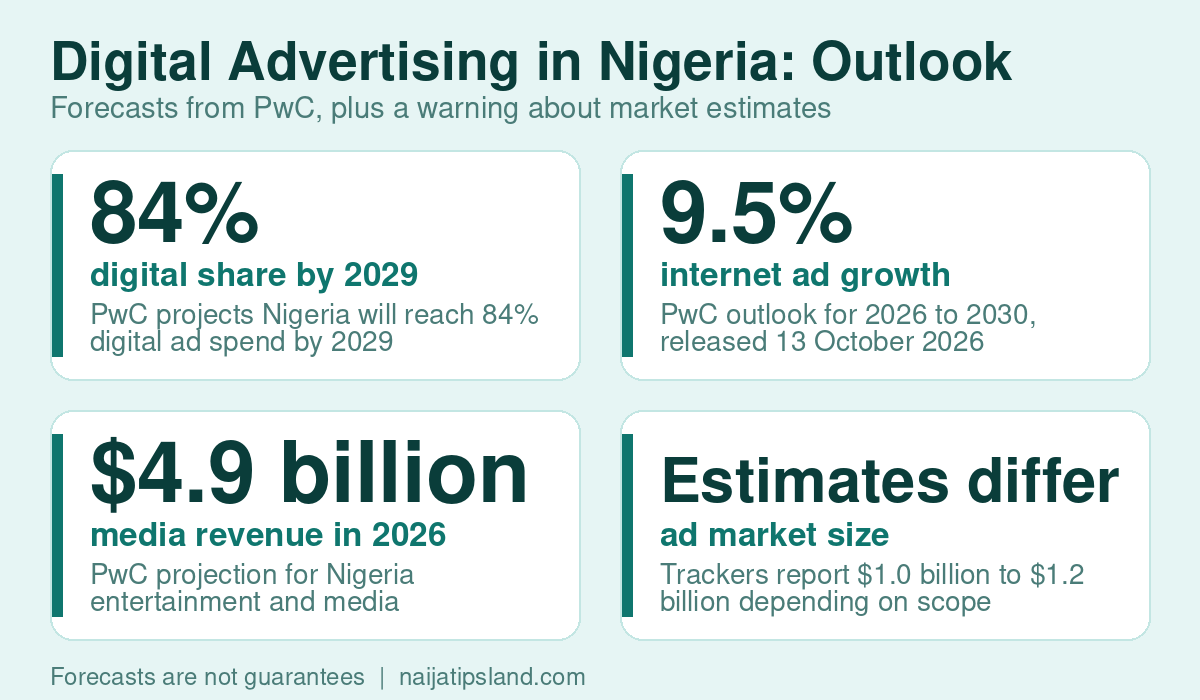
- Digital share: PwC’s Africa Entertainment and Media Outlook 2025 to 2029 projects Nigeria will reach 84% digital ad spend by 2029, compared with about 80% globally and 74% and 64% for South Africa and Kenya. Retail display and paid search are among the fastest-growing segments.
- Growth: PwC’s 2026 to 2030 outlook, released on 13 October 2026, puts Nigeria’s internet advertising growth at about 9.5% a year, and notes that digital growth is concentrating with global platforms.
- Sector size: PwC projected Nigeria’s entertainment and media sector at about $4.9 billion in 2026, up from about $4.5 billion in 2025.
Why do estimates differ? Research firms count different things. One tracker put total advertising spend in Nigeria at about $996 million in 2025, with digital at roughly a third of it. Another valued the online advertising and digital media market at about $1.2 billion in 2025, with a 70% digital share, because it included items such as creator amplification and media services. When you see a figure, check what it covers and who produced it. Use the numbers to understand direction, not to make precise budget promises.
Where the Audience Is
DataReportal’s Digital 2026 report for Nigeria reports potential advertising reach in late 2025 of about 47.8 million adults on TikTok, 38.0 million on Facebook, 30.5 million on YouTube, 10.0 million on Instagram and 6.95 million on X. These are platform estimates of who an advertiser could reach, not unique people, and they overlap. See our guide to social media growth for the full picture. Nigerians also say they use social media on about 5.84 days out of every 7, which is why frequent, relevant messaging can reach people.
Main Types of Digital Ads
- Social media ads on platforms such as TikTok, Facebook, Instagram, YouTube and X.
- Search ads that appear when people search for a product or service.
- Display and programmatic ads that appear on websites and apps.
- Video ads on streaming and video platforms.
- Retail and marketplace ads on e-commerce platforms.
- Influencer and creator content, which counts as advertising when it is paid. See our guide to influencers in Nigeria.
- Messaging-based marketing, such as WhatsApp business messages and communities.
How to Think About Results
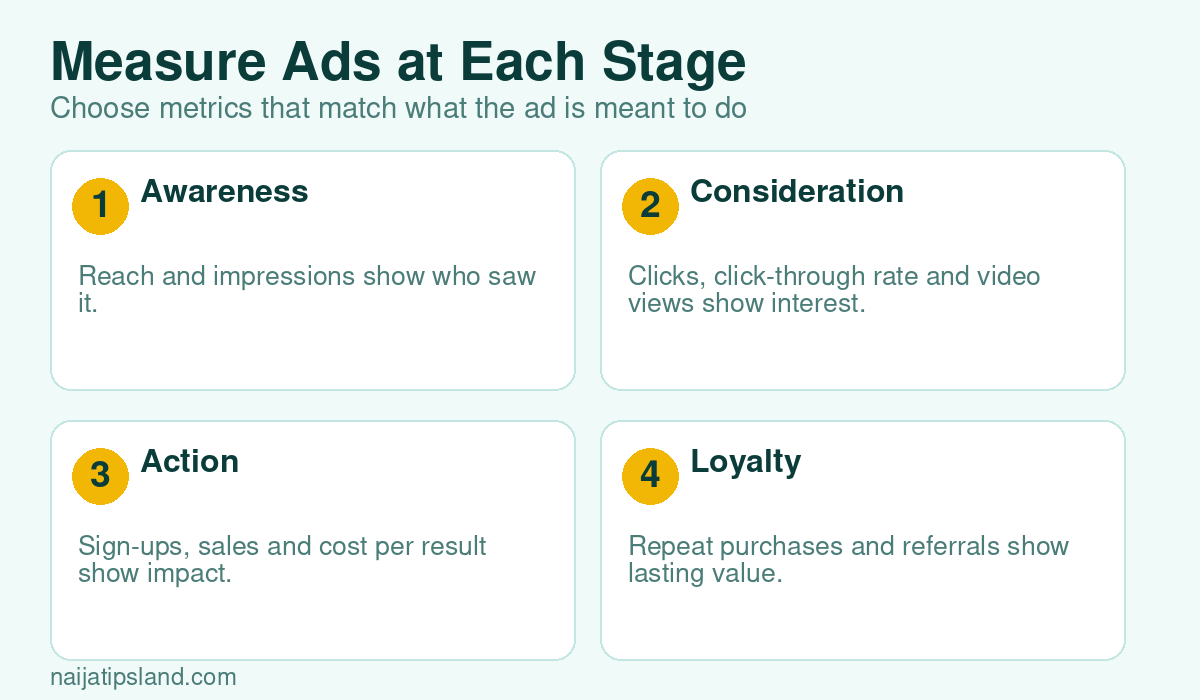
A digital ad can do different jobs: make people aware of you, persuade them to consider you, prompt them to act and encourage them to come back. Measure each stage with the right numbers.
Key metrics in plain language
- Impressions: how many times an ad was shown.
- Reach: how many unique people saw it.
- Click-through rate (CTR): clicks divided by impressions.
- Cost per click (CPC): what you pay for each click.
- Cost per thousand impressions (CPM): what you pay for 1,000 views.
- Conversion rate: the share of visitors who take the action you want.
- Cost per acquisition (CPA): total ad cost divided by the number of customers or sign-ups won.
- Return on ad spend (ROAS): revenue from ads divided by ad cost.
As a hypothetical example, if you spend ₦50,000 and win 25 customers, your CPA is ₦2,000. If those customers brought in ₦200,000 of sales, your ROAS is 4, meaning ₦4 of revenue for every ₦1 spent. Remember that revenue is not profit, so check whether the sales cover your costs.
Common Misconceptions
- “Digital ads guarantee sales.” They put your offer in front of people. Whether they buy depends on price, trust, product, delivery and your website or chat experience.
- “Bigger budgets always win.” A small, well-targeted test often teaches more than a large untested spend.
- “Impressions equal results.” They show visibility, not interest or sales.
- “Only big brands benefit.” Small businesses can run small tests, but they need discipline about tracking and budgets.
- “Digital replaces everything else.” Word of mouth, good service and offline presence still matter.
Practical Steps for Nigerian Businesses
- Set one clear goal, such as enquiries, sign-ups or sales, and decide how you will count it.
- Know your customer: where they live, what they use and what worries them.
- Start with a small test budget you can afford to lose, and run it long enough to learn.
- Pick one or two platforms where your customers already spend time.
- Make mobile-first creative. Use short videos, clear images, captions and plain language, including Pidgin if it suits your audience.
- Send people to a fast page or a chat with a clear next step, because slow pages waste ad money.
- Track results. Use tagged links, conversion tracking and simple records of enquiries.
- Review and improve weekly, changing one thing at a time. Our guide to engagement metrics explains the measurements.
The Rules for Advertisers
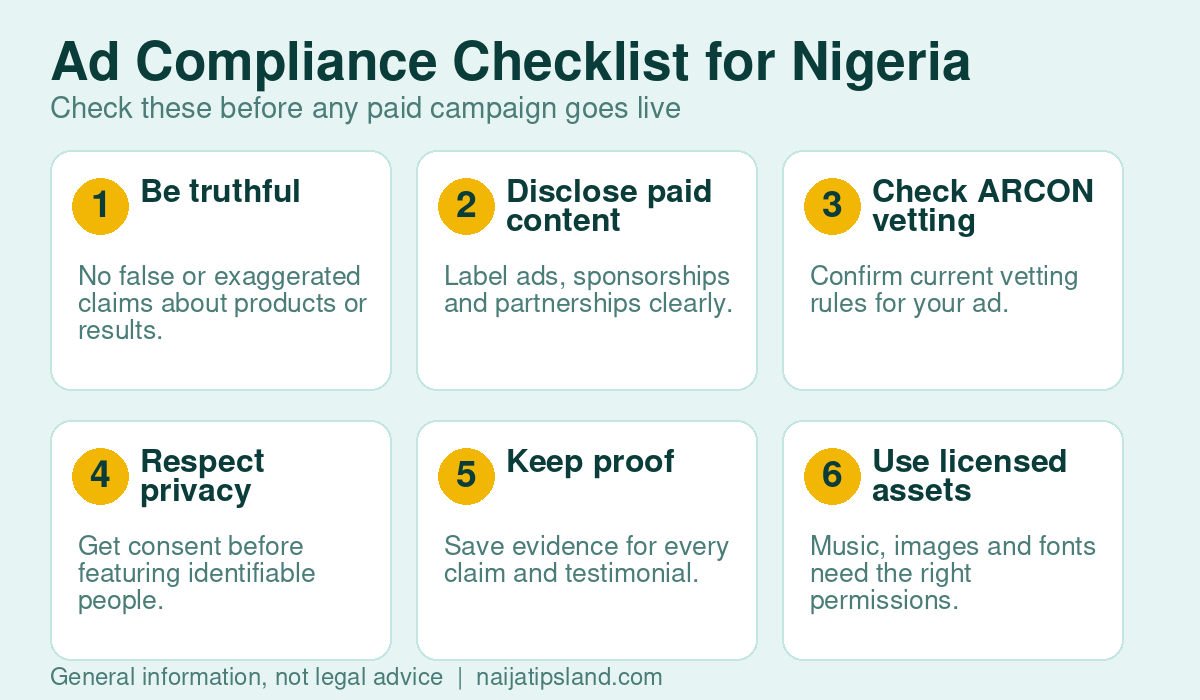
- Vetting (ARCON): the Advertising Regulatory Council of Nigeria says adverts, including online and influencer adverts, should be vetted before exposure. A Federal High Court affirmed ARCON’s authority to regulate digital advertising in April 2025. Commentators report fines of up to ₦1 million per infraction and vetting fees of roughly ₦7,500 to ₦100,000, though the policy has been criticised and may change. Confirm the current position with ARCON.
- Truthfulness (FCCPC): the consumer protection law prohibits false or misleading claims and undisclosed sponsorships.
- Disclosure: label paid posts and partnerships clearly.
- Privacy: the Nigeria Data Protection Act requires a lawful basis, such as clear consent, for processing personal data, which affects targeting, tracking and lead forms. See our data privacy guide.
- Copyright: use music, images and fonts you have the rights to use.
- Registration: operate as a registered business. See our guide to registering a business name.
Fake Ads and Scams
Scammers also advertise. Fake giveaways, cloned brand pages and investment schemes use paid ads to reach victims. If you run a business, watch for impersonators and warn customers. If you are a consumer, check a business’s real website and phone number before you pay. Our guides on internet scams and WhatsApp scams explain the warning signs.
A Sample Test Plan for a Small Budget
Suppose you have ₦50,000 to test one offer. A sensible plan is to run two or three different ads, such as a short video, a single image and a customer testimonial, to one clearly defined audience for about a week each, with the same landing page and the same daily budget. Record impressions, clicks, enquiries and sales for each ad. At the end, keep the one with the lowest cost per result, drop the others and test a new idea against the winner. Do not read too much into tiny differences, because small budgets produce noisy results.
Creative Tips by Format
- Short video: show the point in the first three seconds, add captions and end with one clear action.
- Image ads: use one message, large readable text and a real product or person rather than a cluttered design.
- Search ads: match the wording people actually type, include your location and send them to a page that answers the query.
- Messaging ads: make it clear that clicking opens a chat, and reply quickly when people write.
Frequently Asked Questions
How much of Nigeria’s advertising is digital?
Estimates vary. PwC projects that digital will reach about 84% of ad spend by 2029, while other trackers put the current share at anything from about a third to about 70% depending on what they count.
Which platform is best for ads in Nigeria?
It depends on your audience and goal. TikTok and Facebook have the largest potential reach, YouTube suits video and search-style discovery, and WhatsApp suits direct customer contact.
How much should I spend on digital ads?
Start with a small test budget you can afford to lose, learn what works and increase gradually.
Do I need ARCON approval for social media ads?
ARCON has said adverts need vetting, and a court affirmed its authority, but the policy is contested. Check ARCON’s current guidance before running paid campaigns.
Can I use customer testimonials in ads?
Only if they are genuine and you have permission. Misleading or fake testimonials are risky.
Related Guides
- Social media growth in Nigeria: a workflow that works
- How influencers shape trends and culture in Nigeria
- Engagement metrics explained
- Nigeria’s digital economy in 2026
Sources
- PwC Nigeria: Africa Entertainment and Media Outlook (the page now shows the 2026 to 2030 edition)
- Nairametrics: Digital ads to dominate 84% of Nigeria’s ad spend by 2029
- Business Tech Africa: PwC Entertainment and Media Outlook shows digital growth concentrating with global platforms
- Arbiterz: Nigeria’s entertainment and media sector to hit $4.9bn in 2026
- Greenlearners Technologies: Digital marketing statistics in Nigeria
- Ken Research: Nigeria online advertising and digital media market
- Vanguard: TikTok, Instagram, Facebook or X, where Nigerians are building audiences
- Tribune: Why influencers and digital ad operators need ARCON
- BusinessDay: Businesses strained under advert regulator’s vetting regime
- Mondaq: Regulatory and compliance regulations in influencer marketing and advertising