Last updated: 13 October 2026. This is general information, not legal advice. Fees and rules change, so confirm with the CAC and a lawyer or accountant. We removed worked examples from an earlier version that did not match the law.
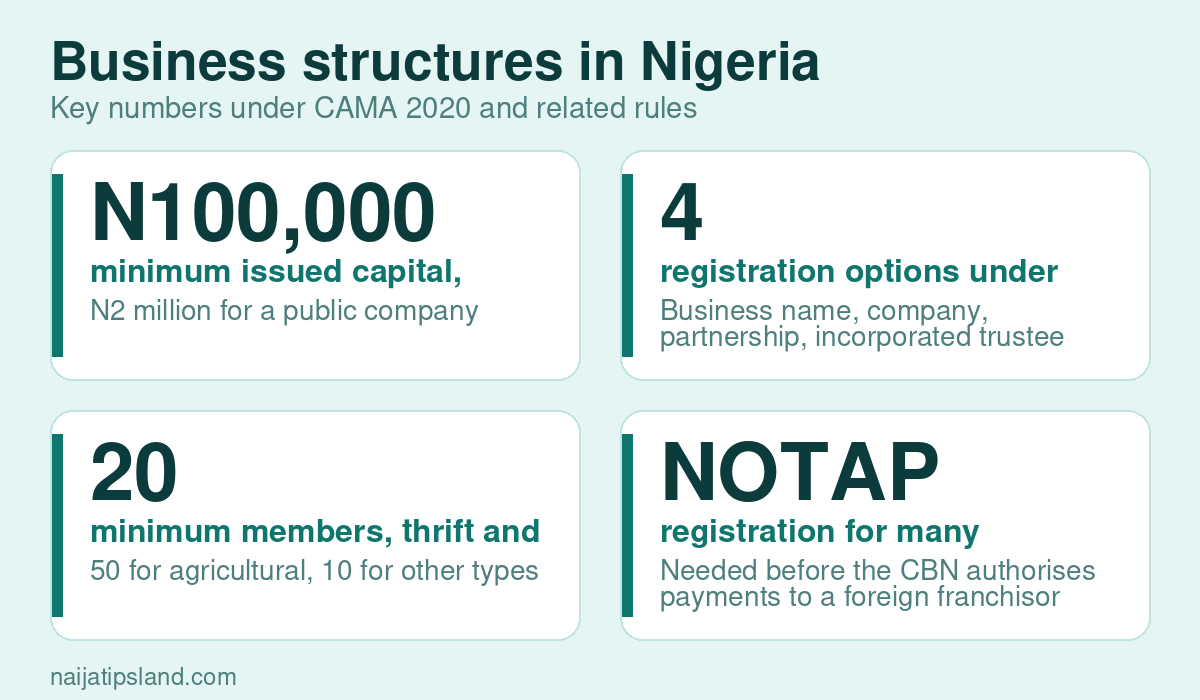
Before you register a business in Nigeria you need to decide what kind of business it will be in law. The choice affects your personal risk, your tax, how easily you can raise money and how big clients see you. Under the Companies and Allied Matters Act 2020 (CAMA), the CAC registers four broad kinds of entity: business names, companies, partnerships and incorporated trustees. Cooperatives and franchises follow other rules. Here are seven structures that most entrepreneurs meet.
1. Business name (sole proprietorship)
A business name is the simplest form, and the owner is called the proprietor. It is quick and cheap to set up, but the business is not separate from you, so you are personally liable for its debts. It suits freelancers, small traders and people testing an idea. Guides report CAC costs of roughly ₦10,000 to ₦25,000 in total, depending on whether you include name reservation and an agent, but fees change, so check the portal. See our guide to registering a business name.
2. Partnership
Two or more people can carry on business together under an ordinary partnership, registered as a business name, in which each partner is personally liable. CAMA also introduced two stronger forms. A limited liability partnership (LLP) has at least two partners, its own legal personality and liability limited to agreed contributions, which suits professional firms. A limited partnership (LP) has at least one general partner with unlimited liability and one or more limited partners who invest but do not manage. Write a partnership agreement whichever form you choose.
3. Private limited company (Ltd)
This is the most common serious choice. A private company is a separate legal person, its shareholders’ liability is limited to what they have not paid on their shares, and it cannot offer shares to the public. CAMA 2020 requires a minimum issued share capital of ₦100,000, and a single person can form a private company. It costs more than a business name, with guides reporting about ₦30,000 to ₦70,000 including stamp duty, and brings duties such as annual returns and tax filings. It is often needed to win corporate contracts and to open some payment accounts.
4. Public limited company (PLC)
A public company can invite the public to buy its shares, usually through the stock exchange, and is subject to stricter disclosure and governance rules. CAMA 2020 sets a minimum issued share capital of ₦2 million, but companies that list face far higher practical requirements from the SEC and the exchange. It is the route for large businesses that want to raise money from many investors.
5. Companies limited by guarantee and incorporated trustees
These are for non-profit purposes. A company limited by guarantee is used for objects such as education, culture, sports, research or charity, and any income must be applied to those objects. Incorporated trustees are registered by appointed trustees for religious, charitable, educational or social purposes. Neither is designed to distribute profit to owners. The Business Facilitation (Miscellaneous Provisions) Act 2023 and CAMA also exempt certain small categories of enterprise from incorporation, so ask the CAC if you think you qualify.
6. Cooperative society
A cooperative is a voluntary association of people with a common need who pool resources for their benefit, such as thrift and credit societies, farming groups or consumer groups. They are governed by the Nigerian Co-operative Societies Act and state rules and are registered with the cooperative authorities, not the CAC. Reported minimums are 20 members for a savings and credit society, 50 for an agricultural society and 10 for other types, and states publish their own fees and requirements. Cooperatives are not NDIC-insured, so check governance carefully before you join. See our guide on common money mistakes.
7. Franchise
A franchise is not a legal entity but a way of doing business: you pay to use an established brand and system. Nigeria has no franchise-specific law, so the contract matters a lot, along with the Federal Competition and Consumer Protection Act and intellectual property law. Where a foreign brand is involved, the agreement generally must be registered with the National Office for Technology Acquisition and Promotion (NOTAP), and the CBN requires that certificate before it authorises payments to the franchisor. Franchisees usually form a company or register a business name to operate.
How to choose
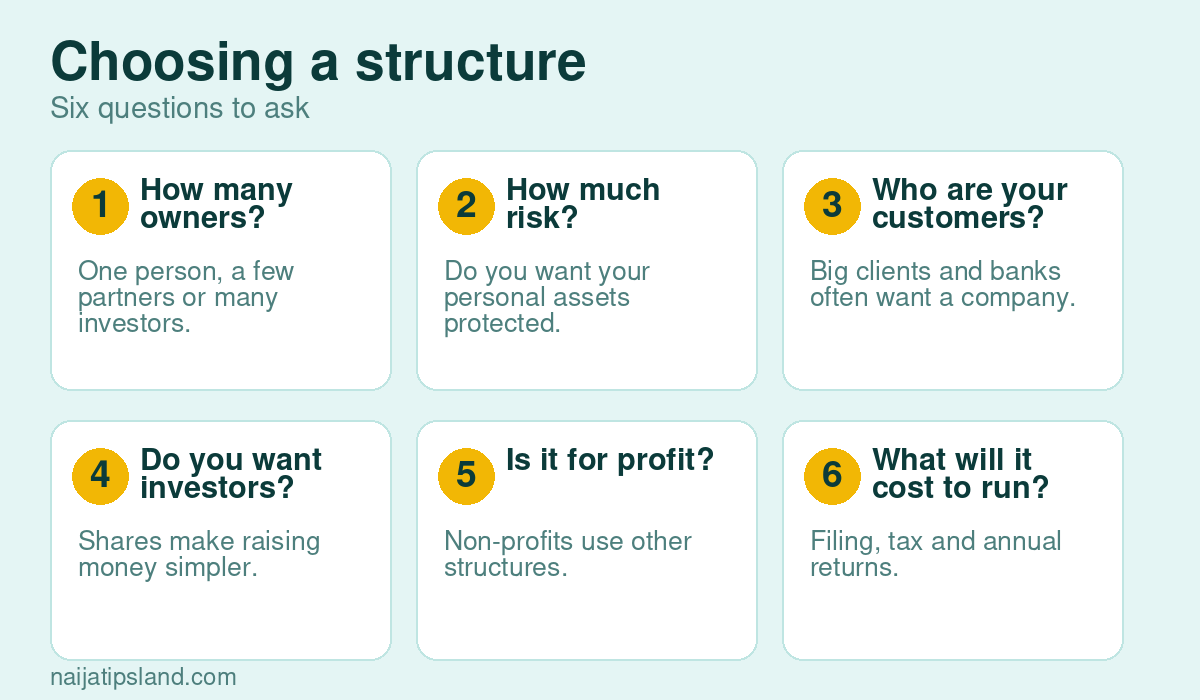
- Testing an idea or freelancing: start with a business name, then upgrade when clients or contracts demand a company.
- Selling to banks, big firms or the government: a private limited company is usually expected.
- Working with partners: use a written agreement, and consider an LLP if you want liability protection.
- Raising money from investors: a company with shares is the standard route.
- Doing charity or community work: a company limited by guarantee or incorporated trustees.
- Pooling savings with a group: a registered cooperative, with strong governance.
Tax and compliance basics
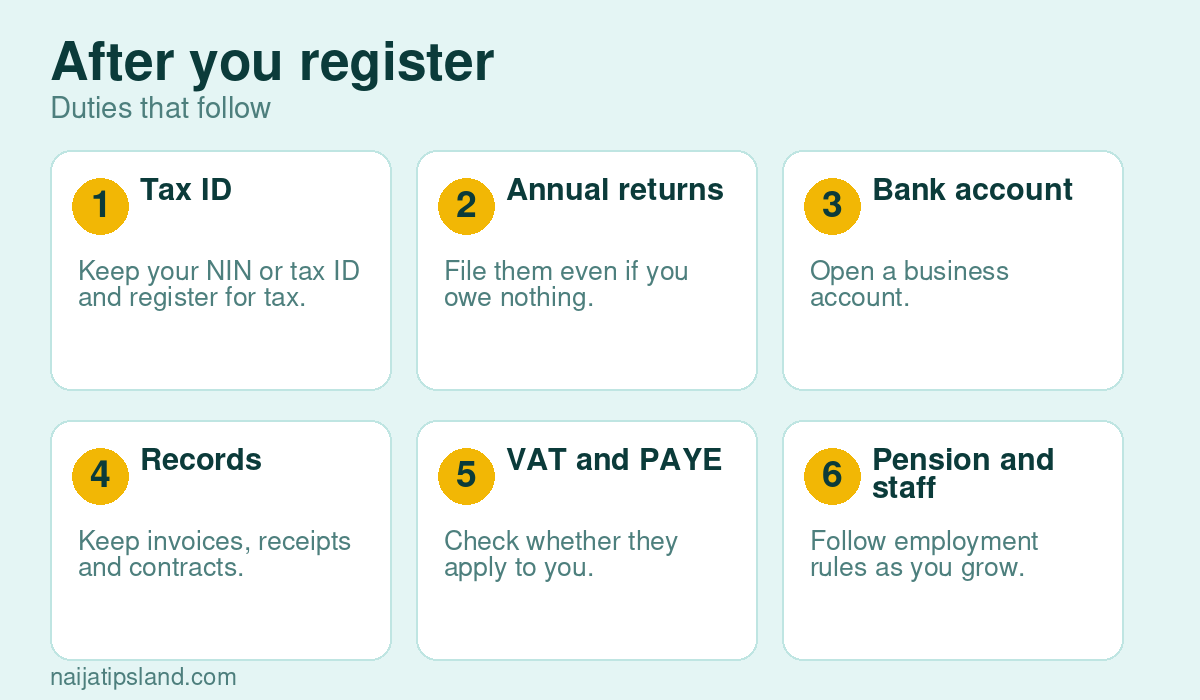
Whichever structure you use, keep records and file what the law requires. Under the Nigeria Tax Act 2025, the first ₦800,000 of an individual’s annual taxable income is taxed at 0%, and small companies may qualify for reliefs, though sources differ on whether the small company turnover threshold is ₦50 million or ₦100 million, so confirm which applies. Even an exempt business generally has to file returns. Read our guides on VAT and saving money, and see side hustle ideas if you are starting small.
Side-by-Side Comparison
- Business name: cheapest and quickest, unlimited personal liability, suits one person or a small group starting out.
- Partnership, LLP or LP: shared ownership and skills, with liability depending on the form, and a written agreement is essential.
- Private company: separate legal person, limited liability, higher cost and compliance, credible with banks and corporate clients.
- Public company: can raise money from the public, with the strictest disclosure and capital expectations.
- Guarantee company or incorporated trustees: for non-profit objects, with no distribution of profit to members.
- Cooperative: member-owned and member-governed, regulated by cooperative authorities rather than the CAC.
- Franchise: a brand licence with its own contract, fees and approvals.
Documents You Will Usually Need
- A valid ID and your NIN for each owner, director or partner.
- Passport photographs, an email address and a phone number.
- Two or more proposed names, and a description of the business activity.
- A business address in Nigeria.
- For companies: share details, the names of directors and shareholders, memorandum and articles of association, and details of anyone with significant control over the company.
Mistakes to Avoid
- Starting as a business name when you will sign big contracts that put you at personal risk.
- Going into partnership without a written agreement on money, roles and exit.
- Letting registration lapse. Late annual returns can bring penalties and risk the entity being struck off.
- Mixing personal and business money in the same account.
- Joining a cooperative or investment group without checking registration and governance.
- Paying an unlicensed agent. Use the CAC portal or an accredited agent.
Frequently Asked Questions
Do I have to register my business?
CAMA generally requires businesses to be registered, with some small categories exempt. Registration also helps you open accounts, sign contracts and win trust.
What is the difference between a business name and a limited company?
A business name is you trading under another name, with unlimited personal liability. A limited company is a separate legal person with limited liability for shareholders.
How much capital do I need?
A business name has no minimum, a private company needs at least ₦100,000 in issued share capital, and a public company at least ₦2 million, under CAMA 2020.
Can I change structure later?
Yes. Many businesses start as a business name and later incorporate as the business grows.
Sources
- Mondaq: An overview of business and non-profit organisations in Nigeria
- Chambers: Corporate Governance 2026, Nigeria
- BusinessDay: CAMA 2020, what you need to know, share capital
- Mondaq: 20 innovations in the Companies and Allied Matters Act 2020
- Mondaq: Procedure for registration of a cooperative society in Nigeria
- Lawpadi: How to start a franchise in Nigeria
- Templars: Navigating cross-border franchise regulation in Nigeria
- Kolonell: Register a business in Nigeria, CAC cost and timeline (2026, indicative fees)
Join the discussion
Have you tried this, or do you have a question we did not answer? Be the first to share your experience. Leave a comment below. Every comment is read by the editor before it appears.