
How to Get a National Insurance Number in the UK (2026): Who Needs One, How to Apply and How Long It Takes

Last updated 28 November 2026. Rules and rates are taken from GOV.UK and HMRC. Check the official pages before you act, because processes do change.
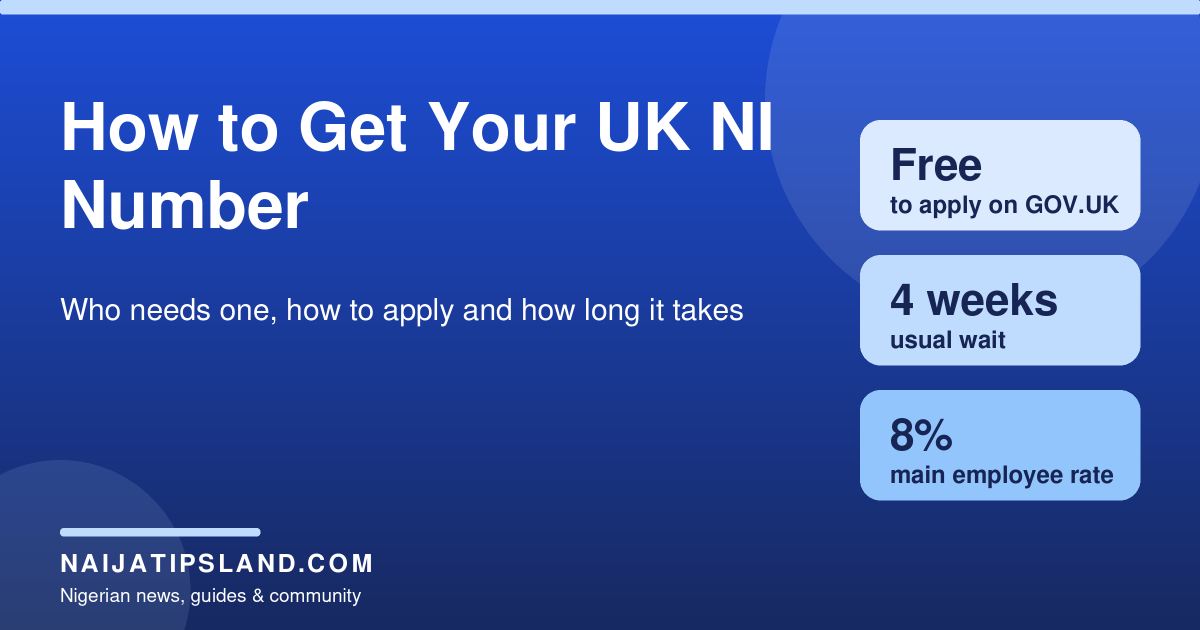
Your National Insurance number is one of the first things a UK employer asks for, and new arrivals from Nigeria often panic when they don’t have one yet. The good news is that you may already have it, the application is free, and you can start work before it arrives. This guide covers who needs a number, how to check if you already have one, how to apply, how long it takes and what you will actually pay in National Insurance once you are working.
If you have just landed, our first 30 days in the UK checklist puts the NI number alongside the GP, the bank account and your eVisa, so you can do them in a sensible order.
What a National Insurance number is
A National Insurance number (people shorten it to NI or NINo) is a personal reference that HMRC and the Department for Work and Pensions use to record your tax and contributions. It looks like this: two letters, six numbers and one final letter, for example QQ 12 34 56 C. That is a sample format, not a real number.
The number matters for two reasons. It makes sure the tax and National Insurance taken from your pay land on your own record, and it links your contributions to things like the State Pension and some benefits. You keep the same number for life, even if you change your name, move house or leave the UK and come back years later.
Do you already have one?
Check this before you apply. GOV.UK says that if you already have a number you don’t need a new one, and it tells visa holders where to look:
- eVisa holders: sign in to your UK Visas and Immigration (UKVI) account and view your eVisa. Many people who applied for a visa from Nigeria will find a number there.
- Old BRP holders: if you were issued a biometric residence permit before BRPs were phased out, the number may be printed on the back of the card.
- People who lived in the UK before: an old payslip, P60 or HMRC letter will show it. You can also find it in the HMRC app or your personal tax account.
Not everyone gets a number with their visa. Dependants, some students and people whose visa was granted in certain ways often have to apply separately. If it isn’t on your eVisa, apply.
Who needs to apply
You need a National Insurance number if you live in the UK, have the right to work and are working, looking for work or have a job offer. You can only apply while you are in the UK, so you can’t sort it out from Lagos before you travel.
You don’t need one to start a benefits claim or a student loan application. GOV.UK says the department will contact you if a number is needed to pay you. You also don’t need one to apply to the EU Settlement Scheme.
Young people who grew up in the UK usually get a number automatically just before they turn 16, as long as a parent claimed Child Benefit for them. If you brought children over from Nigeria and they reach 16 to 19 without a number, they may need to apply online themselves. Our guide to bringing your children from Nigeria to the UK covers their visas and school places.
How to apply, step by step
The only official route is the “Apply for a National Insurance number” service on GOV.UK. Here is how it works in practice.
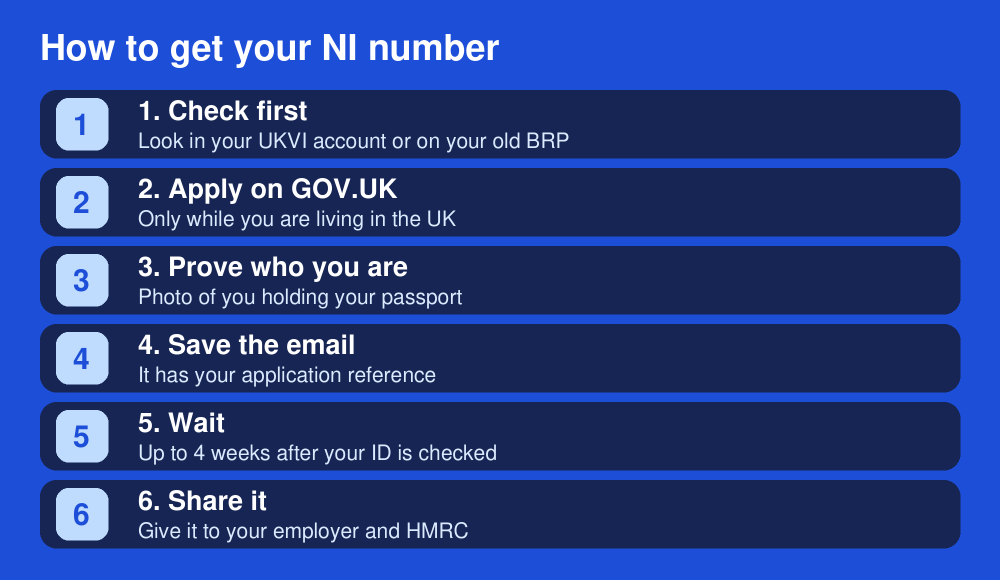
1. Get your documents ready
GOV.UK asks you to have a passport from any country, or a national identity card if you are from the EU, Norway, Liechtenstein or Switzerland. A Nigerian international passport is fine. You may be asked to type in details from the document, so keep it to hand.
2. Fill in the online application
You will give your name, date of birth, UK address, contact details and some information about your immigration status. Use the same spelling of your name as your passport. Mismatched names (an extra middle name here, a missing one there) are a common cause of delays later with employers and banks.
3. Prove your identity
The service asks you to take and upload a photo of yourself holding your passport, plus photos of your other ID documents. A phone camera is fine and someone else can take the picture for you. Follow the photo instructions carefully: good light, nothing covering your face, and the passport details readable.
If you can’t upload photos you can still apply, but it takes longer. You may be asked to attend an appointment in person or post photocopies of your documents, and you will get instructions by email.
4. Keep your reference number
After you submit, you get an email with an application reference number. It also tells you whether you need to give more proof of identity. Save that email somewhere safe because the helpline will ask for the reference.
5. Wait for the letter
GOV.UK says it can take up to 4 weeks to get your number once your identity has been proved. Some people get it sooner. If 4 weeks have passed, you have moved address or your details have changed, call the National Insurance numbers helpline:
- England, Scotland and Wales: 0800 141 2079, Monday to Friday, 8am to 5pm
- Welsh language: 0800 141 2349
- Northern Ireland: 0800 587 0024, Monday to Friday, 9am to 4pm
Can you start work before the number arrives?
Yes. GOV.UK says you can start work before you get your number as long as you can prove your right to work. For most Nigerians that means giving your employer a share code from the “Prove your right to work” service, which pulls the details from your eVisa.
Tell your employer you have applied. Without a number, payroll may put you on an emergency tax code for a while, so your first payslips might show more tax than you expected. Once your number arrives, give it to your employer straight away. HMRC usually corrects the tax code and any overpaid tax comes back through your pay or after the tax year ends.
If you are still job hunting, our guide on how to write a CV for UK jobs as a Nigerian explains how to describe your visa status on a CV, which matters more than people think.
How much National Insurance you will pay in 2026/27
Having a number and paying contributions are different things. You only pay once your earnings pass a threshold. These are HMRC’s figures for the 2026 to 2027 tax year (6 April 2026 to 5 April 2027):
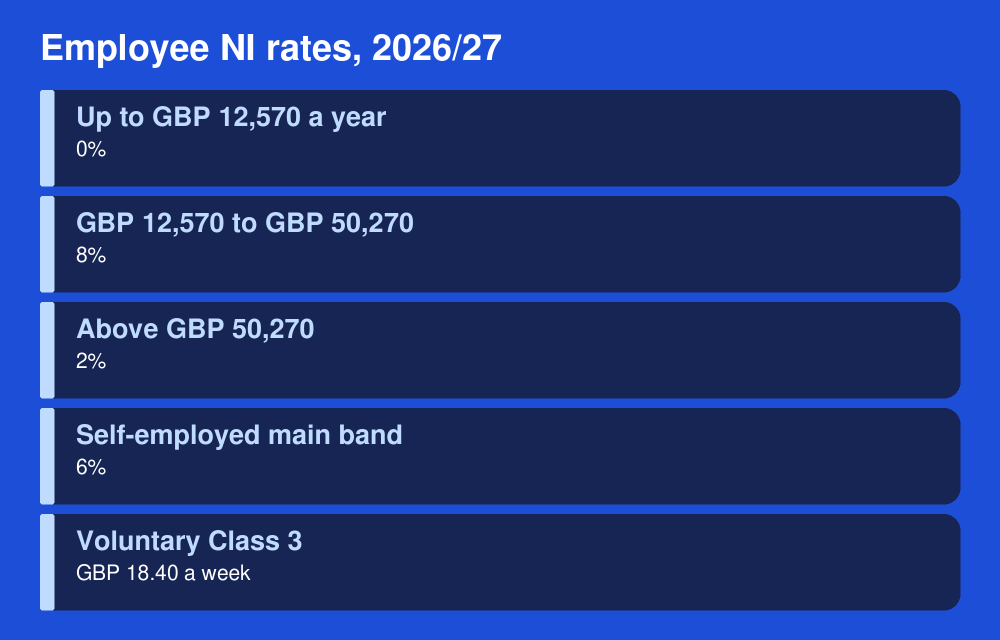
- Employees (category A): nothing on earnings up to £12,570 a year (£242 a week), 8% on earnings between £12,570 and £50,270, and 2% on anything above £50,270.
- Employers: 15% on what they pay you above £5,000 a year. That comes out of their pocket, not your payslip.
- Self-employed: Class 4 at 6% on profits between £12,570 and £50,270 and 2% above that.
- Voluntary Class 3: people with gaps in their record can usually pay to fill them. Accountancy guides put the 2026/27 rate at £18.40 a week. Check GOV.UK before paying.
Here is a rough example. If you earn £30,000 a year as an employee, you pay 8% on the £17,430 above the threshold, which is about £1,394 a year in National Insurance. Income tax is separate. Our cost of living in the UK for Nigerians guide shows how that take-home pay compares with rent and bills.
Why your contribution record matters
Each tax year in which you pay or are credited with enough National Insurance counts as a qualifying year. GOV.UK says you generally need 35 qualifying years for the full new State Pension and at least 10 to get any of it. Many Nigerians who came to the UK in their thirties or forties never think about this until it is too late to fill the gaps cheaply.
You can check your record for free in the HMRC app or your personal tax account. It shows which years count, which have gaps, and whether paying voluntary contributions would add to your pension. If you plan to retire in Nigeria, a UK State Pension can still be paid to you abroad, though it isn’t uprated each year for people living in Nigeria. Check the current rules on GOV.UK before you decide.
Keep your number safe
A National Insurance number is valuable to fraudsters, because together with your name and date of birth it helps them open accounts or claim things in your name.
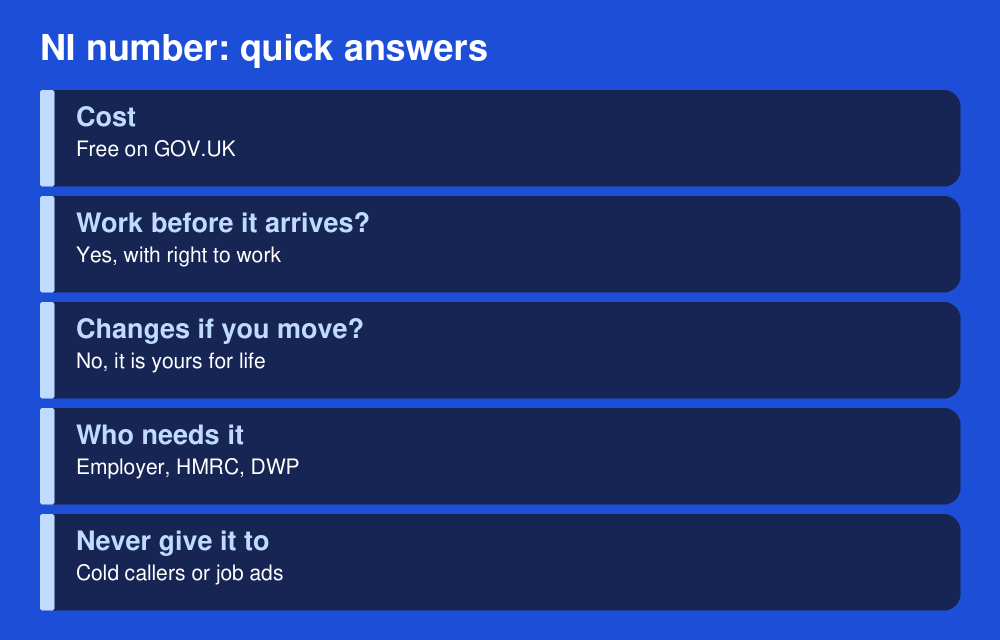
- Applying is free. Some websites charge a “service fee” to fill in the same GOV.UK form for you. You don’t need them.
- Be wary of calls about your NI number. A recorded call saying your National Insurance number has been “suspended” or “compromised” is a scam. Hang up and contact HMRC through GOV.UK if you are worried.
- Job adverts can be traps. A genuine employer asks for your number once you have an offer, not in a first WhatsApp chat. Our guide to “get paid to review products” job scams shows how fake recruiters work.
- Only share it with your employer, HMRC, the DWP, your pension provider and other official bodies that have a real reason to ask.
Common problems and how to fix them
The application keeps failing on the photo. Retake it in daylight against a plain wall, with the passport photo page facing the camera. If it still fails, choose the option to continue without photos and wait for instructions.
Your name is spelled differently on your passport and eVisa. Fix the eVisa through UKVI first, because employers and banks compare the two. Then use the passport spelling on the NI application.
The letter went to an old address. Call the helpline with your reference number. You can also sign up for the HMRC app, which shows your number once it is on your record.
You were in the UK years ago as a student. You probably still have a number. Look for old payslips or call HMRC before you apply again.
Related guide (updated 28 November 2026)
How to open a UK bank account as a new arrival (2026) covers what app banks and high street banks ask for, the eVisa share code, proof of address and your right to a basic bank account.
Frequently asked questions
How much does a National Insurance number cost?
Nothing. The application on GOV.UK is free. Ignore any website that asks for payment to apply for you.
Can I apply for a National Insurance number from Nigeria?
No. You can only apply while you are living in the UK. Check your eVisa first, as many visa holders already have a number.
How long does it take to get a National Insurance number?
Up to 4 weeks after your identity has been proved, according to GOV.UK. It takes longer if you can’t upload photos and need an appointment or have to post documents.
Can I work without a National Insurance number?
Yes, if you can prove your right to work. Your employer may use an emergency tax code until you give them your number.
Do students need a National Insurance number?
Only if they plan to work. Students on a Student visa who take a part-time job within their permitted hours will need one.
Does my National Insurance number change if I leave the UK?
No. It stays the same for life. If you come back years later, use the same number.
Sources
- GOV.UK: Apply for a National Insurance number
- GOV.UK: How to apply for a National Insurance number
- GOV.UK: National Insurance
- GOV.UK: Rates and thresholds for employers 2026 to 2027
- GOV.UK: The new State Pension
- RR Accountants: National Insurance rates 2026/27
Join the discussion
Have you tried this, or do you have a question we did not answer? Be the first to share your experience. Leave a comment below. Every comment is read by the editor before it appears.




Editor note: how long did your NI number take to arrive, and did you have to attend an appointment? Share your experience (without posting the number itself) so other new arrivals know what to expect. – Ade