
Are “Get Paid to Review Products” Jobs Legit? How the WhatsApp and Telegram Task Scam Works (2026)

Last updated 27 November 2026. This guide explains how a common scam works. It doesn’t accuse any real company of running it: scammers borrow the names of well-known brands without their knowledge.
The message usually arrives on WhatsApp from a number you don’t know. “Hello, I am Jessica from the recruitment team. We are hiring part-time staff to review products online. Work 30 minutes a day from your phone and earn N15,000 to N40,000 daily. Are you interested?” Sometimes it claims to come from Amazon, Temu, Jumia, TikTok Shop or a “digital marketing agency”. Sometimes it lands in a WhatsApp group you never joined.
The short answer to the question in the title is no. A job that pays you to rate or review products through a WhatsApp or Telegram chat is almost always a task scam. Real review programmes exist, but they don’t recruit through random messages, and none of them ask you to deposit money. This guide walks through how the scam works, the signs to look for, the few real ways to earn from reviews, and what to do if you have already paid.
How the review task scam works
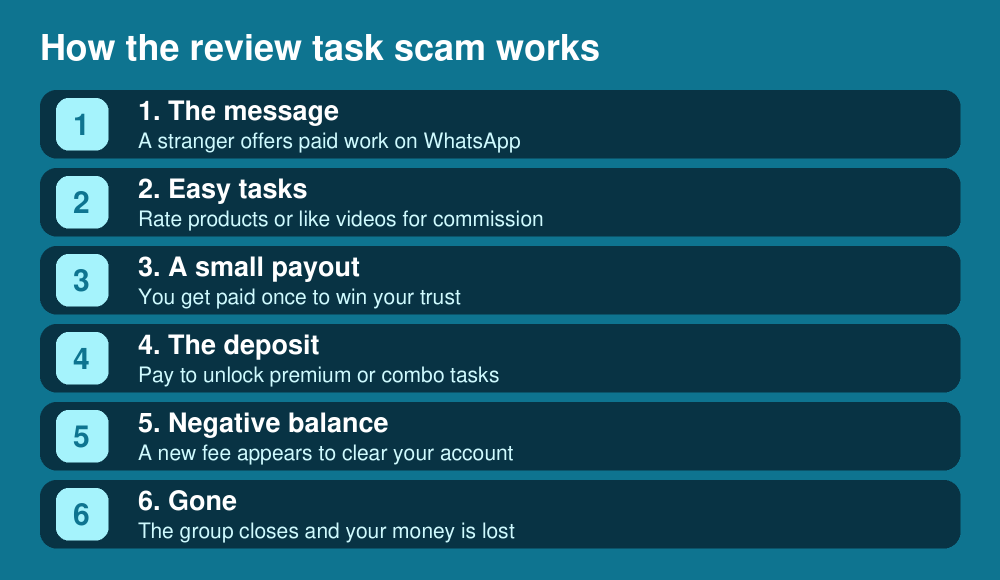
Task scams follow a script. The US Federal Trade Commission, which calls them “gamified job scams”, and the UK consumer group Which? describe the same stages, and the Nigerian versions I have seen follow them closely.
Stage one: the hook. A friendly “recruiter” contacts you, asks a few easy questions and promises daily commission for simple tasks. There is no interview, no contract you can check with a real company and no office address.
Stage two: the platform. You are moved to a Telegram group or told to register on a website or app. You get a “mentor” or “receptionist” who explains the tasks: click to rate a product, “optimise” an item, like a video or leave five stars on a hotel. Your earnings climb on a dashboard.
Stage three: the first payout. To win your trust they pay you a small amount. The FTC says this is usually 5 to 20 dollars in the US. In Nigeria people report a few thousand naira landing in their account. It feels real because the money is real.
Stage four: the deposit. Then the rules change. To withdraw, or to reach the “premium” or “VIP” level, or to finish a “combo task” that pays triple commission, you must top up your account. You are asked to send money to a personal bank account, a POS agent or, more and more, in USDT or another cryptocurrency.
Stage five: the negative balance. After you pay, the dashboard shows a negative balance, a “tax”, a “verification fee” or an “account error” that needs one more payment. Which? says balances are often made to go negative so victims keep topping up, and some are pushed to borrow from family or loan apps.
Stage six: the exit. When you stop paying, or ask too many questions, the group goes quiet, the site stops loading and your mentor blocks you. The money on the dashboard was never there.
How much people lose
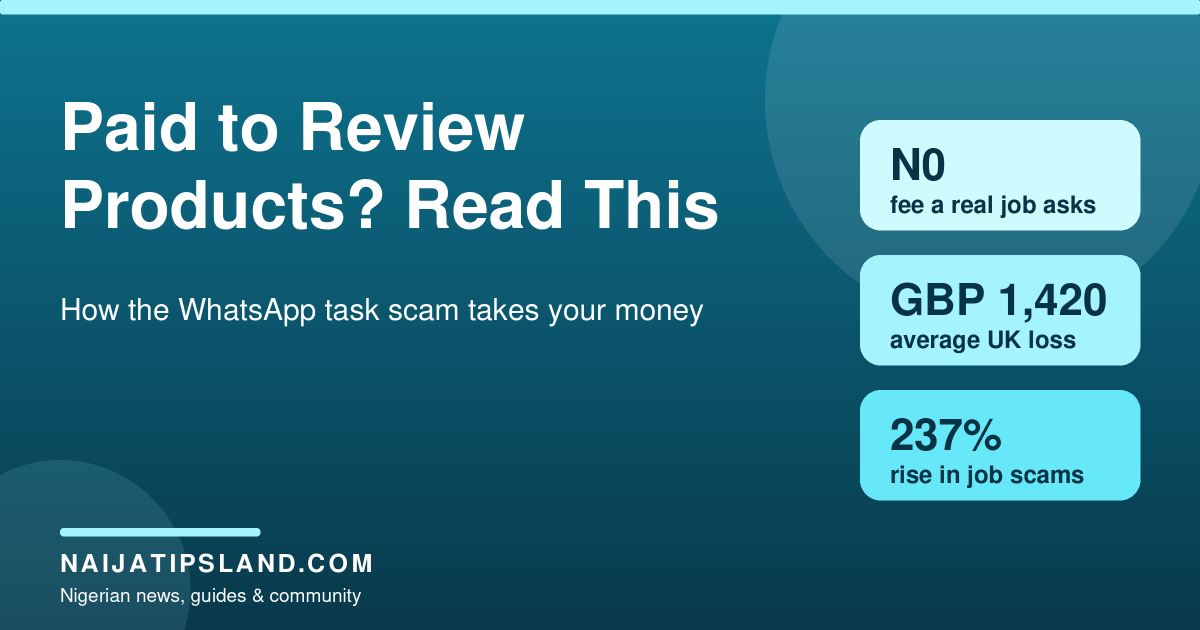
In July 2025 Which? reported Lloyds Bank figures showing a 237% rise in advance-fee job scams, with an average loss of £1,420 per victim and 7% of victims losing more than £5,000. Over half of the victims Lloyds saw were aged 18 to 34. In Nigeria, Africa Check, citing the Nigeria Inter-Bank Settlement System, put total digital payment fraud at N25.85 billion in 2025 and noted that job seekers are often targeted with fake offers on social media.
Losses climb fast because each deposit is bigger than the last. People who started with N10,000 have ended up sending hundreds of thousands, often borrowed, trying to get the earlier money back.
Warning signs to watch for
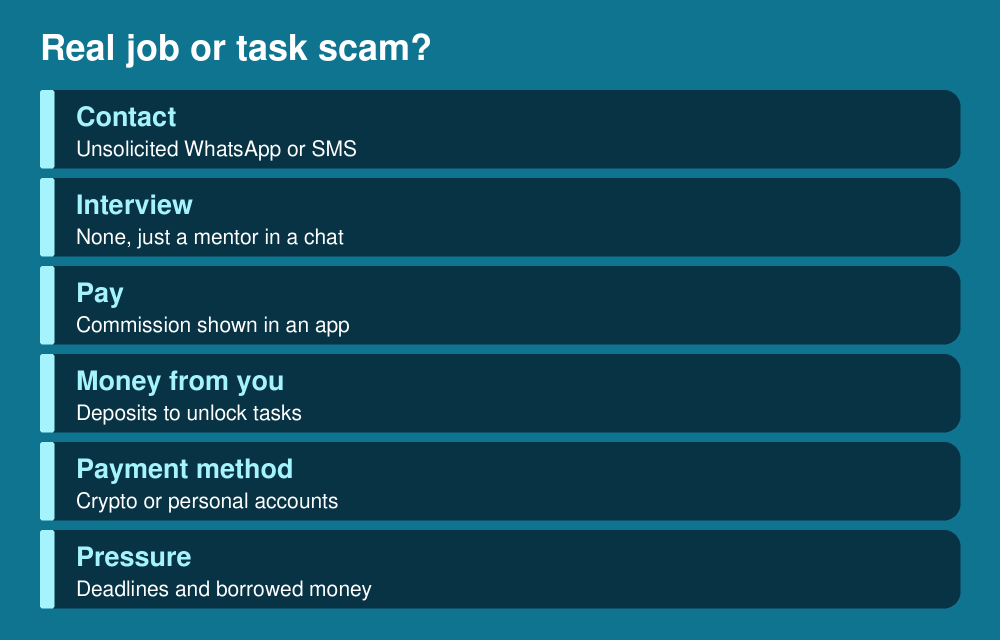
Any one of these should make you stop:
- A job offer you didn’t apply for, sent on WhatsApp, Telegram, SMS or Instagram
- Pay that is far too high for the work, such as N20,000 a day for clicking stars
- No interview, no named manager you can check on LinkedIn and no company address
- Being moved from WhatsApp to Telegram or to an app or website you have never heard of
- Any request to pay before you can earn or withdraw
- Payment to a personal account, a POS agent or in crypto
- A “combo” or “lucky order” that suddenly needs a large top-up
- Pressure: “finish within 30 minutes or your account will be frozen”
- Being asked to receive money from strangers into your own account and pass it on
That last sign needs extra attention. Which? warns that some task scam victims are used to move stolen money, which makes them money mules. In both Nigeria and the UK, letting your account be used this way can lead to your account being frozen and to criminal charges, even if you didn’t know where the money came from.
Why paid reviews are a red flag in themselves
Honest companies don’t pay strangers to post positive ratings. The FTC tells people not to trust anyone who offers to pay for positive ratings or likes. Fake reviews break the rules of Amazon, Google and most big platforms, and in the UK, the Digital Markets, Competition and Consumers Act 2024 bans businesses from commissioning or publishing fake reviews. So even if a “review job” paid you, you would be doing work the platforms ban, and accounts linked to it can be closed.
Is Amazon hiring people on WhatsApp to review products?
No. Amazon’s real review programme is Amazon Vine. According to Amazon’s own Vine help page, it is an invitation-only programme for customers whose reviews Amazon rates highly. Vine Voices get free products to review, and they are not paid to take part. There is no application form, no WhatsApp recruiter and no deposit. If someone says they are “Amazon HR” on WhatsApp, they aren’t.
Legitimate ways to earn from reviews and testing
If you enjoy giving feedback, there are real options, though none pay N20,000 a day:
- User testing sites such as UserTesting and similar platforms pay for recorded feedback on websites and apps. They have open sign-up pages, and many tests are limited by country.
- Paid survey and research panels run by market research firms pay small amounts per survey. Check reviews on Trustpilot and never pay to join.
- Content creation: honest reviews on your own YouTube, TikTok or blog can earn through ads and affiliate links. Our guides to making money from YouTube Shorts in Nigeria and making money online in Nigeria explain how.
- Freelance writing on platforms like Fiverr and Upwork, where buyers pay for product descriptions and articles, not fake ratings.
The rule that separates real from fake is simple. A real job or platform pays you. It never asks you to pay it first.
What to do if you have already paid
Act fast. The sooner the bank hears about it, the better the small chance of stopping a transfer.
- Stop paying. No “final fee” will release your money. Anyone who says they can recover it for a fee is usually part of a second scam.
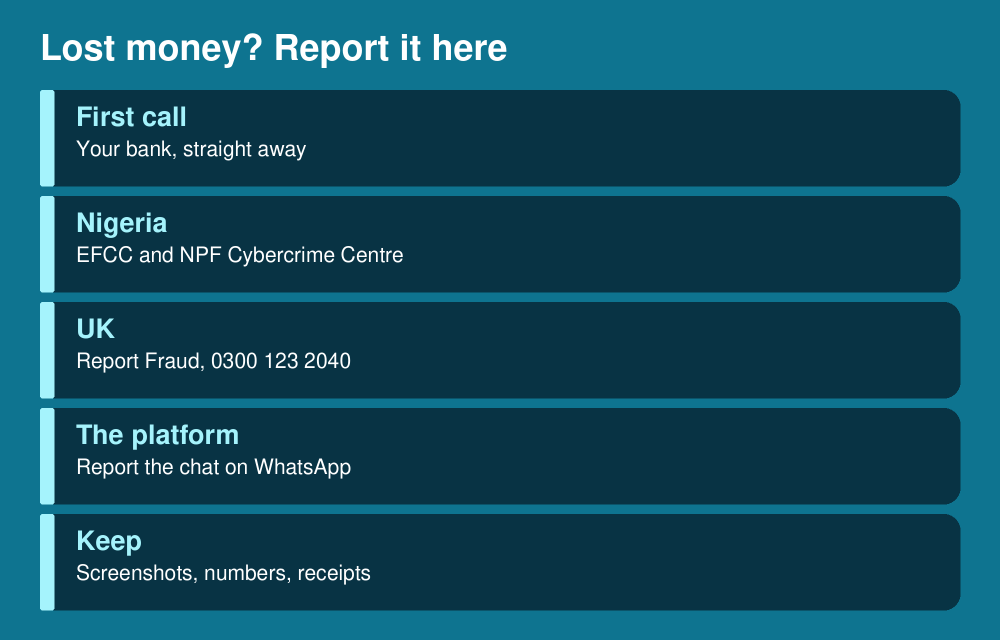
- Call your bank now. Ask them to flag the receiving account and try to recall or freeze the transfer. In Nigeria, use your bank’s official fraud line, not a number someone gives you on WhatsApp.
- Report it. In Nigeria, report to the EFCC (through its website or Eagle Eye app) and to the Nigeria Police Force National Cybercrime Centre. In the UK, report to Report Fraud, the service that replaced Action Fraud in December 2025, at reportfraud.police.uk or on 0300 123 2040. Report the number on WhatsApp too.
- Keep evidence. Screenshot the chats, the dashboard, the account numbers you paid and your bank receipts before the group disappears.
- Secure your accounts. If you shared your BVN, NIN, card details or a one-time code, tell your bank and change your passwords. Our guide on protecting your phone and bank apps from hackers covers the steps.
In the UK, banks can refund some authorised push payment fraud under the rules that took effect in October 2024, though how much you get back depends on your case and on how you paid. Crypto payments are much harder to recover.
Other “easy money” schemes to watch
The review job is one version of a bigger family. The same tricks show up in like-and-earn apps, which we covered in are task-and-earn apps legit in Nigeria, and in phone mining apps covered in are crypto mining apps on your phone legit. If an app or chat pays you to tap, like or rate and then asks for a deposit, treat it the same way.
Frequently asked questions
Are “get paid to review products” jobs on WhatsApp real?
Almost never. Unsolicited offers to rate or review products for commission are a common task scam. Real companies don’t recruit this way and don’t pay for fake ratings.
They already paid me. Doesn’t that prove it’s real?
No. The first small payment is part of the scam. It builds trust so you will make a bigger deposit later.
Is Amazon Vine a scam?
Amazon Vine is real, but it is invitation-only, unpaid and run inside your Amazon account. Nobody gets into Vine through WhatsApp or Telegram.
Can I get my money back?
Sometimes, if you report quickly to your bank. Recovery is hard once money has been moved or converted to crypto. Avoid anyone who charges a fee to recover it.
Can I get in trouble for taking part?
If your account was used to receive and pass on other people’s money, yes, it can be frozen and you may be questioned. Stop, tell your bank and report it.
What is the safest way to earn from home in Nigeria?
Build a skill people pay for, such as writing, design, coding or video editing, and sell it on known platforms. Our personal finance hub lists more options and other scams to avoid.
Sources
- FTC: How to spot and avoid task scams
- Which?: All you need to know about task scams
- Africa Check: Scam trends to watch out for in 2026
- Amazon Vine help page
- GOV.UK: Report Fraud, new service from City of London Police
- Vanguard: UK and FG warn Nigerians to verify job offers
Join the discussion
Have you tried this, or do you have a question we did not answer? Be the first to share your experience. Leave a comment below. Every comment is read by the editor before it appears.




Editor note: have you received one of these “rate products and earn” messages? Tell us what the message said and which app they tried to move you to, so other readers can spot it. Please do not post your bank details, phone number or any link the scammers sent you. – Ade