
How to Write a Personal Statement for a UK University (2027 Entry): The New 3-Question Format, Examples and Tips for Nigerian Applicants

Last updated 26 November 2026. Dates and fees are for the 2027 entry cycle. Always check the UCAS website and each university’s own page before you submit.
The personal statement is the one part of a UK university application where you speak for yourself. Your grades show what you have achieved. The statement shows why you want the course and why you are ready for it. For applicants from Nigeria, it also helps an admissions tutor understand a school system they may not know well.
The format changed for students starting in 2026, and the same format applies for 2027 entry. Gone is the free-flowing essay. You now answer three set questions. This guide explains the format, how to answer each question well, what UCAS says about using AI, the deadlines, and the things Nigerian applicants in particular should think about.
The new UCAS personal statement format
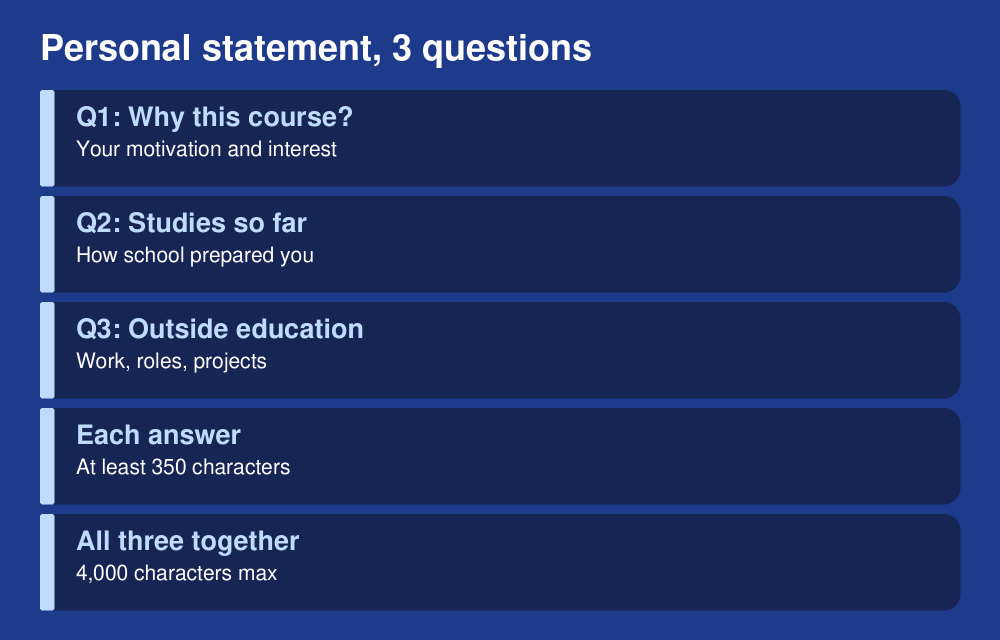
You answer three questions inside the UCAS application:
- Why do you want to study this course or subject?
- How have your qualifications and studies prepared you for this course?
- What experiences outside of education have helped you prepare, and why are they valuable?
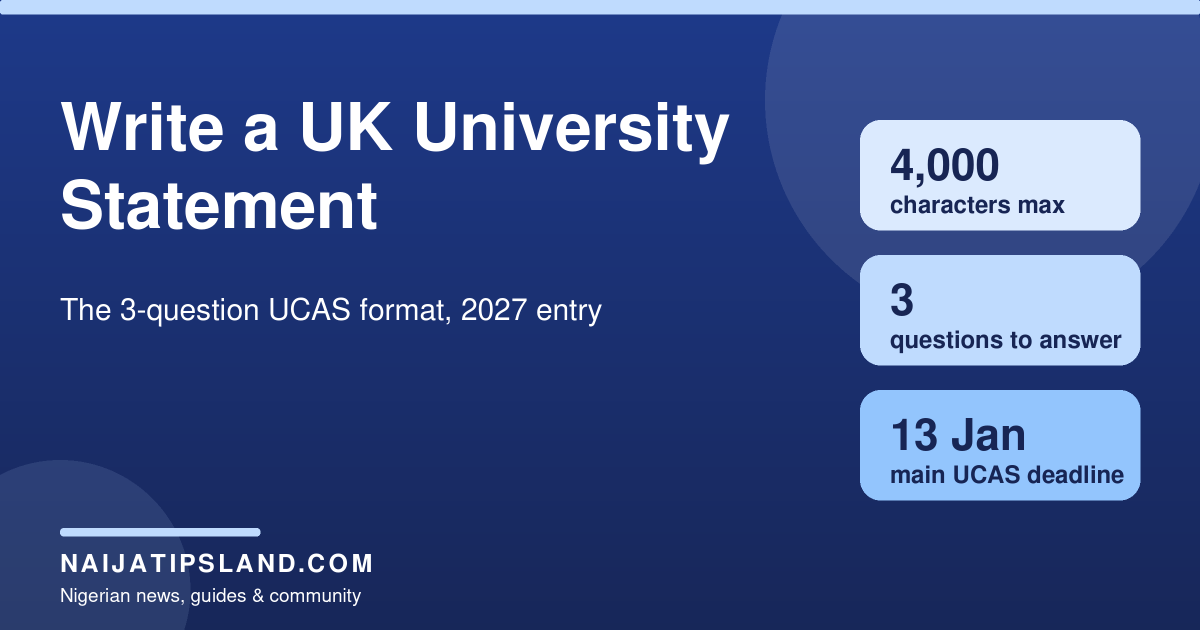
Each answer must be at least 350 characters. The three answers together cannot go over 4,000 characters, and that includes spaces. The UCAS form has a counter, so you will see as you go. You write one statement for all your choices (up to five, or six for conservatoires), so it needs to fit every course you apply for.
4,000 characters is roughly 550 to 650 words. That sounds like a lot until you start writing. Most good statements give the first question the most space, something like 40 to 50%, and split the rest between the other two.
Before you write a word
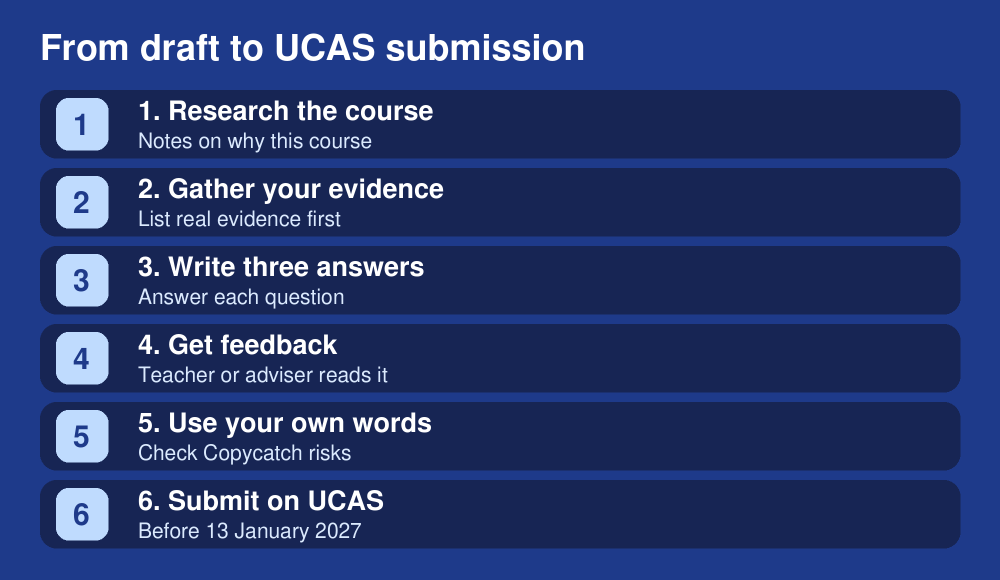
The best statements are planned. Spend an evening on this before you open a blank page.
- Read the course pages properly. Look at the modules for each university on your list. Note topics that genuinely excite you. These give you specific things to mention.
- List your evidence. Write down every book, article, podcast, project, competition, job, volunteering role, club or responsibility that connects to the subject. You will not use all of it.
- Ask “so what?” of each item. For every point, ask what you learned or what it shows about you. Tutors care about reflection, not lists.
- Check for special requirements. Some courses, such as medicine, nursing, teaching and social work, expect relevant work experience or volunteering. Read the entry requirements first.
Question 1: Why do you want to study this course?
This is the heart of your statement. Tutors want to know that your interest is real and that you understand what the course involves.
Start with the subject, not your life story. A short opening line about what drew you in works well if it is specific to you. Avoid quotes from famous people and phrases like “ever since I was young”. Admissions staff read thousands of those.
Then show how you have followed that interest. Mention a topic you read about, what you thought of it, and how it led you to want to study further. If you want to study economics, you could explain how watching the naira fall made you curious about exchange rates, which led you to read about central bank policy, and what you found surprising. That is a personal, specific reason.
Finish with where you want the course to take you, if you know. A career goal is fine, but keep the focus on the subject itself.
Question 2: How have your studies prepared you?
This is where you link your schooling to the course. Do not list your grades. They are already in the application. Instead, pick two or three subjects or projects and say what skills they gave you.
Good examples include a chemistry practical where you had to work out why your results were wrong, an extended essay or research project, a maths competition, or a subject that taught you to write clear arguments. Explain what you did and what it taught you.
For Nigerian applicants, this is also the place to give context the tutor may not have. If you did WAEC and then A levels, a foundation year or the IB, say briefly how one built on the other. If you studied a subject the course needs but your school did not offer it formally, explain how you covered the gap. Keep it factual. Your referee can add more detail in the reference.
Question 3: What experiences outside education helped?
This question covers anything outside the classroom: a part-time job, helping in a family business, volunteering, church or mosque youth roles, sport, music, coding projects, running a social media page, or caring for relatives.
The key word in the question is “valuable”. It is not enough to say you did something. Explain the skill it built and why that matters for the course. Selling at a family shop in Lagos can show you understand customers, cash flow and long hours. That is relevant to business, economics or accounting. Leading a debate club shows you can build an argument and handle pressure, which matters for law.
Two or three well-explained experiences beat a long list of activities.
What admissions tutors look for
- Genuine interest in the subject, shown through what you have read, done or thought about.
- Evidence that you understand what the course involves.
- Skills that will help you cope: independent study, time management, analysis and writing.
- Reflection. What you learned matters more than what you did.
- Clear, simple English with no spelling or grammar mistakes.
They are not looking for big words, dramatic stories or a list of every award you have won. A plain, honest statement with specific examples usually reads best.
Common mistakes to avoid
- Copying from sample statements online. UCAS checks every statement with its similarity detection system, Copycatch. Text that matches other statements gets flagged and the universities are told.
- Writing for one university only. All your choices see the same statement. Naming one university can put the others off.
- Spending too long on your childhood. Keep the focus on recent years.
- Repeating your grades. They are already in the form.
- Claiming things you cannot back up. Interviewers may ask about anything you mention, including a book you say you read.
- Mixing courses that do not fit together. If you apply for pharmacy and law, one statement cannot serve both well.
Can you use AI or ChatGPT?
UCAS has published guidance on this. In short, AI can help you plan, but it should not write your statement.
UCAS says it is fine to use AI tools to brainstorm topics, think about how to structure your answers, and check readability. It also mentions tools such as Grammarly and Microsoft Editor for checking a draft. But it says that generating and submitting all or a large part of your statement with AI “could be considered cheating by universities and colleges”. When you submit, you declare that the statement has not been copied or provided from another source.
UCAS also warns that anything not in your own words could be flagged as fraud. The consequences can include not getting offers or having offers withdrawn. Universities may ask you to talk about what you wrote at interview. The safest approach is to write every sentence yourself and use tools only to check spelling and grammar.
Deadlines and fees for 2027 entry
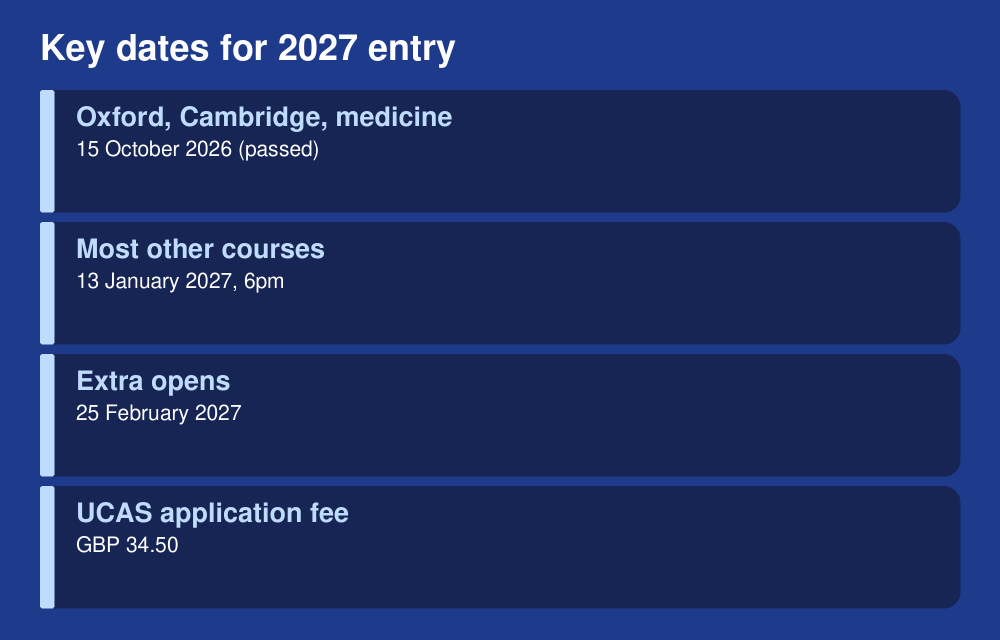
- 15 October 2026: deadline for Oxford, Cambridge and most medicine, dentistry and veterinary courses. This has passed for 2027 entry.
- 13 January 2027, 6pm UK time: the equal consideration date for most other undergraduate courses. Applications sent by then must be treated equally by universities.
- 25 February 2027: Extra opens, for applicants who have used all their choices without an offer.
- After 13 January, many universities still accept applications if they have places, and international students often apply later. Check with each university, since some popular courses fill up.
The UCAS application fee for the 2027 cycle is £34.50. That covers up to five choices, or six for conservatoire applications.
Extra tips for applicants from Nigeria
Applying from Nigeria brings a few extra things to plan for, and some of them affect what you write.
- Entry route. Many UK universities do not accept WAEC or NECO results alone for direct entry to a degree. They usually want A levels, the IB, or a recognised foundation year. Sheffield, for example, lists A levels, the IB, and foundation programmes, including the NCUK International Foundation Year run in Lagos. Check each university’s “Nigeria” entry page.
- English language. Some universities accept a WAEC English grade of C or above instead of IELTS. Sheffield is one. Others need an IELTS for UKVI or another approved test. Your statement is also proof of your written English, so take care with it.
- Your referee. Your school or college writes a reference. Ask your referee to explain your school’s grading system and any context, such as strikes or disrupted terms, that affected your studies.
- Money and visa. A strong statement will not help if you cannot meet the funding rules for a Student visa. Plan your finances early. Our guide to the cheapest UK universities for Nigerian students covers fees and living costs.
- After you graduate. If you are thinking about working in the UK afterwards, read our guide to the UK Graduate Route visa, which is changing in 2027.
- Scholarships. Some scholarships ask for a separate statement. See our guides to Chevening and the Commonwealth Scholarship, both mainly for postgraduate study.
If you are applying for a postgraduate course, the process is different. Most master’s applications go straight to the university, and each one sets its own personal statement question and length.
A simple checklist before you submit
- Each of the three answers is over 350 characters and the total is under 4,000.
- Every claim is true and you could talk about it at interview.
- You have not named a single university.
- A teacher, adviser or someone you trust has read it.
- You have read it aloud to catch clumsy sentences.
- Spelling is checked, including UK spellings if you prefer them.
- Every sentence is in your own words.
Once you arrive, our first 30 days in the UK checklist covers your NI number, GP registration and bank account.
Frequently asked questions
How long is a UCAS personal statement?
Up to 4,000 characters including spaces across all three answers, with at least 350 characters for each answer. That is about 550 to 650 words.
Do I write a different statement for each university?
No. You write one statement through UCAS and all your choices see it, so it should suit every course you apply for.
Do I need headings for the three questions?
No. The UCAS form gives you a separate box for each question, so you just answer them.
Can I apply to a UK university with WAEC only?
Usually not for direct entry to a degree. Most universities want A levels, the IB or a foundation year, though some accept WAEC English in place of IELTS. Check each university’s entry requirements for Nigeria.
Is it too late to apply for 2027?
For most courses, no. The main equal consideration date is 13 January 2027 at 6pm UK time. Oxford, Cambridge and most medicine courses closed on 15 October 2026.
Will UCAS know if I used ChatGPT?
UCAS runs similarity checks on all statements and says text not in your own words could be flagged. Universities may also question you about it. Use AI only to brainstorm or check spelling, and write the statement yourself.
Sources
- Imperial College London: Personal statement (2027 entry questions and limits)
- UCAS: A guide to using AI and ChatGPT with your personal statement
- UCAS: 2027 entry deadline for undergraduate courses
- UCAS: 2027 cycle toolkit
- UCAS: What is the application fee for the 2027 cycle?
- University of Sheffield: Entry requirements for students from Nigeria
- University of Dundee: New UCAS personal statement format
Join the discussion
Have you tried this, or do you have a question we did not answer? Be the first to share your experience. Leave a comment below. Every comment is read by the editor before it appears.





Editor note: are you applying to a UK university for 2027, or helping a child or student apply? Tell us which course and which part of the personal statement you are finding hardest. Please do not post your full statement here, because copied text can be flagged by UCAS. – Ade