
Commonwealth Scholarship for Nigerians (2027/28): Eligibility, Funding and How to Apply

Last updated 15 November 2026. Commonwealth Scholarship rules, amounts and dates change every round, and Nigerian nominators set their own requirements. Always confirm details on the official Commonwealth Scholarship Commission (CSC) website and with your nominator.
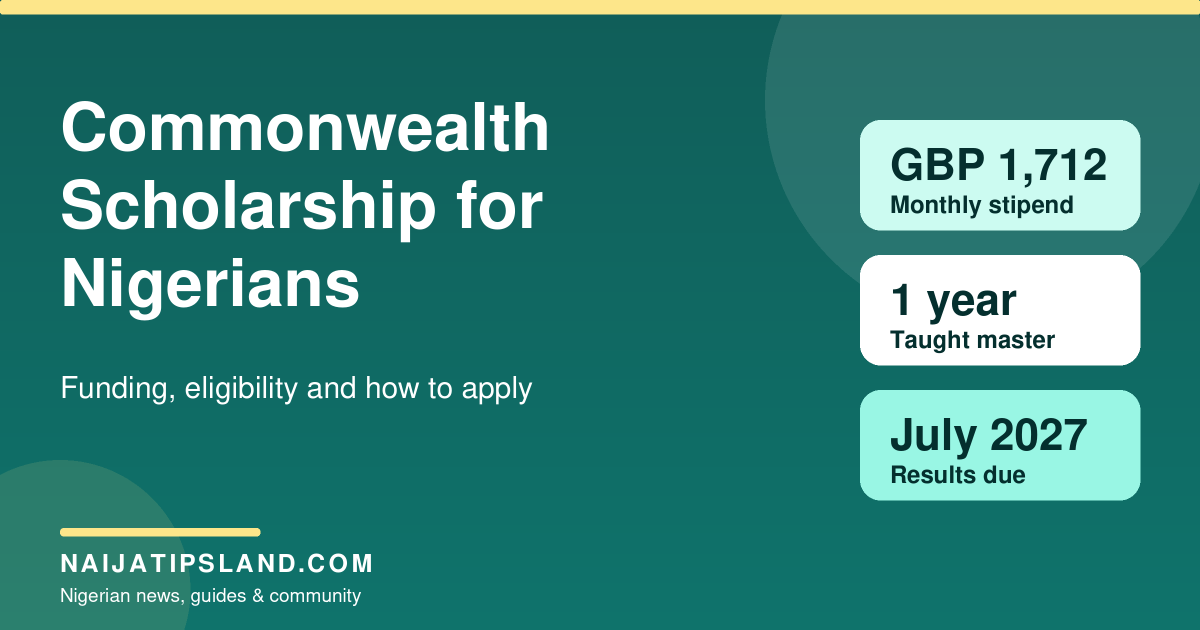
The Commonwealth Scholarship is one of the few UK awards that pays for a full master’s or PhD, tuition and living costs included, and Nigeria is on the eligible list. It is also one of the easiest to miss, because Nigerians cannot simply apply online and wait. You need a nominator first. The 2027/28 round closed on 20 October 2026, so this guide does two jobs: it explains exactly how the scheme works for a Nigerian applicant, and it tells you how to be ready when the next round opens.
What is the Commonwealth Scholarship?
The scholarships are funded by the UK government through the Foreign, Commonwealth and Development Office and run by the Commonwealth Scholarship Commission. They are meant for talented people from eligible Commonwealth countries who could not afford to study in the UK without help, and who are likely to contribute to development when they return home.
Several schemes sit under the Commonwealth banner. The two that matter most for Nigerians are the Commonwealth Master’s Scholarships and the Commonwealth PhD Scholarships. A third, the Commonwealth Shared Scholarships, is co-funded with UK universities for one-year master’s study. The CSC has also run distance learning and split-site awards, though UK universities have reported the split-site scheme as under review.
What does the master’s award cover?
According to the CSC’s page for the 2027/28 round, a Commonwealth Master’s Scholarship covers:
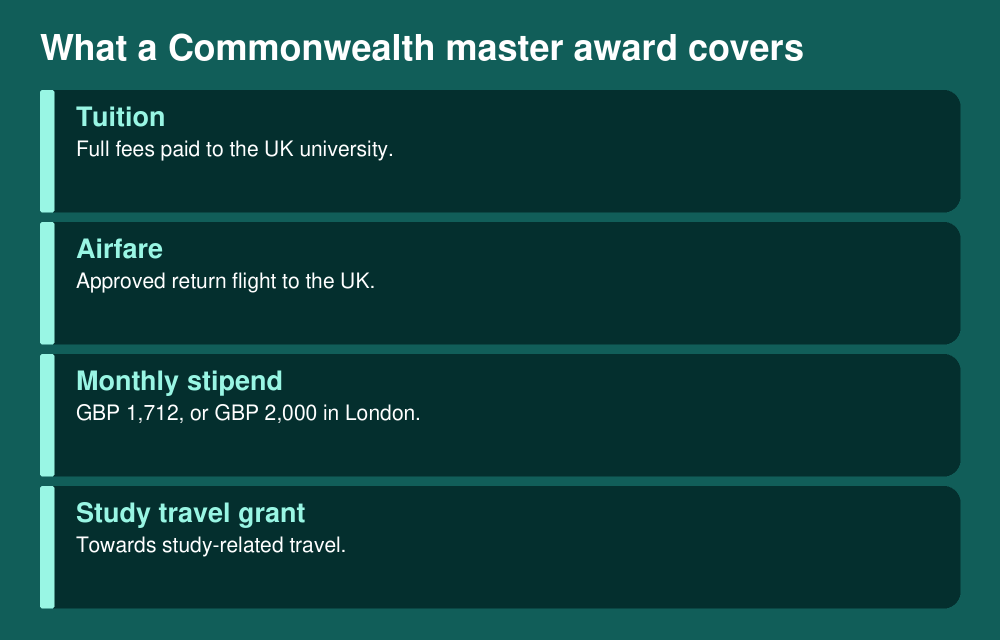
- Tuition: full fees, agreed between the CSC and the university.
- Airfare: an approved return flight between Nigeria and the UK. Fares for dependants and journeys made before the award is confirmed are not reimbursed.
- Stipend: £1,712 a month, or £2,000 a month at universities in the London area, at current rates.
- Study travel grant: towards study-related travel in the UK or overseas.
- Extra support: a child allowance for eligible single, widowed or divorced Scholars with children under 16 living with them in the UK, and a needs assessment for Scholars with a disability.
The scheme funds one-year, full-time taught master’s degrees only. It does not fund MBAs. That detail catches out applicants who choose the wrong course and discover it only after they have been admitted.
For the PhD scheme, the CSC aimed it at least developed countries and fragile states, and Nigeria is one of 17 countries on the list. Awards last 36 months. Check the CSC’s PhD page for the current stipend and benefits, because they differ from the master’s.
Who can apply from Nigeria?
For the master’s scheme the CSC set these rules for the 2027/28 round:
- You are a Nigerian citizen, or have refugee status in Nigeria, and live in Nigeria permanently.
- You can start your UK course by September 2027.
- By September 2027 you hold a first degree at upper second-class (2:1) level, or a lower second-class degree plus a relevant postgraduate qualification, usually a master’s.
- You cannot afford to study in the UK without the scholarship.
- You have not already studied at master’s level in a UK institution or held a Commonwealth Master’s Scholarship. A second master’s needs a strong justification.
The CSC says selection looks at three things: your merit, including academic experience, the quality of your research proposal, and your potential impact on Nigeria’s development. That third point is worth thinking about early. A personal statement that talks only about what you will gain is weaker than one that shows how you will use the degree at home.
The Nigerian twist: you need a nominator
The CSC does not accept direct applications. You apply twice: once to a nominating body, and once on the CSC’s online system, CSC Central, naming that body as your nominator. Nominators set their own rules and often close before the CSC does.
Federal Scholarship Board
The CSC lists the Federal Scholarship Board (FSB) of the Federal Ministry of Education as Nigeria’s national nominating agency. According to reports on the 2027/28 round from OpportunityNest, the FSB asked for a 2:1 for master’s applicants, a relevant master’s plus at least a 2:2 first degree for PhD applicants, evidence of admission to at least two UK institutions, proof of National Youth Service Corps service and, for shortlisted candidates, a printed copy of the application at interview. I could not check the FSB advert itself, so treat that list as a guide and read the current notice when it appears.
FAWE, for women
The Forum for African Women Educationalists (FAWE) was also chosen as a nominating agency for 2027. Its call named Nigeria for both master’s and PhD nominations, said applicants must select FAWE as their nominating agency, and was aimed at female candidates from its listed countries. If you are not eligible under FAWE’s criteria, do not apply through it.
Other nominators
The CSC also approves some NGOs and charities as nominators, and PhD applicants may be nominated through UK universities in certain cases. Check the CSC’s nominating agencies page for the full list.
How to apply: step by step
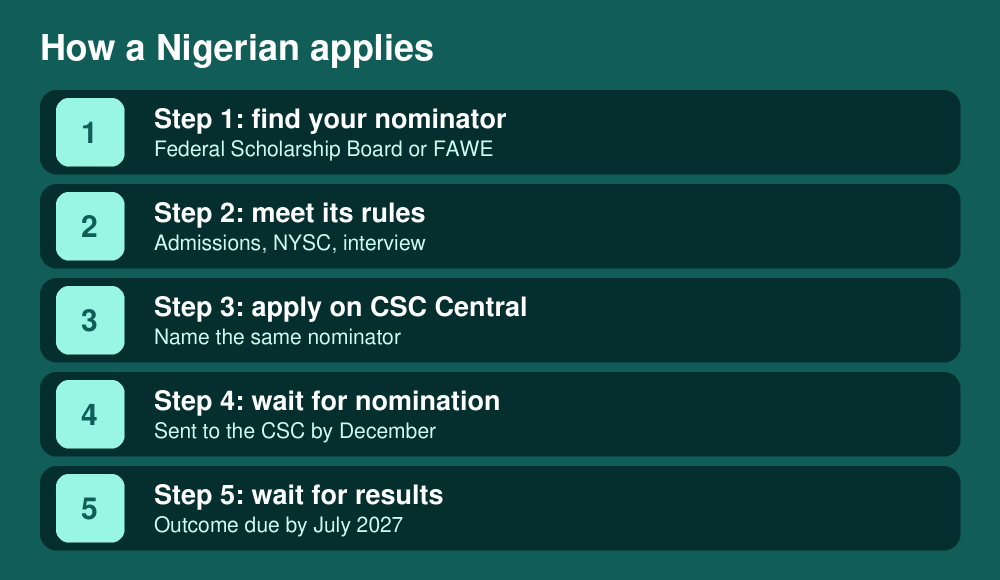
- Find your nominator early. Read the Federal Scholarship Board’s notice, or FAWE’s if you qualify. Write down its closing date, which may be earlier than the CSC’s.
- Prepare your documents. The CSC asks for a passport or national ID, full transcripts with certified translations if they are not in English, and at least two signed PDF references. Ask your referees well in advance.
- Get admission offers. The FSB reportedly wanted evidence of admission to at least two UK institutions, so start university applications before the scholarship window opens.
- Apply to your nominator using its own form and process, and attend any interview.
- Apply on CSC Central and name the same nominator. Registration uses two-factor authentication, so have your phone ready, and submit early because the system gets busy near the deadline.
- Wait. Nominators send their shortlisted candidates to the CSC, and the CSC selects the winners and tells applicants by email.
2027/28 timeline and what comes next
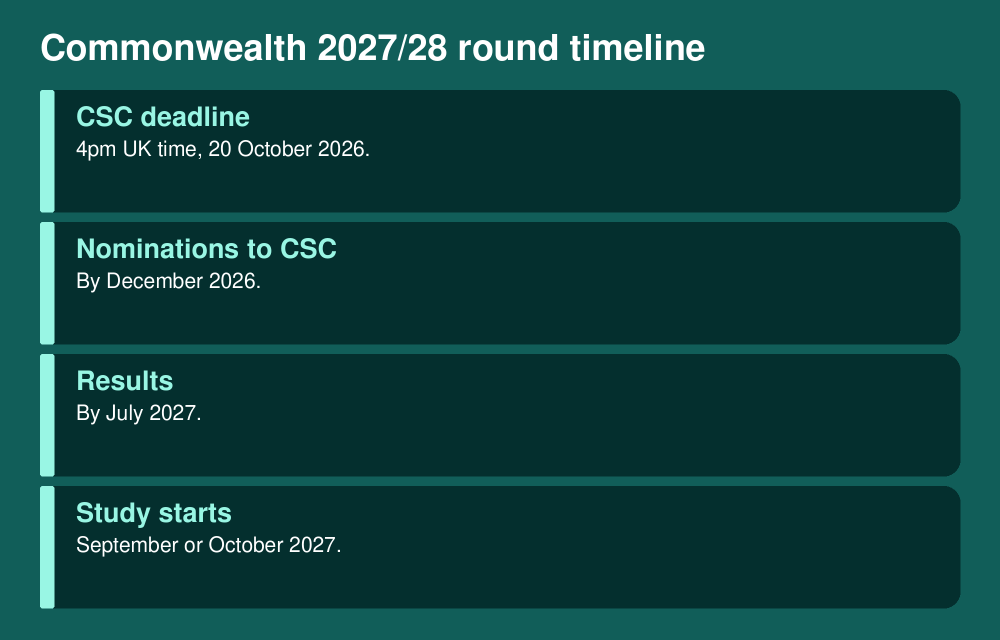
For the 2027/28 round, applications closed at 4pm UK time on Tuesday 20 October 2026, which is also 4pm in Nigeria. Nominators were due to send their candidates to the CSC in December 2026, with outcomes by July 2027 and study starting in September or October 2027. The CSC’s page does not yet give dates for the next main round. OpportunityNest also reports that the Shared Scholarships were scheduled to open in early November and close in mid-December 2026. Check the CSC site directly, because that is a secondary report.
If the pattern holds, expect the next round to open in late summer and close in October 2027, which means your preparation should start now. A sensible plan for the next eleven months:
- Now to January: shortlist UK master’s courses that fit your career and are one-year taught programmes.
- February to May: apply for university admission and request references.
- June to August: draft your personal statement and research proposal, and collect your NYSC and degree documents.
- From the opening date: follow your nominator’s notice closely and submit weeks before the deadline.
Commonwealth or Chevening?
Chevening is another UK government scheme, but you apply to it directly and it expects at least two years of work experience. Commonwealth needs a nominator and stresses financial need and development impact. Read our Chevening scholarship guide for Nigerians and the wider roundup of scholarships for Nigerian students abroad to compare, and see our guide to the DAAD scholarship for Germany if you are open to studying outside the UK.
Avoiding scams
Fake scholarship offers circulate every year. The CSC says it does not charge candidates to apply through its online system. Do not pay agents who promise a guaranteed Commonwealth award, be wary of emails from addresses that do not match the official CSC domain, and always start from the CSC website rather than a link in a message. A nomination is also not a scholarship offer, because the CSC makes the final selection.
Frequently asked questions
Can Nigerians apply for the Commonwealth Scholarship?
Yes. Nigeria is eligible for the Master’s and PhD scholarships, but you must be nominated by an approved body such as the Federal Scholarship Board.
Is the 2027/28 Commonwealth Scholarship still open?
The Master’s and PhD rounds closed on 20 October 2026. The CSC has not yet published dates for the next round, so keep checking its website.
How much is the Commonwealth Scholarship stipend?
The CSC lists £1,712 a month, or £2,000 a month for universities in the London area, at current rates for the master’s scheme. Amounts can change each round.
Can I apply directly to the CSC?
No. The CSC does not accept direct applications. You need a nominator and must also apply on CSC Central.
Do I need IELTS?
Reports say the CSC does not require IELTS, but your chosen UK university may ask for English test results. Confirm with each university.
Is there an application fee?
The CSC says it does not charge to apply through its online system. Do not pay any person or agency to secure a place.
Can women apply through a different route?
Women may apply through FAWE if they meet its criteria, which named Nigeria for both master’s and PhD nominations in its 2027 call.
Sources
- Commonwealth Scholarship Commission: Commonwealth Master’s Scholarships
- OpportunityNest: Commonwealth Scholarship 2027–28, eligibility and timeline
- OpportunityNest: Scholarships for Nigerian students, 2027 status
- FAWE: Call for nominations, Commonwealth Scholarships 2027
- ExamScholars: Commonwealth Scholarships 2027/28 and FAWE
- WithinNigeria: Overseas scholarships Nigerians should watch (6 October 2026)
Join the discussion
Have you tried this, or do you have a question we did not answer? 1 reader has already shared their view. Naijatipsland members help each other with real, first-hand experience.






Editor’s note: the 2027/28 Commonwealth round has closed, so this guide is mainly for planning the next one. Dates, amounts and Nigerian nomination rules change each year, so confirm everything with the CSC and your nominator before you apply. – Ade