

Last updated: 13 November 2026 · By Naijatipsland Editorial Team · Editorial policy
Gut health has become one of the most talked-about wellness topics, and the internet is full of detox teas, expensive probiotic capsules and “gut reset” plans. The honest picture from dietitians and researchers is simpler and cheaper: what you eat, how varied it is, and how you live matter more than any bottle.
This guide explains what “gut health” actually means, what the evidence says about fibre, plant variety, fermented foods and probiotics, which everyday Nigerian foods can help, a gentle four-week plan, and the symptoms that mean you should see a doctor. It is general information, not medical advice. If you have a long-term condition, please check with your doctor or a dietitian before changing your diet.
What is gut health?
Your gut, or digestive system, breaks down food, absorbs nutrients and moves waste out of the body. It is also home to trillions of microorganisms, collectively called the gut microbiota. These bacteria help you digest fibre, support your immune system and make some vitamins. When people talk about a “healthy gut”, they usually mean regular, comfortable digestion and a varied, balanced community of gut bacteria.
The British Dietetic Association (BDA) notes that the balance of gut bacteria can be disrupted by ageing, antibiotics, illness, food poisoning and gut surgery. That is one reason a good diet is worth building before problems start.
1. Eat more fibre, slowly
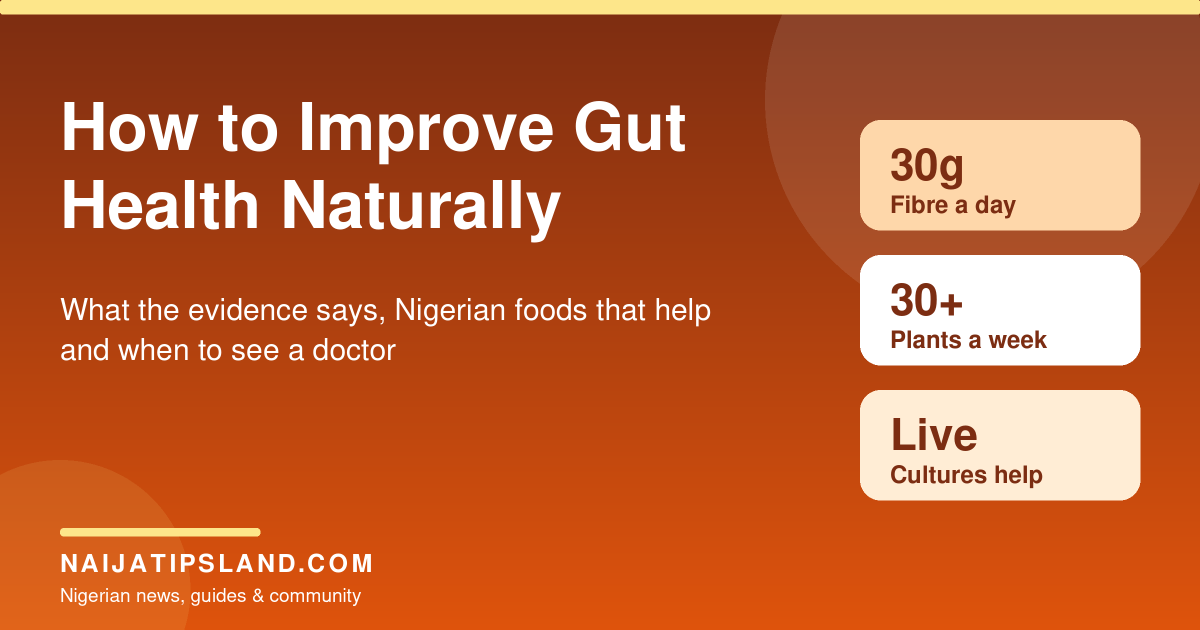
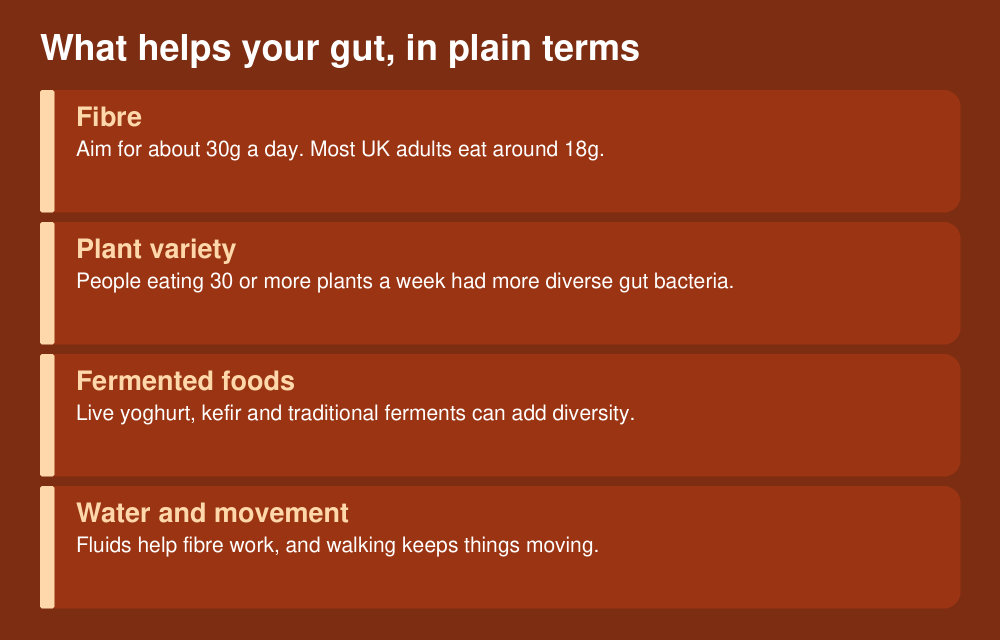
Fibre is the main fuel for your gut bacteria and the best-supported way to look after your digestion. The BDA says adults are recommended to get around 30g of fibre a day, but that adults in the UK currently eat only about 18g, roughly 60 percent of what they should. According to the BDA, eating a range of fibre can improve the diversity of your gut microbiota, ease constipation, support your immune system and reduce inflammation in the gut.
Good everyday sources include beans, lentils, peas, oats, wholemeal bread and pasta, fruit with the skin on, vegetables, nuts and seeds. Two practical rules:
- Go slowly. Raise fibre gradually over a few weeks, because a sudden jump can cause bloating, wind and cramps.
- Drink enough fluid. Fibre draws water into the bowel, so you can end up constipated if you do not drink enough.
2. Eat a wider variety of plants
Different plants feed different gut bacteria. In the American Gut Project, a large citizen-science study, people who ate more than 30 different types of plants a week had more diverse gut microbiomes than people who ate 10 or fewer, and this was true whatever their overall diet type. Plants counted include vegetables, fruit, whole grains, beans, nuts, seeds, herbs and spices.
This was an observational study, so it shows an association, not proof that variety causes better health. But it supports a low-cost habit: instead of eating the same few foods every day, rotate your beans, vegetables, grains, fruit and spices. A pot of stew with tomatoes, peppers, onions, ugu, beans and a mix of spices already counts for many plants.
3. Add fermented foods
Fermented foods are made by microbes breaking down the sugars in food. Yoghurt with live cultures, kefir, sauerkraut and kimchi are common examples, and many traditional Nigerian foods are also fermented.
The best-known trial was run by Stanford researchers and published in the journal Cell in 2021. It followed 36 healthy adults for 10 weeks. People who ate more fermented foods had greater microbial diversity and lower levels of 19 inflammatory proteins in the blood. Interestingly, the group told to eat more fibre did not see the same short-term change in diversity or inflammation, although the researchers stressed that this was a proof-of-concept study over a short time and that fibre has other benefits. A longer period might have been needed for the gut to adapt.
The takeaway is not to drop fibre. It is that fibre and fermented foods may work in different ways, and eating both is a sensible approach. If you choose fermented foods, pick products with live or active cultures on the label and keep hygiene in mind with homemade ferments.
4. Do you need probiotics or prebiotics?
Probiotics are live microorganisms found in some foods and supplements. Prebiotics are the food those microbes feed on, such as onions, garlic, asparagus and chicory root. The BDA’s position is cautious:
- If you are healthy, a probiotic supplement is unlikely to help.
- There is some evidence that certain probiotics may reduce the risk of antibiotic-associated diarrhoea, help with some constipation and bloating, and reduce travellers’ diarrhoea.
- Results differ between products, so the BDA suggests a trial of around four weeks and stopping if there is no benefit.
- People with a weakened immune system should speak to a doctor or dietitian first.
Most people get more benefit from spending money on beans, vegetables and wholegrains than on expensive capsules.
5. Look after the lifestyle factors too
- Move your body. Regular walking and exercise help food move through the gut and can ease constipation.
- Sleep and stress. Gut and brain are closely linked, which is why stress often shows up as stomach trouble. Our guide to natural ways to improve sleep and reduce stress covers simple habits that help.
- Go easy on alcohol and ultra-processed foods. A diet built mostly on packaged snacks, sugary drinks and processed meat usually crowds out fibre and variety.
- Use antibiotics only when prescribed. They are lifesaving when needed, but they also disturb gut bacteria, so never take leftover antibiotics or buy them without a prescription.
Nigerian foods that can support gut health
You do not need imported superfoods. Many everyday Nigerian foods are rich in fibre or plant variety:
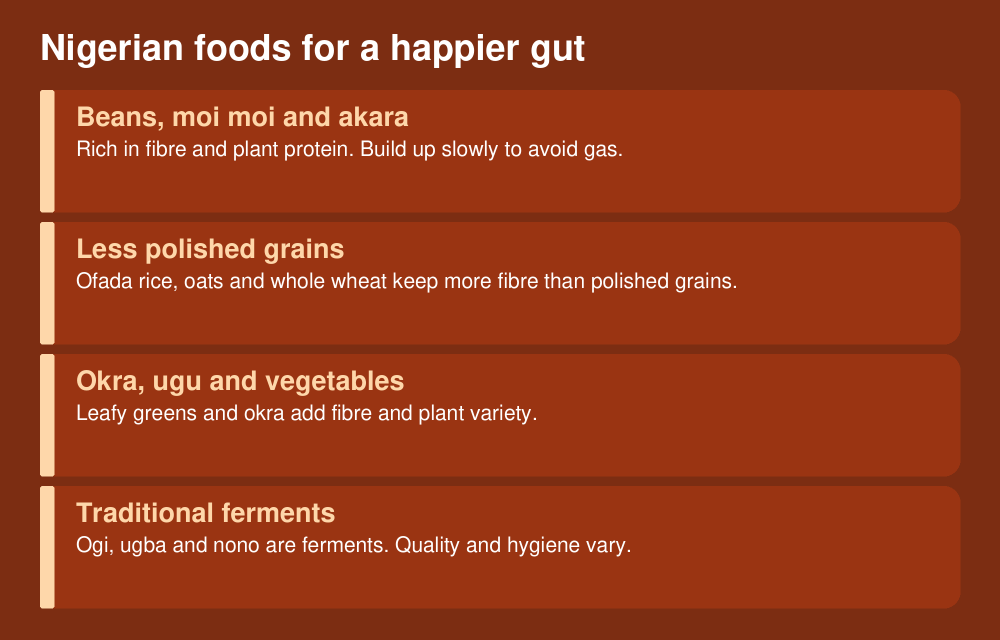
- Beans, moi moi and akara: a good source of fibre and plant protein. If beans give you wind, start with small portions and build up, and soak and cook them well.
- Okra, ugu, spinach and other vegetables: they add fibre and plant variety to soups and stews.
- Less polished grains: ofada rice, oats, whole wheat and brown rice generally keep more fibre than highly polished white rice or refined flour.
- Fruit with the skin on: pawpaw, oranges, guava, apples and pears are easy ways to add fibre.
- Nuts and seeds: groundnuts, melon seeds (egusi) and pumpkin seeds add fibre and healthy fats.
- Traditional ferments: ogi (fermented maize pap), ugba and iru (fermented seeds) and nono (fermented milk) are all part of Nigerian food culture. Evidence on their health effects in people is still limited, and quality varies, so buy from trusted sources, look for NAFDAC-registered packaged products and avoid anything that smells or looks off. Ogi made from refined maize is also low in fibre, so serve it with beans or vegetables.
Watch the extras too: sweetened drinks such as zobo or kunu can carry a lot of added sugar. For more on Nigerian foods and the evidence, see our guides to traditional Nigerian foods and their health benefits and managing high blood pressure with a healthy Nigerian diet.
A gentle four-week plan to start
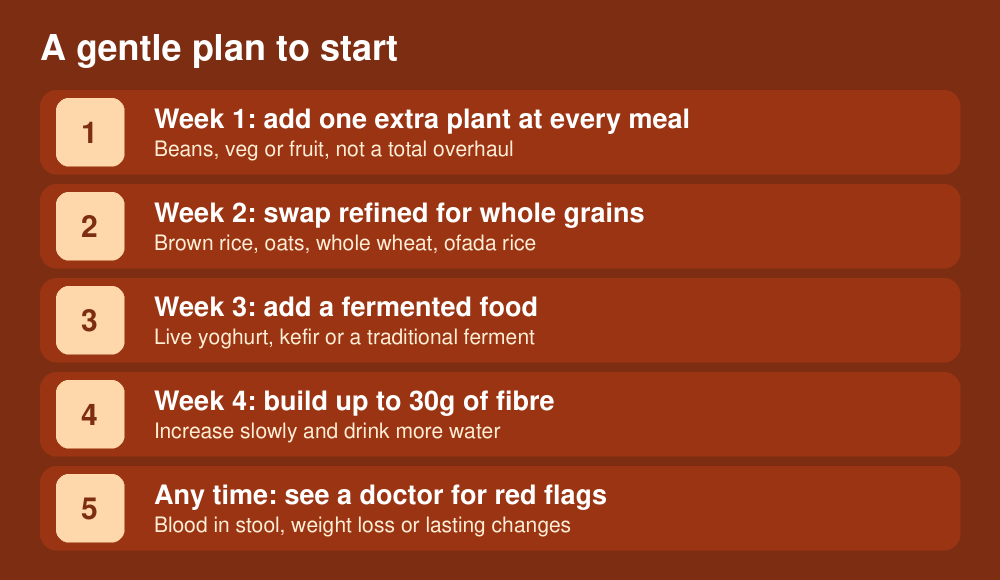
- Week 1: add one extra plant to every meal. A handful of vegetables in your soup, a portion of beans, or a piece of fruit at breakfast.
- Week 2: swap refined for whole. Try oats, brown rice, ofada rice or wholemeal bread in place of the most refined options.
- Week 3: add one fermented food, such as live yoghurt, kefir or a trusted traditional ferment.
- Week 4: work towards about 30g of fibre a day, spread across meals, and keep drinking water. Keep a food diary if you want to count your weekly plant variety.
If any step causes pain, bloating or diarrhoea that will not settle, slow down or speak to a pharmacist or doctor.
When to see a doctor
Diet changes are for general digestive health. They are not a substitute for medical care. The NHS says you should see a GP if you notice any of these, particularly if they last or are unusual for you:
- blood in your poo, which may look red or black
- a change in your bowel habit that is not usual for you, such as softer poo, diarrhoea, constipation, or going more or less often
- losing weight without trying
- feeling very tired or short of breath, which can be a sign of anaemia
- tummy pain, a lump in the tummy, or a feeling of needing to poo even straight after going
These symptoms do not always mean something serious, but they should be checked. People with conditions such as inflammatory bowel disease (Crohn’s disease or ulcerative colitis) or irritable bowel syndrome (IBS) may need different dietary advice, and extra fibre is not always right for them, so ask your doctor or a dietitian.
Related guide (updated 13 November 2026)
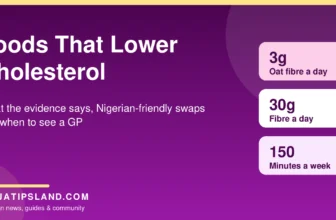
Foods That Lower Cholesterol sets out what the NHS and British Heart Foundation say about oats, beans, nuts, oily fish and unsaturated oils, Nigerian-friendly swaps, a four-week plan and when to see a GP.
Frequently asked questions
What is the fastest way to improve gut health?
There is no quick fix. The best-supported steps are eating more fibre gradually, eating a wider variety of plants, drinking enough fluid and staying active. Expect to give changes several weeks.
Do I need to take probiotics?
Not if you are healthy. The BDA says a probiotic supplement is unlikely to help healthy people. They may help in specific situations, such as preventing diarrhoea from antibiotics, so speak to a dietitian or doctor.
How much fibre should I eat each day?
The BDA says adults should aim for around 30g of fibre a day. Most adults in the UK currently eat about 18g, so most people need to increase gradually.
Are Nigerian fermented foods good for the gut?
They are part of a traditional diet and contain live microbes, but there is little high-quality human research on specific foods like ogi, ugba or nono. Choose safe, hygienic products and treat them as one part of a varied diet.
Do detox teas and gut cleanses work?
There is no good evidence that they do. Your gut, liver and kidneys already clear waste, and strong laxative teas can cause dehydration and cramps. A high-fibre, varied diet is safer.
This article is for general information and is not a substitute for medical advice. Please see a doctor, pharmacist or dietitian about your own health.
Sources
- British Dietetic Association: Fibre food fact sheet
- British Dietetic Association: Probiotics and gut health
- Stanford Medicine: Fermented-food diet increases microbiome diversity and lowers inflammation (Cell, 2021)
- ScienceDaily: American Gut Project and plant variety (2018)
- NHS: Bowel cancer symptoms
Join the discussion
Have you tried this, or do you have a question we did not answer? 1 reader has already shared their view. Naijatipsland members help each other with real, first-hand experience.








Editor’s note: this guide is general health information, not a diagnosis. If you have ongoing tummy pain, blood in your stool, unexplained weight loss or a lasting change in your bowel habit, please see a doctor rather than trying supplements or detoxes. – Ade