
How to Improve Your Credit Score in Nigeria (2026): Check Your Report, Fix Errors and Build Credit

Last updated: 8 November 2026 · By Naijatipsland Editorial Team · Editorial policy
If a bank, fintech or loan app has ever turned you down without a clear reason, your credit record may be part of the answer. Nigeria now has a regulated credit reporting system, and lenders increasingly check it before they say yes. This guide explains how credit scores and credit reports work in Nigeria, how to get your own report, what actually moves your score, and how to fix mistakes. Checked 8 November 2026. Scoring scales, fees and free-report arrangements differ between bureaus and lenders and can change, so confirm the details with the bureau or lender you are dealing with. This is general information, not financial advice.
What a credit score is, and what it is not
A credit report is a record of your borrowing history: loans, overdrafts, credit facilities, repayments and any defaults, held by a licensed credit bureau. A credit score is a number the bureau (or a lender) calculates from that record to estimate how likely you are to repay on time. Scores are usually shown on a 300 to 850 style scale, but each bureau and lender can use its own model, so a score from one source will not match another exactly. What matters most is the report underneath the number.
Your score is not a measure of how much money you have. A salary earner with no borrowing history can have a thin file, while someone with modest income who repays small loans on time can build a strong one.
Who keeps your credit record in Nigeria
Lenders such as banks, microfinance banks and licensed digital lenders report customer borrowing data to credit bureaus licensed by the Central Bank of Nigeria (CBN). The private bureaus most people meet are CRC Credit Bureau, CreditRegistry and FirstCentral. The CBN also runs a Credit Risk Management System (CRMS) that banks report larger facilities to, and CRC states that this data feeds into its reports. The legal framework is the Credit Reporting Act 2017, which sets out how bureaus collect data, how long they keep it and the rights you have over your own file.
Your Bank Verification Number (BVN) is the key that links your records across lenders, so make sure yours is correct. Our guide on how to check your BVN and link it to your bank accounts is covered in the related guides below. CRC says its reports show six years of credit history and that the CBN requires it to keep credit history for ten years, so old problems do not vanish quickly. It also says it cannot delete accurate information on request, but errors can be corrected.
How to get your credit report
You are generally entitled to a copy of your credit report from the bureaus, and nairaCompare reports that you can get one free report a year from each major bureau. Procedures change, so go to each bureau’s official website or app rather than a link from social media or a messaging group.
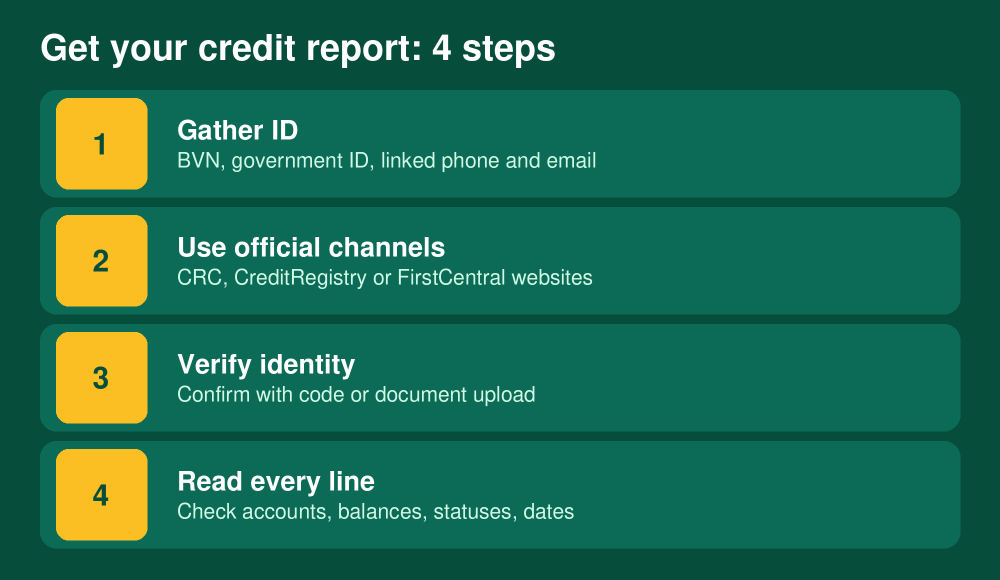
- Gather ID: your BVN, a valid government ID (NIN slip, international passport, driver’s licence or voter’s card) and the phone number and email linked to your accounts.
- Apply through the bureau’s official channel: CRC Credit Bureau, CreditRegistry and FirstCentral each publish their own consumer request process on their websites.
- Verify your identity: expect to confirm details through a code or document upload.
- Read the whole report: check every account, balance, status and date, not only the score.
- Repeat with each bureau: lenders may report to different bureaus, so one report may show what another does not.
Be careful of anyone who asks you to pay a stranger for a “credit clearance” or to send them your BVN and OTP. A legitimate bureau will not ask for your card PIN, your bank password or an OTP. See how to check that a bank, fintech or loan app is licensed before you share documents with any lender.
What affects your score
Models differ, but lenders and bureaus consistently look at the same five things.
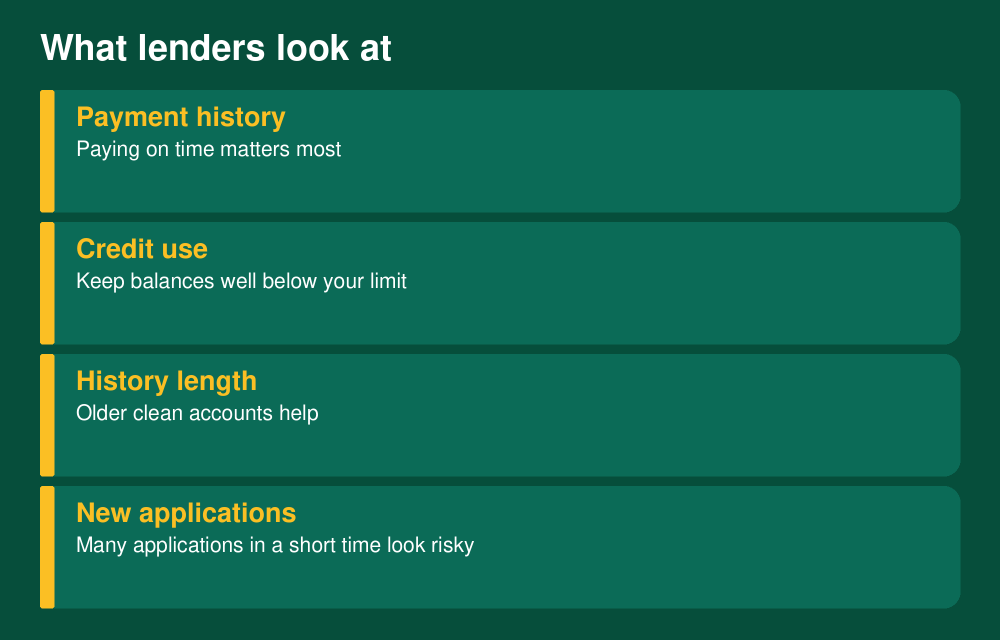
- Payment history: paying on time is the single biggest factor. One missed instalment can stay on your record for years.
- How much of your limit you use: a card or overdraft that is nearly maxed out looks risky. Many guides suggest staying under roughly 30 percent of your limit where you can.
- Length of history: older accounts with a clean record help.
- Mix of credit: a sensible blend of, say, a salary loan and a card is viewed better than only short, high-cost loans.
- New applications: lots of loan applications in a short time can look like financial stress.
How to improve your credit score in Nigeria: a practical plan
Rebuilding credit is slow and there is no legitimate shortcut. A realistic plan looks like this.
- Get your reports first so you know exactly what lenders see.
- Stop new damage. Pay at least the minimum on every facility by its due date. Set standing orders or direct debits a few days before the due date so a late salary does not trip you up.
- Clear arrears and defaults. Talk to the lender, agree a repayment plan and get any settlement terms in writing. Ask for confirmation that the lender will update the bureau once you have paid.
- Bring balances down. Paying overdrafts and card balances below your limit helps over the following months.
- Borrow small and repay early. If you have a thin file, a small, affordable facility repaid on schedule builds history. Only borrow what you can afford; never take a loan just to improve a score.
- Do not apply everywhere. Space out applications.
- Keep your details consistent. The same name spelling, date of birth, phone number and BVN across banks and apps reduces mismatches.
- Re-check every few months. Improvement usually takes many months rather than weeks, and a serious default takes longer.
Loan apps and your credit record
Some digital lenders report to bureaus, so a missed loan-app repayment can end up on your record. Before borrowing, confirm the lender is approved, read the total cost and keep proof of every repayment. Our guide on loan apps in Nigeria: how to check if one is approved and report harassment explains how to do that. Harassment or contacting your phone contacts is a regulatory issue you can report, and does not remove your duty to repay a genuine debt.
How to dispute a mistake
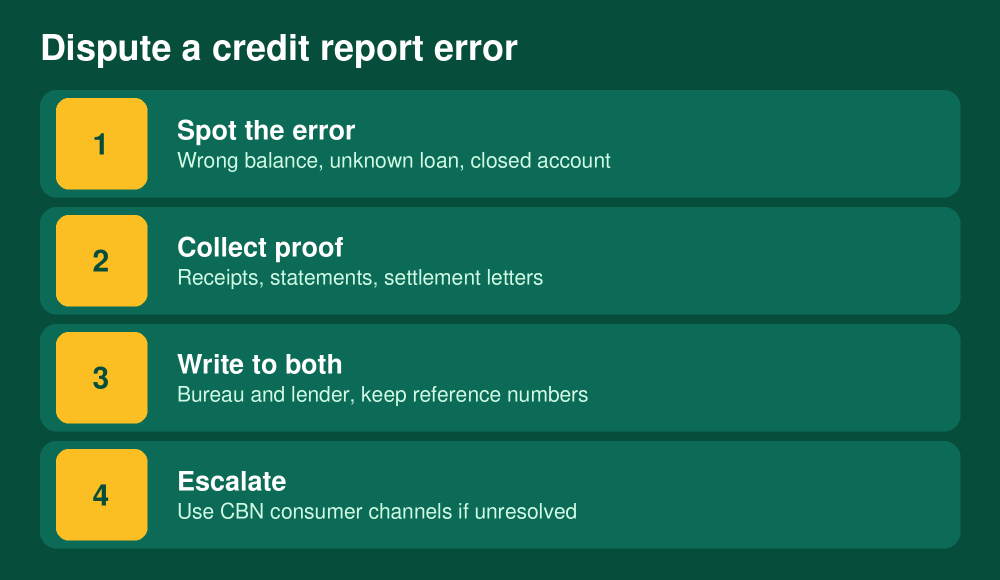
- Identify the exact error: wrong balance, a loan you never took, a closed account still showing as open, or someone else’s record on your file.
- Collect proof: receipts, bank statements, settlement letters or a police/identity-theft report if fraud is involved.
- Contact the bureau using its official dispute channel and also write to the lender that supplied the data. CRC explains that it works with the member institution, which verifies the data, and corrects it if the error is confirmed.
- Keep copies and reference numbers, and follow up in writing. If the bureau and lender do not resolve it, you can complain to the CBN’s consumer protection channels.
Common myths
- “Checking my own score lowers it.” Checking your own report is not the same as a lender’s application search.
- “A credit repair agent can delete a genuine default.” Accurate records cannot simply be removed. Beware of paid “deletion” offers.
- “I have never borrowed, so I have no record.” Small overdrafts, card use and loan-app borrowing may still be reported.
- “One repayment fixes it.” Improvement comes from months of consistent behaviour.
FAQ
Is there an official credit score in Nigeria?
There is no single national score. Each licensed bureau and lender can use its own model, so the number may differ, though the underlying report should be consistent.
Which credit bureaus operate in Nigeria?
The main CBN-licensed private bureaus are CRC Credit Bureau, CreditRegistry and FirstCentral. Check the CBN’s current list of licensed bureaus.
Can I get my credit report for free?
Under the credit reporting framework you are entitled to access your own record, and a free annual report from each bureau is widely reported. Fees and the process can change, so check with the bureau.
How long do bad records stay on my file?
CRC states that its reports show six years of history and that the CBN requires ten years of retention. Treat any late payment as long-lasting.
How long does it take to improve my score?
There is no fixed timeline. Consistent on-time repayments over several months usually help, and serious defaults take longer to recover from.
Does paying off a loan remove it from my report?
Paying a loan updates its status to settled, but the history can remain visible for the retention period.
What if I find a loan I never took?
Report it to the bureau and the lender immediately in writing, and to the police and your bank if you suspect identity theft.
Do I need a credit score to open a bank account?
No. Banks mainly check your BVN and ID to open an account. A credit check matters when you apply for loans or credit.
Bottom line
Get your reports from the official bureaus, pay everything on time, keep balances low, fix errors in writing and be patient. If anyone promises to “boost your score fast” for a fee, walk away.
Sources
- CRC Credit Bureau: Frequently asked questions
- nairaCompare: How to increase your credit score in Nigeria
- Lendsqr: Everything to know about the Nigeria Credit Reporting Act
- Central Bank of Nigeria
More on money in Nigeria: Personal Finance in Nigeria hub.
Join the discussion
Have you tried this, or do you have a question we did not answer? 1 reader has already shared their view. Naijatipsland members help each other with real, first-hand experience.






Thanks for reading. If a lender has ever declined you without explanation, getting your report from the official bureaus is the first step. Questions about the process? Ask below. – Ade Adeniyi