Last updated: 7 November 2026 · By Naijatipsland Editorial Team · Editorial policy
Burnout has become one of the most common complaints among working Nigerians, but it’s rarely named as such – it shows up as “I’m just tired,” “work is just like that now,” or “I haven’t been myself lately.” A 2020 survey by workplace wellness platform WellNewMe, covering employees across Nigerian industries, found that 64% of respondents were at risk of burnout, with worrying numbers reporting physical, emotional, mental, and even spiritual exhaustion. More recent reporting suggests the pressure hasn’t eased – a 2025 BusinessDay analysis noted that over half of Nigerian employees report feeling overwhelmed at work, driven by long hours, economic pressure, and blurred boundaries between work and home life. Here’s what the numbers actually show, what’s driving it, and what genuinely helps.
How Widespread Is Burnout Among Nigerian Workers?
The WellNewMe survey found that burnout in Nigeria isn’t a single feeling – it shows up across several distinct dimensions, and many workers are experiencing more than one at once.
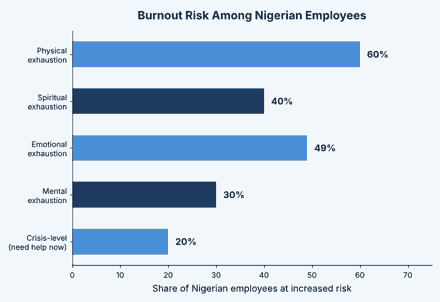
- Physical exhaustion: around 6 in 10 workers reported feeling physically drained on a regular basis.
- Emotional exhaustion: roughly 49% said they felt emotionally depleted by their work.
- Spiritual exhaustion: about 40% reported a sense of disconnection from meaning or purpose in their work.
- Mental exhaustion: close to 3 in 10 described persistent mental fatigue or difficulty concentrating.
- Crisis-level burnout: around 2 in 10 respondents were identified as needing immediate support – not just “tired,” but at a point where their wellbeing was significantly at risk.
That last figure is the one worth sitting with. One in five workers surveyed wasn’t just stressed – they were in a state serious enough to need urgent intervention. If that’s you, or someone you work with, it’s worth treating it with the same seriousness as any other health concern.
What’s Actually Driving Burnout in Nigeria
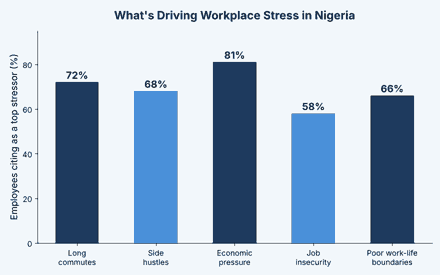
Burnout rarely comes from one thing. For most Nigerian professionals, it’s a combination of economic pressure, infrastructure stress, and a work culture that often treats constant availability as a virtue rather than a cost.
Economic pressure and the cost of living
With inflation squeezing household budgets, many workers feel they can’t afford to slow down, take leave, or push back on unreasonable workloads – even when exhaustion is clearly affecting their health and performance. A 2025 BusinessDay report quoted Lagos Business School lecturer Yetunde Anibaba describing how this pressure shows up directly in the workplace, with more than half of employees surveyed reporting they feel consistently overwhelmed.
Side hustles and multiple income streams
For many Nigerians, a single salary doesn’t stretch far enough, so a second or third income stream has become close to necessary rather than optional. The trouble is that “rest” often disappears entirely – evenings and weekends that should recharge you instead become a second shift.
Long, draining commutes
In cities like Lagos, Abuja, and Port Harcourt, commutes of two or more hours each way aren’t unusual. That’s four-plus hours a day spent in traffic before and after a full workday – time that’s neither work nor rest, and that steadily erodes energy and patience.
Job insecurity
With layoffs and economic uncertainty a regular feature of the news cycle, many employees feel they can’t say no to extra demands or set boundaries around their time, out of fear that doing so marks them as replaceable.
Poor work-life boundaries
WhatsApp and email make it easy for work to follow you home – and in many Nigerian workplaces, responding to a boss’s message at 9pm or on a Sunday is treated as normal, even expected, rather than an overreach.
Recognizing the Warning Signs – and What Actually Helps
Burnout tends to build gradually, which is exactly why it’s easy to dismiss early on. Catching it before it reaches a crisis point usually comes down to noticing a shift in how you’re functioning, not just how you’re feeling.
Watch for these signs
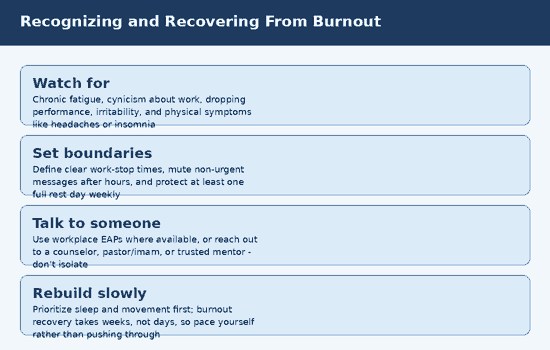
- Chronic fatigue that doesn’t improve with a weekend of rest
- Growing cynicism or detachment toward work you used to care about
- A noticeable drop in performance or focus you can’t seem to fix
- Irritability or a short fuse with colleagues, friends, or family
- Physical symptoms – headaches, stomach issues, disrupted sleep – with no clear medical cause
Set boundaries where you can
- Decide on a work-stop time and actually hold to it, even if it feels uncomfortable at first
- Mute non-urgent work notifications outside working hours
- Protect at least one full rest day a week, even if it’s not a full weekend
Talk to someone
- If your employer has an Employee Assistance Programme (EAP), it exists for exactly this – use it
- A counselor or therapist can help you work through what’s driving the exhaustion, not just the symptoms
- A pastor, imam, mentor, or trusted elder can also be a genuine source of support, especially where formal mental health services feel inaccessible
Rebuild slowly
Recovery from burnout isn’t instant, and it rarely responds well to being rushed. Prioritizing sleep and basic movement first – before trying to overhaul your entire routine – tends to work better than an ambitious all-at-once reset. Expect the process to take weeks, not days, and treat small, consistent improvements as real progress.
When It’s More Than Burnout
Burnout and clinical depression or anxiety can look similar, and one can tip into the other. If low mood, hopelessness, or loss of interest in daily life persists for more than two weeks, or if you’re having thoughts of harming yourself, that’s a signal to seek professional support rather than trying to manage it alone – a doctor, mental health professional, or a helpline can help you figure out the right next step.
The Bottom Line
Burnout in Nigeria isn’t a personal failing or a sign that you’re not working hard enough – with roughly 64% of workers at risk according to recent survey data, it’s a widespread response to genuinely difficult economic and workplace conditions. Recognizing the signs early, setting whatever boundaries are realistically available to you, and reaching out for support – whether that’s a counselor, a trusted community figure, or your employer’s EAP – gives you a real shot at recovering before exhaustion turns into something harder to reverse.
This article is for general informational purposes and is not a substitute for professional medical or mental health advice. If you are experiencing persistent low mood, hopelessness, or thoughts of self-harm, please reach out to a qualified mental health professional or a crisis helpline in your area.
Related guide (updated 7 November 2026)
Natural ways to improve sleep and reduce stress (evidence-based habits)
Join the discussion
Have you tried this, or do you have a question we did not answer? Be the first to share your experience. Naijatipsland members help each other with real, first-hand experience.